Strategic architecture case studies to deconstruct Amazon, Notion, OpenAI and peers for extractable patterns, not hero narratives
By Alex Pawlowski
Published: 2026-09-14
URL: https://thestrategystack.substack.com/p/strategic-architecture-case-studies
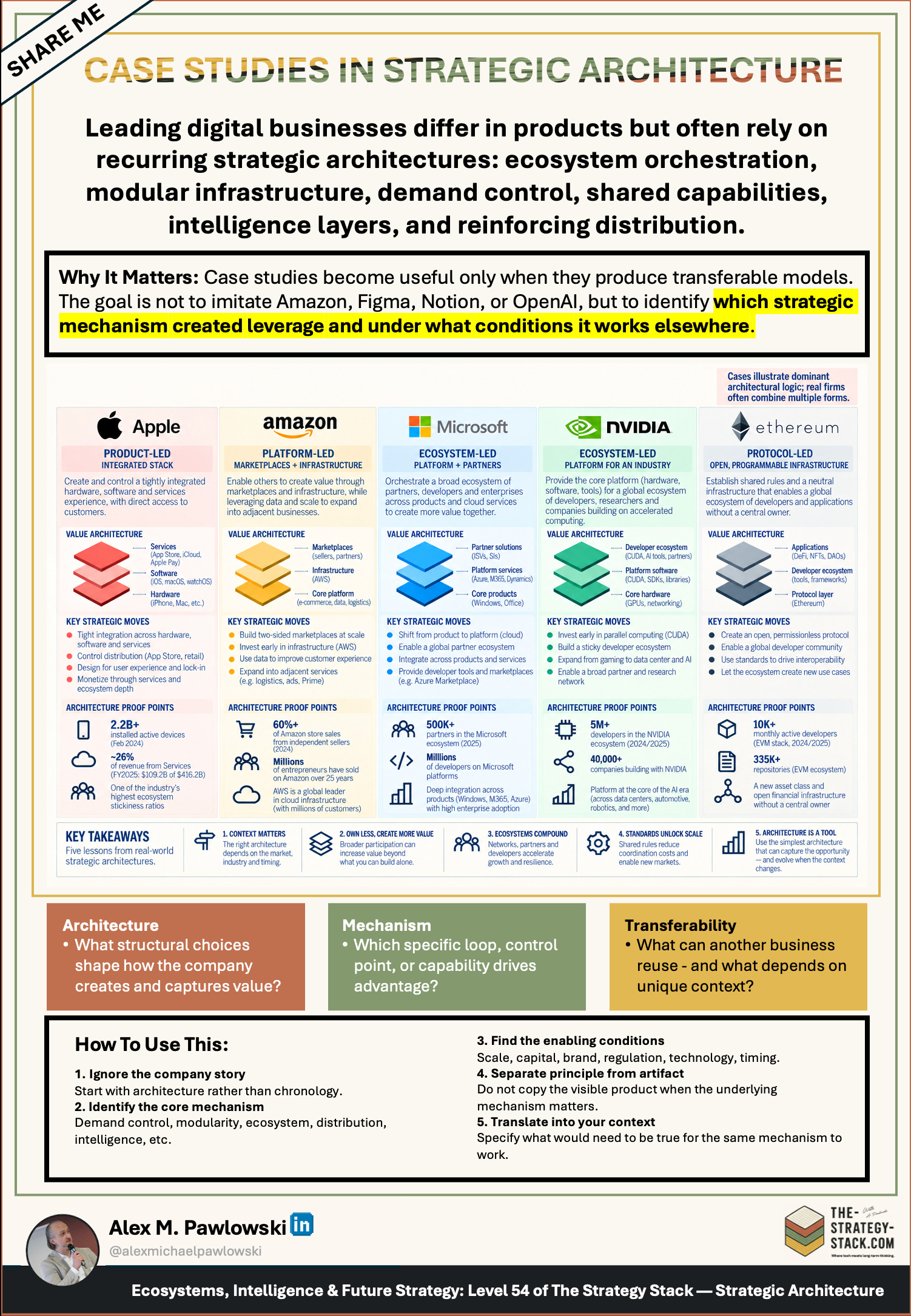
Strategy case studies fail in two ways.
Hero worship - copy the surface move, ignore the structural preconditions.
Context denial - dismiss every example as not comparable and learn nothing.
The mastery move is architectural deconstruction: what mechanism did this firm employ, at which evolution stage, with which leverage stack - and what transfers to your context with modification?
Level 54 applies Phase IV frameworks to firms operators already study - not as inspiration, but as pattern libraries.
The Deconstruction Lens
For each case, ask six questions from this phase:
Evolution stage - product, platform, ecosystem, or protocol - and is the firm transitioning or deepening?
Leverage stack - how do code, audience, capital, and intelligence reinforce?
Flywheel - what stock accumulates each cycle - and what is theater?
Cross-pollination - how do business lines or products make each other smarter?
Antifragile design - what gains from volatility - or merely survives?
Adaptive loops - how fast does strategy update from evidence?
Patterns emerge when you compare answers - not when you collect anecdotes.
Amazon: Infrastructure as Compounding Protocol
Stage - ecosystem moving toward protocol layers (AWS, marketplace standards)
Transferable pattern - reinvest cash flow into reusable infrastructure that lowers marginal cost for the next business line; treat internal tools as external products when scale permits
Non-transferable - capital depth, time horizon, regulatory tolerance of a decades-long builder
Extract - flywheel portfolio at civilizational scale - each line feeds data, demand, or infrastructure for the next
Notion: Product → Platform via Composable Value
Stage - platform - templates, integrations, team workflows, API ecosystem
Transferable pattern - turn user-created structure into network value; grow from tool to coordination layer without losing individual adoption wedge
Non-transferable - timing into remote-work explosion; specific UX love and community culture
Extract - evolution path discipline - deepen product reliability before expanding orchestration; audience trust as gate to platform moves
OpenAI: Intelligence Layer as Strategic Shock
Stage - platform/ecosystem hybrid - developers, enterprises, consumers on shared model infrastructure
Transferable pattern - when a capability layer shifts (AI), re-architect the firm around intelligence leverage - not bolt AI onto old form
Non-transferable - research capital, talent concentration, compute economics at frontier scale
Extract - leverage stack where intelligence is not a feature but the coordination layer; adaptive loops at extreme speed because model capability shifts weekly
What Never Transfers
Founder genius myths · Right-place-right-time luck · Capital you don’t have · Regulatory moats you can’t replicate · Brand heat from a single cultural moment
Case studies are useful for mechanism identification, not playbook photocopying.
Building Your Pattern Library
Maintain a living index - even five firms - deconstructed with the six lenses above. Update when they pivot. Compare your leverage stack and evolution stage to their mechanism at a similar stage - not their current headline.
Smaller operators often find better analogs in focused teardowns - firms at similar scale that solved orchestration, retention, or intelligence integration without Fortune-500 capital. The Duolingo arc - gamification as retention architecture, data as product input - transfers more directly to digital entrepreneurs than AWS economics ever will.
The case study habit is not nostalgia. It is compressed experience - cheaper than learning every evolution mistake firsthand.
The Failure Pattern
Case study learning fails when:
-
Teams copy pricing or feature moves without stage diagnosis
-
Be like Amazon without infrastructure economics
-
Platform strategy imported before product gates clear
-
AI strategy copied as feature list, not intelligence-layer redesign
-
One success story overrides portfolio logic and risk management
How to Use This Framework
1. Pick three comparables at different stages
Not all heroes - include a cautionary tale.
2. Run the six-lens deconstruction
Document answers in one page per firm - no prose worship.
3. Extract 2–3 transferable mechanisms
Name the mechanism, the precondition, and the modification required for you.
4. List explicit non-transfers
What would be irresponsible to copy?
5. Map to your evolution path
Which stage are you in - and which case is the relevant analog?
6. Stress-test against your leverage stack
Would their mechanism reinforce your layers - or cannibalize?
7. Archive as living cases
Revisit when market shifts - architecture evolves; so should your library.
Diagnostic questions:
-
Which case study are you secretly using as justification - and have you deconstructed it yet?
-
What mechanism from a giant could work at your scale with one modification?
-
What did a failed pivot in your sector teach that success stories hide?
👉 Unlock the Strategy Stack
…and access the Business Model Series, advanced Cheat Sheets, the Operator Vault, and various essays at the intersection of strategy and technology.
In this series →
Read next →
Go deeper →