Ecosystems, intelligence, and future strategy - the Levels 37–55 capstone: where platforms become ecosystems, intelligence becomes infrastructure, and strategy becomes a long-horizon operating system
By Alex Pawlowski
Published: 2026-09-14
URL: https://thestrategystack.substack.com/p/ecosystems-intelligence-future-strategy-phase-iv
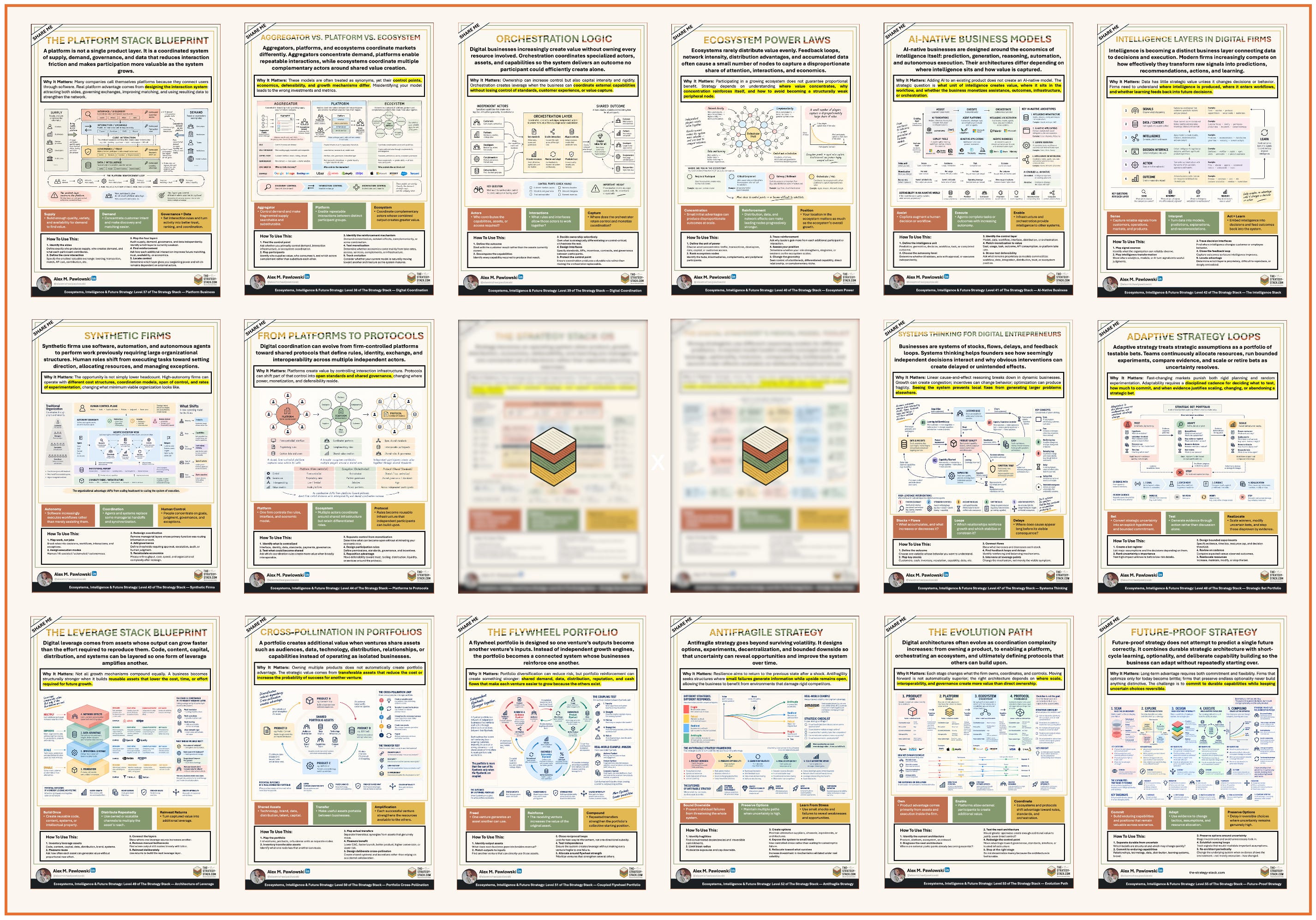
If platforms feel like product catalogs, AI feels like feature sprawl, or future strategy means quarterly pivots, the problem is often missing ecosystem logic - not missing technology budgets.
Phase One mapped the foundations of digital value - leverage, learning, independence, and the stack underneath durable firms.
Phase Two mapped architecture - value units, model logics, networks, distribution, demand, audience, and retention as one connected system.
Phase Three mapped scaling and defensibility - automation systems, unit economics, moats, aggregation, and closed-loop strategic learning.
Phase Four exists to do the final job.
It maps ecosystems, intelligence, and future strategy: how platform stacks become orchestrated ecosystems, how power laws govern network effects at scale, how AI-native models restructure firm logic, how intelligence layers integrate into digital operations, how synthetic firms emerge, how platforms evolve toward protocols, how strategy becomes an operating system, and how mental models, systems thinking, adaptive loops, leverage stacks, portfolio flywheels, antifragility, and evolution paths combine into architecture that survives disruption.
With the publication of Level 55, Phase Four is now complete.
This article is the map.
Why Phase Four Exists
Most strategic obsolescence isn’t caused by weak execution.
It’s caused by platform myopia - treating ecosystems as marketplaces, intelligence as dashboards, adaptation as reactivity, and durability as today’s moat extended indefinitely.
Teams confuse:
-
Products with platform stacks
-
Marketplaces with orchestrated ecosystems
-
AI features with AI-native business models
-
Data pipelines with intelligence layers
-
Automation with synthetic firm logic
-
Platforms with protocols
-
Frameworks with operating systems
-
Mental models with slogans
-
Resilience with antifragility
-
Case studies with transferable architecture
Phase Four dismantles those confusions.
It establishes shared logic for how digital businesses operate at ecosystem scale, integrate intelligence as infrastructure, and design strategy for horizons measured in decades - not quarters.
If Phase Four does its job, strategy stops being a reaction to the next platform shift — and becomes a system that gets stronger under volatility.
The Nineteen Frameworks of Ecosystems, Intelligence & Future Strategy
Each level answers a specific strategic question. Individually they’re useful. Together, they form a coherent system.
Level 37 - Platform Stack Blueprint
What sits beneath a platform - and what must connect?
Maps infrastructure, data, intelligence, orchestration, interfaces, and governance as a stack - not a product roadmap.
Level 38 - Aggregator & Platform Ecosystem
When does aggregation become ecosystem orchestration?
Distinguishes demand-side concentration from multi-sided coordination — and tests whether participants create or extract value.
Level 39 - Orchestration Logic
Who coordinates - and who captures?
Maps rules, incentives, routing, and governance when no single firm owns the full value chain.
Level 40 - Ecosystem Power Laws
Why do winners take most - and can you design for it?
Network effects, preferential attachment, and winner-take-most dynamics — with diagnostics for where power actually concentrates.
Level 41 - AI-Native Business Models
What changes when intelligence is the product - not the feature?
Restructures value creation, delivery, and capture when AI is embedded in the model logic, not bolted onto legacy workflows.
Level 42 - Intelligence Layers in Digital Firms
Where does intelligence live - and who acts on it?
Maps perception, reasoning, decision, and execution layers - with human governance and feedback at each boundary.
Level 43 - Synthetic Firms
What happens when agents become operators?
Explores firm boundaries when AI agents handle discovery, coordination, execution, and learning - and humans govern intent.
Level 44 - Platforms to Protocols
When does a platform become infrastructure others build on?
Tests modularity, interoperability, and governance decentralization - the path from walled gardens to protocol layers.
Level 45 - The Strategy Stack OS
Can strategy run like an operating system?
Unifies assumptions, diagnostics, decision rules, feedback loops, and portfolio logic into a repeatable strategic runtime.
Level 46 - Digital Strategist Mental Models
Which lenses prevent expensive confusions?
A curated set of models for platform dynamics, intelligence integration, leverage, and long-horizon tradeoffs.
Level 47 - Systems Thinking for Digital Entrepreneurs
What are you optimizing - and what are you breaking?
Maps stocks, flows, feedback loops, and delays — so local wins don’t produce systemic failure.
Level 48 - Adaptive Strategy Loops
How does strategy evolve without losing coherence?
Sense → interpret → decide → act → learn — at ecosystem speed, with guardrails against reactive thrashing.
Level 49 - Leverage Stack Blueprint
Where does one unit of effort produce disproportionate return?
Stacks code, media, capital, labor, and intelligence leverage — and tests whether layers reinforce or cannibalize.
Level 50 - Cross-Pollination Portfolios
How do separate bets make each other smarter?
Maps knowledge transfer, shared infrastructure, and audience overlap across portfolio assets - without forced synergy theater.
Level 51 - Flywheel Portfolio
Can multiple businesses share one compounding engine?
Designs portfolio-level flywheels where each asset feeds the next cycle — data, audience, capability, or capital.
Level 52 - Antifragile Strategy
Does volatility make you weaker - or stronger?
Distinguishes robustness from anti-fragility - and builds optionality, redundancy, and stress-responsive learning into the model.
Level 53 - Evolution Path
What is the next viable form of this business?
Maps staged transitions - from product to platform, platform to protocol, firm to ecosystem - with explicit capability gates.
Level 54 - Strategic Architecture Case Studies
What transfers - and what doesn’t?
Deconstructs real architectures across ecosystems, intelligence integration, and portfolio design — with extractable patterns, not hero narratives.
Level 55 - Future-Proof Strategy
How do you build for unknown unknowns?
Combines scenario logic, option portfolios, adaptive loops, and architectural flexibility - strategy as durable orientation, not fixed prediction.
What Phase Four Gives You
Taken together, Levels 37–55 provide:
-
A mastery-level view of platform stacks and orchestrated ecosystems
-
Frameworks for AI-native models, intelligence layers, and synthetic firm logic
-
Protocol thinking and a strategy operating system for long-horizon coherence
-
Mental models, systems thinking, and adaptive loops for volatile environments
-
Portfolio architecture — leverage stacks, cross-pollination, flywheels, and antifragility
-
Evolution paths, case-study patterns, and future-proof strategic design
Phase Four doesn’t tell you which platform to copy next.
It tells you how to build an organization that thinks in ecosystems, runs on intelligence, and designs strategy for decades - not quarters.
How to Use This Collection
Platform and ecosystem leaders: Start with Levels 37–40 when orchestration, power laws, and multi-sided dynamics are the constraint
AI and product strategists: Start with Levels 41–44 when intelligence integration and model-native design need architecture, not experiments
CSOs and portfolio operators: Start with Levels 45–51 when strategy must operate as a system across multiple assets and leverage types
Founders and long-horizon builders: Start with Levels 52–55 when anti-fragility, evolution paths, and future-proof design are the question
Return to these levels whenever:
-
Platform investments produce products, not ecosystems
-
AI projects multiply without changing the business model
-
Intelligence sits in dashboards but not in decisions
-
Portfolio assets compete instead of cross-pollinate
-
Strategy survives one disruption but not the next
-
Future-proof language cannot survive a scenario stress test
That’s usually a signal that ecosystem mastery and long-horizon architecture - not execution intensity — are the missing layer.
Sequential path: 37 → 38 → 39 → … → 55
Best when auditing the full ecosystems-and-intelligence stack.
By constraint: Jump to the level that matches the problem - platform stack if coordination is the bottleneck; AI-native models if intelligence is bolted on; Strategy Stack OS if decisions lack a shared runtime; antifragile strategy if volatility exposes fragility; future-proof strategy if horizons exceed the planning cycle.
With Phase One, Two, and Three: Start from Foundations of Digital Value (Levels 1–12), Architecting Digital Models (Levels 13–24), and Scaling and Defensibility (Levels 25–36) if vocabulary from earlier phases is not yet shared. Phase Four assumes scale and defensibility - but you can enter wherever the constraint is sharpest.
What Comes Before (Context)
Phase One is about foundations.
Phase Two is about architecture.
Phase Three is about scale and defensibility.
Phase Four is about mastery - ecosystems, intelligence integration, and future strategy at the horizon where platforms become protocols, firms become systems, and advantage becomes architectural.
Durability is built from the bottom up. Skipping Phase Three and jumping to ecosystem power laws produces slides, not strategy.
Closing Thought
Most companies don’t fail because they lack AI budgets or platform ambition.
They fail because nothing evolves - not the model, not the ecosystem, not the intelligence layer, not the portfolio logic, not the strategic horizon.
Phase Four of The Strategy Stack exists to fix that.
Because once ecosystems orchestrate cleanly, intelligence runs as infrastructure, and strategy operates across decades, execution finally has something future-proof to defend.
👉 Unlock the Strategy Stack
…and access the Business Model Series, advanced Cheat Sheets, the Operator Vault, and various essays at the intersection of strategy and technology.
Start here →
Phase III →
Phase II →
Phase I →