How to combine scenario logic, option portfolios, adaptive loops, and architectural flexibility for durable orientation, not fixed prediction for a future-proof strategy
By Alex Pawlowski
Published: 2026-09-14
URL: https://thestrategystack.substack.com/p/future-proof-strategy
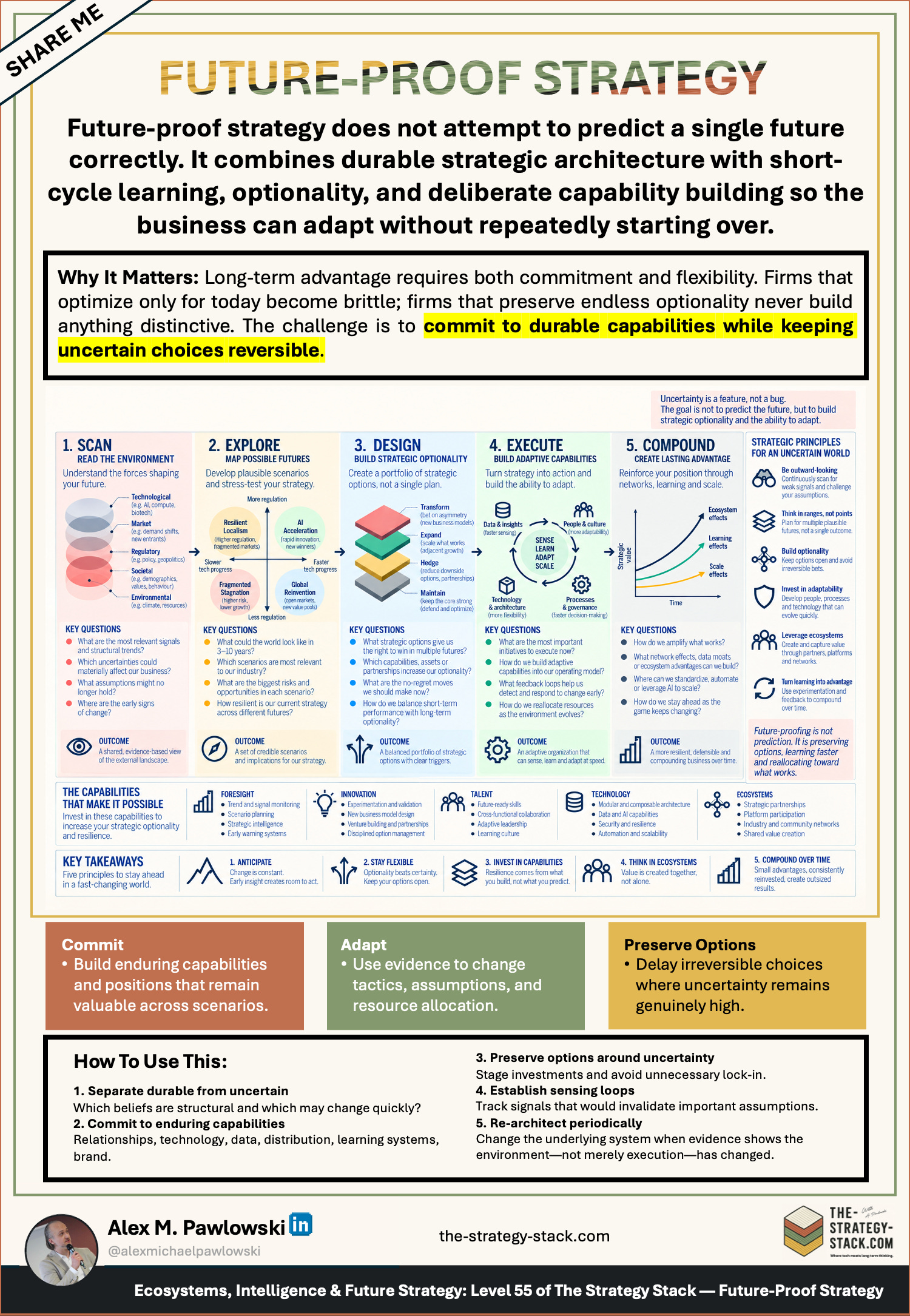
Nobody predicts the future.
Executives who sell certainty are selling comfort - not strategy.
Future-proof strategy is not a crystal ball. It is architecture that survives multiple futures - combining scenario logic, option portfolios, adaptive loops (Level 48), antifragile design (Level 52), and evolution discipline (Level 53) into a durable orientation when specifics remain unknowable.
The goal is not to be right about 2030. The goal is to remain viable, learn faster, and capture upside across a range of 2030s - without betting the firm on one forecast.
Phase IV ends here: from platform stacks to intelligence layers to portfolio flywheels to this - strategy as long-horizon operating system, not quarterly theater.
You now hold nineteen frameworks - Levels 37 through 55 - for ecosystems, intelligence integration, and long-horizon architecture. Future-proof strategy is not a separate discipline. It is what the stack produces when operated together: platforms that orchestrate, intelligence that decides, portfolios that compound, models that adapt, architectures that gain from disorder.
Prediction vs Orientation
Prediction - commit resources to one expected future; maximize efficiency if correct; fragile if wrong
Orientation - define direction, constraints, and capabilities that work across scenarios; sacrifice peak efficiency for survivability and upside optionality
Future-proof firms know where they are going and what they will not trade away - while keeping form, tactics, and portfolio mix adaptive.
The Four Pillars
Scenario logic - map divergent but plausible futures; identify no-regret moves and scenario-specific bets
Option portfolios - small positions that pay off disproportionately if a scenario arrives; barbell against core stability
Adaptive loops - shorten sense-to-update cycle so wrong assumptions die fast - governed, not chaotic
Architectural flexibility - modular products, decoupled revenue, portable audience, multi-platform presence, intelligence that retools rather than rewires
Together these produce strategic slack - not waste, but capacity to respond without existential rewrites.
Scenario Practice (Lightweight)
You do not need a consulting war room.
You need three futures:
Baseline - current trajectory continues with incremental AI and platform shift
Acceleration - intelligence commoditizes faster; distribution consolidates; winner-take-most dynamics intensify
Fragmentation - regulation, decentralization, or niche rebellion breaks aggregators; long tail returns
For each: what breaks in our model, what strengthens, what option do we wish we had bought cheap?
That third question is where future-proofing becomes actionable today.
Closing the Loop on Phase IV
Return to the hub when auditing the full mastery stack - or when onboarding a leadership team to shared vocabulary across platform, intelligence, and portfolio layers.
The sequential path (37 → 55) is the curriculum. Future-proof strategy is the capstone posture: orientation over prediction, options over certainty, adaptation over rigidity, architecture over heroics.
Most firms will not adopt every framework at once. Start where constraint is sharpest - then expand until strategy runs as a system, not a sequence of urgent reactions.
The Failure Pattern
Future-proof strategy fails when:
-
Scenario work produces slides, not decision rules
-
Options are never funded - all capital in the baseline bet
-
Flexibility is cut for efficiency - then shock arrives
-
Long-term means avoiding hard choices this quarter
-
Phase IV frameworks live in curriculum but not in operating cadence
How to Use This Framework
1. Write constitutional orientation
Three to five commitments that survive any scenario in your set.
2. Build a minimal scenario set
Three futures, one page each - forces and implications, not prose novels.
3. Identify no-regret moves
Investments that help in all scenarios - audience trust, data discipline, modular architecture.
4. Fund explicit options
Budget and attention for bets that matter only if scenario B or C arrives.
5. Connect to adaptive loops
Pre-commit: which signals shift you toward which scenario - and what changes?
6. Audit architectural flexibility
How much of the firm must be rebuilt if platform X disappears or AI cost drops 90%?
7. Close the Phase IV stack
Revisit Levels 37–54 annually - ecosystem mastery is maintenance, not graduation.
Diagnostic questions:
-
Which future would kill you fastest - and do you have an option against it?
-
What are you calling “strategy” that is actually a single-scenario bet?
-
If you could not predict next year, what orientation would still be correct?
👉 Unlock the Strategy Stack
…and access the Business Model Series, advanced Cheat Sheets, the Operator Vault, and various essays at the intersection of strategy and technology.
Phase IV complete →
Go deeper →