Blue ocean vs red ocean - compete in contested demand or restructure the value curve; know which ocean matches your capabilities and capital
By Alex Pawlowski
Published: 2026-09-18
URL: https://thestrategystack.substack.com/p/blue-ocean-red-ocean-strategy
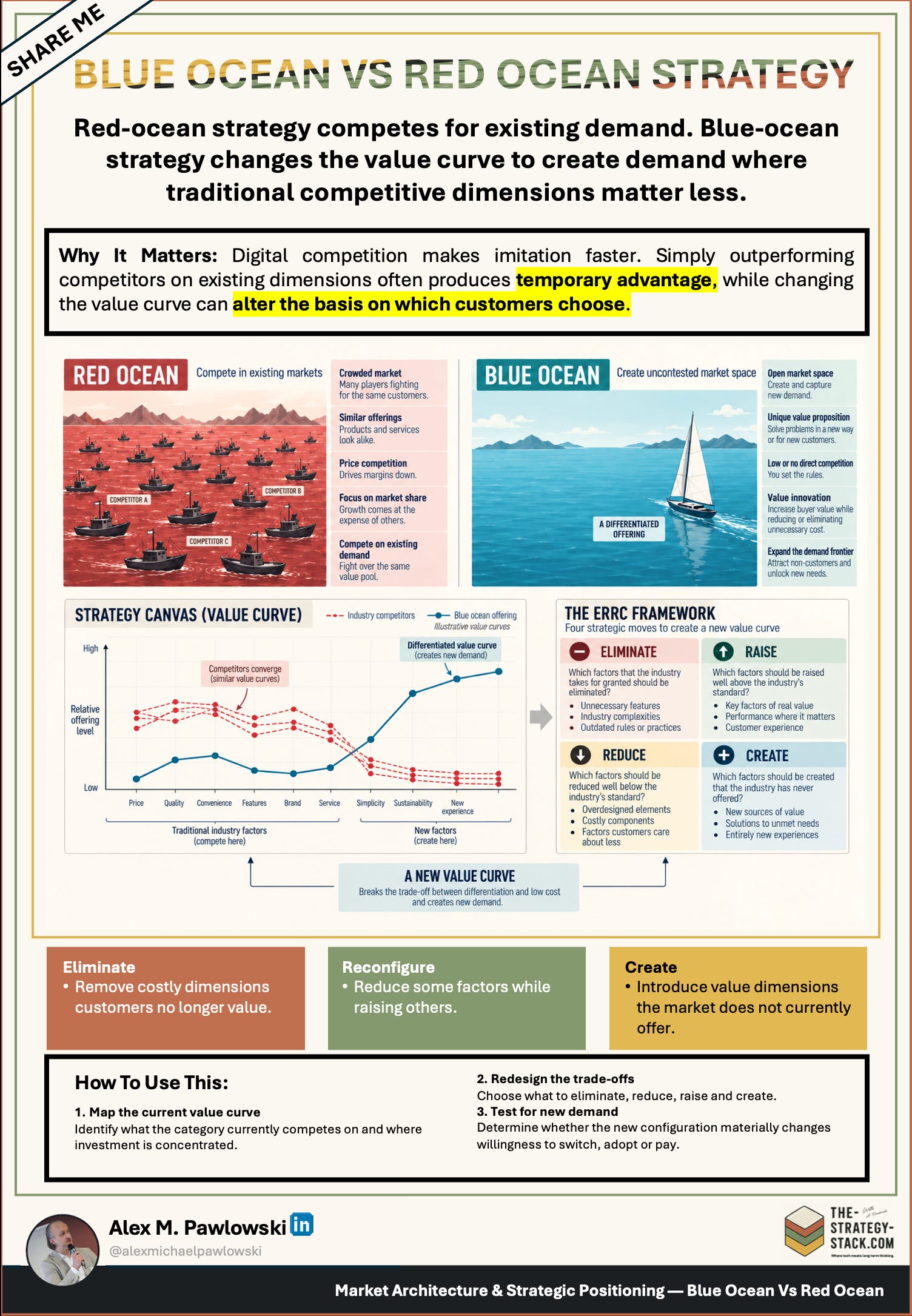
Every founder wants a blue ocean.
Few can afford one.
Red ocean strategy competes in existing markets - same buyers, same budgets, same evaluation criteria. Advantage comes from execution, cost position, distribution, or niche focus within known rules.
Blue ocean strategy restructures the market itself - eliminating, reducing, raising, or creating factors of value so that a new buyer segment or use case becomes viable. Advantage comes from value curve design, not incremental feature wins.
The mistake is treating blue ocean as a branding exercise. Real blue oceans change what buyers pay for and why - not merely what the slide says.
Red Ocean Logic
Red oceans are not failures. They are where most durable businesses live.
Characteristics:
Demand is proven - buyers know the category and the budget line
Competition is visible - incumbents, substitutes, and price pressure are mapped
Success metrics are familiar - win rate, CAC, retention, NPS
Defensibility comes from position within structure - cost, brand, network, vertical depth
Red ocean winners often look boring from the outside: tighter segmentation, superior unit economics, embedded distribution, or aggregator-style demand concentration.
The error is entering a red ocean with blue ocean messaging - claiming “new category” while fighting on incumbents’ terms.
Blue Ocean Logic
Blue oceans reconfigure the value curve:
Eliminate - factors the industry competes on that buyers no longer value
Reduce - overserved dimensions that inflate cost without improving outcomes
Raise - underserved dimensions buyers would pay for if offered
Create - factors the industry never provided
Cirque du Soleil eliminated animals and star performers; raised artistry; created theatrical narrative. Southwest eliminated meals and hub complexity; reduced price; raised frequency. Digital examples follow the same logic - when the curve moves, competition resets.
Blue oceans require education cost and patience. The market must learn a new comparison set. Capital must survive the gap between vision and proven demand.
The Decision Filter
Choose red ocean when:
-
You can win a defined segment with superior economics or distribution
-
Buyer education cost exceeds your runway
-
Incumbents are slow but not blind — speed to liquidity matters
-
Category criteria already favor your wedge
Choose blue ocean when:
-
Existing value curves systematically overserve or underserve a large group
-
You can prove willingness to pay for the restructured offer — not merely interest
-
You can survive 18–36 months of market education
-
Restructuring creates defensibility incumbents cannot copy without cannibalization
Many “blue oceans” are red ocean niches with better copy. Apply the test: did you change the value curve - or only the adjectives?
Hybrid Reality
Most strategies sequence both.
Blue ocean entry → red ocean defense once imitators arrive
Red ocean wedge → blue ocean expansion once distribution and proof exist
Platform businesses often start blue (new coordination mechanism) and end red (winner-take-most once the market matures). The strategic question is which phase you are in - and whether capital, narrative, and product match that phase.
How to Use This Framework
1. Map the industry value curve
What does everyone compete on? What do buyers actually pay for?
2. Identify overserved and underserved
Where is cost inflated without value? Where is pain unaddressed?
3. Stress-test blue ocean claims
Would buyers need new budget, new criteria, or new behavior?
4. Align ocean choice with economics
Education cost, sales cycle, and margin structure must fit the ocean.
5. Plan the transition
Blue oceans turn red. Know your defensibility before imitators arrive.
Diagnostic questions:
-
Are you in a blue ocean - or a red ocean with a fresh coat of paint?
-
If incumbents copied your curve tomorrow, would you still win?
-
Does your capital runway match the ocean you chose?
👉 Unlock the Strategy Stack
…and access the Business Model Series, advanced Cheat Sheets, the Operator Vault, and various essays at the intersection of strategy and technology.
In this series →
https://thestrategystack.substack.com/p/market-architecture-strategic-positioning
Read next →
https://thestrategystack.substack.com/p/strategic-depth-vs-breadth
Go deeper →