How do architectures behave where intelligence, data loops, and learning economics are designed into the core, not bolted on as features
By Alex Pawlowski
Published: 2026-09-13
URL: https://thestrategystack.substack.com/p/ai-native-business-models
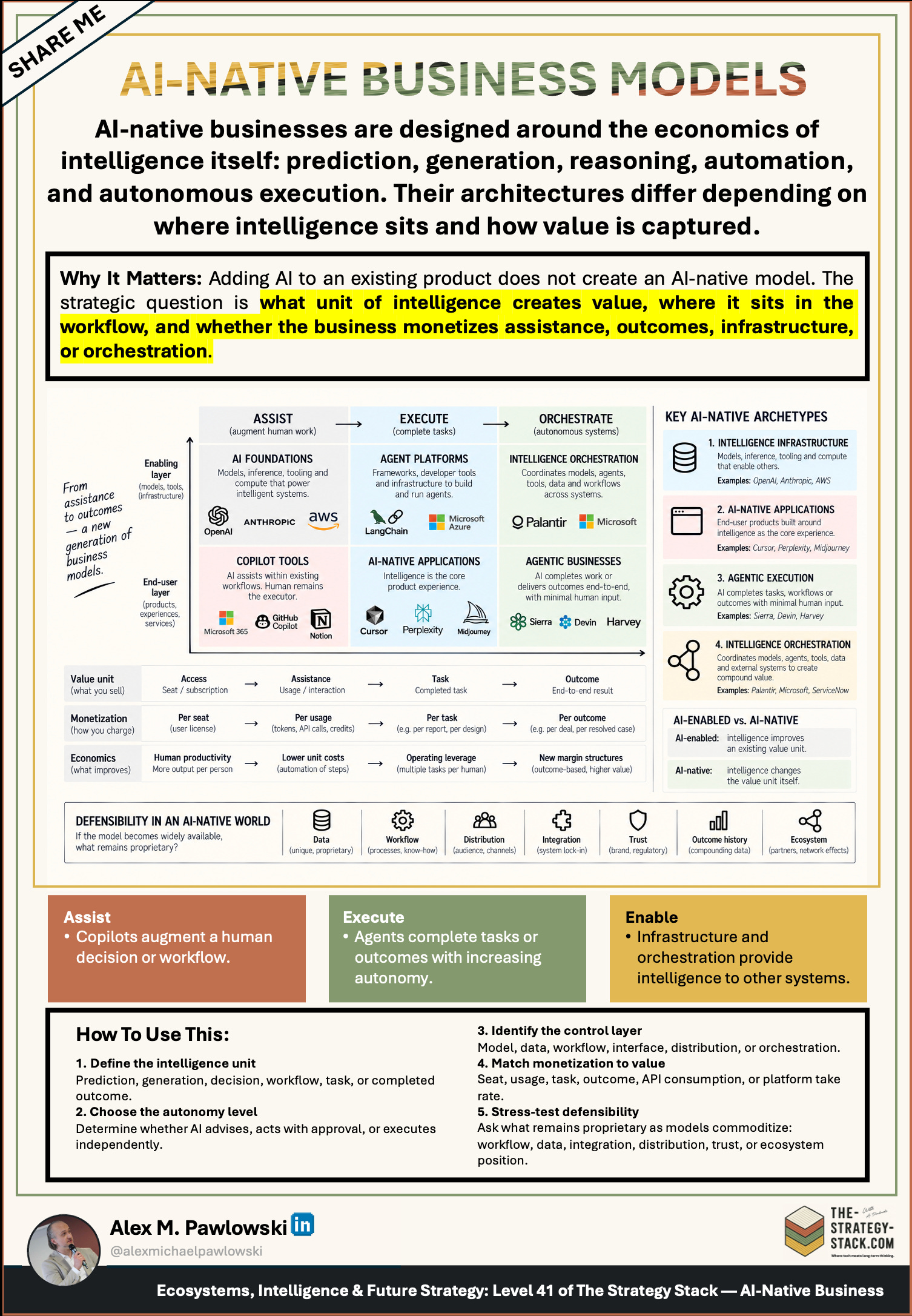
Every incumbent is adding AI features.
Summaries, copilots, chat widgets, auto-classification - a thin intelligence layer on top of workflows designed decades ago. That is AI-augmented business. It improves productivity. It rarely changes who wins.
AI-native business models are different. Intelligence is not a feature - it is the architecture. Data loops, agent orchestration, inference economics, and human oversight are designed into the core from the start. The product gets better because it runs - not because a roadmap adds another model call.
The distinction determines whether AI compounds into defensibility or depreciates into table stakes.
Built for Intelligence
AI-native architectures share five design properties:
Intelligence as infrastructure - not interface
Inference runs continuously - routing, ranking, predicting, generating - embedded in the value delivery path. Users do not turn on AI. The system thinks by default.
Data loops as product
Every interaction generates signal that improves the next interaction - for the same user and across users. Data flywheels are product requirements, not analytics projects.
Agent orchestration as operations
Work decomposes into tasks agents handle - with human escalation paths, tool access, and outcome verification. Operations scale through coordination logic, not headcount linearity.
Economics that account for inference
Unit economics include model cost, latency, failure rates, and human review - priced into the model from day one, not discovered at scale.
Governance for autonomous action
When systems act - not just recommend - oversight, audit trails, and rollback mechanisms are first-class. Trust is architectural, not policy slides.
Native vs Bolted-On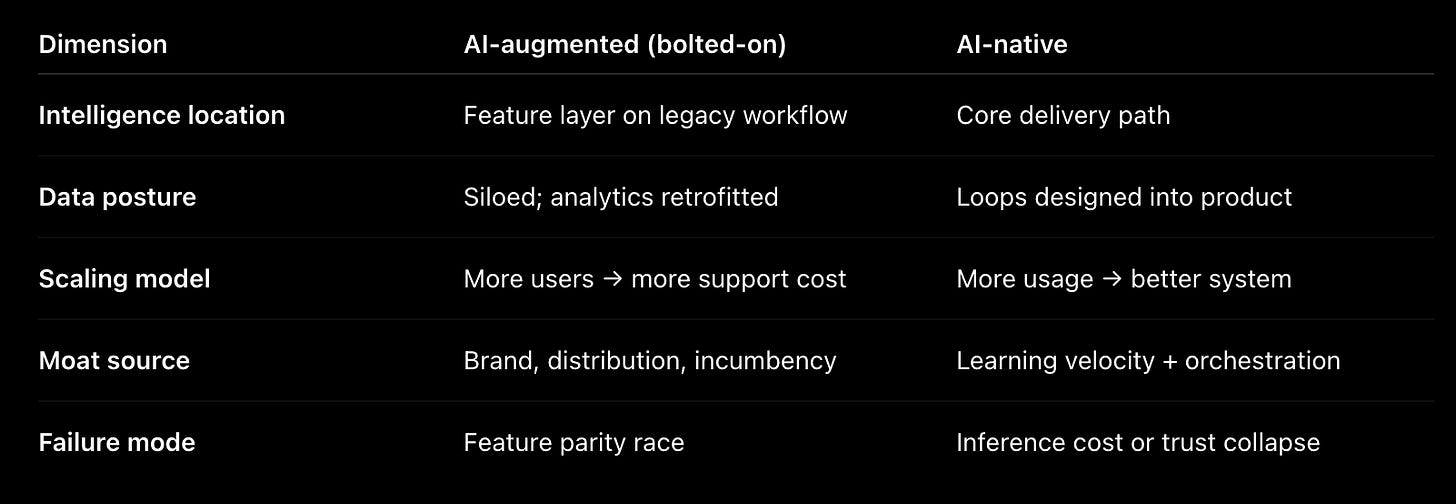
Most enterprises are augmented today - and that is a valid starting point. The strategic question is whether the next architecture is native - or whether competitors will design native models while incumbents optimize copilots.
Harvey, Glean, and Cursor-class products did not retrofit intelligence onto 2015 SaaS. They designed intelligence-first value chains - and unit economics that assume models get cheaper while data gets richer.
Not every business must be AI-native today. But every business must decide whether intelligence will remain a productivity layer - or become the reason customers choose, stay, and pay. That decision shapes architecture, hiring, data strategy, and capital allocation for the next decade.
The firms that win rarely announce AI transformation. They ship products where the system improves because customers use it - and where competitors cannot catch up by adding the same API call.
The Design Imperatives
1. Start from the outcome loop
What must be true after each interaction - and what should the system learn automatically? Design backward from the closed loop, not forward from the feature list.
2. Make data contractual
Define what is captured, who benefits, and how signal improves product behavior. Data rights and portability are strategic - not legal afterthoughts.
3. Orchestrate before automating
Map agent tasks, tool access, human checkpoints, and failure modes before scaling autonomy. Native does not mean unsupervised.
4. Price the inference stack
Model cost per outcome, not per seat. If intelligence is core, margin structure must reflect variable compute - with paths to improvement as models commoditize.
5. Build trust mechanisms early
Explainability, override, audit, and rollback - especially when agents act in customer environments. Native architectures fail on trust before they fail on technology.
Build the Test
Run this diagnostic on any AI initiative:
-
Does usage make the product materially better for the next user? If no, you have augmented productivity - not a native loop.
-
Would removing AI eliminate the value proposition - or just slow it down? Native models collapse without intelligence; augmented models revert to legacy software.
-
Do unit economics improve with scale - or degrade with inference volume? Native designs plan for both curves.
Can a competitor replicate with the same model API? If yes, your moat is execution speed - not architecture. Native moats live in data, orchestration, and domain loops.
Diagnostic questions:
-
Is intelligence on the critical path - or adjacent to it?
-
Where does human oversight add value - and where does it add latency without learning?
-
If model APIs commoditized tomorrow, what would still be hard to copy?
👉 Unlock the Strategy Stack
…and access the Business Model Series, advanced Cheat Sheets, the Operator Vault, and various essays at the intersection of strategy and technology.
In this series →
https://thestrategystack.substack.com/p/ecosystems-intelligence-future-strategy-phase-iv
Read next →
https://thestrategystack.substack.com/p/intelligence-layers-digital-firms
Go deeper →