Why value concentrates at specific network nodes and how to map where advantage accrues before scale hardens the curve
By Alex Pawlowski
Published: 2026-09-13
URL: https://thestrategystack.substack.com/p/ecosystem-power-laws
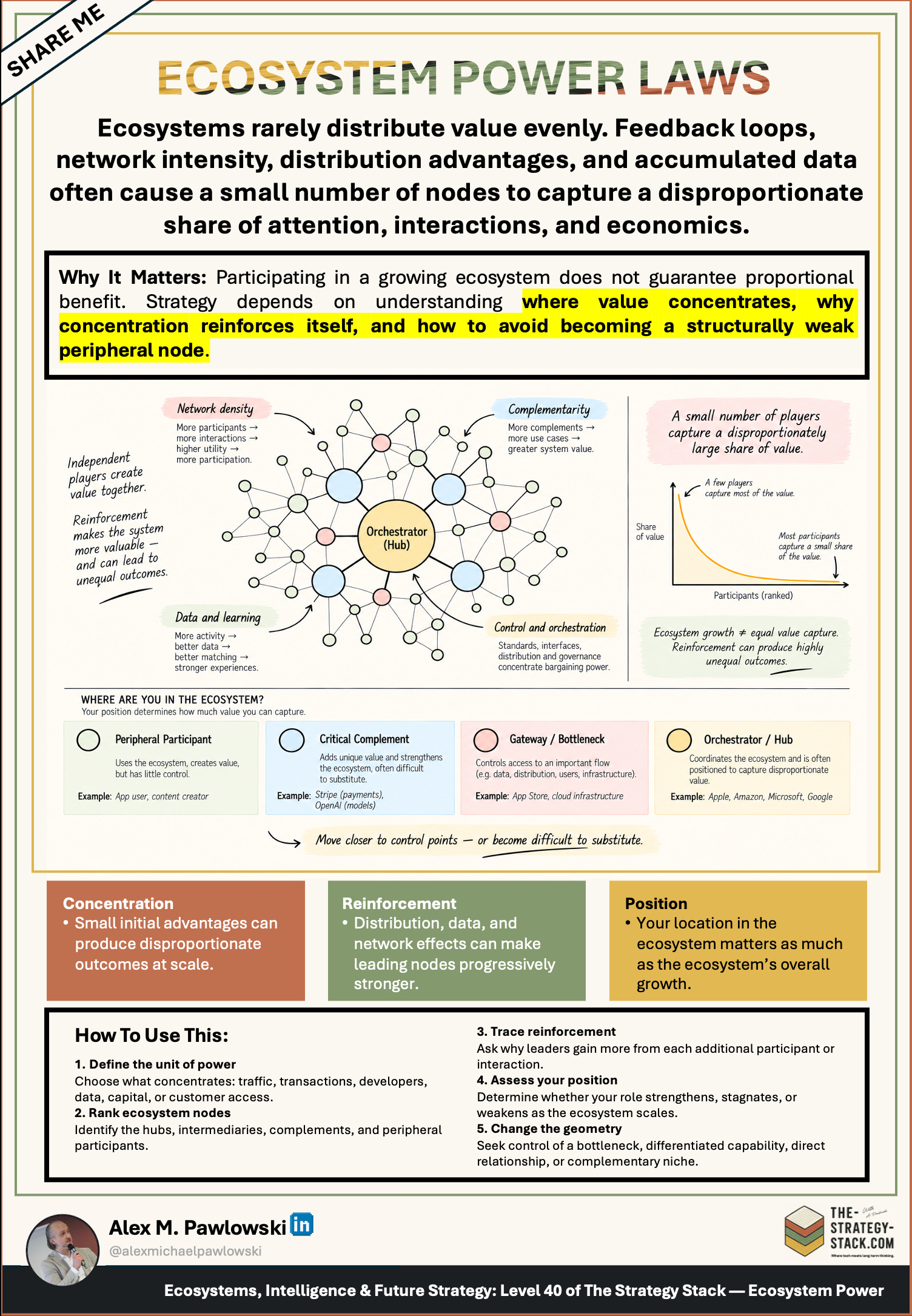
Most ecosystem metrics report activity - users, listings, transactions, developers.
Activity scales. Value does not scale evenly.
In nearly every mature network, a small number of nodes capture a disproportionate share of attention, revenue, data, and strategic optionality. The long tail stays active - but marginal. This is not a bug. It is a power law - and ignoring it produces strategy that optimizes for volume while missing where power actually forms.
Ecosystem Power Laws describe where value concentrates as networks densify - and why the winners are often determined early, at specific structural positions.
The Power Curve
Network value distribution follows a curve steeper than normal:
-
A minority of suppliers drive a majority of GMV
-
A minority of users generate a majority of engagement and data
-
A minority of complementors account for most ecosystem innovation
-
A minority of nodes sit on most paths between other nodes
The curve tightens as the ecosystem matures. Early diversification gives way to concentration - not because the system failed, but because preferential attachment rewards nodes that already have connectivity, trust, and data advantage.
Strategic implication: position matters more than participation count. Being in the ecosystem is not the same as occupying a node where value accrues.
Nodes That Capture Value
Four node types consistently capture disproportionate share:
Orchestration hubs - control coordination
Whoever sets standards, routes transactions, or owns the default interface sits on the highest-traffic paths. Value flows through them - fees, data, and strategic leverage accumulate at the hub.
High-connectivity suppliers - become defaults
The seller, creator, or provider with the most links to demand becomes the safe choice - ranking algorithms and user habit reinforce the lead. Second place is not half the value; it is a fraction.
Data-rich interfaces - learn faster
Nodes that see cross-participant behavior compound intelligence others cannot access. The learning gap widens - not linearly, but exponentially with scale.
Standard-setters - anchor complementor investment
Whoever defines compatibility captures investment from everyone who builds to the standard. Forking is possible - but expensive. The standard-setter node becomes sticky even without owning all transactions.
If you cannot name which node type you occupy - or aspire to occupy - you are likely in the long tail by default.
Misread Concentration
Teams misread power laws when they:
-
Celebrate total ecosystem size while top-decile participants capture all economics
-
Subsidize the long tail indefinitely instead of investing in hub strength
-
Assume decentralization rhetoric equals decentralized value capture
-
Treat every participant as equally strategic - diluting governance and incentives
-
Enter ecosystems late without a wedge into a high-connectivity position
Activity without position is the most common trap: thousands of users, hundreds of suppliers - and margin accrues entirely to the orchestrator or the top five percent of either side.
Early Positioning
Power laws are path-dependent. Nodes that gain early connectivity advantage rarely lose it without disruption - incumbents on high-traffic paths get more traffic; data-rich interfaces learn faster; standard-setters attract more complementors.
Late entrants must choose: wedge into a high-value node (niche supply dominance, specialized data, regional demand concentration) or disrupt the hub (new standard, new interface, new economics). Competing as undifferentiated long-tail supply in a mature curve is a slow-margin strategy.
YouTube creators, Amazon sellers, and App Store developers all live inside the same structural reality - the platform captures orchestration value; a small fraction of participants capture most of the economic surplus on their side.
Audit Your Network
1. Plot the distribution
Rank participants by contribution - revenue, engagement, data volume, referrals. Confirm whether you are looking at a curve or pretending it is a normal distribution.
2. Map the paths
Draw how value and information flow between nodes. Which nodes sit on the most paths? That is where power laws bite first.
3. Identify early-lock positions
Which positions, if occupied early, become self-reinforcing? Where is it still possible to become a hub - and where is the window closing?
4. Align investment to node strategy
If you orchestrate: strengthen hub mechanisms - standards, data, governance. If you participate: find a wedge into high-connectivity supply or demand - not undifferentiated long-tail presence.
5. Monitor curve steepening
As the ecosystem matures, track whether concentration is accelerating. Power law dynamics rarely reverse without structural disruption.
Diagnostic questions:
-
What percentage of ecosystem value is created by the top ten percent of participants?
-
Are you building a hub - or renting access to someone else’s?
-
If concentration doubled, would your strategy get stronger or get squeezed?
👉 Unlock the Strategy Stack
…and access the Business Model Series, advanced Cheat Sheets, the Operator Vault, and various essays at the intersection of strategy and technology.
In this series →
https://thestrategystack.substack.com/p/ecosystems-intelligence-future-strategy-phase-iv
Read next →
https://thestrategystack.substack.com/p/ai-native-business-models
Go deeper →