How to distinguish among the three forms of digital market power before you copy the wrong playbook or claim the wrong moat
By Alex Pawlowski
Published: 2026-09-13
URL: https://thestrategystack.substack.com/p/aggregator-platform-ecosystem
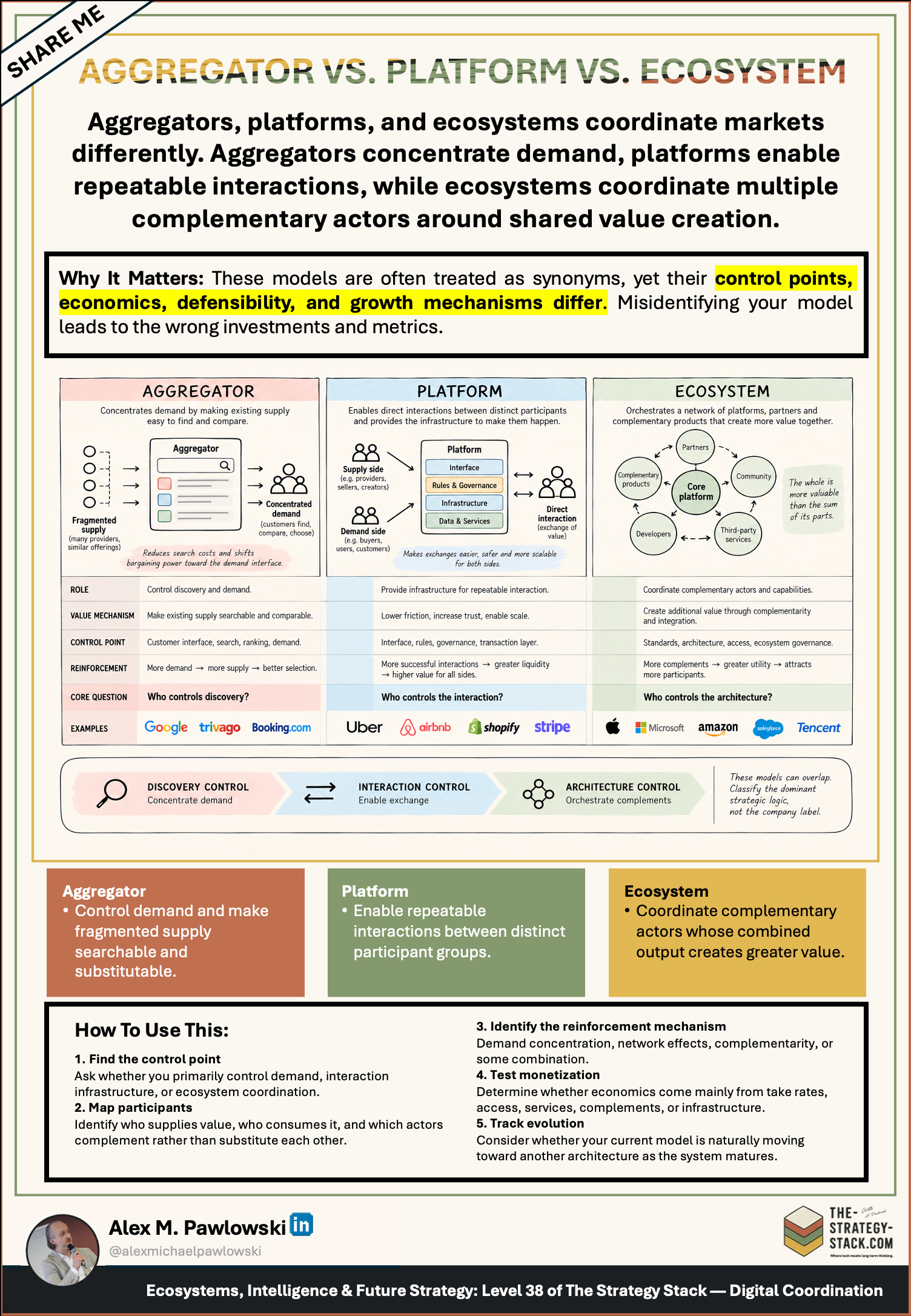
Strategy conversations collapse three different animals into one word: platform.
Google is not Airbnb is not Shopify is not Apple’s developer ecosystem - yet all appear on the same slide with the same bullet points. The confusion is expensive. Aggregator economics require demand concentration. Platform economics require exchange design and data loops. Ecosystem economics require orchestration across independent creators of complementary value.
Pick the wrong model and you optimize for the wrong metric - take rate when you need developer adoption, or openness when you need demand ownership.
Three Forms of Market Power
Aggregator - owns the demand relationship
The aggregator controls where users begin. Supply is fragmented, modularized, and substitutable. Power comes from demand concentration - suppliers increasingly need the interface more than the interface needs any one supplier. Discovery, ranking, transaction, and trust live at the aggregator layer.
Examples: Google Search, Amazon marketplace discovery, Uber rider app, Netflix content interface.
Platform - enables exchange between sides
The platform provides infrastructure for two or more sides to transact - with rules, data capture, and tools that improve matching over time. Power comes from network density and learning loops - more participants make the exchange more valuable and more efficient.
Examples: Stripe connecting merchants and payment networks, Airbnb connecting hosts and guests with trust infrastructure, app stores connecting developers and users.
Ecosystem - coordinates complementary value creation
The ecosystem orchestrates independent actors building on shared standards, APIs, or economic alignment - often without the center owning the full transaction. Power comes from complementor investment - the more others build on your foundation, the harder the system is to replicate.
Examples: Apple iOS developer ecosystem, Salesforce AppExchange, AWS partner and ISV layer, open-source cores with commercial orbit.
The Decision Matrix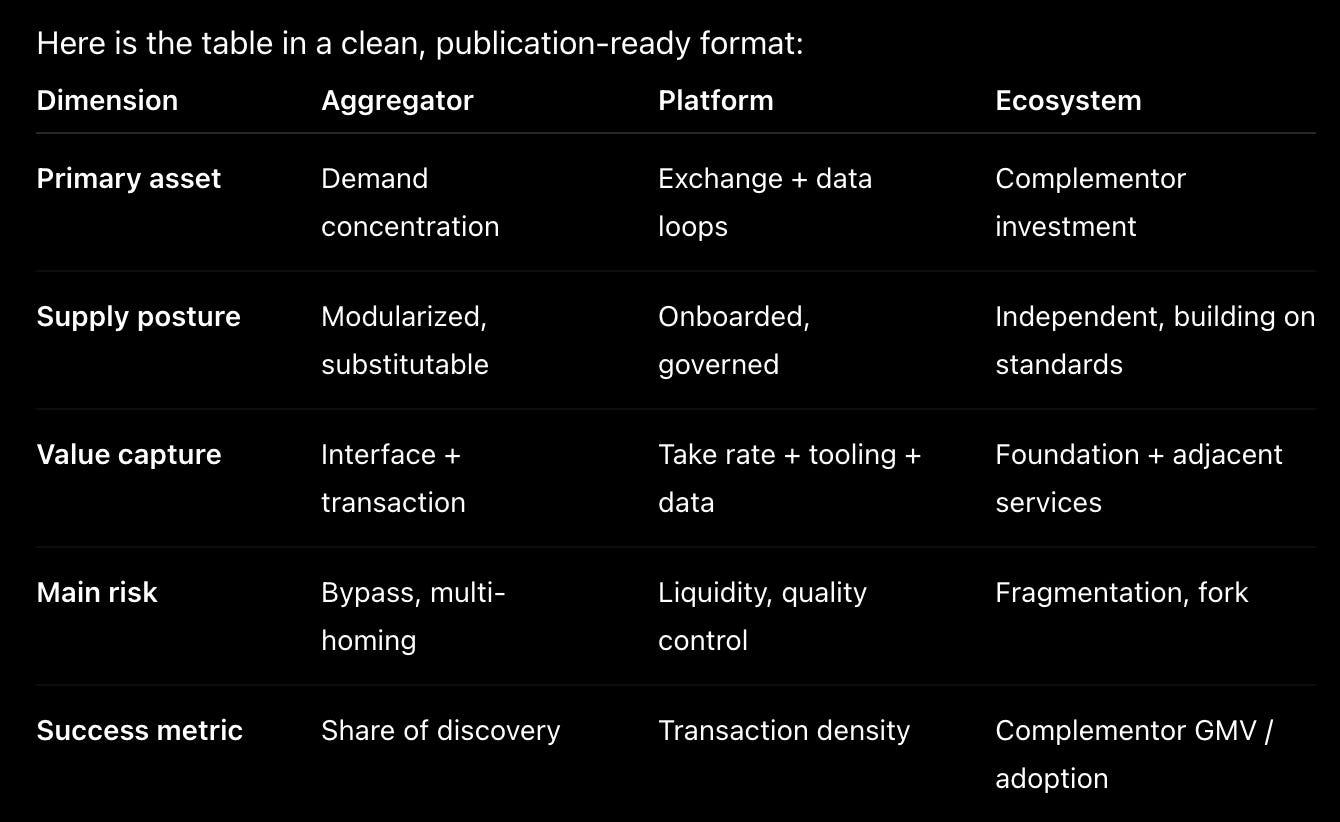
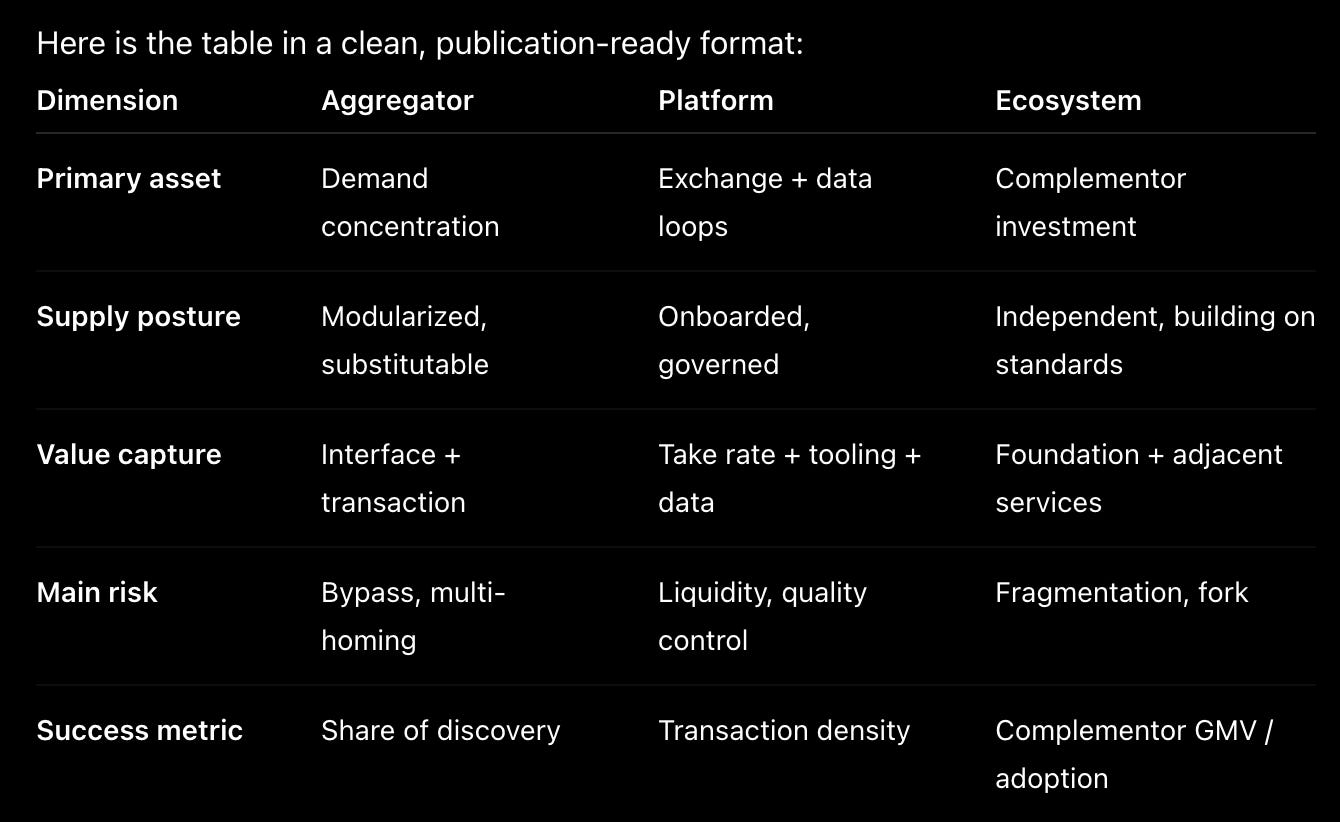
Use the matrix as a diagnostic, not a identity badge. Many firms blend modes - Amazon aggregates demand and runs a platform. The question is which mode drives marginal strategic leverage at your current scale.
When Labels Mislead
Calling yourself a platform when you aggregate
If suppliers are interchangeable and users start at your interface, you are playing aggregator economics - even if the pitch deck says two-sided marketplace. Optimize for demand habit and ranking control, not supplier tooling alone.
Calling yourself an ecosystem when you integrate
If complementors cannot build independently on shared standards - if every extension requires your roadmap - you have a product suite, not an ecosystem. Ecosystems require outside investment that compounds without your direct labor.
Calling yourself an aggregator when you lack concentration
If users multi-home freely and no side depends on you disproportionately, aggregation logic does not apply yet - you are still buying liquidity on both sides.
Blending modes without sequencing
Many firms need aggregator-style demand before ecosystem depth is viable - or platform liquidity before governance scales. The error is pursuing all three simultaneously without knowing which mode funds the next.
Apply the Distinction
1. Identify your primary power source
Demand ownership, exchange efficiency, or complementor depth - rank them honestly.
2. Map participant dependence
Who needs whom more as you scale? Symmetry suggests weak power; asymmetry suggests which model fits.
3. Align metrics to model
Aggregators track discovery share and supplier substitutability. Platforms track liquidity, match quality, and repeat exchange. Ecosystems track complementor build velocity and standard adoption.
4. Choose the right competitive response
Against an aggregator: differentiate supply or own a demand niche. Against a platform: improve a side they under-serve. Against an ecosystem: narrow to a wedge they cannot orchestrate quickly.
Diagnostic questions:
-
If your largest supplier or complementor left tomorrow, would users notice within a week?
-
Is your strategic narrative consistent with where power actually accrues today?
-
Which model are you aspiring to - and what layer is missing to get there?
👉 Unlock the Strategy Stack
…and access the Business Model Series, advanced Cheat Sheets, the Operator Vault, and various essays at the intersection of strategy and technology.
In this series →
https://thestrategystack.substack.com/p/ecosystems-intelligence-future-strategy-phase-iv
Read next →
https://thestrategystack.substack.com/p/orchestration-logic
Go deeper →