Feedback systems for strategic decision-making - shorten the distance between signal, interpretation, action, and corrected assumptions
By Alex Pawlowski
Published: 2026-09-11
URL: https://thestrategystack.substack.com/p/strategic-feedback-system
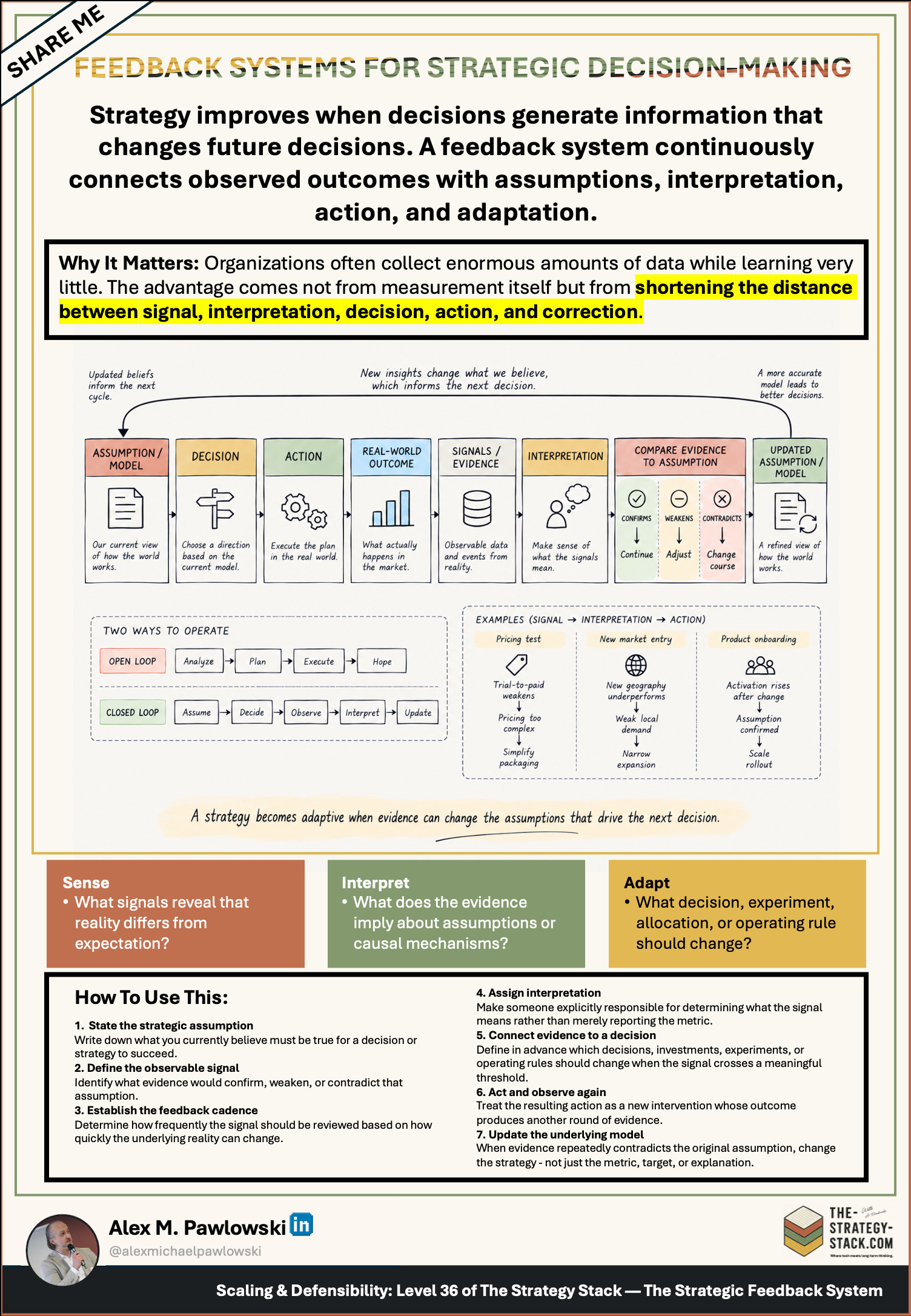
Organizations collect data without learning.
Dashboards refresh. Decks update. Assumptions survive quarterly reviews because nobody owns the connection between evidence and model revision.
Strategy improves when decisions generate information that changes future decisions. The strategic advantage is often not better analysis upfront - it is shortening the distance between signal, interpretation, decision, action, and correction.
Open loop: Analyze → Plan → Execute → Hope
Closed loop: Assume → Decide → Observe → Interpret → Update
Phase III closes here: scale and defensibility require systems that learn — not committees that ratify last year’s thesis.
The Closed Loop
Assumption / model - our current view of how the world works
Decision - choose a direction based on that model
Action - execute in the real world
Outcome - what actually happens
Signals / evidence - observable data and events
Interpretation - what the signals mean for the assumption
Compare evidence to assumption - confirms (continue), weakens (adjust), contradicts (change course)
Updated assumption / model - refined view that informs the next decision
New insights change what you believe. What you believe informs what you decide next. Without the update step, the loop is open - and strategy becomes performance art.
Examples: Signal → Interpretation → Action
Pricing test - trial-to-paid weakens → packaging too complex → simplify tiers
Market entry - new geography underperforms → local demand weaker than assumed → narrow expansion
Onboarding change - activation rises → assumption confirmed → scale rollout
Each example assigns interpretation - not just measurement.
The Three Moves
Sense - what signals reveal that reality differs from expectation?
Interpret - what does evidence imply about assumptions or causal mechanisms?
Adapt - what decision, experiment, allocation, or operating rule should change?
The Failure Pattern
Feedback systems fail when:
-
Metrics exist but nobody owns interpretation
-
Evidence contradicts the strategy - and the strategy stays unchanged
-
Learning is annual while markets move weekly
-
Dashboards measure activity, not assumptions under test
-
Agile teams iterate products but not strategic models
How to Use This Framework
1. State the strategic assumption
Write what must be true - falsifiable, not vague.
2. Define the observable signal
What evidence would confirm or contradict it?
3. Establish the feedback cadence
How often should signals be reviewed - matched to decision speed?
4. Assign interpretation
Who decides what the signal means - not just who reports it?
5. Connect evidence to a decision rule
Pre-commit: if signal crosses threshold X, change Y.
6. Act and observe again
Treat the next action as a new intervention - not a victory lap.
7. Update the underlying model
Change the strategy when evidence repeatedly contradicts assumptions - not only the metric target.
Diagnostic questions:
-
What assumption is your current strategy betting on - can you name it in one sentence?
-
What signal would make you change course - and who would pull the trigger?
-
Is your organization running open loop on its most important bet?
👉 Unlock the Strategy Stack
…and access the Business Model Series, advanced Cheat Sheets, the Operator Vault, and various essays at the intersection of strategy and technology.
Phase III complete →
Go deeper →