Scaling and defensibility - the Levels 25–36 capstone: where scale compounds, moats form, and strategy becomes a closed learning system
By Alex Pawlowski
Published: 2026-09-11
URL: https://thestrategystack.substack.com/p/scaling-and-defensibility-phase-iii
If automation feels like tool sprawl, scale feels like coordination chaos, or “defensibility” means a better pitch deck, the problem is often missing systems logic - not missing ambition.
Phase One mapped the foundations of digital value - leverage, learning, independence, and the stack underneath durable firms.
Phase Two mapped architecture - value units, model logics, networks, distribution, demand, audience, and retention as one connected system.
Phase Three exists to do the next job.
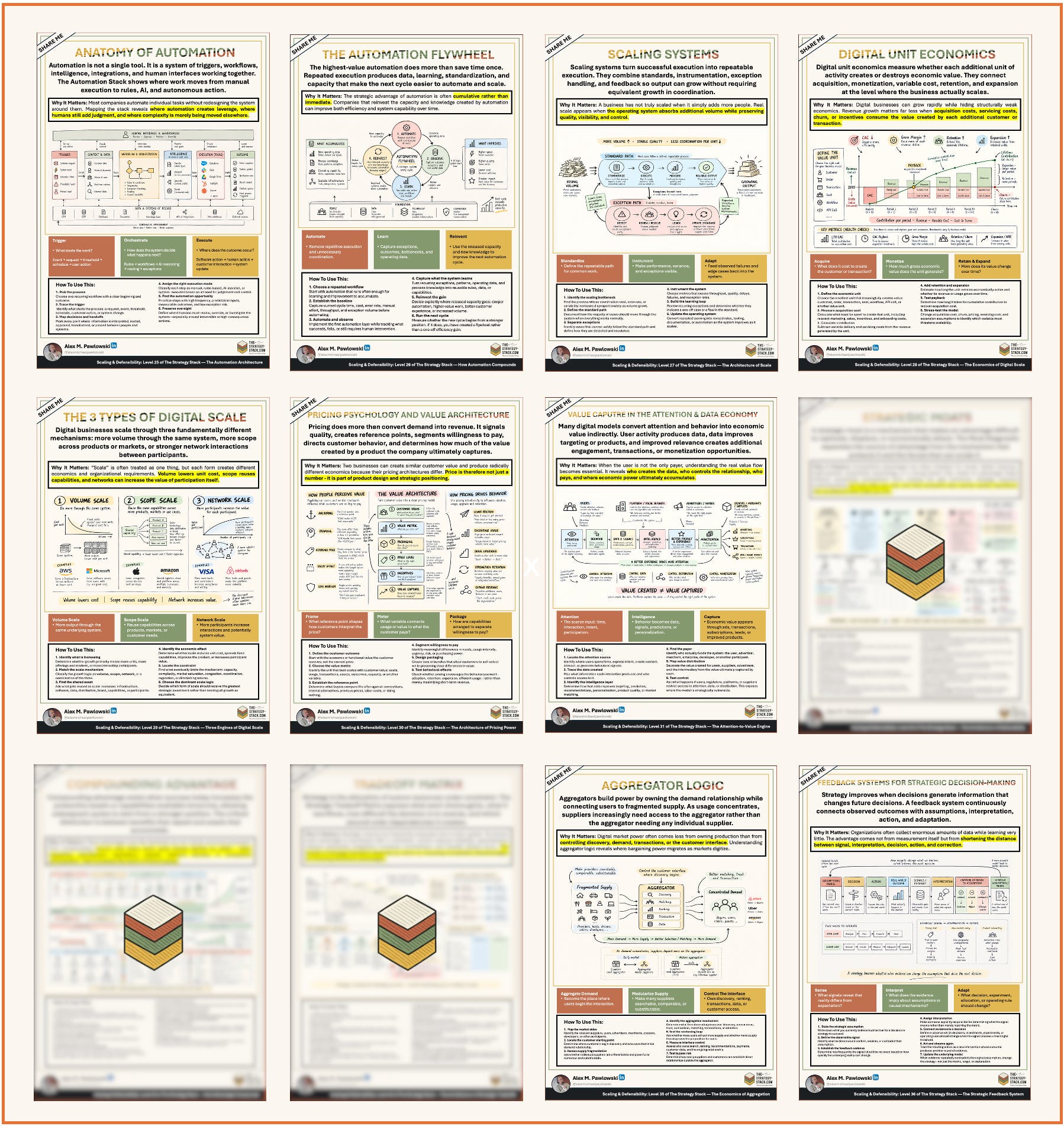
It maps scaling and defensibility: how automation becomes a compounding system, how scale types differ, how unit economics and pricing architecture work, how attention and data convert to capture, how moats form and compound, how aggregators flip power, and how strategy learns through closed feedback loops.
With the publication of Level 36, Phase Three is now complete.
This article is the map.
Why Phase Three Exists
Most durability failures aren’t caused by weak vision.
They’re caused by unclosed loops - automation without learning, growth without economics, advantage without protection, decisions without revision.
Teams confuse:
-
Tools with automation systems
-
Activity with compounding scale
-
Revenue growth with unit economics
-
Features with moats
-
Dashboards with strategic feedback
-
Aggregation slides with demand-side power
Phase Three dismantles those confusions.
It establishes shared logic for how digital businesses scale without linear coordination cost and defend without confusing today’s win with tomorrow’s barrier.
If Phase Three does its job, strategy stops being a sequence of heroic quarters - and becomes a system that gets stronger as it runs.
The Twelve Frameworks of Scaling and Defensibility
Each level answers a specific strategic question. Individually they’re useful. Together, they form a coherent system.
Level 25 - Anatomy of Automation
Why is automation a system, not a tool?
Maps triggers, context, orchestration, intelligence, execution, and outcomes — with human governance and systems of record beneath.
Level 26 - The Automation Flywheel
When does automation compound instead of saving time once?
Automate → observe → learn → reinvest. The strategic advantage is often cumulative, not immediate.
Level 27 - Scaling Systems
How does successful execution become repeatable execution?
Standards, instrumentation, exception paths, and learning loops - so volume grows without heroic coordination.
Level 28 - Digital Unit Economics
Does each additional unit create or destroy value?
Connects acquisition, contribution, payback, retention, and expansion at the unit level - before growth hides weak economics.
Level 29 — The 3 Types of Digital Scale
Volume, scope, or network — which mechanism are you actually building?
Each scale type creates different economics and requires different investment. Not all growth is the same kind of scale.
Level 30 - Pricing Psychology and Value Architecture
Why is price part of product design?
Frame, meter, package, and capture — not just price points. Two firms with similar value can produce radically different economics.
Level 31 - Value Capture in the Attention & Data Economy
Who creates data — and who captures value?
Maps attention, behavior, intelligence, and monetization when the user is not the only payer. Value created ≠ value captured.
Level 32 - Strategic Moats
Why is winning today not the same as defensibility tomorrow?
The Moat Diagnostic separates advantage from protection, reinforcement, stickiness, and erosion risk.
Level 33 — Compounding Advantage
What does each cycle leave behind?
Distinguishes repeating benefits from accumulating and compounding assets — and tests whether the loop actually accelerates.
Level 34 - The Strategic Tradeoff Matrix
What disadvantage are you willing to accept?
Maps gain, sacrifice, reversibility, dependencies, and second-order effects — strategy as chosen constraint, not wishful alignment.
Level 35 - Aggregator Logic
When does demand concentration flip market power?
Own demand, modularize supply, control the interface — and test whether the flywheel is real or a marketplace fantasy.
Level 36 - Feedback Systems for Strategic Decision-Making
Does your strategy learn - or perform?
Closed loop: assume → decide → observe → interpret → update. Open loop ends in hope.
What Phase Three Gives You
Taken together, Levels 25–36 provide:
-
A systems view of automation and operational scale
-
Economics literacy at the unit and pricing-architecture level
-
Defensibility diagnostics beyond feature comparisons
-
A closed-loop model for strategic learning
Phase Three doesn’t tell you which competitor to attack next.
It tells you how to build an organization that scales without breaking and defends without deluding itself.
How to Use This Collection
Operators and COOs: Start with Levels 25–27 when automation and coordination cost are the constraint
Finance and growth leaders: Start with Levels 28–30 when economics and pricing architecture need audit
CSOs and strategists: Start with Levels 32–36 when defensibility, tradeoffs, and learning loops are the question
Return to these levels whenever:
-
AI and automation projects multiply without compounding returns
-
Scale adds headcount faster than output
-
Revenue grows while unit economics weaken
-
Moat language cannot survive a competitor copy scenario
-
Strategy decks survive contact with contradictory evidence
That’s usually a signal that systems and defensibility — not execution intensity — are the missing layer.
Sequential path: 25 → 26 → 27 → … → 36
Best when auditing the full scale-and-defensibility stack.
By constraint: Jump to the level that matches the problem - automation stack if tools sprawl; unit economics if growth masks margin; moats if advantage feels temporary; feedback systems if assumptions never update.
With Phase One and Two: Start from Foundations of Digital Value (Levels 1–12) and Architecting Digital Models (Levels 13–24) if vocabulary from earlier phases is not yet shared. Phase Three assumes architecture - but you can enter wherever the constraint is sharpest.
What Comes Before (Context)
Phase One is about foundations.
Phase Two is about architecture.
Phase Three is about scale and defensibility - the layer where systems must compound, economics must work, and advantage must survive imitation.
Durability is built from the bottom up. Skipping Phase Two and jumping to moats produces slides, not strategy.
Closing Thought
Most companies don’t fail because they lack automation budgets or growth targets.
They fail because nothing compounds - not operations, not economics, not advantage, not learning.
Phase Three of The Strategy Stack exists to fix that.
Because once systems scale cleanly and models learn from evidence, execution finally has something durable to defend.
👉 Unlock the Strategy Stack
…and access the Business Model Series, advanced Cheat Sheets, the Operator Vault, and various essays at the intersection of strategy and technology.
Start here →
Phase II →
Phase I →