Digital unit economics - whether each additional unit of activity creates or destroys value across acquisition, monetization, retention, and expansion
By Alex Pawlowski
Published: 2026-09-11
URL: https://thestrategystack.substack.com/p/digital-unit-economics
Revenue growth can mask economics that do not work.
Teams celebrate new customers while acquisition cost, servicing cost, and churn consume the value each unit was supposed to create. Board slides show charts up and to the right; the model quietly asks for more capital to survive its own success.
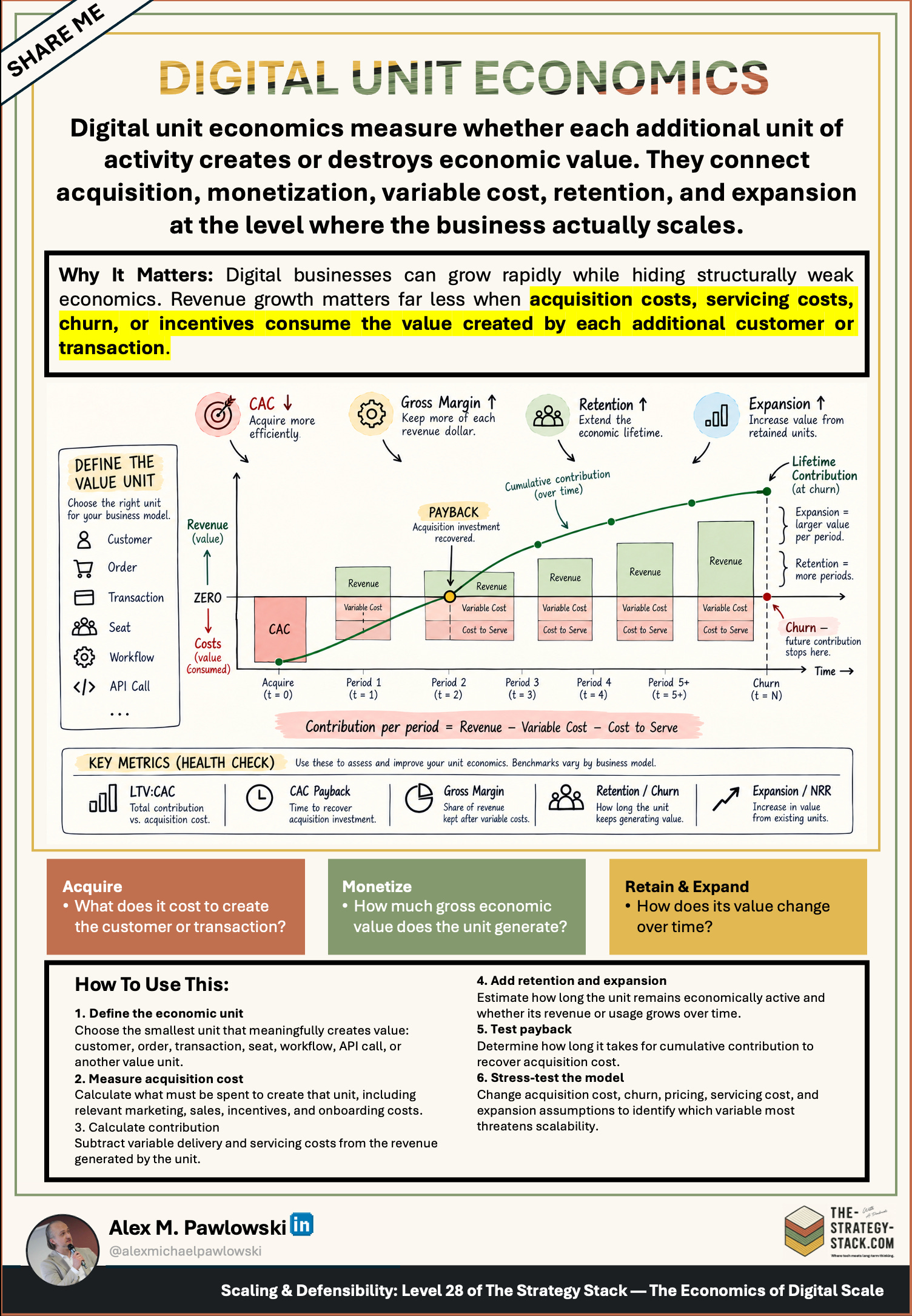
Digital unit economics measure whether each additional unit of activity - customer, transaction, seat, workflow, API call - creates or destroys economic value over its lifetime. It connects acquisition, monetization, variable cost, retention, and expansion into one picture.
This framework assumes you already defined the value unit (see below). Unit economics asks whether the economics around that unit actually compound.
Define the Economic Unit
Start with the smallest unit that creates measurable value:
Customer · Order · Transaction · Seat · Workflow · API call
The unit must be repeatable, attributable, and comparable over time. If you cannot track it from acquire → contribute → churn, you do not have unit economics - you have revenue stories.
The Lifecycle: Acquire to Lifetime Contribution
Acquire (t=0) - CAC and onboarding cost
Marketing, sales, incentives, implementation - everything required to create the unit.
Period contribution - revenue minus variable cost and cost to serve
Each period: did this unit put money back toward recovering acquisition?
Payback - when cumulative contribution crosses zero
How long until the unit repays what it cost to acquire? Payback that lengthens while you scale is a warning, not a milestone.
Retention - how many periods the unit stays active
Churn is not a dashboard mood - it is shortened economic life.
Expansion - value per period grows
Higher NRR, upsell, usage growth within the unit. Expansion can rescue weak acquisition; it cannot forever rescue weak core value.
Lifetime contribution - total value minus total cost to create and serve
The question investors and operators should align on before scaling spend.
The Four Levers
-
CAC ↓ - acquire more efficiently
-
Gross margin ↑ - keep more of each revenue dollar
-
Retention ↑ - extend economic lifetime
-
Expansion ↑ - increase value from retained units
Improve the weakest lever first. Optimizing CAC while contribution per period is negative scales a leak.
The Failure Pattern
Unit economics break when:
-
Billing unit and value unit diverge — you optimize the wrong thing
-
CAC is blended until every channel looks profitable
-
Variable cost rises with scale faster than revenue per unit
-
Retention decays while headline revenue grows
-
Expansion masks a core unit that never pays back
Stress-test: Which variable, if 20% worse, breaks the model? That is your strategic risk - not the scenario where everything goes right.
How to Use This Framework
1. Define the economic unit
Not your billing unit - the unit that creates customer value and revenue together.
2. Measure acquisition cost honestly
Include sales, marketing, onboarding, and incentives - fully loaded.
3. Calculate contribution per period
Revenue minus variable delivery and servicing costs.
4. Add retention and expansion
Estimate active periods and whether value per period grows.
5. Test payback
How long to recover CAC - and what happens if CAC or churn moves?
6. Stress-test the model
Identify the single variable that most threatens scalability.
Diagnostic questions:
-
Does each new unit improve the average - or dilute it?
-
Is payback shortening or lengthening as you scale?
-
What would have to be true for lifetime contribution to work at 2× volume?
👉 Unlock the Strategy Stack
…and access the Business Model Series, advanced Cheat Sheets, the Operator Vault, and various essays at the intersection of strategy and technology.
In this series →
Read next →
Go deeper →