Value orchestration and strategic control — when to own, access, or orchestrate resources based on importance and coordination advantage
By Alex Pawlowski
Published: 2026-09-03
URL: https://thestrategystack.substack.com/p/own-vs-orchestrate
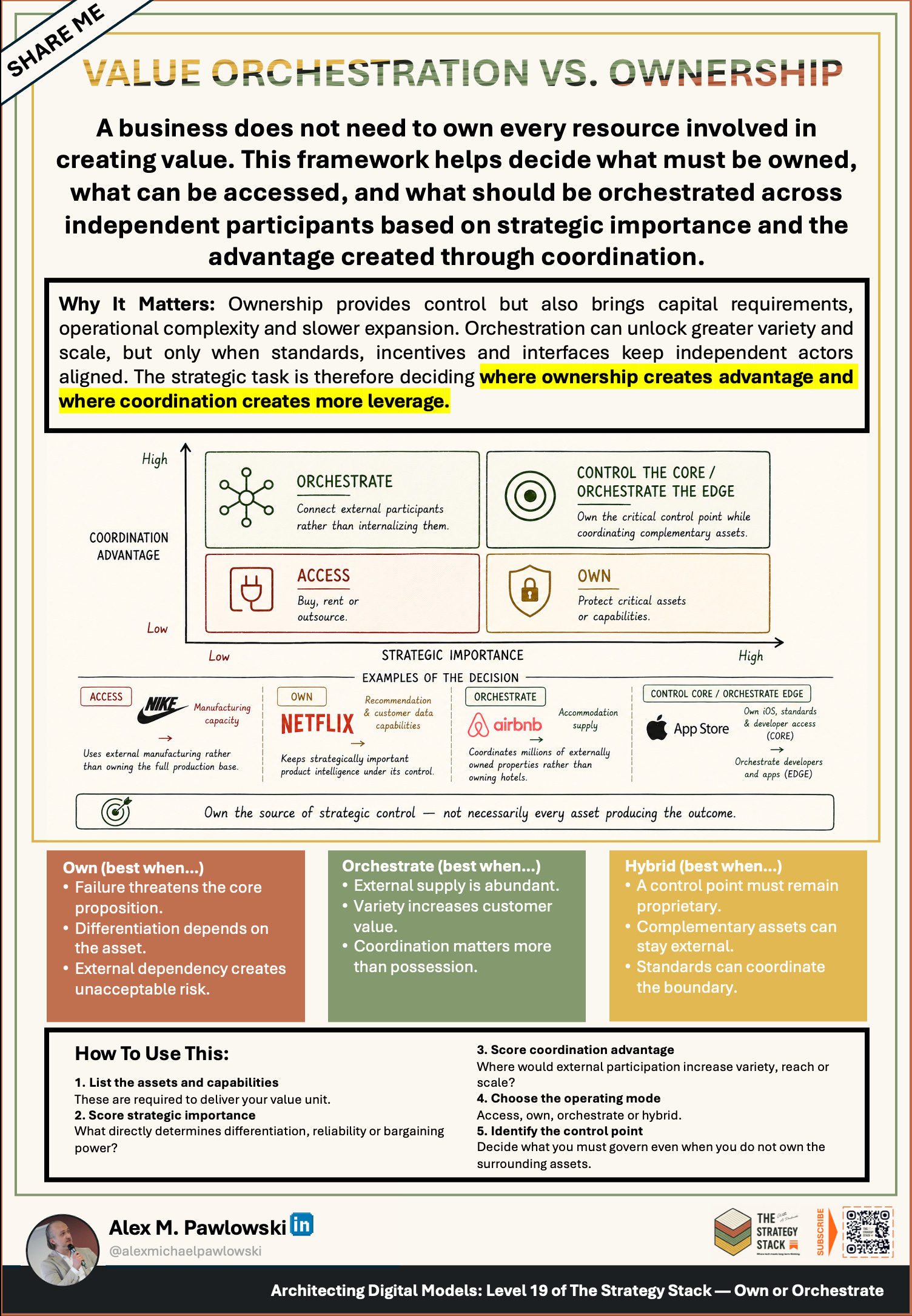
Every business must decide what to own, what to access (buy, rent, outsource), and what to orchestrate (coordinate across external participants).
Ownership provides control — but brings capital requirements, operational complexity, and slower expansion.
Orchestration unlocks variety and scale — but requires standards, incentives, and interfaces to keep independent actors aligned.
The strategic task is not maximal ownership. It is deciding where ownership creates advantage and where coordination creates more leverage.
Own the source of strategic control — not necessarily every asset producing the outcome.
The Decision: Four Operating Modes
Plot resources on two axes: strategic importance and coordination advantage.
Access (low importance, low coordination)
Buy, rent, or outsource. Example: Nike using external manufacturing capacity for non-differentiating production.
Own (high importance, low coordination)
Protect critical assets in-house. Example: Netflix keeping recommendation systems and customer data capabilities under direct control.
Orchestrate (low importance, high coordination)
Connect external participants rather than internalizing them. Example: Airbnb coordinating externally owned properties through standards and trust systems.
Control the core / orchestrate the edge (high on both)
Own the control point while coordinating complementary assets. Example: Apple owning iOS while controlling standards and developer access, and orchestrating third-party apps.
When to Use Each Mode
Own when: Failure threatens the core proposition · Differentiation depends on the asset · External dependency creates unacceptable risk
Orchestrate when: External supply is abundant · Variety increases customer value · Coordination matters more than possession
Access when: The capability is commoditized and does not differentiate the value unit
Hybrid when: A control point must remain proprietary · Complementary assets can stay external · Standards can coordinate the boundary
Common Errors
-
Owning commoditized assets that drain capital without differentiation
-
Orchestrating without standards — coordination cost explodes
-
Outsourcing strategically critical capabilities because it is faster this quarter
-
Treating “asset-light” as synonymous with “no control”
The App Store works because Apple owns the control point. Airbnb works because trust and standards coordinate the edge. In both cases, the mode matches the economics.
How to Use This Framework
- List assets and capabilities required to deliver your value unit.
- Score strategic importance — what determines differentiation, reliability, or bargaining power?
- Score coordination advantage — where would external participation increase variety, reach, or scale?
- Choose the operating mode — access, own, orchestrate, or hybrid.
- Identify the control point — what must you govern even when you do not own surrounding assets?
👉 Unlock the Strategy Stack
…and access the Business Model Series, advanced Cheat Sheets, the Operator Vault, and various essays at the intersection of strategy and technology.
In this series →
Read next →
Go deeper → 
Hit subscribe to get it in your inbox. And if this spoke to you:
➡️ Forward this to a strategy peer who’s feeling the same shift. We’re building a smarter, tech-equipped strategy community—one layer at a time.
Let’s stack it up.
A. Pawlowski | The Strategy Stack