Channel strategy and distribution control — plot owned vs. rented channels by control and embeddedness to find hidden gatekeeper dependency
By Alex Pawlowski
Published: 2026-09-03
URL: https://thestrategystack.substack.com/p/distribution-control-map
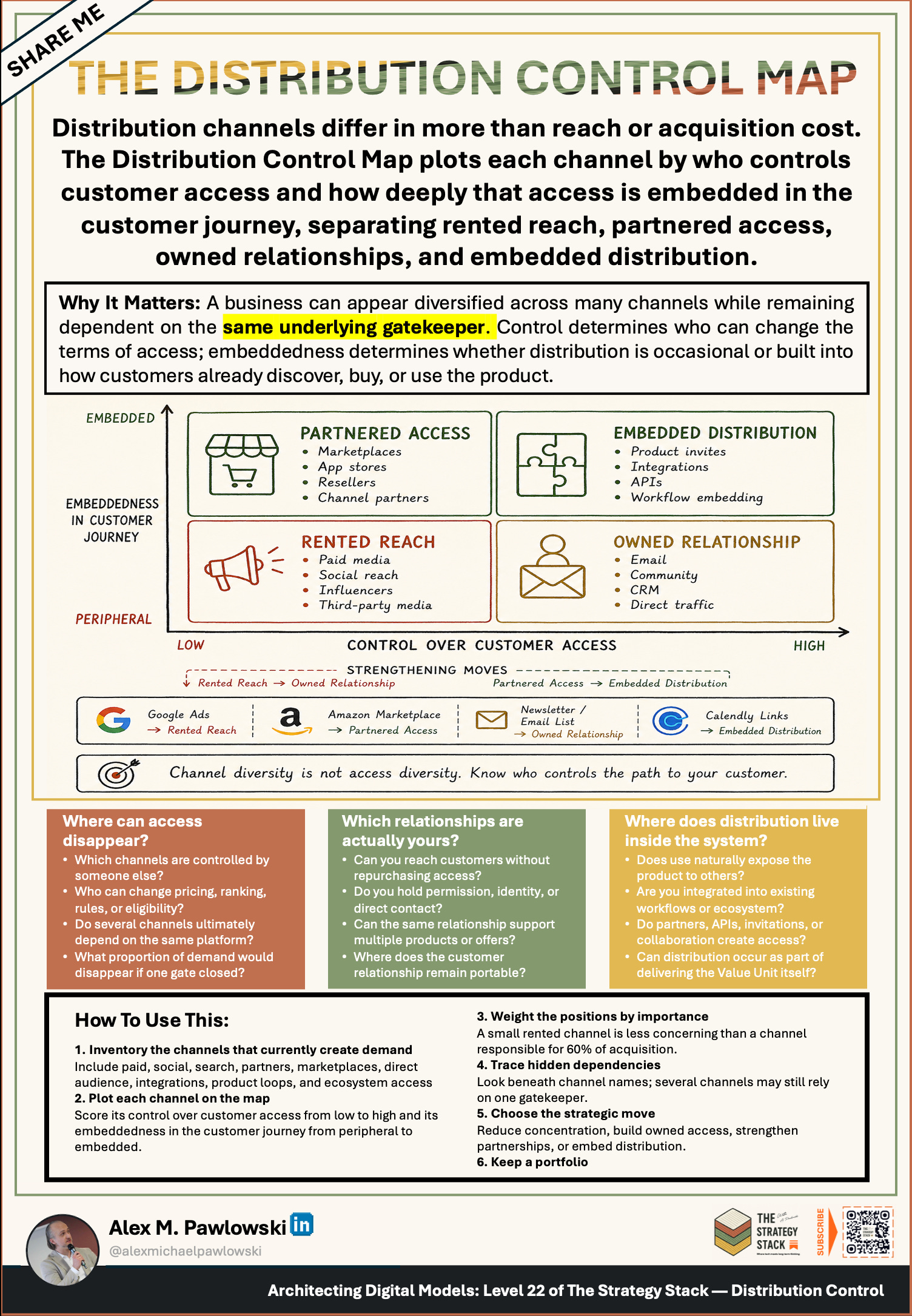
A business can look diversified while depending on the same underlying gatekeeper.
Ten channels. One platform that can change terms overnight.
Distribution control is about who can change the rules of access — not whether a channel is currently performing well.
Embeddedness is whether distribution lives inside the customer’s existing behavior, or arrives as occasional interruption.
Plot channels on both axes and dependency becomes visible. Channel diversity is not access diversity.
This framework complements distribution leverage:
leverage asks what persists after effort; control asks who owns that persistence.
The Map: Four Quadrants
Rented reach (low control, peripheral)
Paid media, social reach, influencers, third-party media. Attention purchased; disappears when spend stops.
Partnered access (low control, embedded)
Marketplaces, app stores, resellers, channel partners. Distribution lives in the journey — terms set elsewhere.
Owned relationship (high control, peripheral)
Email, community, CRM, direct traffic. Direct permission exists — but distribution is not yet embedded in workflow.
Embedded distribution (high control, embedded)
Product invitations, referral links, collaborative sharing, embeddable widgets, product-generated links. Distribution is part of how work gets done — Calendly-style scheduling links, Dropbox-style invitation mechanics, payment buttons in checkout.
Strategic Moves
Two shifts strengthen most portfolios:
- Rented reach → Owned relationship
Convert attention into permission — email, accounts, subscriptions, identifiable contact.
- Partnered access → Embedded distribution
Move from platform-mediated access toward product or workflow mechanics you control directly.
The goal is not to abandon platforms. It is to reduce concentration and increase control where it matters.
Hidden Dependencies
Weight each channel by importance — revenue, acquisition volume, strategic dependence.
A small rented channel is noise. One responsible for 60% of acquisition is existential risk.
Common patterns:
-
Multiple “diversified” social channels dependent on one algorithm
-
App store ranking driving most trials
-
Marketplace owning the customer relationship
-
Paid and organic search both dependent on one platform’s policies
Trace gatekeepers beneath channel names. “Multi-channel” often means multi-door, same landlord.
How to Use This Framework
- Inventory channels creating demand today.
- Plot each on control (low → high) and embeddedness (peripheral → embedded).
- Weight by importance — size the risk, not just the position.
- Trace hidden dependencies — common gatekeepers beneath different labels.
- Choose the strategic move — reduce concentration, build owned access, strengthen partnerships deliberately.
- Maintain a portfolio — no single quadrant should carry the business alone.
👉 Unlock the Strategy Stack
…and access the Business Model Series, advanced Cheat Sheets, the Operator Vault, and various essays at the intersection of strategy and technology.
In this series →
Read next →
Go deeper → 
Hit subscribe to get it in your inbox. And if this spoke to you:
➡️ Forward this to a strategy peer who’s feeling the same shift. We’re building a smarter, tech-equipped strategy community—one layer at a time.
Let’s stack it up.
A. Pawlowski | The Strategy Stack