Demand generation system — map how you create signals, capture intent, convert interest, and recycle outcomes into market evidence
By Alex Pawlowski
Published: 2026-09-03
URL: https://thestrategystack.substack.com/p/demand-generation-system
Funnel metaphors are useful shorthand. They are also incomplete.
Buyers discover, compare, leave, and return. They encounter proof in one channel and act in another. They build intent over weeks while dashboards measure only this week’s clicks.
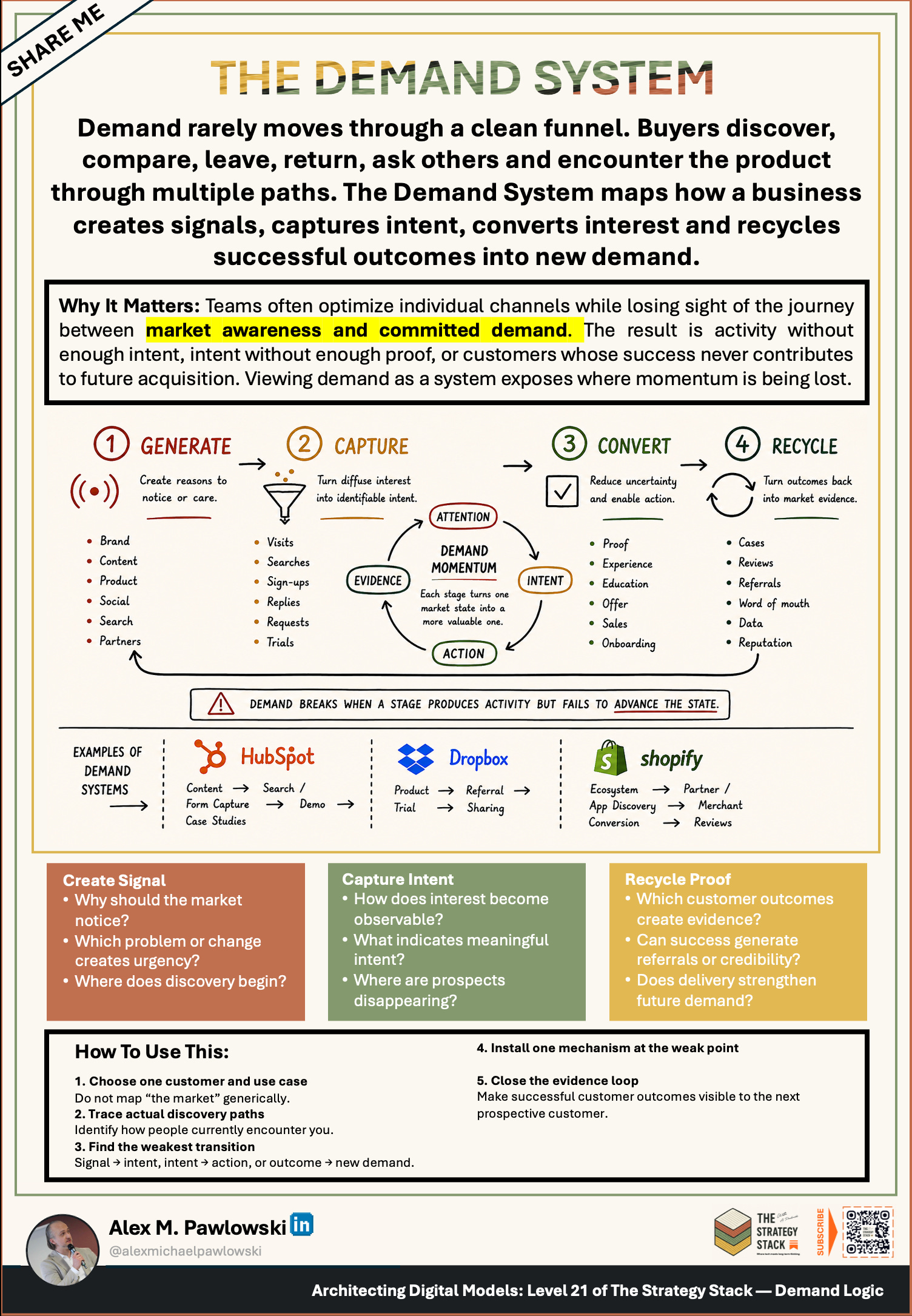
A demand generation system maps how a business creates signals, captures intent, converts interest, and recycles successful outcomes — so activity advances market state instead of merely registering activity.
The system fails when a stage produces motion but does not advance the state — lots of content with no captured intent, lots of trials with no visible proof for the next buyer.
The Model: Four Stages
Generate — Create reasons to notice or care.
Brand, content, product, social, search, partners.
Capture — Turn diffuse interest into identifiable intent.
Visits, searches, sign-ups, replies, requests, trials.
Convert — Reduce uncertainty and enable action.
Proof, experience, education, offer, sales, onboarding.
Recycle — Turn outcomes back into market evidence.
Cases, reviews, referrals, word of mouth, data, reputation.
Funnels describe an idealized path. This model describes what must happen regardless of path shape.
Demand Momentum
At the center: a loop advancing market state.
Attention → Intent → Action → Evidence — and back to attention.
Each transition should increase value:
-
Attention becomes intent when interest is identifiable
-
Intent becomes action when uncertainty drops
-
Action becomes evidence when outcomes are visible to the next prospect
The warning sign is not “non-linear behavior” — that is normal. The warning sign is high activity with flat transitions.
Where Transitions Break
Teams optimize channels in isolation:
Marketing often owns generation; sales and product share conversion; customer success may own recycling — formally or not, depending on the model.
Nobody owns the handoffs.
The gap between market awareness and committed demand is where most models leak — not inside any single function.
Salesforce: Thought leadership / event signal → form capture → discovery call / demo → case study recycled into the next campaign
Canva: Template discovery → account / project creation → first design completed → share or template publish as proof for the next user
Stripe Atlas / docs-led PLG: Developer docs and signal → signup / keys → first successful integration → public case or integration directory entry
Each example is designed around a weak transition — generate → capture → convert → recycle — not a hero channel.
How to Use This Framework
1. Choose one customer and use case — do not map generically.
2. Trace actual discovery paths — how do people currently encounter you?
3. Find the weakest transition — signal to intent, intent to action, or action to evidence?
4. Install one mechanism at the weak point — one capture form, one proof asset, one referral loop.
5. Close the evidence loop — make success visible to the next prospective customer.
👉 Unlock the Strategy Stack
…and access the Business Model Series, advanced Cheat Sheets, the Operator Vault, and various essays at the intersection of strategy and technology.
In this series →
Read next →
Go deeper → 
Hit subscribe to get it in your inbox. And if this spoke to you:
➡️ Forward this to a strategy peer who’s feeling the same shift. We’re building a smarter, tech-equipped strategy community—one layer at a time.
Let’s stack it up.
A. Pawlowski | The Strategy Stack