Digital value creation through three engines — code, data, and community — and how they combine into reusable capability
By Alex Pawlowski
Published: 2026-09-03
URL: https://thestrategystack.substack.com/p/digital-value-engines
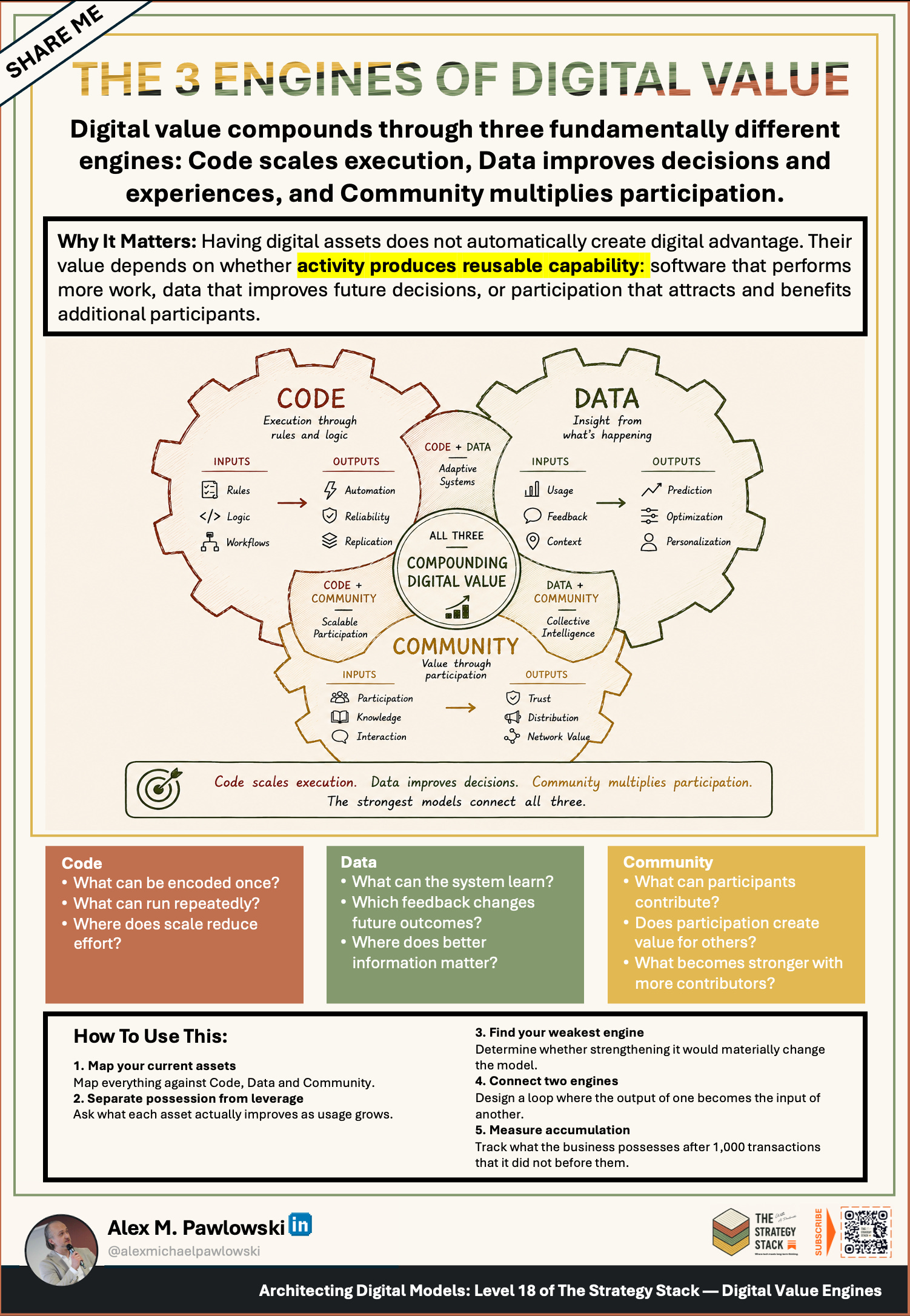
Owning digital assets is not the same as building digital advantage.
Digital value creation compounds when a business develops reusable capability — assets that perform more work, improve future decisions, or attract more participants as usage grows.
This framework names three engines that produce that capability:
Code — execution through rules and logic
Data — insight from what is happening
Community — value through participation
Individually, each engine contributes. Connected deliberately, they compound.
The Model
Code
Inputs: Rules, logic, workflows
Outputs: Automation, reliability, replication
Question: What can be encoded once and run repeatedly? Where does scale reduce marginal effort?
Data
Inputs: Usage, feedback, context
Outputs: Prediction, optimization, personalization
Question: What can the system learn? Which feedback changes future outcomes?
Community
Inputs: Participation, knowledge, interaction
Outputs: Trust, distribution, network value
Question: What can participants contribute? Does participation create value for others?
Where Engines Combine
Code + Data → Adaptive systems that improve execution from information
Data + Community → Collective intelligence from participation at scale
Code + Community → Scalable participation without proportional headcount
All three → Compounding digital value — the cycle most transformation programs describe but rarely build
The 1,000-Transaction Test
Many firms possess code, data, and community — but treat them as static possessions.
Data sits in warehouses without closing feedback loops. Community exists as support forums without contributing to product or distribution. Code automates tasks without learning from outcomes.
After 1,000 transactions, ask: What does the business possess that it did not have before them?
If the answer is only “more rows in a database,” you have storage — not engines.
How to Use This Framework
- Map current assets under Code, Data, and Community.
- Separate possession from leverage — which assets improve as usage grows?
- Find your weakest engine — would strengthening it change the business model?
- Connect two engines — design a loop where one engine’s output becomes another’s input.
- Run the 1,000-transaction test on your most important customer journey.
👉 Unlock the Strategy Stack
…and access the Business Model Series, advanced Cheat Sheets, the Operator Vault, and various essays at the intersection of strategy and technology.
In this series →
Read next →
Go deeper → 
Hit subscribe to get it in your inbox. And if this spoke to you:
➡️ Forward this to a strategy peer who’s feeling the same shift. We’re building a smarter, tech-equipped strategy community—one layer at a time.
Let’s stack it up.
A. Pawlowski | The Strategy Stack