Customer retention framework — diagnose whether value repeats, accumulates, or becomes embedded in work, relationships, and routines
By Alex Pawlowski
Published: 2026-09-03
URL: https://thestrategystack.substack.com/p/customer-retention-framework
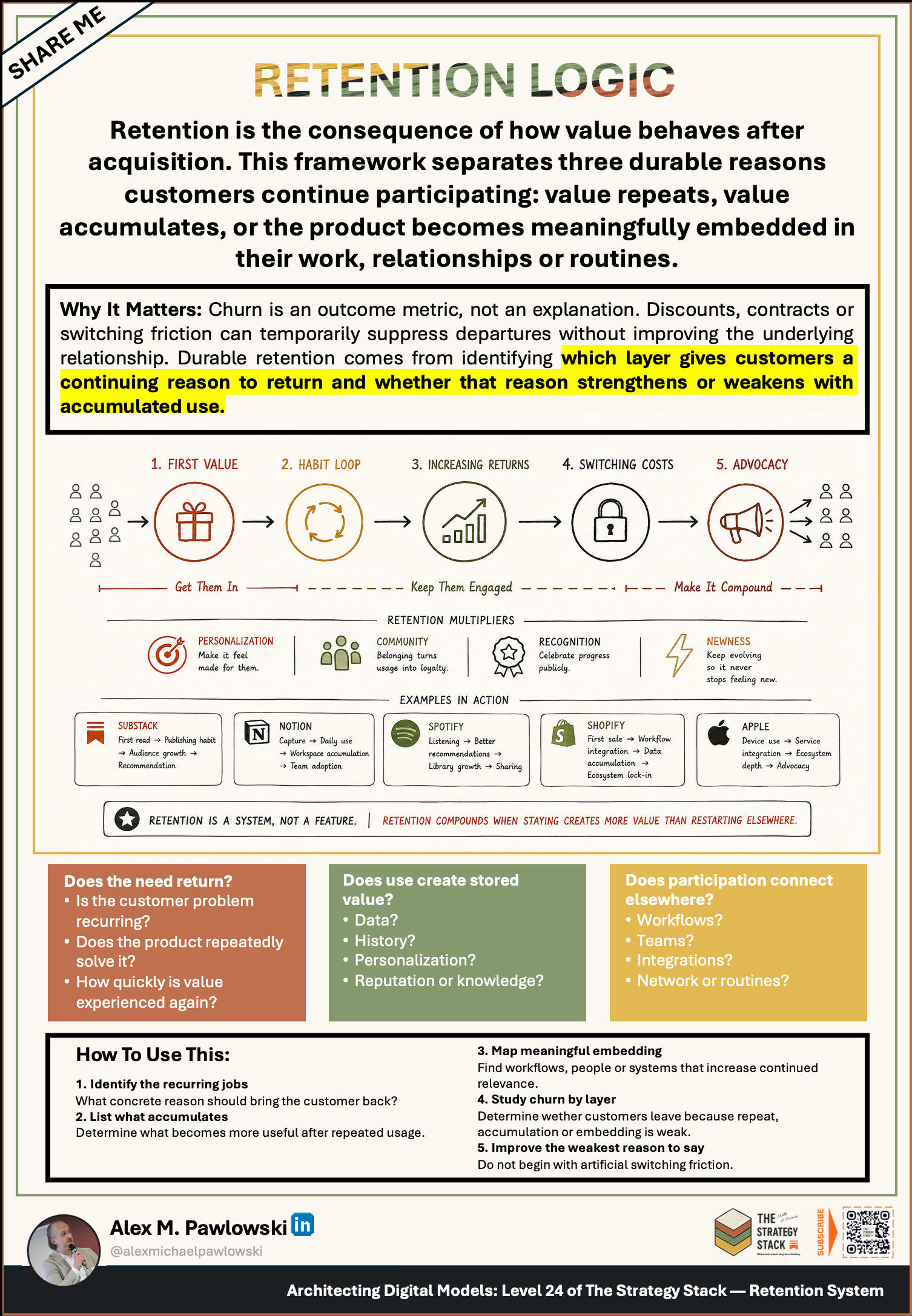
Retention is the consequence of how value behaves after acquisition.
Churn is an outcome metric — not an explanation.
Discounts, contracts, and artificial friction can suppress departures temporarily. They do not create a continuing reason to return.
A useful customer retention framework identifies which layer gives customers a reason to stay — and whether that reason strengthens or weakens with accumulated use.
Retention is a system, not a feature.
The Journey: Five Stages
First value — Initial value realization. The customer confirms the job can be done here.
Habit loop — Recurring routine established. The product fits into how work or life actually runs.
Increasing returns — The product improves with use — through data, personalization, or accumulated content.
Switching costs — Leaving becomes costly because of stored value — history, integrations, reputation, team adoption.
Advocacy — Satisfied customers refer others, restarting the journey for new participants.
The first four stages describe why an existing customer stays. Advocacy is different: it is the downstream output of sufficiently strong retention — not a mechanism that keeps the current customer. Advocacy feeds acquisition; it does not substitute for repeat value, accumulation, or embedding.
Three Durable Reasons to Stay
Does the need return?
Recurring problem, repeated solution, rhythm of value experience.
Does use create stored value?
Data, history, personalization, reputation, knowledge that would be costly to recreate elsewhere.
Does participation connect elsewhere?
Workflows, teams, integrations, network routines that increase the cost of leaving.
Study churn by layer. Customers leave because repeat value is weak, accumulation never happened, or embedding failed — not because you lack a “retention feature.”
Retention Multipliers
Four forces amplify staying once a core reason exists:
Personalization — the product feels increasingly specific to the user
Community — belonging reinforces continued participation
Recognition — visible progress increases commitment
Newness — evolution prevents staleness without breaking accumulated value
Multipliers strengthen an existing reason to stay. They do not replace one.
Examples in Motion
Substack: First read → publishing habit → audience growth → (advocacy: recommendations bring new readers)
Notion: Capture → daily use → workspace accumulation → team adoption
Spotify: Listening → better recommendations → library growth → sharing
Shopify: First sale → workflow integration → data accumulation → ecosystem depth
Different paths. Same diagnostic: staying creates more value than restarting elsewhere.
How to Use This Framework
- Identify recurring jobs — what concrete reason should bring the customer back?
- List what accumulates — what becomes more useful after repeated usage?
- Map meaningful embedding — workflows, people, or systems that increase continued relevance.
- Study churn by layer — which reason to stay is weakest at departure?
- Improve the weakest layer first — do not begin with artificial switching friction.
👉 Unlock the Strategy Stack
…and access the Business Model Series, advanced Cheat Sheets, the Operator Vault, and various essays at the intersection of strategy and technology.
Phase II complete →
Go deeper → 
Hit subscribe to get it in your inbox. And if this spoke to you:
➡️ Forward this to a strategy peer who’s feeling the same shift. We’re building a smarter, tech-equipped strategy community—one layer at a time.
Let’s stack it up.
A. Pawlowski | The Strategy Stack