Aggregator logic - how demand concentration, modularized supply, and interface control create market power in digital markets
By Alex Pawlowski
Published: 2026-09-11
URL: https://thestrategystack.substack.com/p/aggregator-logic
Some of the most durable digital businesses do not own what they sell.
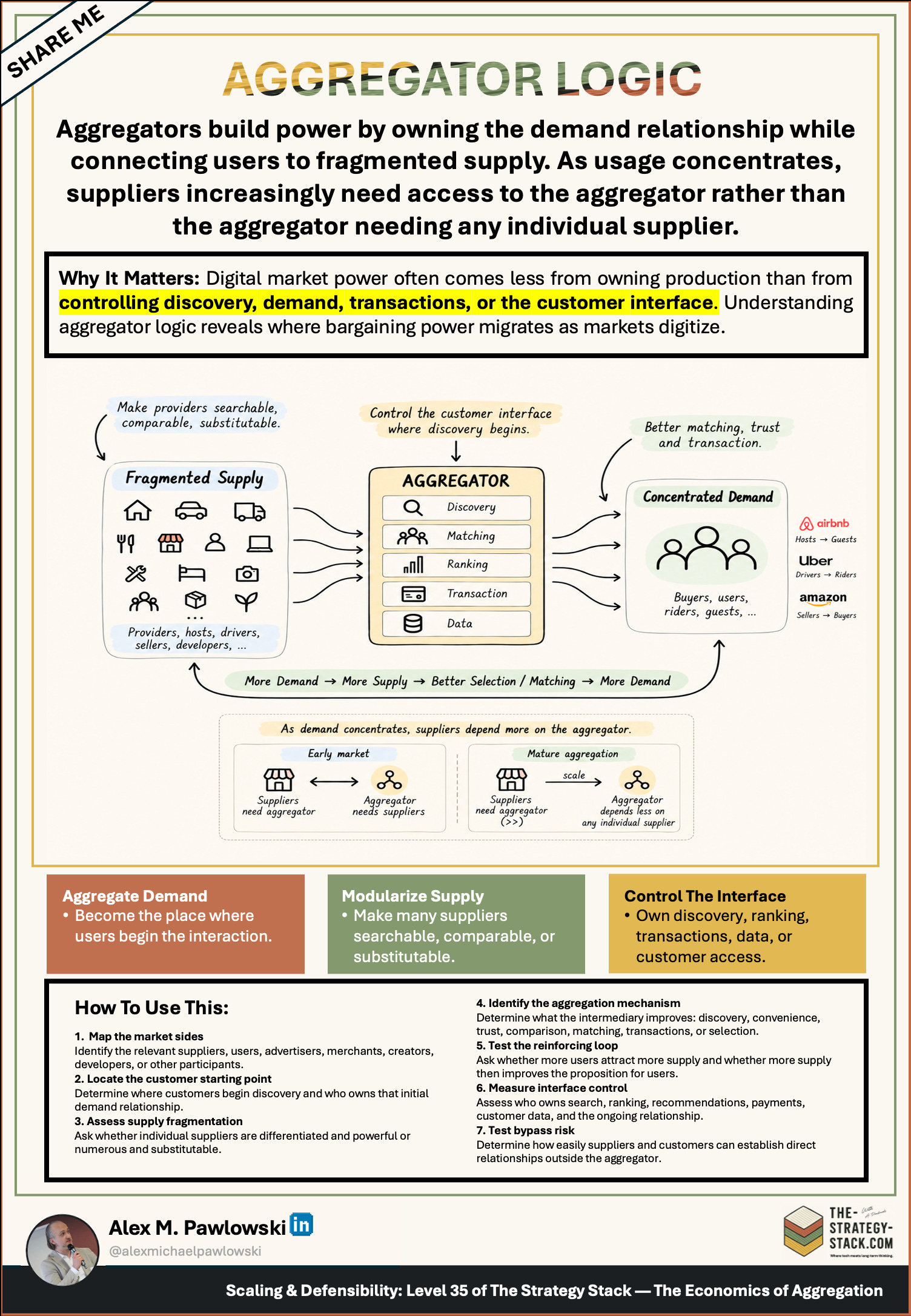
They own the demand relationship while connecting users to fragmented supply. As usage concentrates, suppliers increasingly need access to the aggregator - rather than the aggregator needing any individual supplier.
That is aggregator logic: control where discovery begins, make supply searchable and substitutable, capture transactions and data at the interface, and let the flywheel densify.
Airbnb hosts need guests the platform aggregated. Uber drivers need riders. Amazon sellers need buyers. The power shift is not moral - it is structural.
The Model: Three Strategic Moves
Aggregate demand - become where users begin
Search, habit, trust, default. Demand concentration is the asset.
Modularize supply - make providers comparable and substitutable
Standards, ratings, searchability, onboarding friction low enough to expand supply without losing quality control.
Control the interface - own discovery, ranking, transaction, data
Who appears first, who gets the click, who processes payment, who learns from the interaction.
The Flywheel
More demand → more supply → better selection and matching → more demand
Early markets: suppliers and aggregators need each other symmetrically.
Mature aggregation: suppliers depend more on the aggregator than the aggregator depends on any one supplier.
Multi-homing and bypass remain risks - but concentration shifts bargaining power toward the interface.
Evidence: When Aggregation Is Real
Uber - drivers ↔ riders; supply fragmented; discovery and trust at app
Airbnb - hosts ↔ guests; inventory fragmented globally; reviews and search at platform
Amazon marketplace - sellers ↔ buyers; catalog infinite at the interface; fulfillment and ads as additional capture layers
Contrast with a brand manufacturer that sells direct: strong product logic, weak aggregation - different economics, different strategic playbook.
The Failure Pattern
Aggregator strategies fail when:
-
Supply is not actually fragmented - or not substitutable
-
Demand never concentrates - multi-homing stays cheap
-
The interface does not improve matching enough to justify the take rate
-
Suppliers bypass once they know the customer - and nothing prevents it
-
Ranking and trust are gamed until the marketplace collapses
Platform strategy slides without demand aggregation is usually product strategy with a fee.
How to Use This Framework
1. Map the market sides
Suppliers, users, advertisers, developers - all participants.
2. Locate the customer starting point
Where does discovery actually begin?
3. Assess supply fragmentation
Are individual suppliers differentiated - or interchangeable at the point of purchase?
- Identify the aggregation mechanism
Trust, convenience, selection, price comparison, logistics - what does the intermediary improve?
5. Test the reinforcing loop
Does more demand attract more supply in a way that improves the user proposition?
6. Measure interface control
Who owns search, ranking, payments, data?
7. Test bypass risk
How easily can parties transact directly outside the aggregator?
Diagnostic questions:
-
If your top supplier left, would users notice - or would replacements fill the gap?
-
Is power shifting toward the interface as you scale - or are you still buying supply?
-
What would bypass look like - and what stops it?
👉 Unlock the Strategy Stack
…and access the Business Model Series, advanced Cheat Sheets, the Operator Vault, and various essays at the intersection of strategy and technology.
In this series →
Read next →
Go deeper →