Part 2 of 2. When your skills live inside an agent you built yourself, claude plugin eval can't reach them. Here is a small runner that can.
By Alejandro Aboy
Published: 2026-11-09
URL: https://thepipeandtheline.substack.com/p/evals-for-your-skills-agents
Hi there! Alejandro here 😊
Subscribe if you like to read about technical data & AI learnings, deep dives!
Enjoy the reading and let me know in the comments what you think about it 👨🏻💻
📝 TL;DR
claude plugin evalonly tests plugins, so an agent you wrote with an SDK needs its own runner
- Anthropic’s develop-tests guide ranks checks by reliability: code first, a judge model second, humans last
- Everything runs through
claude -p, so it uses your Claude Code subscription and needs no API key
- Across 27 runs, skill routing passed and three answers broke one rule from my own prompt
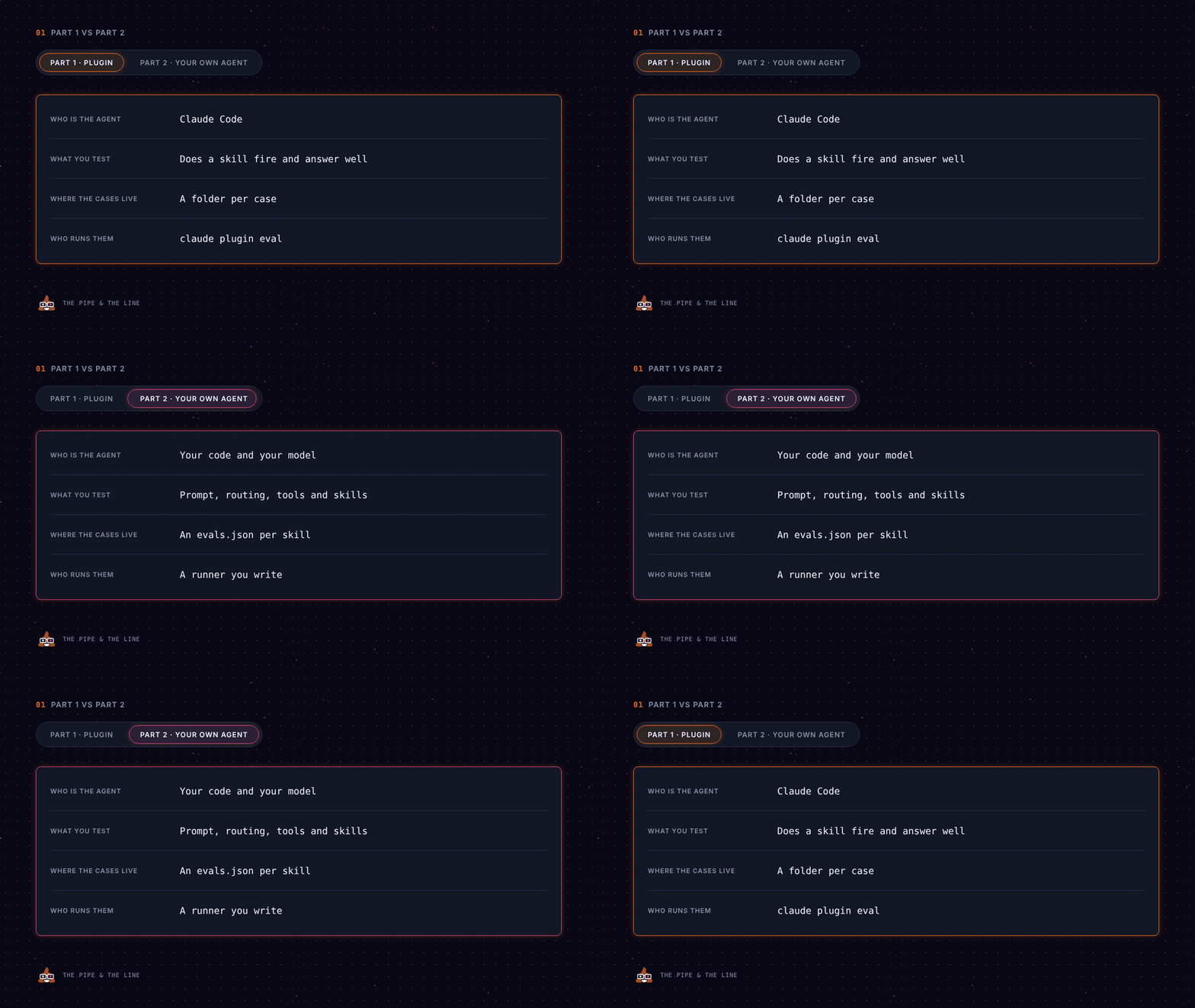
In Part 1 I tested skills that live in Claude Code, packaged as a plugin.
There, Claude Code is the agent: it loads the plugin, decides when a skill applies and runs it. claude plugin eval only has to watch.
But on agent projects, many skills live somewhere else, inside an agent you built yourself with an SDK or a framework like Agno, Langchain.
That agent has its own system prompt with routing rules, its own tools and picked model. Claude Code never loads any of it, so the plugin tool has nothing to run. In this article we will see the approach to define eval criteria for an agent following Anthropic best practices.
The Approach at a Glance
agent-evals/
├── run.py # runs the agent and grades it
├── analyze-articles/
│ └── evals.json # cases for one skill (one folder per skill)
├── routing/evals.json # cases about picking the right skill
├── rubrics/ # shared rules for the judge model
├── baseline.json # the last scores I accepted
└── hook.sh # reruns everything when the prompt changes
It works like Part 1, with a few differences:
- One
evals.jsonper skill holds the prompts and the checks, instead of one folder per case.
- The checks are code & a judge model with a rubric, the same two types as before.
- A
baseline.jsonstores the scores, so a drop shows up as a regression next time you try the evals.
One evals.json per Skill
{
“id”: “articles-natural-phrasing”,
“prompt”: “How are my latest articles doing? thepipeandtheline.substack.com”,
“success_criteria”: “Loads analyze-articles before any data tool, fetches performance for the articles it lists, and reports each metric relative to the publication average.”,
“code”: {
“first_tool”: “get_skill_instructions”,
“skill_arg”: “analyze-articles”,
“tools_min”: {”get_substack_articles”: 1, “get_article_performance”: 3},
“order”: [”get_skill_instructions”, “get_substack_articles”, “get_article_performance”]
},
“rubrics”: [”metrics-anchored”, “grounded-in-data”, “no-url-nagging”],
“rubric”: “The answer contains a performance table or ranking of articles, names the top performers with a reason each, and ends with concrete next steps.”
}
The code block is cheap and gives the same verdict every time.
The rubrics turn rules I already wrote in my system prompt into checks. e.g. metrics-anchored says a raw number with no average or ranking next to it fails.
Following best practices, we use different models, in this case the judge is Sonnet while the agent is Haiku.
There are nine cases: one or two per skill, plus routing cases (a general question must call no tool).
Thanks for reading The Pipe & The Line! This post is public so feel free to share it.
Running The Eval Tasks
Using Your Subscription
You can use claude -p, Claude Code’s non-interactive mode.
Both the agent and the judge go through it, so every run uses my subscription:
claude -p "<question>" \
--output-format stream-json --verbose \
--model haiku \
--system-prompt "$SYSTEM_PROMPT" \
--mcp-config mcp.json --strict-mcp-config \
--tools "" \
--allowedTools "mcp__skills__\*" "mcp__substack__\*" \
--setting-sources "" \
--no-session-persistence \
--max-turns 30
In plain words:
- The agent gets my system prompt and runs on Haiku.
- It only sees the tools I listed explicitly in the MCP config, with none of Claude Code’s own tools and none of my local settings.
- It prints every step it takes, and those steps are what the code checks read.
The Results
The 27 runs (9 cases, 3 times each) took under 5’.
- Routing passed. The agent loaded the right skill first, and a general question used no tools.
- 3 answers broke my own rule. For articles, notes and ideas the agent showed figures like “9 reactions, 0 comments” with no average next to them.
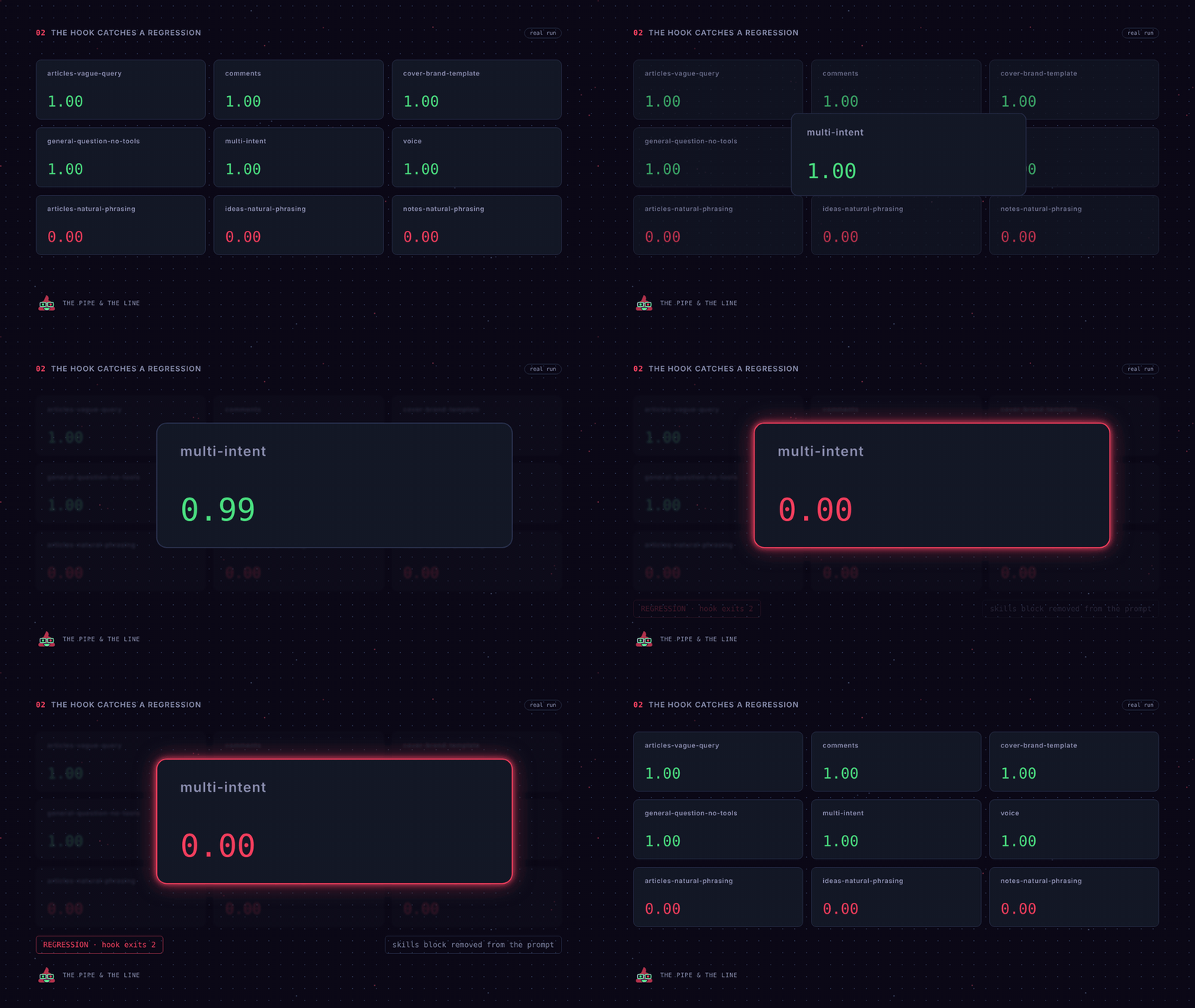
These scores were stored baseline.json.When a change drops a case below it, the runner prints REGRESSION and exits with an error.
The Hook
Same idea as in Part 1, aimed at the agent’s files: a hook reruns the evals whenever Claude edits the prompt or the skill loading code.
I removed the skills block from the prompt as a test and the hook caught it: a case that mixes analysis and ideas went from 1.00 to 0.00.
This is only meant for maintenance, so we keep nudging Claude Code to trigger the workflow after a change on specific files, which makes this an exact approach compared to Part 1.
Wrapping Up
2 ways of evaluating skills:
- If your skills live in a Claude Code as a plugin,
claude plugin evalgives you cases, graders and a with-and-without comparison with less code. - If they live inside your own agent, a small runner over
claude -pgives you the same checks, plus a baseline that warns you when the prompt or the model changes.
These cases query live data, which is a great production proxy, so the numbers drift!
And this is great because the checks look at behavior and never at exact values.
In both cases the value is the same: when you change a skill, a prompt or a model, you find out what broke in minutes, and hooks makes it super easy to catch it before it’s too late.
If you enjoyed the content, hit the like ❤️ button, share, comment, repost, and all those nice things people do when like stuff these days. Glad to know you made it to this part!

Hi, I am Alejandro Aboy. Started in digital marketing, moved to website tracking, data analytics, analytics engineering, data engineering, AI engineering and right now I am still figuring out what my role will look like in the next 6 months.
I am just learning stuff and sharing it and hope that’s enough for you to learn great things about Data & AI overlaps!