Our agent had 70 tools and used 10 of them 90% of the time. Moving the other 60 out of the context window cleaned up its performance more than any prompt change did.
By Alejandro Aboy
Published: 2026-11-19
URL: https://thepipeandtheline.substack.com/p/what-to-do-your-mcp-has-too-many
Hi there! Alejandro here 😊
Subscribe if you like to read about technical data & AI learnings and deep dives!
Enjoy the reading and let me know in the comments what you think about it 👨🏻💻
📝 TL;DR
- 10 of our 70 tools covered 90% of the calls, so pinning those 10 and putting the rest behind BM25 search cut the context window from 57k to 20k tokens.
- Search only works when each tool has one clear job, because overlapping tools compete in the ranking.
- You can’t choose which tools to pin without traces, so set up observability first.
When I wrote about Progressive Disclosure I argued that an agent shouldn’t load a whole schema to answer one question, and I used Claude Code’s deferred tools as a side example.
But how would that work from an MCP perspective?
This MCP servers started growing pretty fast: supporting new integrations, backend tooling and other ways of driving actions.
Every addition was reasonable, but after a while the agent started each request with 70 tool definitions and roughly 10 lines of docstring explaining each one, which means the model read a manual before it read the user’s question 😅
Then I looked at usage:
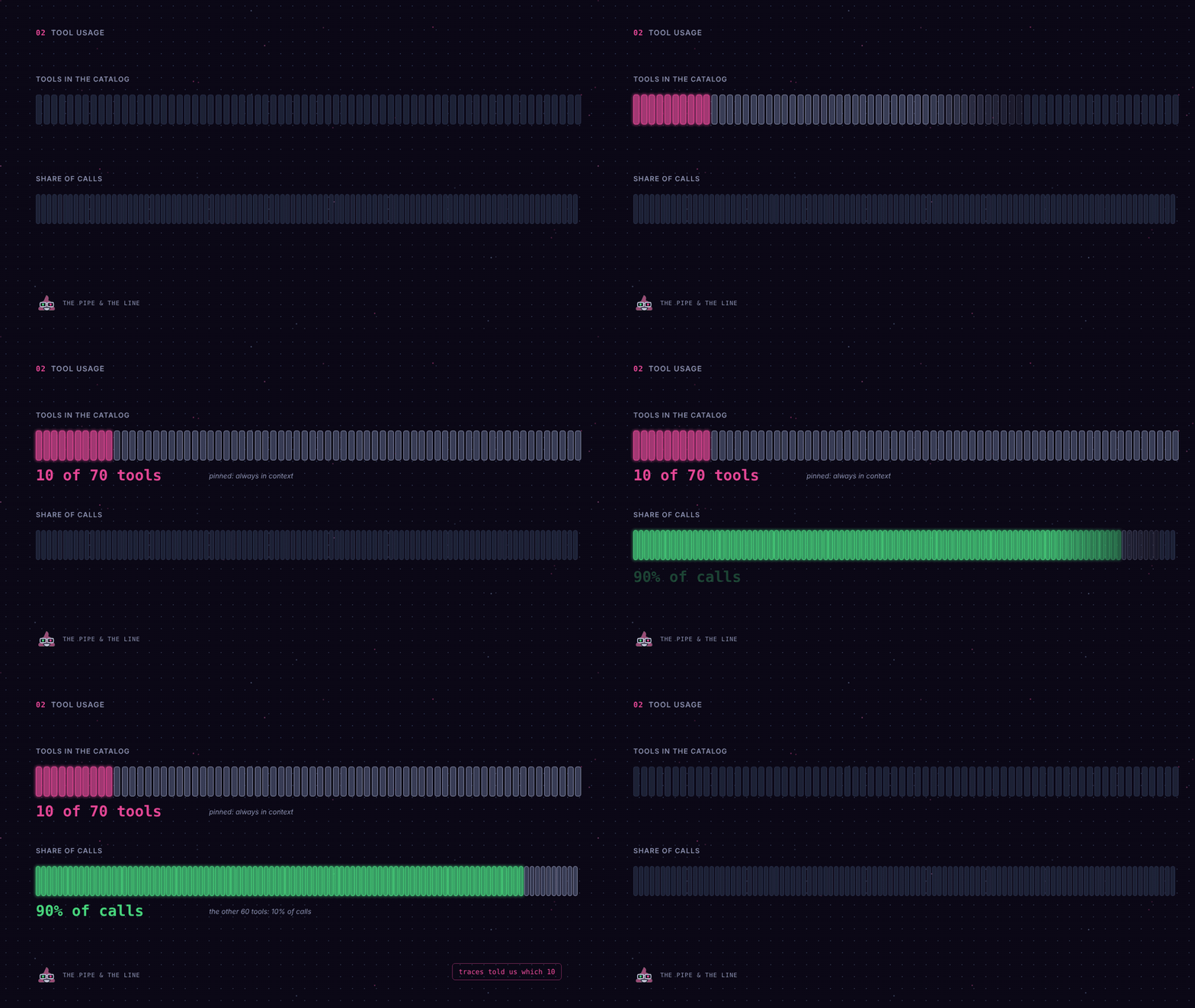
10 tools covered 90% of the calls and the other 60 sat in the context window every time.
Counting the system prompt (static, plus the parts injected at runtime), the skills and the tools, the agent carried 57k tokens before it read the user’s question.
10 of 70 tools, 90% of the calls.
Let’s take a look at how you can solve this using FastMCP!
Pin The Top Used, Search The Rest
The fix has two parts:
- The 10 tools that do most of the work stay always visible, so the agent calls them without a search step.
- The remaining 60 sit behind BM25 search, where the agent searches and gets back only the best matches with their schemas.
BM25 scores tools by how often the query terms appear and how rare they are across the catalog.
In FastMCP’s implementation it indexes tool names, descriptions, parameter names and parameter descriptions, returns the top 5 by default, and keeps pinned tools out of the search results so they never show up twice.
Same request, before and after: 70 tool definitions against 10 pinned tools plus search.
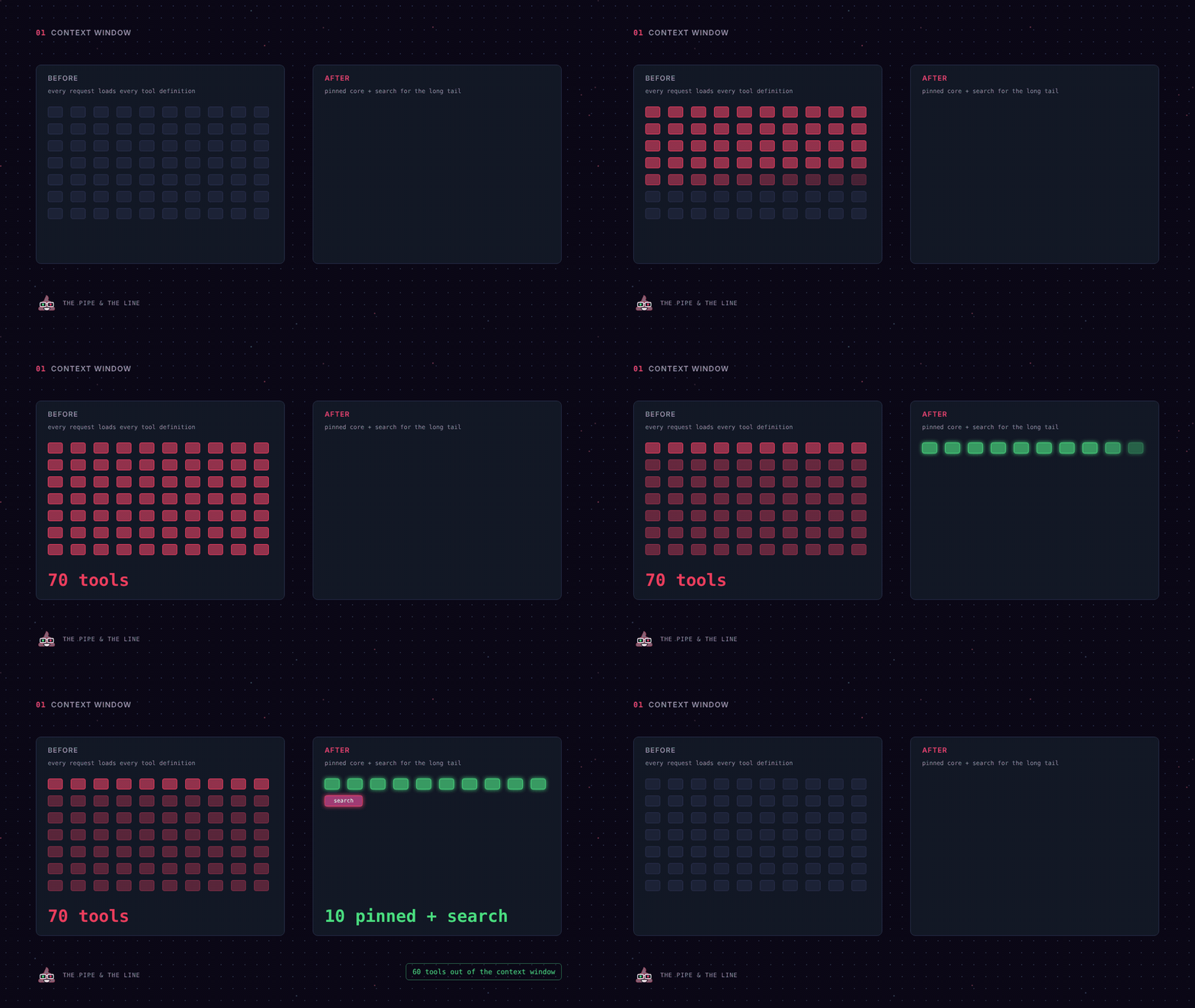
After implementing this in production the context window went from 57k to 20k tokens, and the tools that matter stayed one call away.
One job per tool
It’s important, even before setting up observability and trying to save tokens and improve performance, to apply the single responsibility principle to MCP tools, a fundamental that will 10x the tool search quality afterwards.
If two tools can answer the same request, BM25 returns both and the model has to guess.
If you build AI Analytics Agents, you might hit the same issue when a question can be answered with multiple models.
Thanks for reading The Pipe & The Line! This post is public so feel free to share it.
Are You Doing Data-Driven Guessing?
It’s worth noting that you need to set the right tracking, data modeling and observability to enjoy these evidence-backed decisions 😉.
“10 tools cover 90% of the calls” is a number I could only state because the agent is traced. Without traces I would have pinned the tools I assumed were popular.
Traces give the volume to decide with: which tools get called, in which order, and which ones the agent searches for over and over, a sign they belong in the pinned set.
Usage analytics can group the calls by verb (list, get, create and so on), so the report stays readable while the catalog changes. I covered that loop in AI Observability For Data Engineers and I suggest thinking of that first because you can’t tune what you don’t measure.
When You Don’t Need Tool Search
It’s pretty easy to break down:
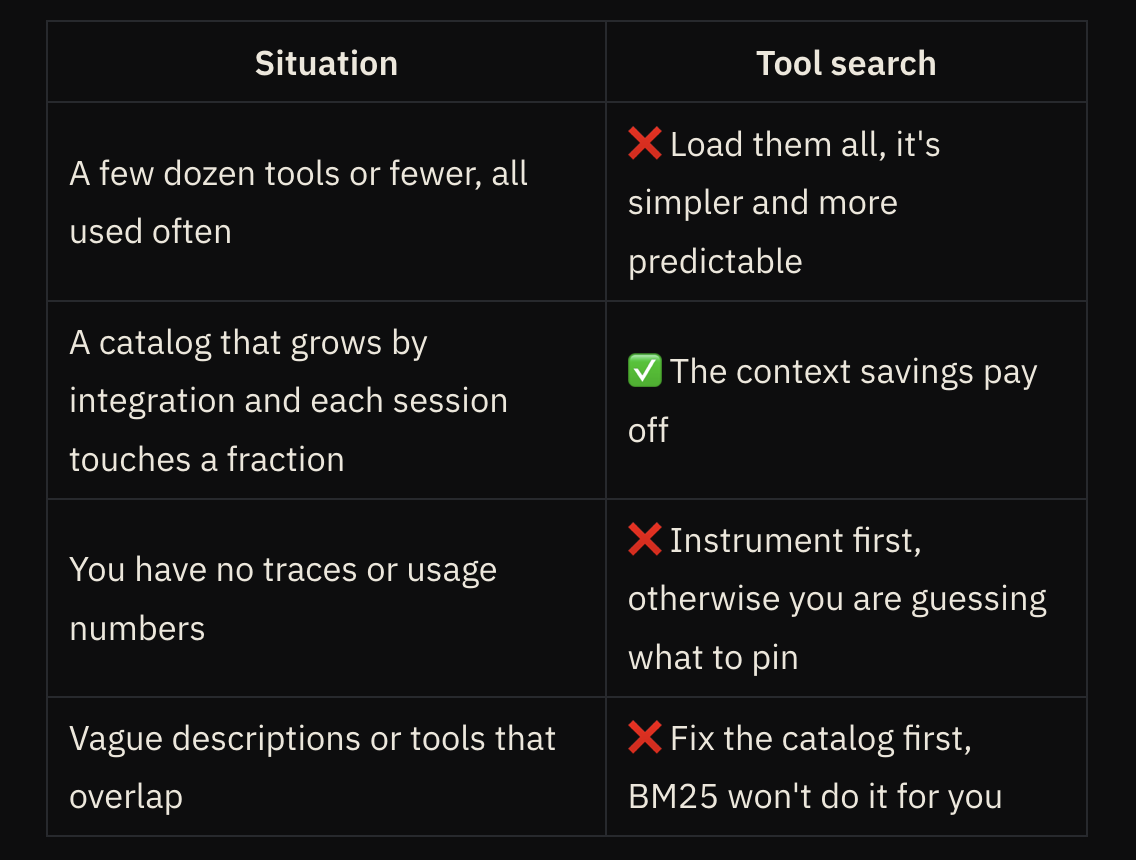
The full catalog is probably all you need until the agent starts picking the wrong tool or the tool definitions weigh more than the question.
Tool search should be agent design, not just an optimisation tweak!
If you enjoyed the content, hit the like ❤️ button, share, comment, repost, and all those nice things people do when like stuff these days. Glad to know you made it to this part!

Hi, I am Alejandro Aboy. Started in digital marketing, moved to website tracking, data analytics, analytics engineering, data engineering, AI engineering and right now I am still figuring out what my role will look like in the next 6 months.
I am just learning stuff and sharing it and hope that’s enough for you to learn great things about Data & AI overlaps!