Part 1 of 2. How to know your skills still fire after every change, with claude plugin eval on your Claude Code subscription.
By Alejandro Aboy
Published: 2026-11-04
URL: https://thepipeandtheline.substack.com/p/evals-for-your-skills-claude-code
Hi there! Alejandro here 😊
Subscribe if you like to read about technical data & AI learnings, deep dives!
Enjoy the reading and let me know in the comments what you think about it 👨🏻💻
📝 TL;DR
-
A skill without an eval breaks silently: change a description and the agent just stops picking it
-
claude plugin eval runs each case with and without the plugin, and the difference (Δ) proves the skill adds something
-
Concrete PASS and FAIL rubrics and a stronger judge model keep the scores stable
-
A PostToolUse hook turns a failing eval into feedback Claude fixes in the same session
I been doing heavy work on my Claude Code harness over the last year.
Self verification was my main focus, which involved running a couple skills in a step-by-step flow that was linting and polishing code according to best practices.
But over time, model changes and other contextual drifts, they stopped working as usual, and it was hard to rely on the harness anymore.
Recently Antrhopic launched a new way of testing them that forces people to learn AI observability basics (woho!) and have a system in place everytime they change something.
Let’s see how it works!
The Project: Substack Agent
I picked a project that I used multiple times, which is a proxy of many things I do in production.
My Substack Author Agent has six skills (analyze-articles, analyze-notes, analyze-comments, content-ideas, brand-voice, visual-brand).
Change any tiny thing and the answer gets worse without any warning you can rely on.
The main thing you need to keep in mind for skill evals:
-
You pick a skill
-
Set a case that acts as a grader e.g. Is X tool used?
-
Run it to see if it passes or fails
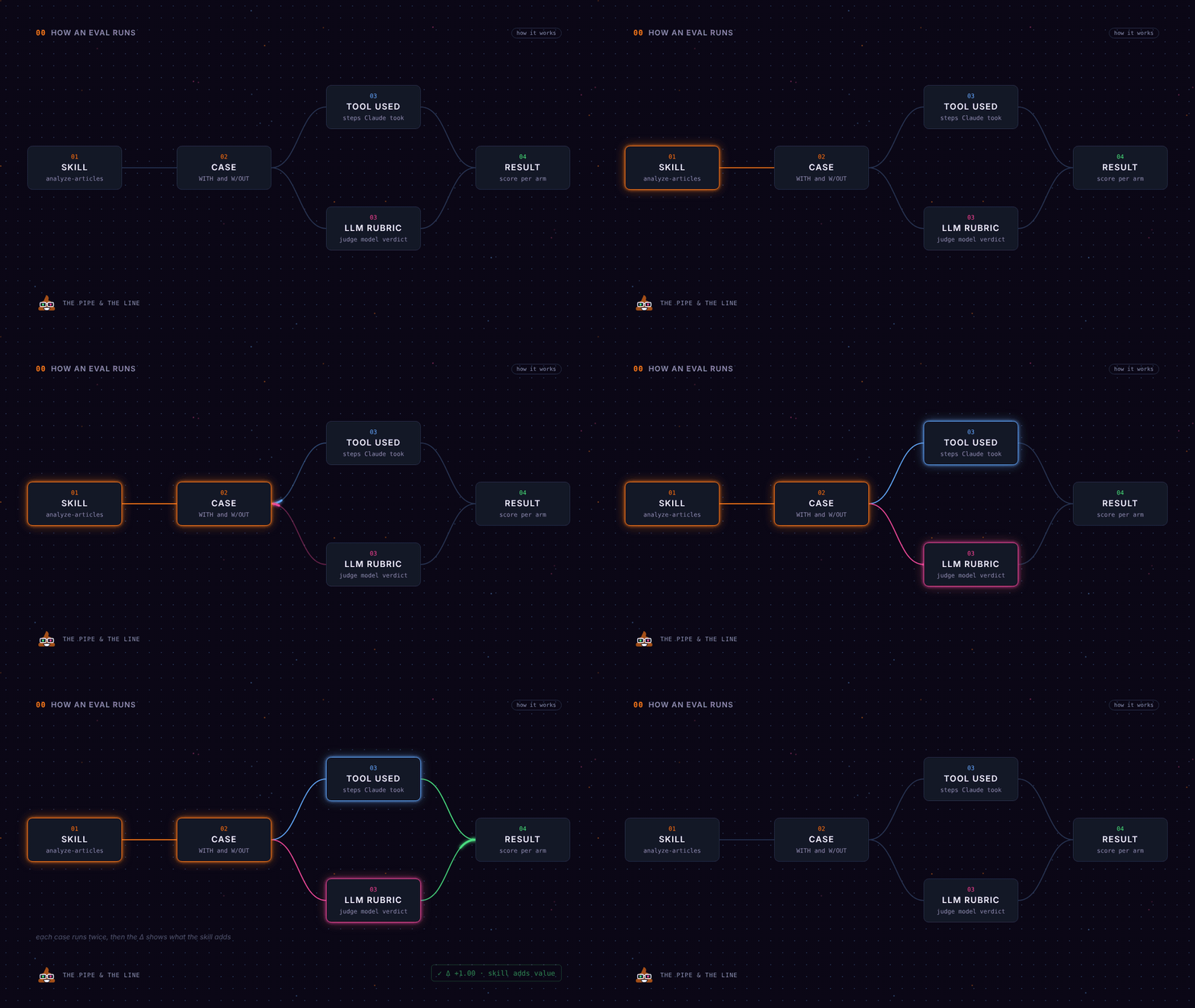
The Approach at a Glance
The evals live next to the skills they test:
skills/
└── analyze-articles/SKILL.md       # the skill under test (6 in total)
evals/
├── analyze-articles/               # one case per skill
│   ├── prompt.md                   # what a user would type
│   └── graders/                    # pass/fail checks on the run
└── unrelated-request/              # a case where no skill should fire
scripts/eval-hook.sh                # runs only the case of the skill you edited
claude plugin eval runs every folder under evals/ as a case, once with the plugin and once without it. The rest of the article walks through each piece. It runs on your Claude Code login, so every run in this article used my subscription.
Types of Graders
Every grader is a file with a type: in its frontmatter. There are six, and each one is a pass/fail check: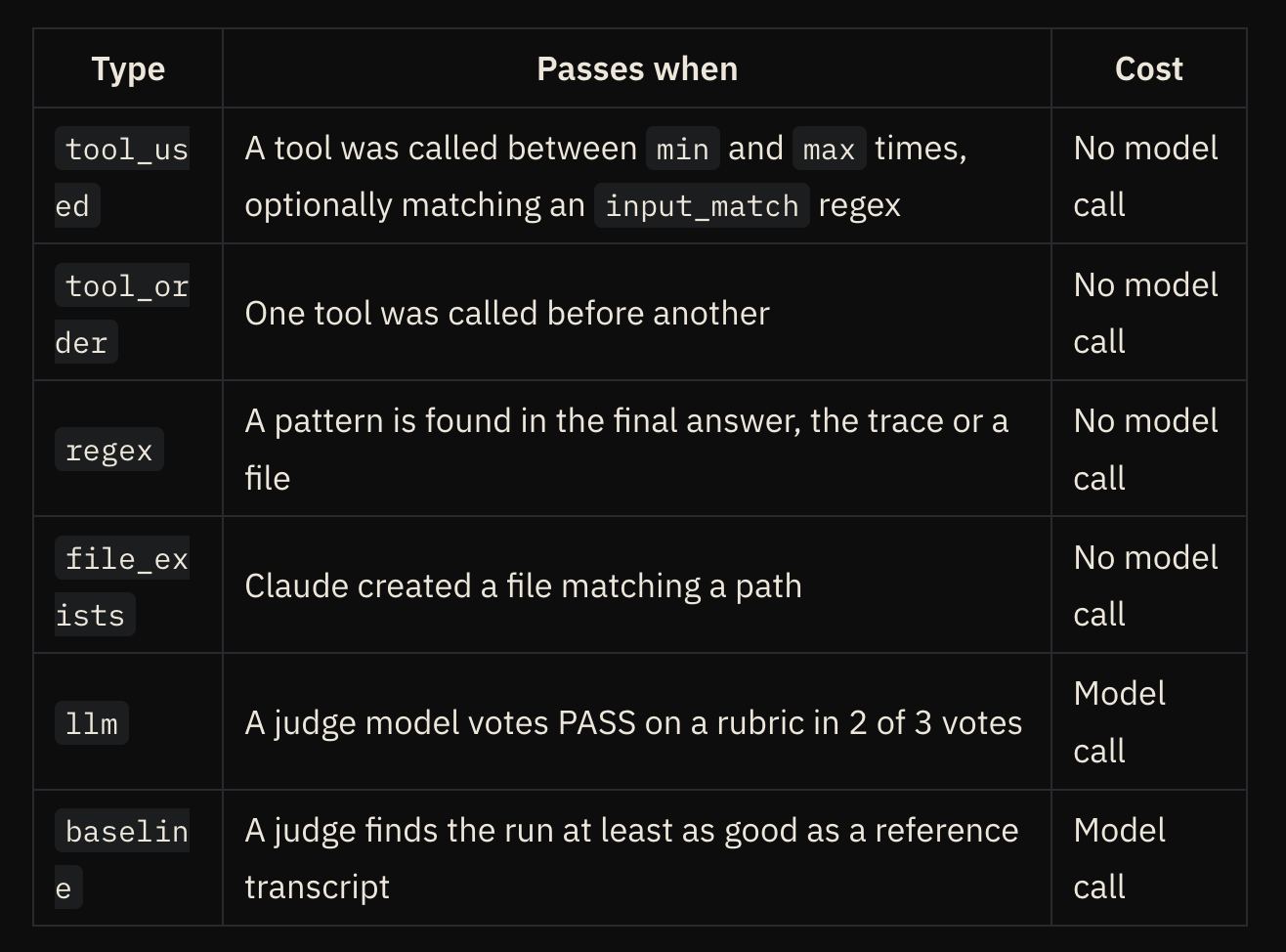
The first four are deterministic and give the same verdict every time. The last two depend on a judge, so they vary more.
I use tool_used and llm here: one grader on the steps Claude took, one on the result.
Thanks for reading The Pipe & The Line! This post is public so feel free to share it.
Example with analyze-articles skill
Taking evals/analyze-articles/, this is how it looks when we zoom in:
analyze-articles/               # one case per skill
├── prompt.md                   # what a user would type
└── graders/                    # pass/fail checks on the run
│   ├── skill-fired.md          # type: tool_used
│   ├── fetched-performance.md  # type: tool_used
│   └── rubric.md               # type: llm
-
graders/ holds one file per pass/fail check.fetched-performance.md is a tool_used grader. It passes if Claude called the data tool at least three times:
---
type: tool_used
tool: get_article_performance
min: 3
---
-
rubric.md is an llm grader. The body is plain English, and a judge model decides:
---
type: llm
---

PASS if the reply compares the articles using reactions, restacks and comments, names specific titles, and includes at least one concrete recommendation.

FAIL if the reply is generic writing advice, contradicts the tool data, or asks for the publication URL again.
-
skill-fired.md is a third grader, a tool_used that checks Claude invoked the analyze-articles skill.
Each case runs with and without the plugin. The Δ between both arms is the number that matters: a lone 1.00 doesn’t say whether the skill helped or Claude would have done it anyway.
The Eval Results
The judge model is Sonnet (--judge-model sonnet), and the rubrics are written as concrete PASS and FAIL conditions that don’t depend on formatting. I triggered 7 cases, with 3 runs per case.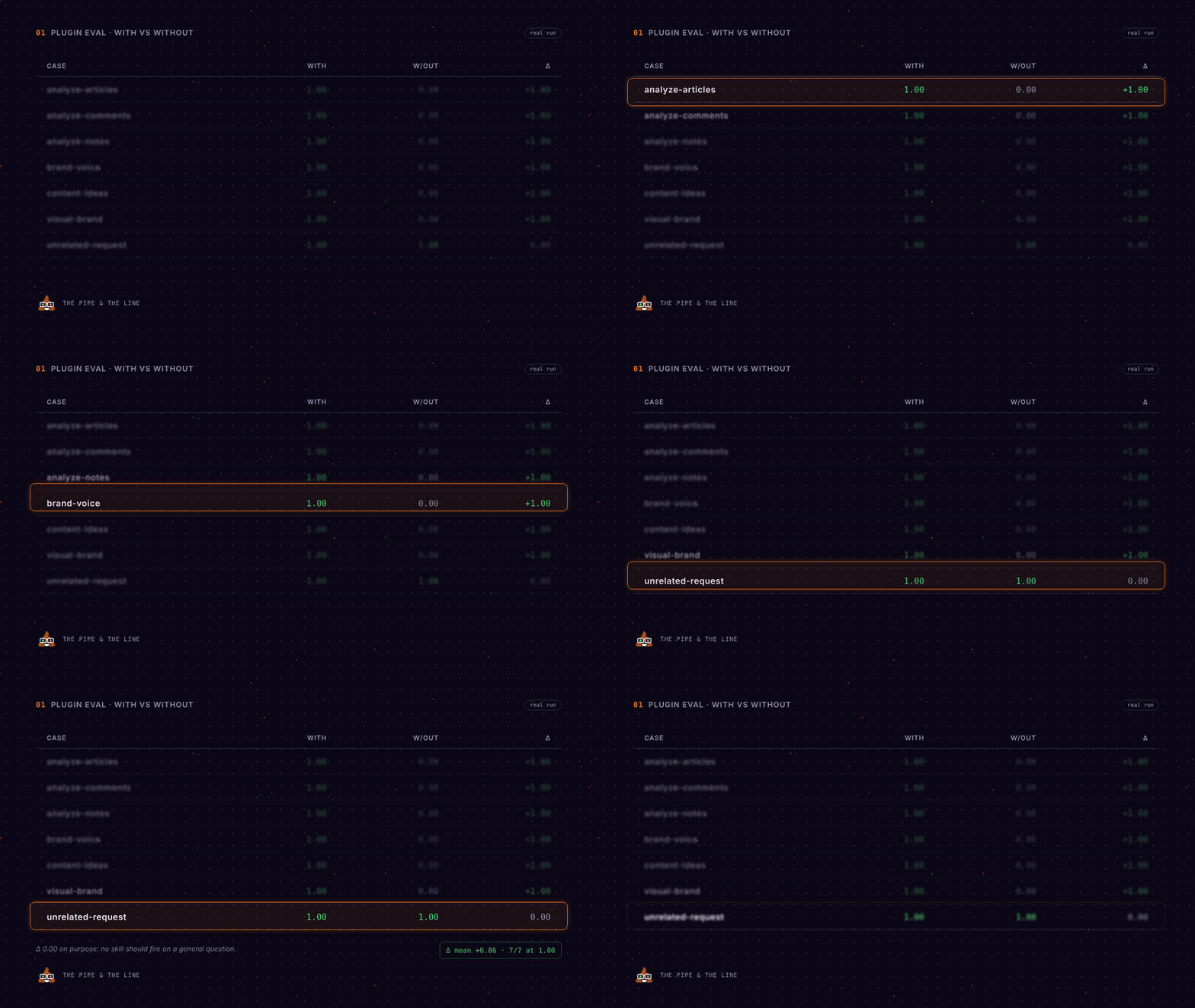
And you can get great reports like this breakdown of eval results: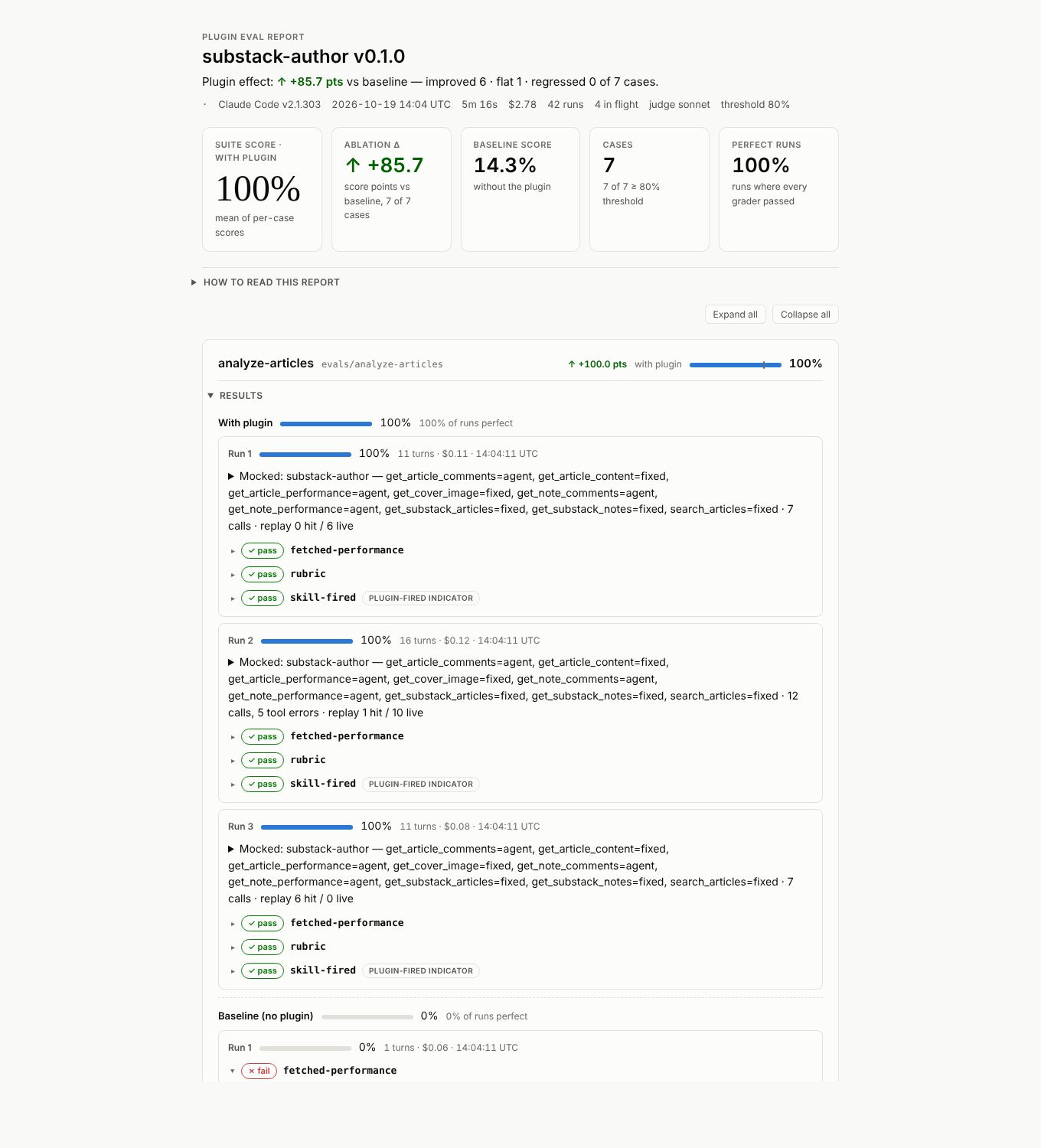 The HTML report lists every run with its graders, WITH and W/OUT the plugin.
Claude Code writes this report.html itself on every run. The only thing my script added was a screenshot of it.
Thanks for reading The Pipe & The Line! Subscribe for free to receive new posts and support my work.
A Hook so Claude Runs This When You Edit Skills
Running everything on each edit is slow. A PostToolUse hook is a great tool because it runs only the case of the skill you edited:
{
"hooks": {
"PostToolUse": [{
"matcher": "Edit|Write|MultiEdit",
"hooks": [{ "type": "command", "command": "\"$CLAUDE_PROJECT_DIR\"/scripts/eval-hook.sh", "timeout": 300 }]
}]
}
}
The hook checks which file Claude just edited. If it is a skill, it runs only that skill’s eval case, once.
If the case fails, the hook sends the failing graders back to Claude, which sees them as feedback and can fix the skill right away.
I changed the description of analyze-notes to “Formats Markdown tables for spreadsheets” and skill-fired rubric failed and it had great signal to be restored.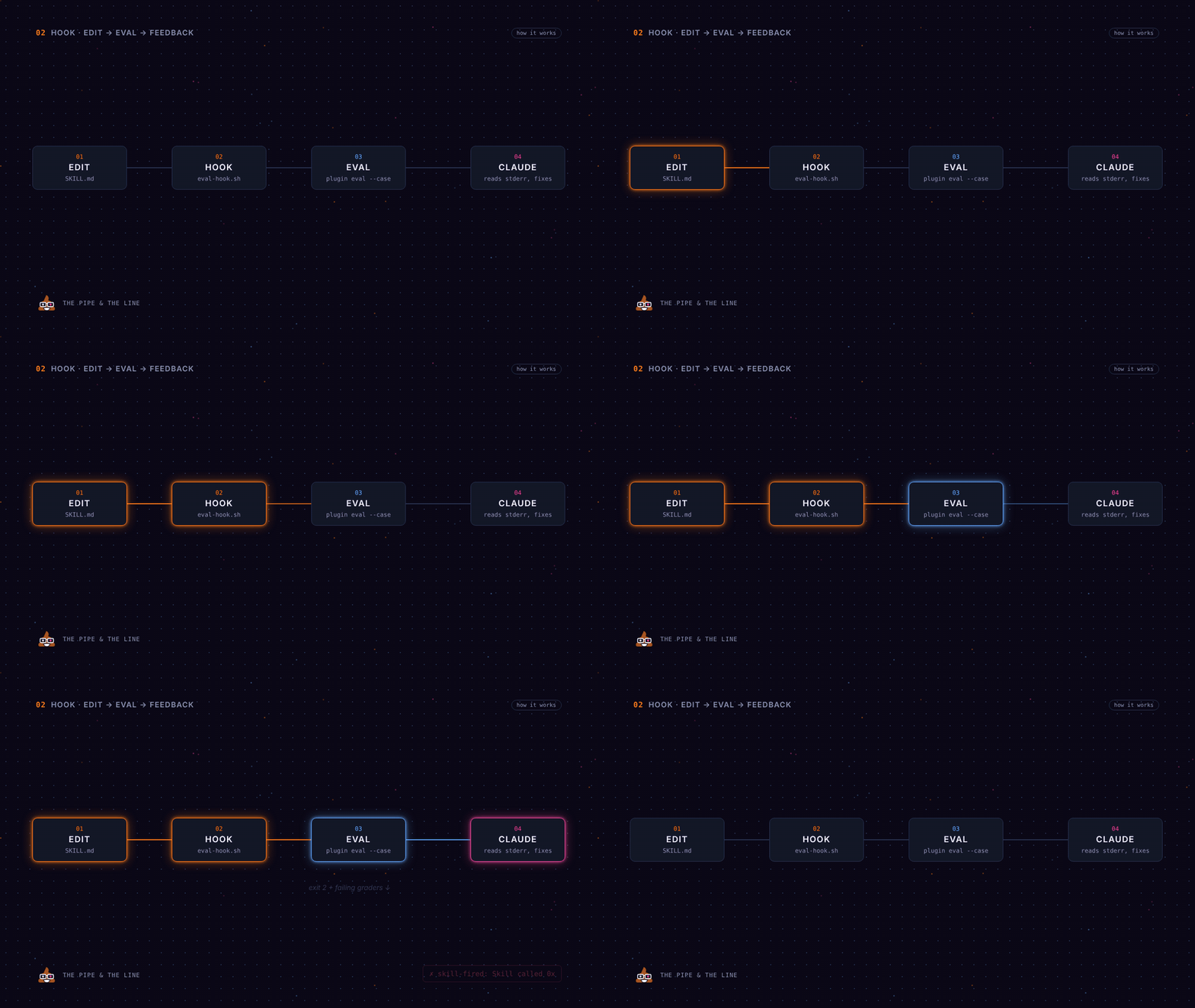
Hope this was useful and that you enjoyed it.
An agent built with an SDK needs another approach, which is Part 2. Stay tuned!
If you enjoyed the content, hit the like ❤️ button, share, comment, repost, and all those nice things people do when like stuff these days. Glad to know you made it to this part!

Hi, I am Alejandro Aboy. Started in digital marketing, moved to website tracking, data analytics, analytics engineering, data engineering, AI engineering and right now I am still figuring out what my role will look like in the next 6 months.
I am just learning stuff and sharing it and hope that’s enough for you to learn great things about Data & AI overlaps!