I started digging into how Decision models can shape Data Pipelines to support different use cases far away from the typical we are used to handle.
By Alejandro Aboy
Published: 2026-10-28
URL: https://thepipeandtheline.substack.com/p/what-decision-models-change-for-data-engineers
It’s been a while! Happy to be back.
I published my last article on June and decided to take a break. Since then:
-
Ironically, I got over 2k subscribers, so maybe that’s a sign to stop posting 😂
-
I came back but not officially, just to rant a little bit on my B Side publication.
-
I implemented a lot of cool projects, with a lot of overlap between Data & AI. Now I have a backlog full of great stuff!
-
I am living the AI revolution every day at work, so a lot of what I can share will have real angles on how things are shifting, way more raw than the AI bubble you can see from Linkedin guru.
I want to personally thank to give me the extra push that I needed to get back on track.
Let’s go!
Ale from The Pipe & The Line
📝 TL;DR
-
Data Processing needs are mutating heavily since AI became a consumer.
-
Decision Models can add a fast, simple layer to make great data transformation actions without relying on more complex services.
-
The demo project showcases a pipeline where we use OpenAI Decisions API to identify crime probability and type based on images received as input.
I remember the days when Data Engineers were calling APIs to move data from A to B, or using tools like Fivetran to do the abstracted version of that. Most of us still spend time with typical ETL needs.
AI as a data consumer already changed a lot on how this scope works, no matter if you work with a warehouse or lakehouse approach.
Thanks for reading The Pipe & The Line! Subscribe for free to receive new posts and support my work.
The 2 typical use cases, BI for self analytics and unstructured data for ML pipeline training are now fading into an endless mix of multimodal inputs that kill the classic flows we are used to, which make new use cases come to life.
That’s why I put together this article, to navigate how Data Engineering use cases can shift as we know them, where data processing needs to be more flexible and faster than ever.
Let’s get to it.
What Are Decision Models?
Data teams have run classifiers like XGBoost in pipelines for years: a small model that takes a row and returns a label with a probability.
Decision models are that same idea for the LLM era: TypeSafe introduced them as System One Decision Models with Jev. OpenAI’s Decisions API is its proposal for the same paradigm, and it is the one I use later in the article.
Here’s a comparison on LLMs vs Decision Models: 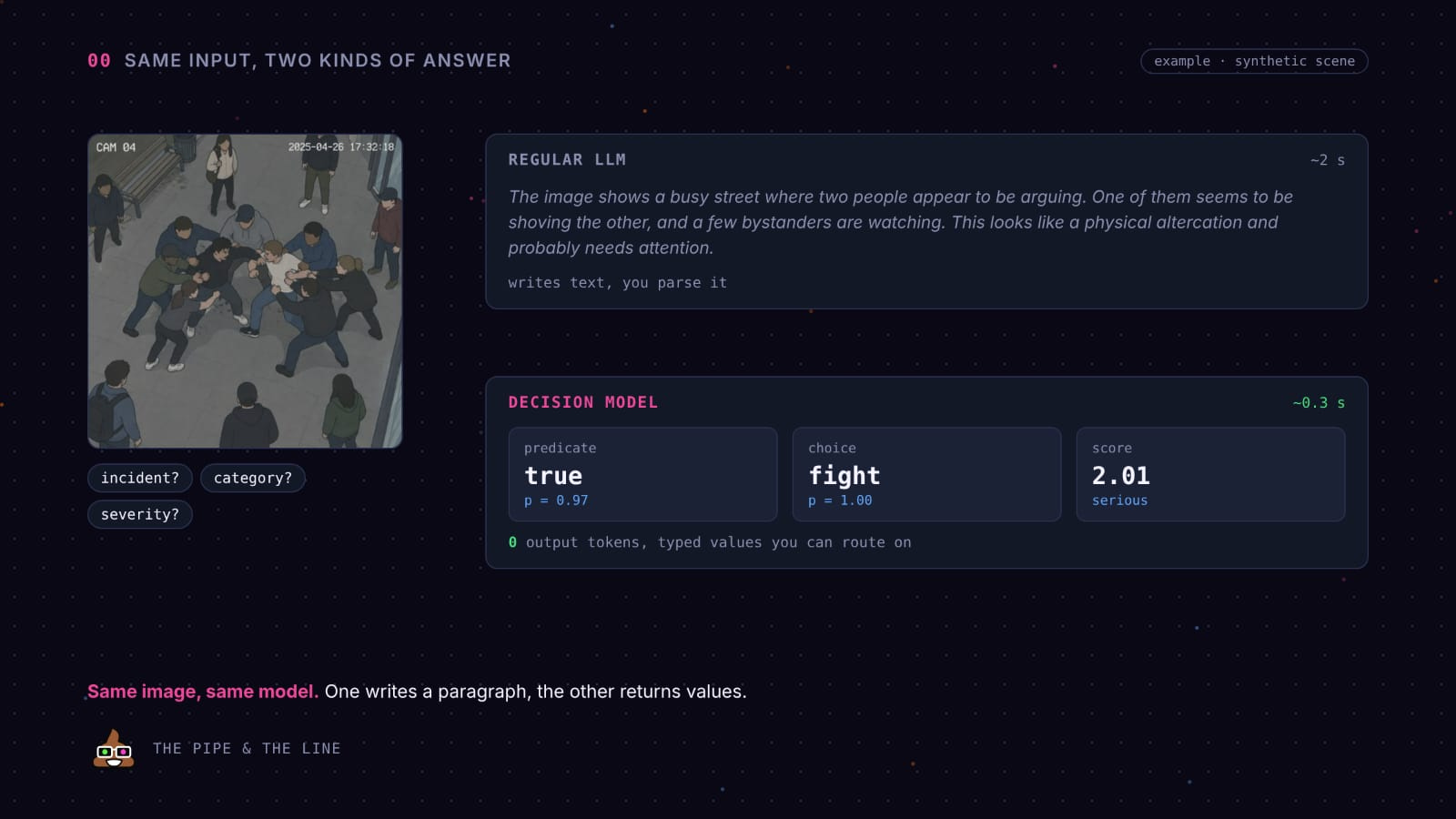
It goes like this:
-
You send the input and the questions.
-
You get back typed values: true/false, a score or a choice among the available options.
-
It cannot write you a paragraph at all.
-
Latency is dead fast, which makes it ideal for flexible data processing flows.
Let’s see how it all plays out in the demo project.
The Pipeline: Spotting Crimes in Camera Images
The pipeline simulates a camera feed: each image arrives, goes to OpenAI’s Decisions API with three questions, and the answers decide whether it raises an alert.
The images are synthetic CCTV-style illustrations (no real people) generated with gpt-image-2.5-flare, and each animation below is one real response from the run.
The Decisions API has three question types:
-
predicate (yes/no)
-
choice (one option from a closed list)
-
score (a level on a scale)
Images go in as input_image with a base64 data URL, plus an optional detail setting (low, high, auto or original). This is the request from my test, trimmed:
QUESTIONS = [
{"type": "predicate",
"name": "incident",
"instructions": "Does the scene show a crime or violent incident in progress?"},
{"type": "choice",
"name": "category",
"instructions": "Which category best describes the scene?",
"choices": [{"value": v, "description": d} for v, d in [
("normal", "ordinary everyday activity"),
("theft", "stealing or robbery"),
("fight", "physical violence between people"),
("vandalism", "damaging property")]]},
{"type": "score",
"name": "severity",
"instructions": "How severe is what is happening?",
"levels": [{"label": l, "description": l} for l in ["none", "minor", "serious", "critical"]]},
]
body = {"model": "gpt-6-luna",
"questions": QUESTIONS,
"input": [{"role": "user", "content": [
{"type": "input_image", "image_url": f"data:image/png;base64,{b64}", "detail": "low"}]}]}
r = await client.post("https://api.openai.com/v1/decisions", json=body)
One call carries all three questions, and the response gives a probability per option:
{"type": "choice",
"name": "category",
"choice": "theft",
"confidence": 0.89,
"probabilities": [{"value": "normal", "probability": 0.08},
{"value": "theft", "probability": 0.92},
...]}
Output tokens were 0 in every call, and each image cost about 667 input tokens at detail: low.
Thanks for reading The Pipe & The Line! Subscribe for free to receive new posts and support my work.
Going Through Each Scene
1. A normal scene. Nothing to flag, so the pipeline stores it and moves on. No incident, normal category, 0 severity.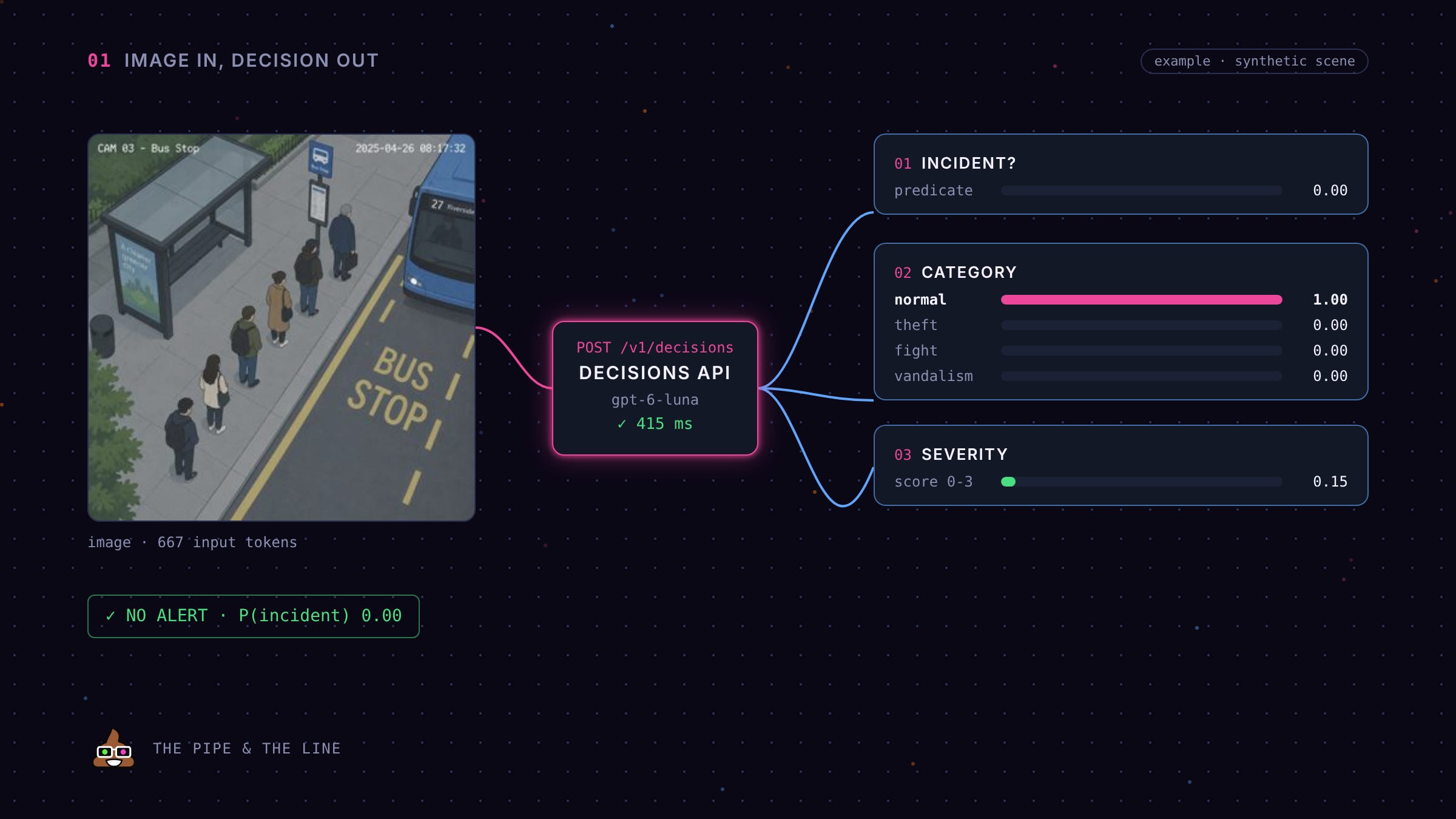
2. A fight outside a bar. All three answers agree, so the alert fires. Incident, category: fight and severity 2.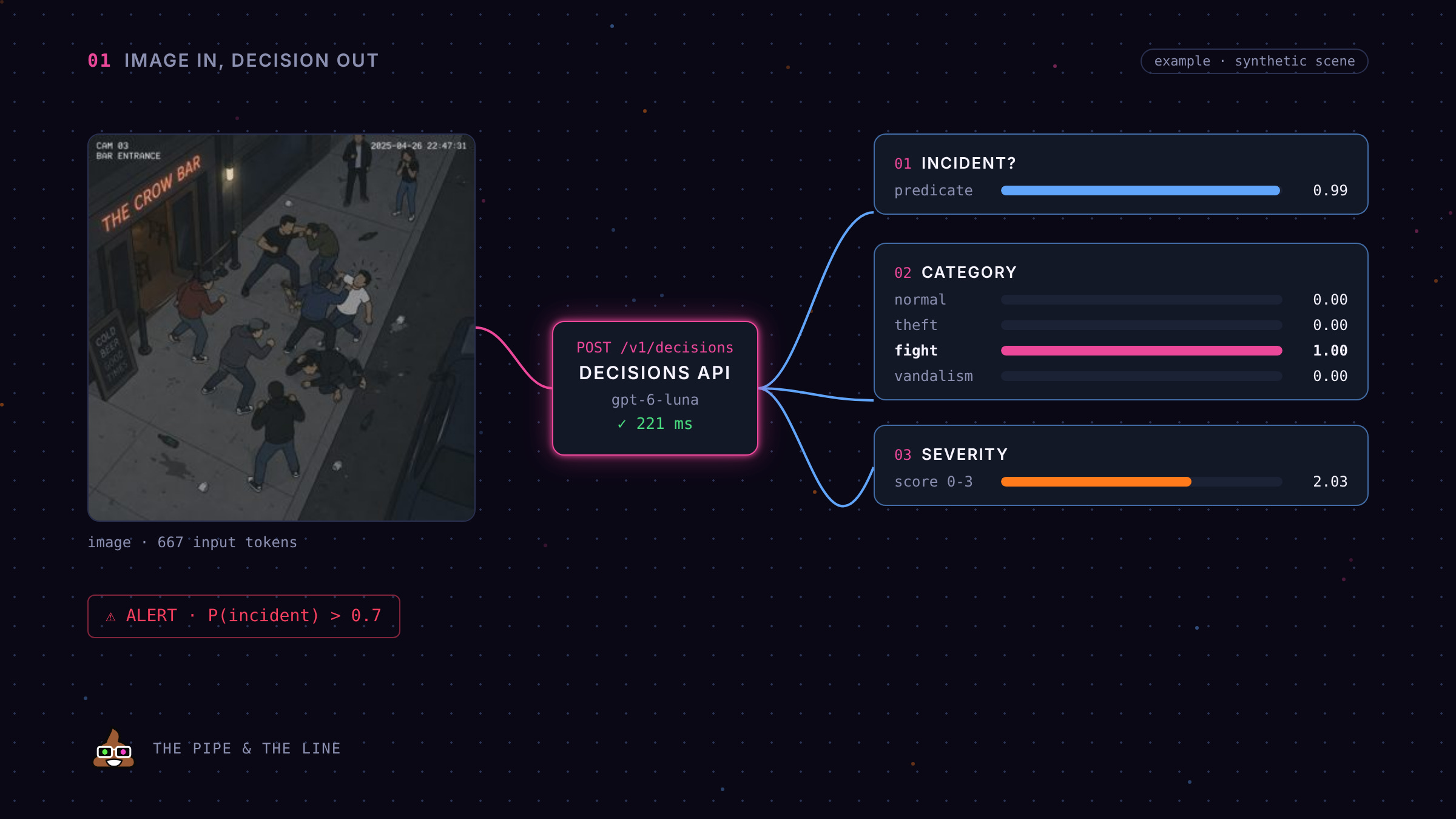
3. Vandalism on a shop shutter. Same here: the answers agree and the alert fires. Incident, category: vandalism, severity 2.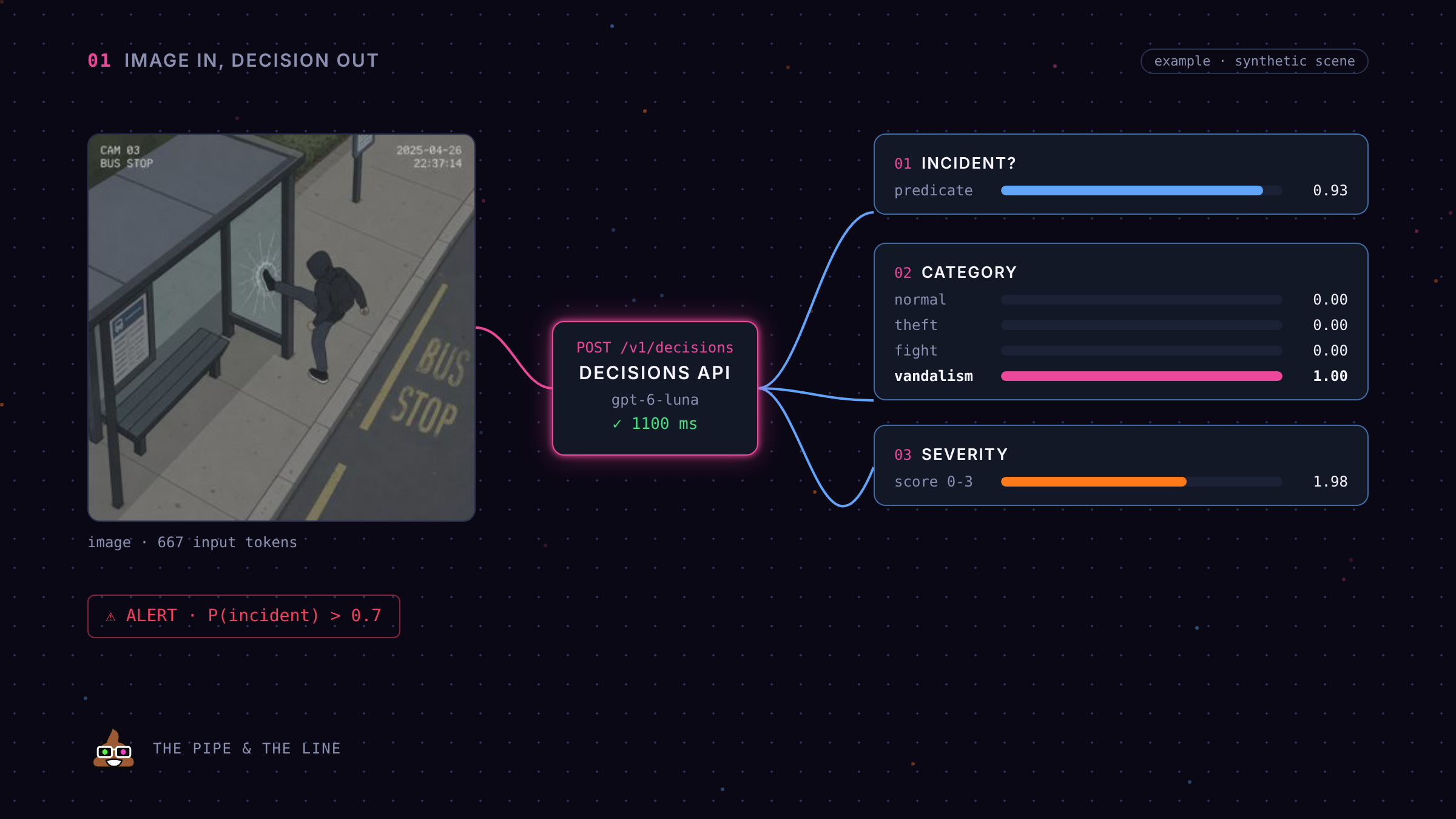
4. A shoplifter putting earbuds in a backpack. The yes/no question stays quiet and would have missed it, but the category question still calls it theft. 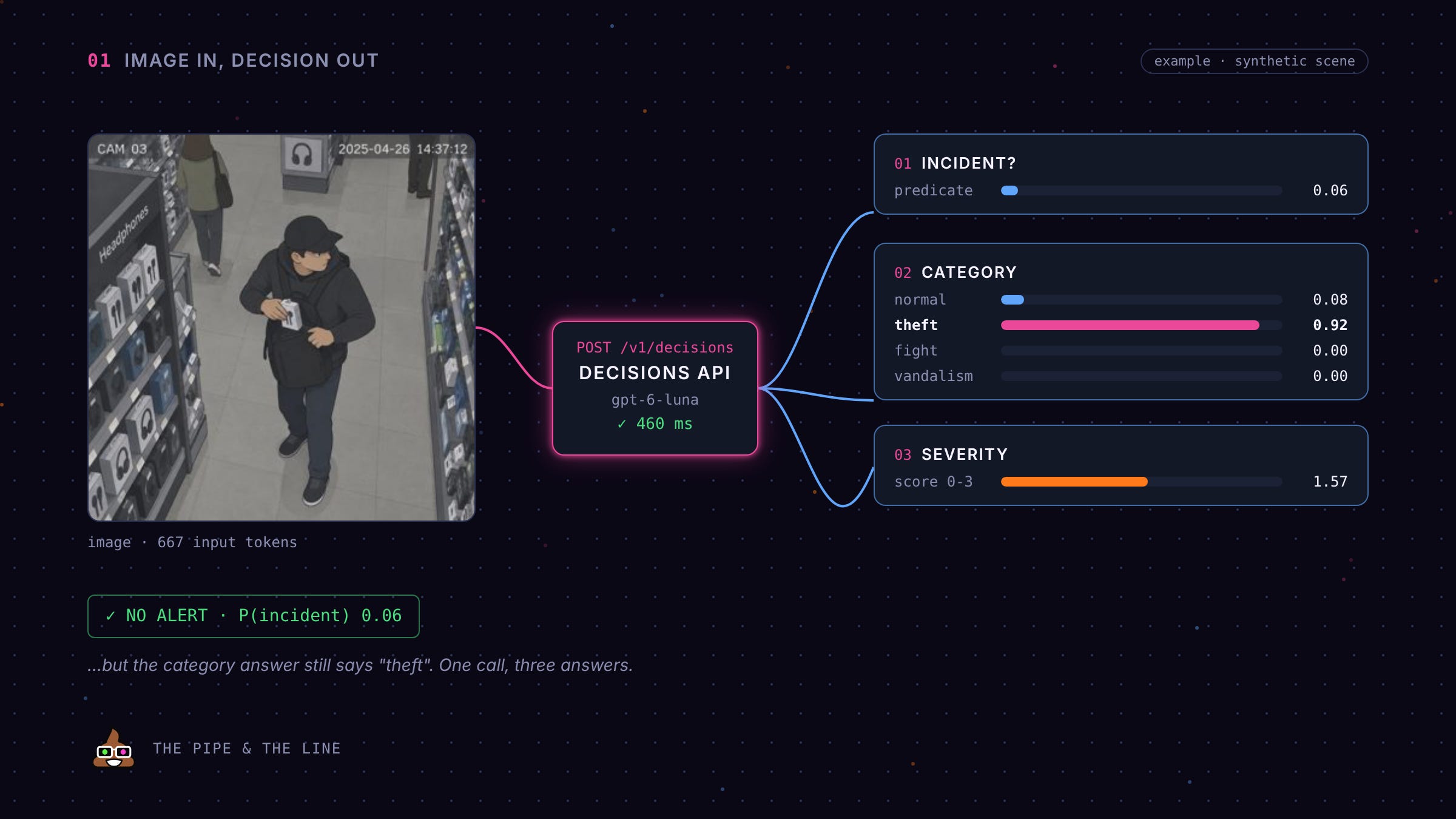
Thanks for reading The Pipe & The Line! This post is public so feel free to share it.
Benchmarking Decision Models With Regular LLMs
To see what the decision model buys, I ran the same 47 images through gpt-6-luna twice.
Once on the Decisions API, and once on the Responses API as a regular LLM, with the same three questions and JSON back.
The second set of images had harder normal scenes, like someone running for a bus or a worker repainting a crosswalk.
I only looked at that set after picking the alert rule on the first one.
An alert means the category question returned anything but normal.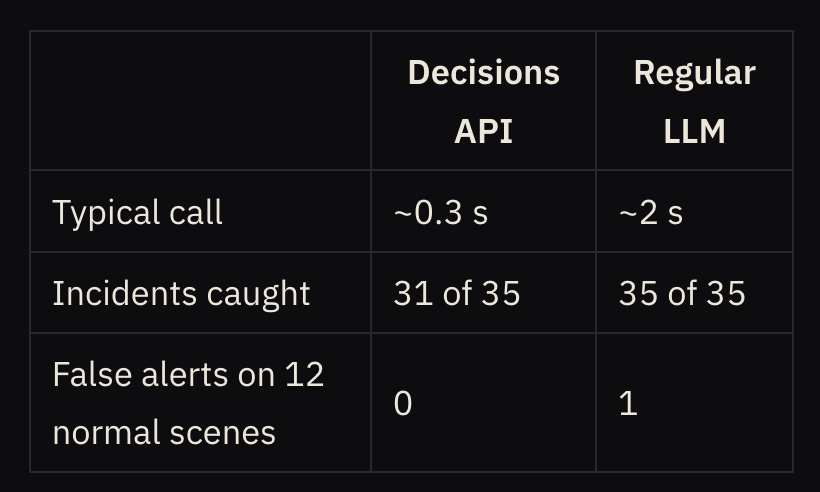
-
Speed. About seven times faster is what lets it sit in a live flow.
-
Accuracy. LLM can outperform Decision Models on specific edge cases. The misses are quiet scenes, with high confidence, so a threshold won’t fix them.
-
Combined types. The yes/no missed on the theft case was caught by the LLM, but combining decision types is key to compensate for those with a composite output.
When to use it, when not to
Use it when:
-
You need a fast, typed verdict per item (route, flag, score). -The categories are a short closed list you can describe in a sentence.
-
A wrong triage is cheap, because a human or a second step reviews the flagged items.
-
You have no labelled dataset to train a vision model on.
Skip it when:
-
You need an explanation, since you get probabilities and no reasoning.
-
You need to know where something is in the image (if working with multimodal inputs), since there is no location question.
-
You need a guarantee on every item, since answers are probabilities and the slowest calls take seconds.
If you enjoyed the content, hit the like ❤️ button, share, comment, repost, and all those nice things people do when like stuff these days. Glad to know you made it to this part!

Hi, I am Alejandro Aboy. Started in digital marketing, moved to website tracking, data analytics, analytics engineering, data engineering, AI engineering and right now I am still figuring out what my role will look like in the next 6 months.
I am just learning stuff and sharing it and hope that’s enough for you to learn great things about Data & AI overlaps!
Thanks for reading The Pipe & The Line! Subscribe for free to receive new posts and support my work.