What part of your pipeline wastes the most time?
By Basant
Published: 2026-02-23
URL: https://theautomator.substack.com/p/the-intelligence-inflection-point
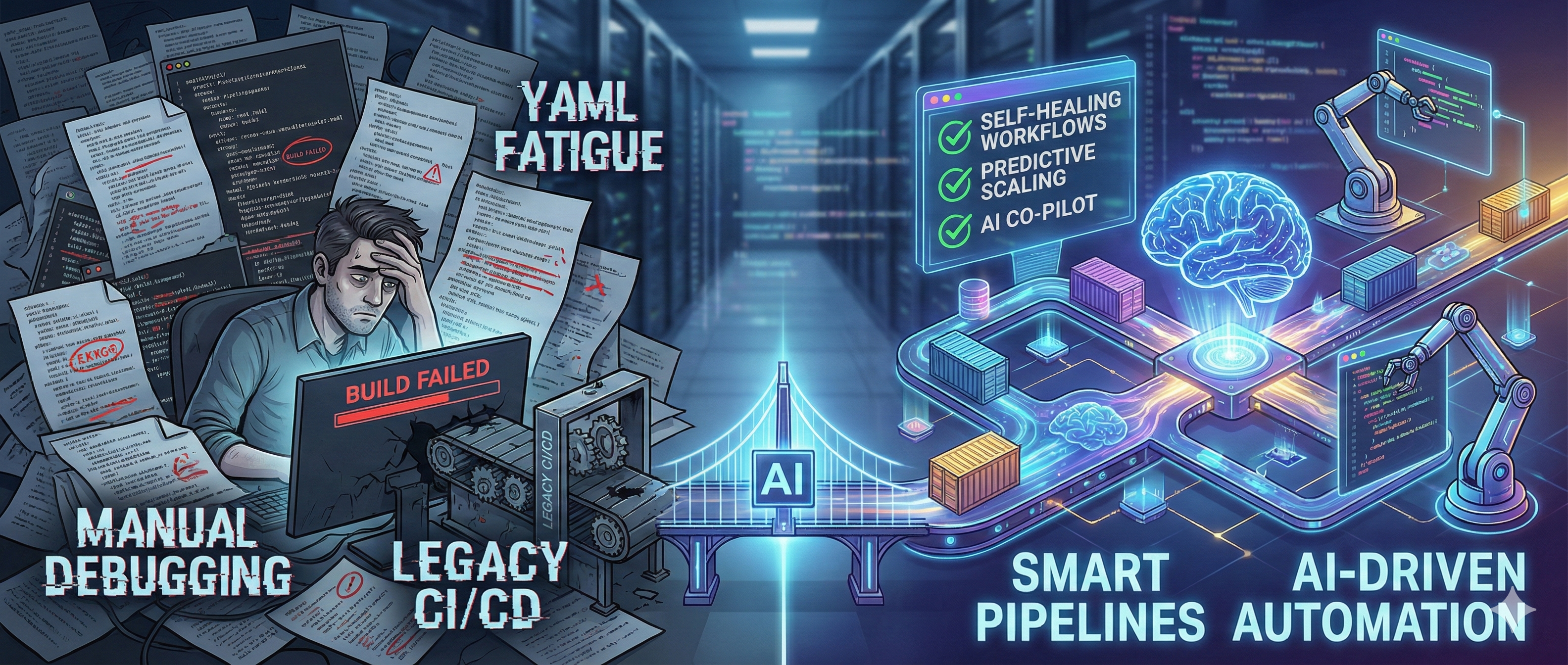
1. Introduction: When Pipelines Become a Full-Time Job
You open a pull request. The build fails. The error references line 742 in a YAML file.
You scan indentation.
You check anchors and conditionals.
You compare with another repo’s workflow.
What should be automation often turns into manual troubleshooting.
Platforms like Jenkins, GitHub Actions, and GitLab CI/CD have made delivery faster. But as organizations scale, pipelines grow into layered systems—handling builds, containers, security scans, infrastructure provisioning, testing matrices, and environment promotion logic.
At some point, the pipeline itself becomes one of the most complex parts of the stack.
That is where AI is starting to reshape the workflow.
2. The Real Problem: Configuration at Scale
2.1 Pipeline Growth Outpaces Standardization
In many teams:
- Each service has its own variation of CI logic
- Copy-paste patterns accumulate
- Conditional rules expand over time
- Environment-specific exceptions multiply
The result is configuration drift across repositories.
Pipelines begin to reflect historical decisions rather than current architecture.
2.2 Debugging Becomes Forensic Work
When builds fail, engineers often:
- Read thousands of lines of logs
- Manually correlate commit changes
- Search internal Slack threads
- Compare with previous successful runs
This is reactive work. It consumes senior engineering time.
3. What “Smart Pipelines” Actually Mean
The shift is not about new tooling. It is about new interaction patterns.
AI introduces assistance at four practical layers.
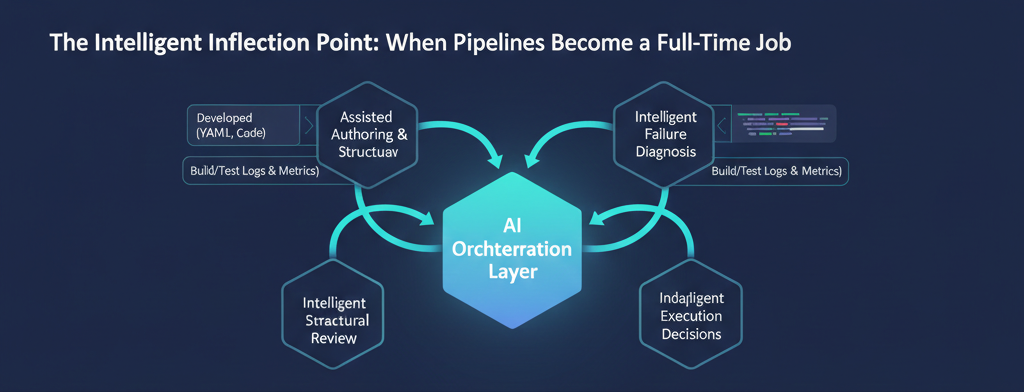
3.1 Assisted Authoring
Instead of building pipelines step by step:
- Describe the project context
- Generate a baseline workflow
- Apply organization-wide standards automatically
This reduces boilerplate and enforces consistency from day one.
For growing teams, this is a governance advantage.
3.2 Structural Review and Optimization
AI systems can analyze pipeline definitions and identify:
- Redundant jobs
- Missing caching strategies
- Inefficient parallelization
- Security misconfigurations
This functions as continuous pipeline review, not just code review.
3.3 Intelligent Failure Diagnosis
When builds break, AI can:
- Parse logs across stages
- Correlate errors with recent changes
- Identify likely root causes
- Suggest focused remediation steps
This shortens investigation cycles and reduces context switching.
3.4 Data-Driven Execution Decisions
Over time, AI can learn patterns such as:
- Frequently failing test suites
- High-risk deployment windows
- Services with unstable builds
- Historical rollback triggers
Pipelines begin to respond to operational signals rather than static rules.
This is where CI/CD transitions from scripted automation to adaptive orchestration.
4. Impact on the DevOps Role
As pipeline intelligence increases, the DevOps focus shifts.
Less emphasis on:
- Maintaining repetitive YAML blocks
- Debugging syntax edge cases
- Manually tuning each repository
More emphasis on:
- Defining deployment policies
- Setting guardrails for automation
- Designing reusable workflow standards
- Evaluating risk signals before release
The work becomes architectural and systemic rather than purely operational.
5. Practical Use Cases in Real Teams
5.1 Standardized Pipeline Templates Across 100+ Services
AI can analyze common patterns and generate consistent pipelines aligned with internal security and compliance requirements.
This reduces review overhead and onboarding time.
5.2 Test Selection Based on Code Changes
Instead of running full regression suites on every commit, AI can evaluate changed files and trigger only relevant tests.
Faster feedback. Lower compute cost.
5.3 Smarter Deployment Controls
Rather than static approval gates, deployment decisions can incorporate:
- Historical failure data
- Current system metrics
- Risk scoring models
Rollouts become evidence-driven.
6. Constraints and Guardrails
AI-assisted pipelines require structure:
- Version-controlled prompts or configuration rules
- Clear policy boundaries
- Auditable decision trails
- Human validation for critical production changes
Intelligence without governance creates new operational risk.
7. Where This Is Heading
Pipelines are evolving into feedback systems.
Future workflows will likely include:
- Continuous optimization of execution order
- Automated rollback reasoning
- Adaptive environment promotion strategies
- Ongoing refactoring of pipeline logic based on usage patterns
The YAML file becomes an implementation detail, not the primary interface.
Conclusion: Designing the Next Generation of Delivery Systems
Pipeline complexity will continue to grow as systems scale.
Manual configuration management alone does not scale at the same rate.
AI introduces structured assistance across authoring, review, debugging, and optimization. The opportunity is to reduce repetitive configuration work and focus engineering effort on system design, reliability strategy, and policy definition.
For DevOps engineers, the next step is practical experimentation:
- Identify repetitive pipeline patterns in your organization
- Introduce AI-assisted generation in non-critical environments
- Measure time saved in debugging and review cycles
- Gradually expand usage under defined governance
CI/CD is not becoming less important. It is becoming more intelligent.
The teams that adapt early will spend less time maintaining pipelines—and more time improving how software moves from commit to production.