Offloading Cognitive Load to Build More Resilient Systems.
By Basant
Published: 2026-01-28
URL: https://theautomator.substack.com/p/ai-isnt-replacing-devops-its-absorbing
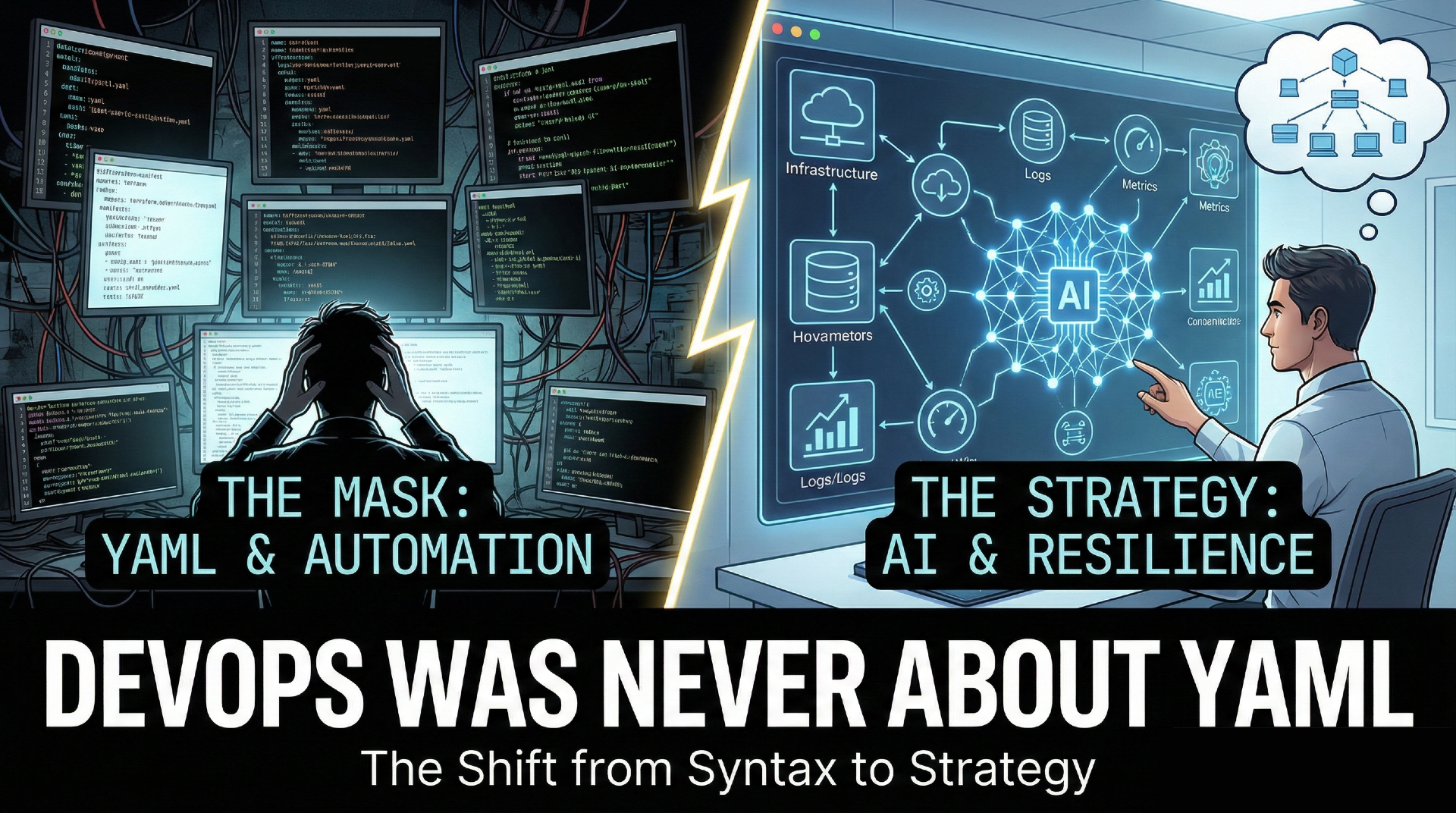
DevOps was never about YAML.
It just wore YAML as a mask—Terraform manifests, CI pipelines, and sprawling shell scripts. Those were merely the visible artifacts, the paper trail of a much deeper struggle. The real work of DevOps has always been the invisible art of holding complex systems together under extreme duress.
Thanks for reading The Systems Notebook! Subscribe for free to receive new posts and support my work.
It is the discipline of navigating:
- Infrastructure Limits: Managing the friction between theoretical architecture and physical reality.
- Failure Modes: Anticipating the “impossible” chain reactions before they happen.
- Deployment Risks: Engineering safety into a process that inherently invites chaos.
- Human Error: Building guardrails for the one variable that can’t be patched.
The Shift from Syntax to Strategy
AI isn’t “replacing” this work; it is finally absorbing the repetitive cognitive load that engineers have been carrying as a tax for years. The transition we are seeing isn’t the death of the role—it’s the liberation of it. We are moving away from being the translators of configuration and becoming the architects of resilience.
And this shift is already happening.
DevOps Was Automated Long Before AI
By the time AI entered the conversation, DevOps teams had already automated most execution paths:
- infrastructure provisioning
- application deployment
- scaling and rollback
- basic recovery mechanisms
Yet teams were still stretched thin.
That’s because automation mainly reduced manual effort, not mental effort.
You still had to:
- remember provider edge cases
- reason about blast radius
- debug CI failures with poor error messages
- reconcile configuration drift
- keep historical incidents in your head
The work didn’t disappear. It just moved from keyboards into people’s brains.
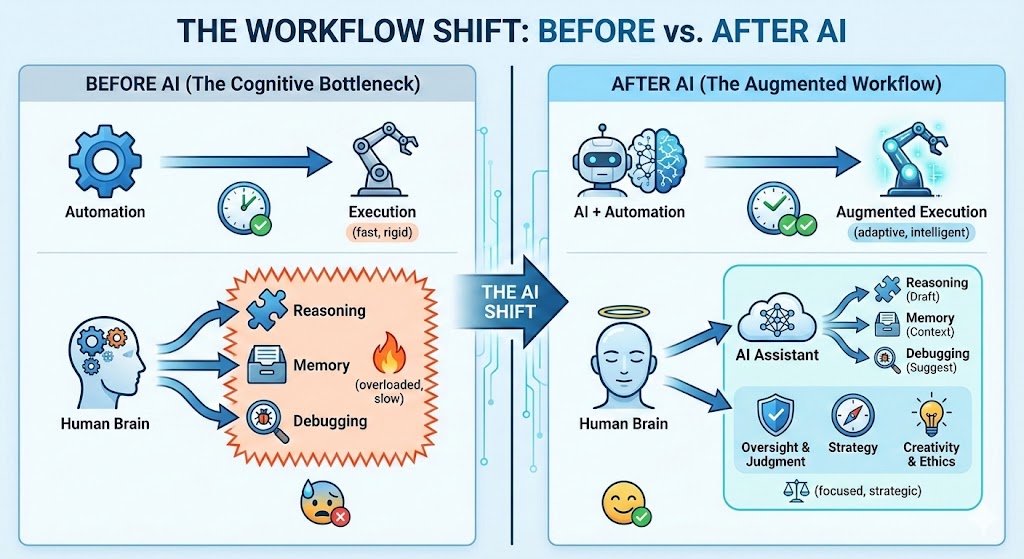
This is where the pressure built up.
The Real Bottleneck: Cognitive Load
Most DevOps failures don’t happen because tools are missing.
They happen because too much context is required at once.
A single decision may depend on:
- current infrastructure state
- recent deployments
- past incidents
- undocumented team conventions
- cloud provider behavior that changed quietly
None of this lives in one system.
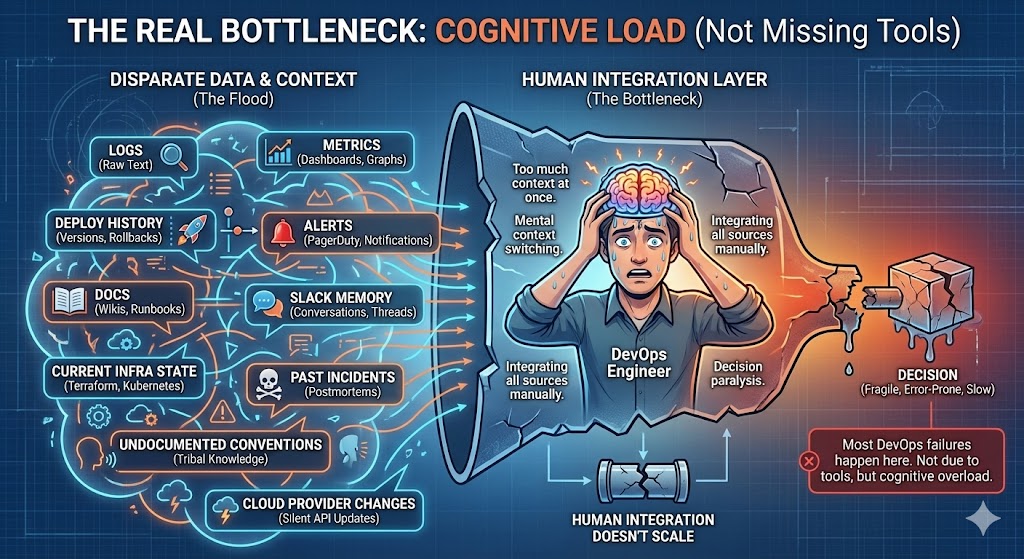
Humans become the integration layer. That doesn’t scale well.
What AI Is Actually Doing in DevOps
AI is not taking over operations.
It is becoming a shared context layer.
That distinction matters.
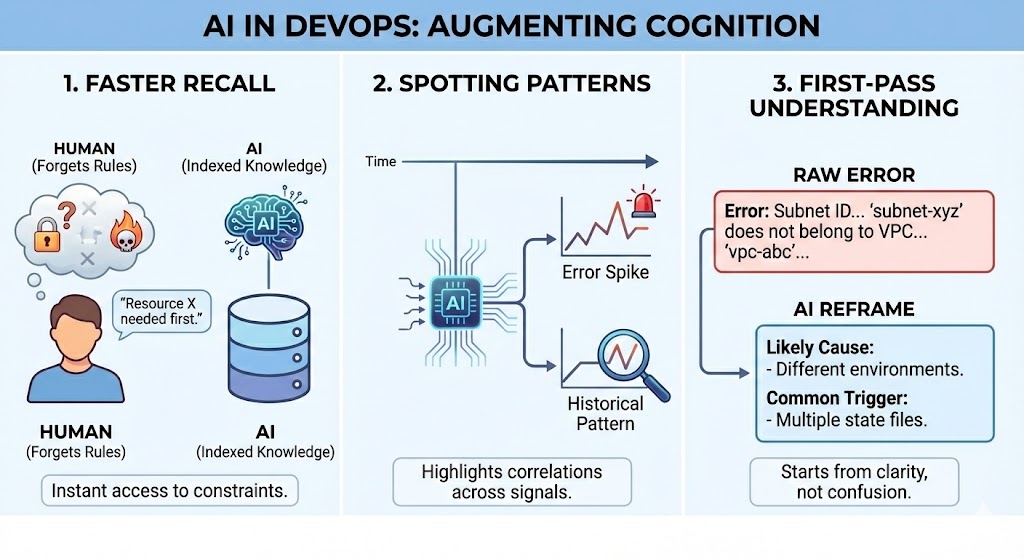
1. Remembering Constraints Humans Forget
A large part of DevOps work is remembering rules:
- which resources must exist first
- which arguments are mutually exclusive
- which “small change” caused a major incident last time
AI is good at this because it has seen the patterns repeatedly.
Engineer: “Can I apply this change safely?” AI: “This usually fails unless resource X already exists.”
Nothing magical. Just faster recall.
2. Spotting Patterns Across Signals
Humans debug sequentially.
AI works across signals.
Given logs, metrics, traces, and recent changes, AI can surface correlations that are easy to miss under time pressure.
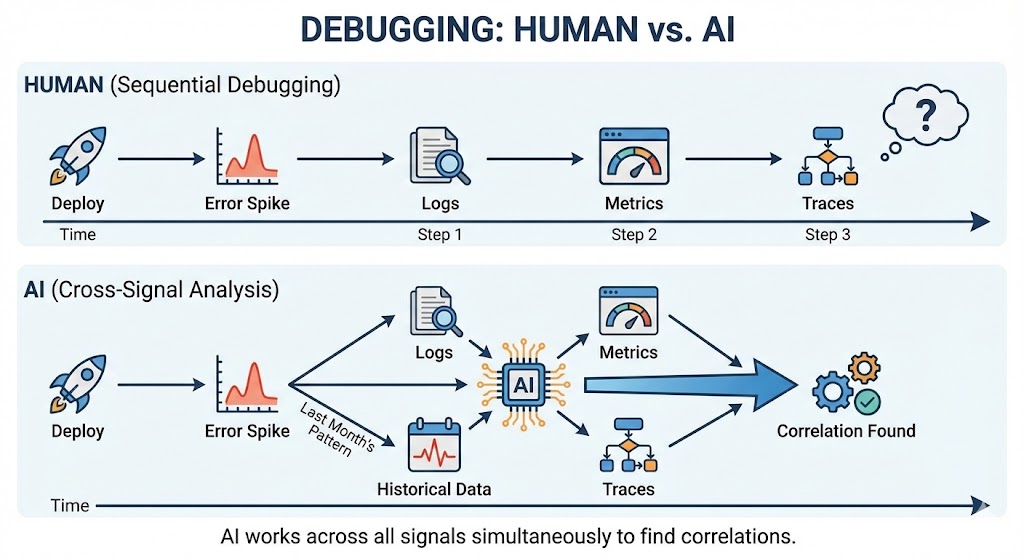
AI doesn’t decide the cause. It highlights where to look first.
That alone saves hours during incidents.
3. Producing First Drafts of Understanding
AI is useful as a first-pass explainer.
For example, a CI failure:
Error: Subnet ID ‘subnet-xyz’ does not belong to VPC ‘vpc-abc’
On its own, this error forces context switching.
AI reframes it:
Likely cause:

- Subnet and VPC are from different environments

Common trigger:

- Variables sourced from multiple state files
The engineer still decides what to do. But they start from clarity, not confusion.
What AI Is Not Doing
This is where expectations need to stay grounded.
AI should not:
- apply infrastructure changes directly
- auto-remediate production incidents without guardrails
- make business-risk decisions
DevOps is not only technical work.
It is risk management.
AI: “This change is valid.” Human: “Yes, but not during peak traffic.”
That judgment remains human.
A Better Mental Model
Instead of thinking about AI as automation, think of it as externalized reasoning.
Intent (Human) │ ▼ Context & Options (AI) │ ▼ Execution (Deterministic Systems) │ ▼ History & Audit (Git)
- Humans define intent
- AI supplies context
- Systems execute predictably
- Git remains the source of truth
This is how AI scales teams without reducing safety.
What This Means for DevOps Engineers
DevOps roles are not disappearing.
They are shifting.
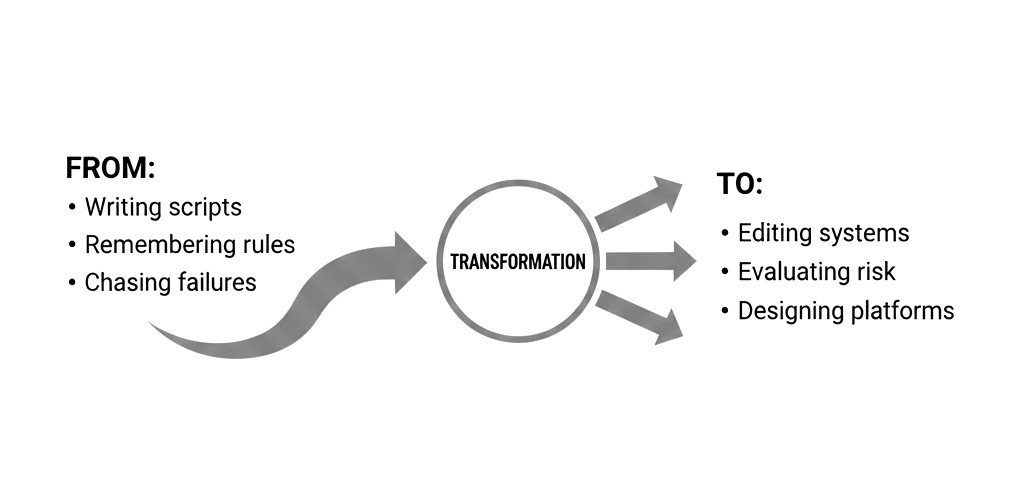
AI absorbs:
- lookup
- recall
- repetition
Humans retain:
- judgment
- accountability
- system design
This is not replacement. It is leverage.
Thanks for reading The Systems Notebook! Subscribe for free to receive new posts and support my work.