A simple starter workflow for giving AI your source material, decisions, examples, prompts, and standards.
By The Agentic Teacher
Published: 2026-07-01
URL: https://theagenticteacher.substack.com/p/how-to-build-your-first-codex-usable
Week 4 of 4: Codex for non-coders. Build the first working version.
Your first Codex-usable knowledge repo does not need to be perfect.
It needs to be usable enough that Codex can stop starting from a blank chat.
That distinction matters. Once people hear the word repo, they often imagine something technical or developer-only. That is not the frame here.
It is a place where reusable business context lives.
If your Codex chats, prompts, examples, decisions, and standards are scattered, Codex keeps rebuilding the same background. You explain the audience again. You restate the offer. You remind it what tone to use. You repeat the same project for the fifth time.
That is not a prompt problem anymore.
That is a missing source-of-truth problem.
Start With Usable, Not Perfect
The first mistake is trying to build the whole system at once.
Do not start by moving every old chat, every document, every prompt, and every half-finished idea into a perfect folder structure. That will make the repo feel like another productivity project.
Start with one working version.
The goal is not to organize your entire intellectual life.
The goal is to create a small place where AI can find the context it needs for the next real task.
If the first version helps you reuse one useful conversation, one decision, one prompt, or one example, it is already doing its job.
What AI-Usable Means In Plain Language
Codex-usable does not mean advanced.
It means the material is stored in a way that Codex can understand and apply.
For example, a folder full of random screenshots is not very AI-usable. A file called source-summary.md that explains what a conversation was about is much more useful.
A buried chat titled “new chat” is not very AI-usable. A short file called key-ideas.md is better.
A prompt floating in your memory is not very AI-usable. A saved prompt with a clear task, context, and expected output is better.
A Codex-usable repo gives Codex answers to basic questions:
- What is this work about?
- What context matters?
- What decisions have already been made?
- What examples should guide the output?
- What standards should the work follow?
- What should not be changed?
That is enough to change the quality of the next Codex session.
The Smallest Useful Repo Structure
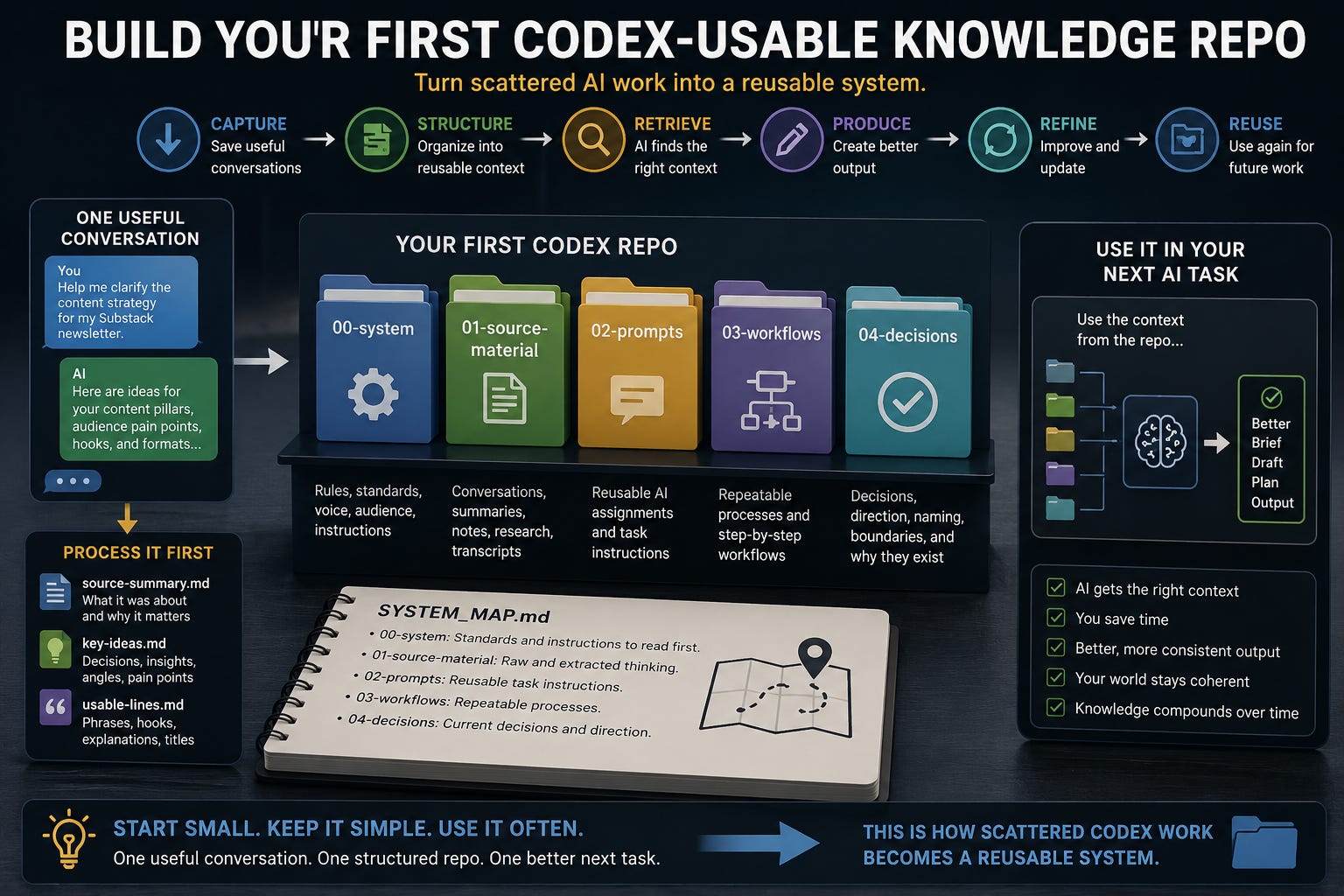
Start with five folders and one system map.
Create:
00-system01-source-material02-prompts03-workflows04-decisionsSYSTEM_MAP.md
This is not the only possible structure. It is a starter structure.
The point is to give different kinds of reusable context a clear home.
00-system holds operating rules, standards, audience notes, voice notes, and instructions AI should follow.
01-source-material holds useful conversations, summaries, key ideas, transcripts, notes, and usable lines.
02-prompts holds reusable AI assignments and task instructions.
03-workflows holds repeatable business processes, such as how you turn a chat into a brief, a brief into a draft, or a draft into Notes.
04-decisions holds choices you do not want to keep relitigating: audience, offer language, content direction, publishing rules, naming decisions, and why those choices were made.
That is enough for a first version.
The System Map Tells AI How To Use The Repo
The SYSTEM_MAP.md is the plain-language guide to the repo.
It tells AI what each folder is for.
It does not need to be long.
A simple system map might say:
00-system contains standards and instructions that should be read before creating content.
01-source-material contains raw and extracted thinking from conversations, notes, research, and transcripts.
02-prompts contains reusable task instructions.
03-workflows contains repeatable processes.
04-decisions contains decisions that should be treated as current unless updated.
That small file matters because it reduces guessing. Instead of asking AI to infer your structure, you explain the structure directly.
This is one of the easiest ways to make a folder system more useful to AI.
Process One Conversation Before Building More
Do not build ten folders before you have used one.
Choose one useful AI conversation and process it into source material.
Start with three files:
source-summary.mdkey-ideas.mdusable-lines.md
The source summary should answer: What was this conversation about, and why is it useful?
The key ideas file should capture the strongest concepts, decisions, examples, audience pain points, workflow seeds, and future article angles.
The usable lines file should save phrases, titles, hooks, explanations, and sentences that may be worth reusing later.
This first extraction is more important than the folder structure.
It proves the repo can hold useful thinking.
Use The Repo In Your Next AI Task
The repo becomes valuable when you use Codex with it.
Imagine a solopreneur who publishes on Substack. They have one strong AI conversation about a content cluster. Instead of leaving it in chat history, they save a source summary, key ideas, and usable lines.
The next time they ask Codex to create a brief or draft, they do not start from memory.
They say:
“Use the source summary, key ideas, and usable lines before creating this brief.”
That is the shift.
The repo is not there to look organized.
It is there to make the next Codex task better.
Keep It Simple Enough To Maintain
A repo that is too complicated will not survive real work.
The first version should be boring enough to use.
Five folders. One system map. One processed conversation. One next Codex task that uses the saved context.
That is the whole starter loop:
capture -> structure -> retrieve -> produce -> refine -> reuse
You can add more later. You can create article folders, offer folders, client folders, research folders, or brand folders when the work actually needs them.
But do not start there.
Start with the smallest structure that helps AI stop guessing.
The first version does not need to be complicated. A starter kit can give you the initial map so your source material, prompts, workflows, decisions, and standards have somewhere to live. If it helps you reuse one real conversation in the next Codex task, it is doing its job.
For now, build one simple repo for Codex.
Put one useful conversation inside it.
Use it in the next Codex task.
That is how scattered Codex work starts becoming a reusable system.
Part of the Codex for Non-Coders Series
This article is part of a four-week Agentic Teacher sequence on using Codex as a non-coder.
The series moves from understanding what Codex is, to organizing reusable context, to building your first Codex-usable knowledge repo.
The goal is simple: help you turn scattered AI use into a working system Codex can actually use.
This closes the four-week sequence. The next step is learning how to turn this first repo into a fuller AI Command Center OS.
This Substack is reader-supported. To receive new posts and support my work, consider becoming a free or paid subscriber.