Use this quick check to see whether AI has the task, source material, decisions, examples, and standards it needs to do useful work.
By The Agentic Teacher
Published: 2026-06-30
URL: https://theagenticteacher.substack.com/p/the-five-question-test-for-your-ai
Week 4 of 4: Codex for non-coders. Check whether your workspace can actually support the work.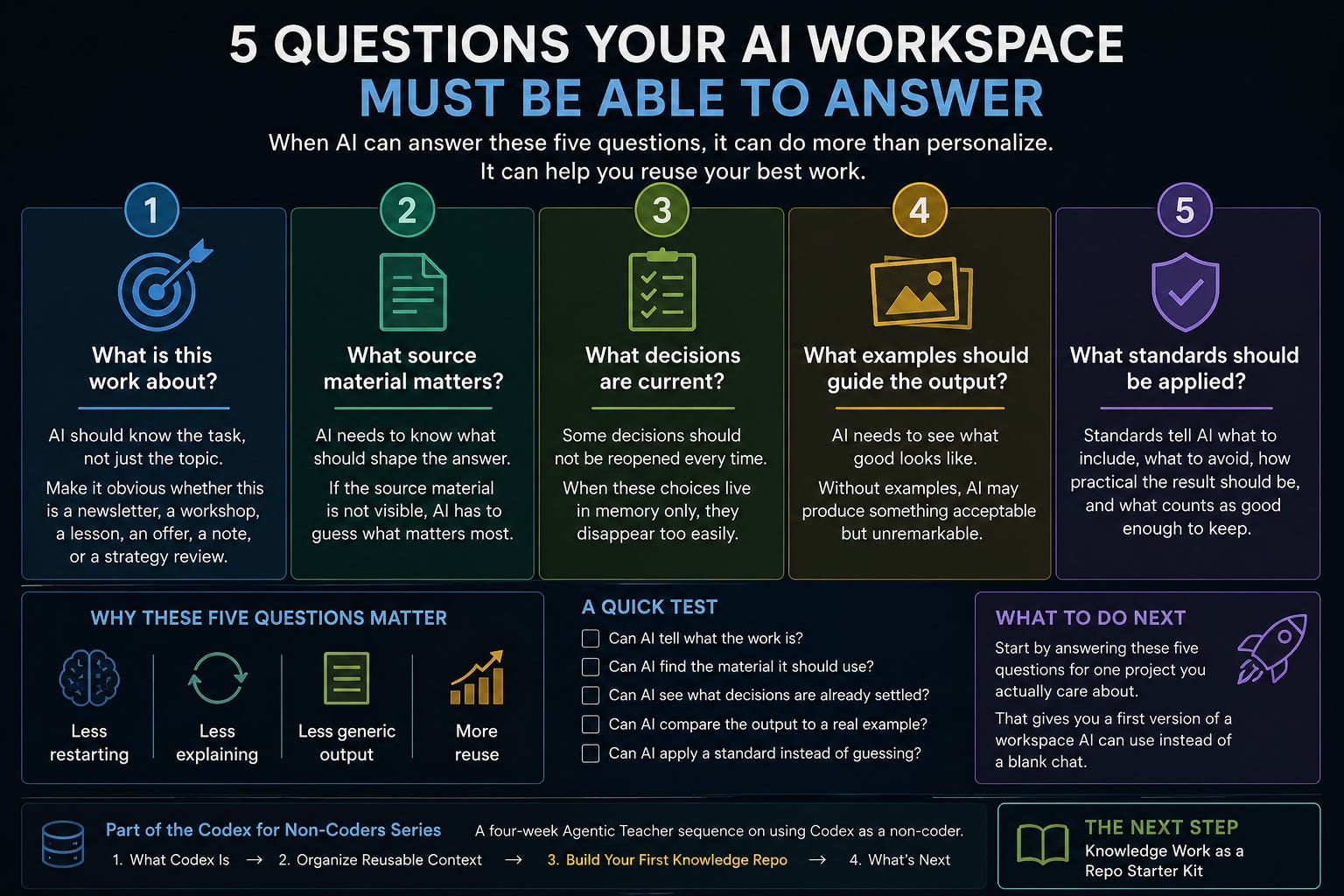
If you want AI to help with real work, it should not just know your tone or remember a few preferences. It should be able to answer the basic questions that make the work usable again.
When AI cannot answer those questions, the next response usually starts from partial memory and guesswork.
These five questions show the difference.
1. What is this work about?
AI should know the task, not just the topic.
A vague request like “help with this” is not enough. The workspace should make it obvious whether the work is a newsletter, a workshop, a lesson, an offer, a note, or a strategy review.
If the task is clear, the response can be clear.
2. What source material matters?
AI needs to know what should shape the answer.
That might be a useful conversation, a transcript, a client note, a draft, a voice sample, or a piece of research.
If the source material is not visible, AI has to guess what matters most. That is how generic output happens.
3. What decisions are current?
Some decisions should not be reopened every time.
Audience, offer, positioning, publishing rules, naming, and content boundaries all count here.
When these choices live in memory only, they disappear too easily. When they are part of the workspace, AI can work from them instead of re-arguing them.
4. What examples should guide the output?
AI needs to see what good looks like.
That could be a strong opening, a preferred article format, a clean client deliverable, or a before-and-after example that shows the level of quality you want.
Without examples, AI may produce something acceptable but unremarkable.
With examples, the output has something to aim at.
5. What standards should be applied?
This is the part that keeps the work from drifting.
Standards tell AI what to include, what to avoid, how practical the result should be, and what counts as good enough to keep.
A workspace without standards can still produce text.
It just cannot reliably produce the right kind of text.
Why these five questions matter
If your AI workspace can answer these five questions, it is already doing more than personalization.
It is helping AI work from the actual material around the task.
That means less restarting.
Less explaining.
Less generic output.
And more reuse.
A quick test
Take one real project and ask:
- Can AI tell what the work is?
- Can AI find the material it should use?
- Can AI see what decisions are already settled?
- Can AI compare the output to a real example?
- Can AI apply a standard instead of guessing?
If the answer is mostly no, the workspace is still too thin.
That does not mean the AI is bad.
It means the environment needs more structure.
What to do next
Do not try to fix everything at once.
Start by answering these five questions for one project you actually care about.
That gives you a first version of a workspace AI can use instead of a blank chat.
Then, when you are ready to build the first working version, you will know exactly what the system needs to hold.
The Next Step
If you want a simple structure for turning that gap into a usable setup, the Knowledge Work as a Repo Starter Kit is the natural next step.
Part of the Codex for Non-Coders Series
This article is part of a four-week Agentic Teacher sequence on using Codex as a non-coder.
The series moves from understanding what Codex is, to organizing reusable context, to building your first Codex-usable knowledge repo.
The goal is simple: help you turn scattered AI use into a working system Codex can actually use.
Next in the series: How to Build Your First Codex-Usable Knowledge Repo
This Substack is reader-supported. To receive new posts and support my work, consider becoming a free or paid subscriber.