The workflows that break AI are rarely the clean ones. They are the messy exceptions people have been manually absorbing for years.
By Ashu Kumar
Published: 2026-07-16
URL: https://theagenticstack.substack.com/p/your-company-does-not-have-an-ai
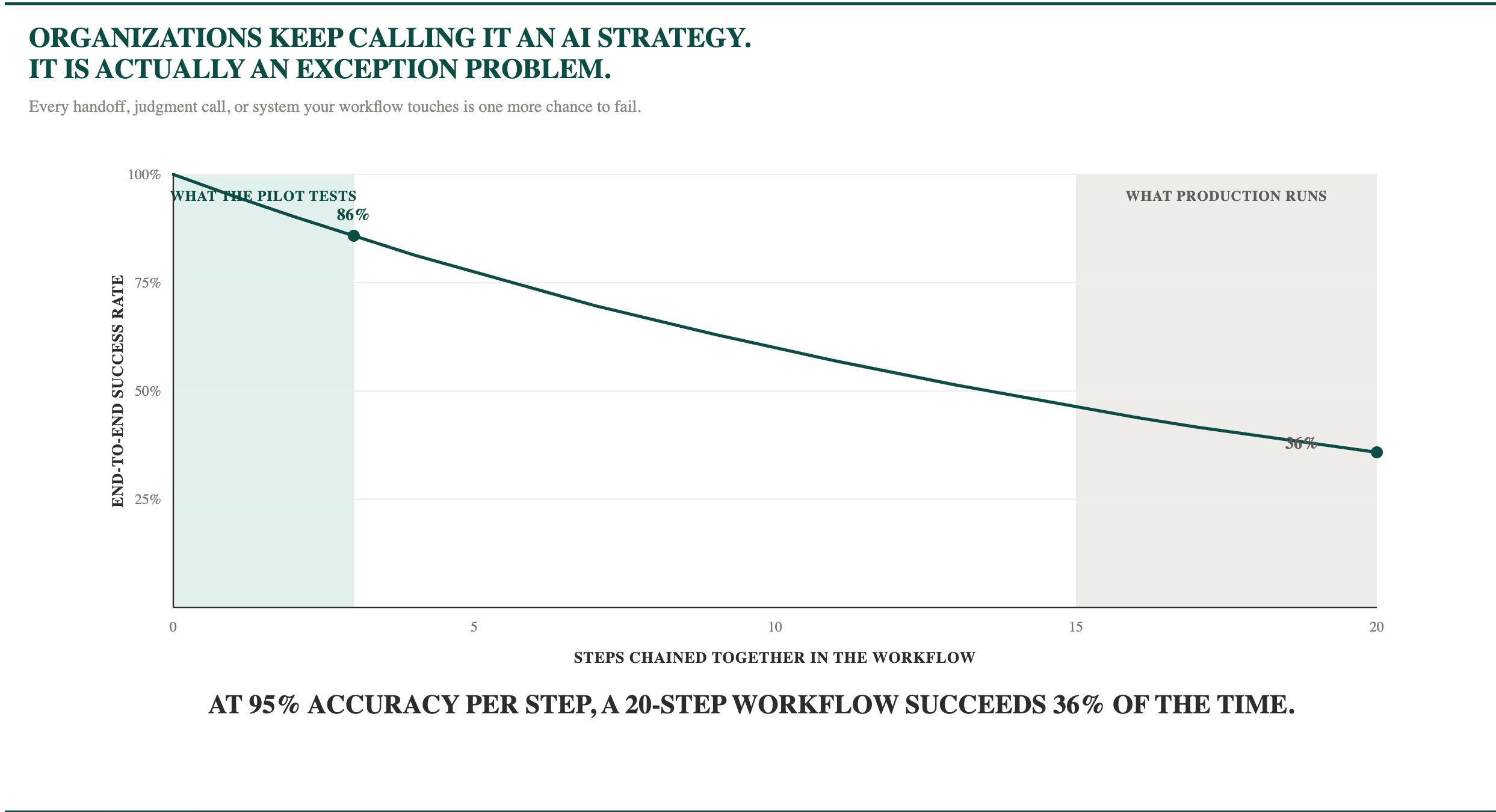
The AI pilot worked because the workflow was clean.
The data was selected carefully.
The use case was narrow.
The process was explained in advance.
The edge cases were removed.
The demo users were friendly.
The success metric was simple.
The model had just enough context to look impressive.
Thanks for reading The Agentic Stack! Subscribe for free to receive new posts and support my work.
Then production introduced the real company.
Missing fields.
Special customers.
Old contracts.
Regional rules.
Approval delays.
Policy exceptions.
Broken handoffs.
Shadow spreadsheets.
One-off decisions.
Teams that disagree on who owns the next step.
The model did not fail first.
The exceptions did.
And that is where many AI strategies start to break.
Not because the company chose the wrong model.
Not because the prompt was bad.
Not because the demo was fake.
But because the organization had been surviving on human exception handling for years — and nobody had mapped it.
AI did not create the mess.
It exposed it.
The clean workflow was already the easy part
Most companies do not struggle with the happy path.
The happy path is usually documented, automated, measured, or at least understood.
A customer submits a complete request.
The system routes it correctly.
The data is available.
The policy is clear.
The approval owner is known.
The next step is obvious.
The outcome can be tracked.
AI can help there, but that is rarely where the deepest enterprise value sits.
The real value is trapped in the messy middle.
The invoice that does not match the purchase order.
The customer ticket that looks solved but keeps reopening.
The contract clause that does not fit the standard approval path.
The compliance control that technically passed last year but now needs new evidence.
The support case where the policy says one thing, the customer tier says another, and the account team knows a third thing that never made it into the system.
The procurement request that should be simple, except the vendor is strategic, the budget owner changed, and legal has a side agreement from two years ago.
That is where companies bleed time.
That is where managers get pulled in.
That is where Slack threads replace process.
That is where spreadsheets become unofficial systems of record.
That is where AI pilots quietly stop looking magical.
Because the model is no longer solving a clean workflow.
It is touching the exception layer of the business.
Exceptions are where the real company lives
Every enterprise has two versions of itself.
The first version is the official company.
It lives in process documents, workflow diagrams, onboarding decks, SOPs, system fields, and quarterly transformation slides.
This version looks organized.
The second version is the real company.
It lives in comments, email threads, manager judgment, Slack messages, approval shortcuts, undocumented workarounds, special customer rules, local team habits, and “ask Priya, she knows how this works.”
This version runs the business.
AI works beautifully when the official company and the real company match.
But they often do not.
The process says every refund above a threshold needs finance approval.
The real workflow says enterprise customers go through customer success first.
The system says the ticket is resolved.
The real workflow says the customer will reopen it unless engineering confirms the root cause.
The policy says evidence must be attached.
The real workflow says the auditor accepts one screenshot from one system but not another.
The CRM says the opportunity is in negotiation.
The real workflow says legal is blocked, pricing changed twice, and the champion left the company.
This is why AI initiatives often hit friction after the pilot.
The pilot teaches the model the official workflow.
Production asks it to survive the real one.
The exception problem hides behind the word “strategy”
A lot of companies say they need an AI strategy.
They create working groups.
They evaluate vendors.
They build pilots.
They approve budgets.
They choose platforms.
They define governance.
They launch internal enablement programs.
All of that can be useful.
But many AI strategies skip the most important question:
Where does work actually break?
Not where is AI exciting?
Not where can we add a chatbot?
Not where can we automate a task?
Not which team has the biggest backlog?
Where does the workflow hit exceptions that humans are quietly absorbing?
That is the better starting point.
Because AI does not only automate tasks.
It forces hidden decisions into the open.
Who owns this case?
Which rule applies?
Is this customer an exception?
Can this action be taken automatically?
What evidence is enough?
Who approves the override?
What happens when the system is uncertain?
Where does the work go next?
If the company cannot answer those questions, the AI system inherits the ambiguity.
And ambiguity does not become strategy just because a model is involved.
It becomes automation debt.
The pilot works because people protect it
Pilots are usually protected environments.
Someone chooses the use case.
Someone cleans the input.
Someone watches the output.
Someone explains the failure.
Someone manually handles the edge case.
Someone makes sure the demo does not hit the weird part of the workflow.
That is not wrong. Pilots need control.
But it creates a false sense of readiness.
The pilot answers:
Can AI perform this task under controlled conditions?
Production asks something harder:
Can AI survive the operating reality of this business?
That reality includes incomplete data, conflicting policies, changing priorities, unusual customers, delayed approvals, system outages, unclear ownership, compliance constraints, and human judgment.
A model can summarize a ticket.
But can it tell when the ticket should not be closed?
A model can draft a customer reply.
But can it know when the account team needs to approve the tone?
A model can classify an invoice exception.
But can it detect that this vendor has a non-standard contract term?
A model can generate an audit summary.
But can it identify that the evidence is stale, incomplete, or not acceptable for this region?
That is the difference between task performance and workflow reliability.
Most AI strategies overestimate the first and underestimate the second.
The happy path creates demos. Exceptions create businesses.
The easiest AI demos are built on clean inputs.
Upload a document.
Ask a question.
Generate a summary.
Draft an email.
Classify a request.
Suggest a next step.
These demos are useful, but they rarely show the full business case.
Enterprise value appears when AI reduces the cost of exceptions.
When it catches the ticket that would have reopened.
When it finds the invoice issue before month-end close.
When it prepares the audit evidence before the scramble.
When it routes the procurement request before it stalls.
When it flags the customer risk before renewal.
When it identifies the claim that needs human review.
When it explains why a workflow is stuck.
That is not glamorous.
But it is valuable.
The happy path is where AI looks good.
The exception path is where AI becomes necessary.
Because exceptions are expensive.
They create delay, rework, escalation, customer frustration, compliance risk, missed revenue, and managerial drag.
Every exception is a small tax on the organization.
Most companies do not measure that tax clearly.
They just feel it.
AI can help, but only if the company stops pretending the workflow is cleaner than it is.
The wrong AI strategy starts with use cases
This may sound strange, because every AI transformation program asks for use cases.
But “use case” is often too broad.
“AI for customer support.”
“AI for finance operations.”
“AI for procurement.”
“AI for HR.”
“AI for compliance.”
“AI for sales productivity.”
These are not use cases.
They are territories.
A better strategy starts with exception maps.
Where does support break?
Not “answer customer questions.”
That is too broad.
The better question is:
Which tickets reopen, escalate, violate SLA, require manager review, or bounce between teams?
Where does finance break?
Not “process invoices.”
The better question is:
Which invoice exceptions block close, require manual matching, need policy interpretation, or create duplicate payment risk?
Where does compliance break?
Not “collect evidence.”
The better question is:
Which controls repeatedly miss evidence, require manual screenshots, depend on unclear owners, or fail because the source system changed?
Where does sales break?
Not “improve productivity.”
The better question is:
Which opportunities stall because follow-ups are missed, pricing approvals are delayed, legal review is unclear, or account context is scattered?
The exception is the unit of AI strategy.
Not the department.
Not the tool.
Not the model.
The exception.
Before automating the workflow, map the exceptions
Most teams want to jump straight into solution mode.
Which model should we use?
Should this be an agent?
Should it connect to our CRM?
Should we build or buy?
Can it take action?
Can we deploy it this quarter?
Those questions matter later.
First, ask:
What are the top exceptions in this workflow?
For each one, define:
What triggers it?
How often does it happen?
Who handles it today?
What systems do they check?
What judgment do they apply?
What evidence do they need?
What policy governs it?
What happens if they get it wrong?
What is the cost of delay?
What action can be automated?
What action needs approval?
What should escalate?
This is not glamorous work.
But it is the difference between an AI pilot and an AI operating system.
If you cannot describe the exceptions, you cannot safely automate the workflow.
You can only automate the illusion of the workflow.
And production will punish that.
AI should not just answer. It should reveal the broken handoff.
One of the biggest mistakes companies make is evaluating AI only by output quality.
Was the answer correct?
Was the summary useful?
Was the classification accurate?
Was the draft good?
Those are important questions.
But in enterprise workflows, AI should also reveal where the process itself is broken.
If the agent cannot determine the owner, that is not only an AI failure.
It may be an ownership problem.
If the agent cannot decide which policy applies, that is not only a retrieval problem.
It may be a policy conflict.
If the agent cannot take action because approval is unclear, that is not only an automation limitation.
It may be a decision-rights problem.
If the agent keeps asking for missing context, that is not only a prompt issue.
It may be a data-capture problem.
This is where AI becomes useful beyond automation.
It becomes a diagnostic tool for the organization.
Every time the system gets stuck, ask:
Did the model fail?
Or did the workflow fail to define the next step?
That distinction matters.
Because if the workflow is ambiguous, a better model may only produce a more confident wrong answer.
The best AI teams will become exception teams
The strongest enterprise AI teams will not only be model teams.
They will be exception teams.
They will study where work deviates from the happy path.
They will map the messy cases.
They will identify which exceptions are common, costly, and repetitive.
They will separate exceptions that can be automated from exceptions that require human judgment.
They will define the evidence needed for each decision.
They will build escalation paths.
They will create feedback loops from approvals, edits, and rejections.
They will measure whether the workflow actually improves.
This is a different kind of AI work.
Less demo-driven.
More operational.
Less “look what the model can do.”
More “look where the company keeps breaking.”
That is how AI becomes serious inside enterprises.
It stops being a layer of intelligence sprinkled across tools.
It becomes a way to redesign how work moves through the company.
The exception layer needs a different product design
Most enterprise software is designed around standard flows.
Create request.
Assign owner.
Move status.
Approve.
Close.
But exceptions do not behave like standard flows.
They branch.
They pause.
They need evidence.
They cross teams.
They require judgment.
They trigger policy questions.
They need audit trails.
They sometimes need to be rejected, escalated, or parked.
AI products built for exceptions need different design.
They need to show uncertainty, not hide it.
They need to show evidence, not just conclusions.
They need to identify missing context.
They need to route work to the right owner.
They need to explain why an item is blocked.
They need to distinguish between “ready to automate” and “needs human review.”
They need to learn from human overrides.
They need to create an audit trail of decisions.
In other words, the product should not pretend every case is clean.
It should be designed for the messy cases.
That is where enterprise AI products will earn trust.
Not by eliminating every human decision.
By making the hard decisions easier, safer, and better supported.
The leadership problem
The exception problem is uncomfortable because it is not just technical.
It is organizational.
A messy exception often reveals a leadership question.
Who owns the customer outcome when support, product, and account management all touch the case?
Who owns the invoice when procurement, finance, legal, and the business unit all contributed to the delay?
Who owns audit readiness when evidence lives across systems and teams?
Who owns onboarding when sales closed the deal, success inherits the customer, legal negotiated exceptions, and product has to enable features?
AI does not magically resolve these ownership questions.
It exposes them.
That is why some AI programs stall.
The company thought it was buying automation.
But the project started asking for decisions the organization had avoided making.
What should happen when policy conflicts with customer value?
Who can override the standard flow?
Which exceptions are acceptable?
Which risks need approval?
Which team owns the final outcome?
These are not model questions.
They are management questions.
And without answers, AI becomes another place where ambiguity accumulates.
The real readiness test
A company is not ready for production AI just because it has data, tools, and executive sponsorship.
It is ready when it understands its exceptions.
Before deploying AI into a workflow, ask:
What are the top five exceptions in this process?
How often do they happen?
Who handles them today?
What do they check?
What decision do they make?
What evidence do they trust?
What systems do they touch?
What happens when they are wrong?
Which exceptions can be automated?
Which require human judgment?
Which need escalation?
Which should never be handled by AI?
If the team cannot answer these questions, the AI strategy is premature.
Not because AI cannot help.
But because the workflow has not been made legible enough for AI to operate safely.
The first step is not always automation.
Sometimes the first step is making the exception visible.
Final thought
Your company may not have an AI strategy problem.
It may have an exception problem.
The workflows that break AI are rarely the clean ones.
They are the messy, undocumented, judgment-heavy cases people have been manually absorbing for years.
Those exceptions are not noise.
They are the real operating system of the business.
AI can help with them, but only if companies stop pretending the happy path is the whole process.
The best AI programs will not begin with the question:
Where can we add AI?
They will begin with a better one:
Where does work break, who fixes it today, and what would it take for AI to help safely?
That is where the value is.
Not in the clean demo.
In the exception.
Because production AI does not fail when everything goes right.
It fails where the real company begins.
Discussion prompt
Where do you see the biggest exception problem in enterprise AI today: support escalations, invoice exceptions, procurement intake, compliance evidence, customer onboarding, sales approvals, incident response, or something else?