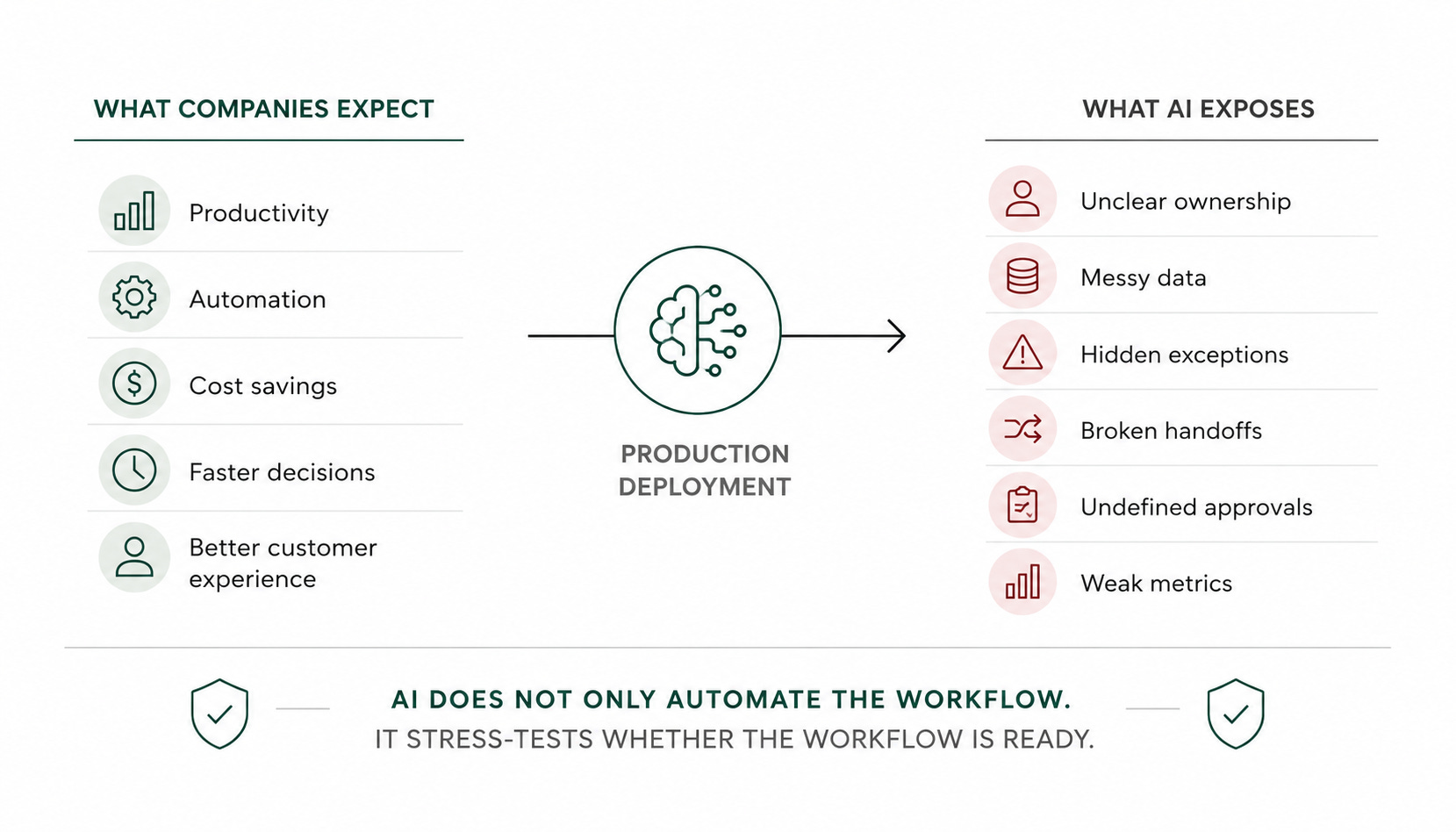
When companies add AI to real workflows, it exposes weak ownership, messy data, unclear decisions, broken handoffs, and processes nobody fully understood.
By Ashu Kumar
Published: 2026-07-21
URL: https://theagenticstack.substack.com/p/ai-is-not-a-strategy-it-is-a-stress
Most companies think AI will reveal how advanced their technology is.
It usually reveals something else.
Thanks for reading The Agentic Stack! Subscribe for free to receive new posts and support my work.
How unclear their ownership is.
How messy their data is.
How many decisions depend on tribal knowledge.
How many workflows survive because humans quietly patch them every day.
How often the official process is not the real process.
That is why so many AI pilots look promising and so many AI rollouts feel painful.
The pilot tests whether the model can perform a task in a controlled environment.
Production tests whether the company actually understands the work.
Those are very different tests.
AI is not just a productivity tool.
It is a stress test for the operating system of the company.
And most companies are surprised by what it exposes.
The pilot does not test the company
A pilot is usually protected.
The use case is narrow. The data is selected. The users are friendly. The edge cases are avoided. The workflow is explained in advance. The success metric is simple. Someone is watching closely.
That is not wrong. Pilots need boundaries.
But a pilot often tests the AI under ideal conditions, not the company under real ones.
The model gets a clean document.
The workflow has a clear start and end.
The decision is obvious.
The owner is known.
The risk is low.
The output is easy to judge.
Then the company moves the same idea toward production.
Suddenly the AI touches real workflows.
The data is incomplete. The customer has a special contract. The policy has exceptions. The source system is stale. The approval owner is unclear. The team handling the request is not the team that owns the outcome. The process says one thing, but the people doing the work know another.
The model may still be capable.
But the company around it is not ready.
This is the part most AI strategies underestimate.
The hard question is not only:
Can the model do the task?
The harder question is:
Can the workflow survive automation?
AI exposes ownership gaps
Most workflows look owned until something goes wrong.
A support ticket is closed, but the customer comes back.
Who owns the failure?
Support says the response followed the process.
Product says the root cause was not fixed.
Customer success says the account context was ignored.
The AI team says the model generated a reasonable answer.
The workflow team says the ticketing rules routed it correctly.
Everyone can explain their part.
Nobody owns the outcome.
AI exposes this quickly.
When a human handles a messy workflow, ownership gaps are often hidden inside judgment. Someone messages a manager. Someone knows who to ask. Someone makes the exception. Someone quietly fixes the record.
When AI enters the workflow, those informal patches disappear.
The system needs to know:
Who owns the decision?
Who owns the action?
Who owns the customer impact?
Who approves the exception?
Who reviews the failure?
Who updates the policy?
Without clear ownership, AI does not create leverage.
It creates confusion faster.
A company should not ask AI to move work through a workflow until it knows who owns the outcome of that work.
AI exposes data gaps
Many AI failures are blamed on the model.
But the model is often working with the company’s reality.
A customer profile is incomplete.
A contract is stored in one system, but the renewal terms live in an email.
The CRM says the deal is active, but the account team knows the champion left.
The policy document says one thing, but the latest exception was approved in Slack.
The product usage data is delayed.
The support ticket has missing fields.
The invoice references a vendor name that does not match procurement records.
The AI gives a weak answer, and the first reaction is:
“The model is not good enough.”
Sometimes that is true.
But often the deeper issue is that the company’s data is not good enough to support the decision it wants AI to make.
AI makes data quality visible because it tries to use the data operationally.
Dashboards can hide messy data.
Reports can average it out.
Humans can compensate for it.
AI cannot always do that.
It needs usable context at the moment of work.
That is why AI projects often become data projects, even when nobody planned for that.
The model did not create the data problem.
It exposed the cost of ignoring it.
AI exposes decision gaps
Companies often want AI to make recommendations before they have defined how decisions should be made.
Should this refund be approved?
Should this customer be escalated?
Should this invoice be blocked?
Should this incident become SEV-2?
Should this sales opportunity get legal review?
Should this compliance evidence be accepted?
These are not just AI questions.
They are decision-rights questions.
Who is allowed to approve?
Who can override?
Which policy applies?
Which exceptions are acceptable?
Which risks require escalation?
Which actions can be automated?
Which actions must stay human?
In many companies, these rules are not written clearly.
They live inside experienced employees.
They depend on context, relationships, risk tolerance, customer tier, regional rules, and past exceptions.
AI forces those rules into the open.
That can feel uncomfortable.
A team may think it is buying automation, but the project starts asking management questions:
Who decides?
What rule matters most?
What happens when two rules conflict?
What is the threshold for human review?
What does “good” actually mean?
If those answers are unclear, the AI system will either stop too often, act too confidently, or route everything back to humans.
None of those outcomes scale well.
Before AI can improve decisions, the company must define decision rights.
AI exposes handoff gaps
Most business processes do not fail inside one step.
They fail between steps.
Support waits for engineering.
Finance waits for procurement.
Procurement waits for legal.
Sales waits for pricing.
Customer success waits for product.
Compliance waits for evidence owners.
Operations waits for approvals.
The official workflow says the item moves from Team A to Team B.
The real workflow depends on messages, reminders, relationships, shortcuts, and follow-ups that never appear in the process diagram.
This is where AI often gets stuck.
It can summarize the case.
It can draft the response.
It can classify the request.
It can recommend the next step.
But then the work reaches a handoff that nobody owns clearly.
The AI asks: where should this go?
The system says one thing.
The team says another.
The policy says something else.
The person who knows the real answer is on vacation.
This is not an AI limitation.
It is an operating model limitation.
AI does not only need a task.
It needs a path.
If the handoff is broken, AI will not fix it by moving faster.
It will move the confusion faster.
AI exposes exception debt
Every company has exception debt.
Special customers.
One-off contracts.
Manual approvals.
Regional policies.
Legacy systems.
Temporary workarounds that became permanent.
Fields people stopped filling in.
Spreadsheets that quietly became critical infrastructure.
Processes that work only because a few people know how to handle the strange cases.
Exception debt does not always show up in dashboards.
It shows up when AI tries to operate inside the workflow.
The clean cases work.
The messy cases break.
And the messy cases are often where the real cost lives.
A support agent can answer common questions, but the expensive work is escalation, churn risk, refunds, product bugs, and angry enterprise customers.
A finance agent can process simple invoices, but the expensive work is exceptions, mismatches, approvals, and blocked close.
A compliance agent can summarize policies, but the expensive work is missing evidence, unclear owners, outdated controls, and audit-specific judgment.
A sales agent can draft follow-ups, but the expensive work is pricing exceptions, legal review, renewal risk, and account-specific context.
AI exposes exception debt because exceptions are where the company has been using humans as glue.
If the AI strategy ignores exceptions, it will automate the easy part and leave the expensive part untouched.
AI exposes metric gaps
Many AI programs start with vague goals.
Improve productivity.
Reduce manual work.
Increase efficiency.
Enhance decision-making.
Accelerate operations.
These sound good, but they are not operational enough.
When AI enters a real workflow, the metric has to become specific.
Are we reducing cycle time?
Lowering cost per case?
Reducing reopen rate?
Improving first-contact resolution?
Shortening audit prep?
Reducing invoice exception backlog?
Improving SLA compliance?
Reducing escalation volume?
Increasing approval accuracy?
Reducing manual review hours?
If the metric is vague, every AI result becomes debatable.
One team says the output was useful.
Another says it added review work.
One manager says it saved time.
Another says it created risk.
One user says it improved quality.
Another says it required too much correction.
AI does not just need a use case.
It needs a measurable business outcome.
Without that, the company cannot tell whether it has built leverage or just added another layer of software.
The stress test pattern
Most AI rollouts follow a pattern.
First, the demo creates confidence.
The model summarizes, drafts, classifies, or recommends.
People see the potential.
Then the pilot creates excitement.
A small workflow improves. Users save time. Leaders see momentum.
Then production creates friction.
The system hits missing data, unclear owners, exceptions, approvals, policy conflicts, edge cases, handoffs, and trust issues.
This is where companies often make the wrong diagnosis.
They say:
“We need a better model.”
Sometimes they do.
But often they need a better understanding of the workflow.
They need clearer ownership.
Cleaner data.
Defined decision rights.
Explicit escalation paths.
Better exception handling.
Stronger feedback loops.
More precise success metrics.
AI is the stress test that reveals which of these foundations are weak.
The companies that win will not treat every failure as a model failure.
They will ask:
What did this failure reveal about how our company actually works?
That question changes the whole program.
Use AI as diagnosis before automation
The smartest companies will use AI in two phases.
First as diagnosis.
Then as automation.
Before asking AI to take action, use it to reveal the workflow.
Where does the process break?
Which cases need human judgment?
Which fields are missing most often?
Which policies are ambiguous?
Which approvals cause delays?
Which teams receive the most escalations?
Which customer segments create exceptions?
Which decisions are repeatedly overridden?
Which outputs do humans edit?
Which recommendations get rejected?
That diagnostic phase is valuable by itself.
It shows where the company is not ready.
It also shows where AI can help safely.
Once the workflow is visible, automation becomes easier.
The company can decide what AI should detect, summarize, draft, recommend, route, approve, or escalate.
But skipping the diagnostic phase is dangerous.
It turns AI into a layer on top of confusion.
And confusion scales poorly.
The real AI strategy is operational clarity
A good AI strategy is not just a list of models, vendors, pilots, and governance principles.
It is a plan for making work legible enough for AI to help.
That means answering practical questions.
Who owns the workflow?
What data is trusted?
Which decisions matter?
Which exceptions are common?
Which actions are allowed?
Which actions require approval?
Where does uncertainty escalate?
What evidence must be shown?
What gets logged?
What outcome should improve?
These questions may feel less exciting than choosing a model.
But they are what determine whether AI creates durable value.
The companies that succeed with AI will not be the ones that simply deploy the most tools.
They will be the ones that understand their work deeply enough to redesign it.
AI is not a shortcut around operational clarity.
It demands it.
What leaders should ask before scaling AI
Before scaling AI across a workflow, leaders should ask a different set of questions.
Not:
Which AI tool should we buy?
But:
Where does this workflow break today?
Not:
Can the model perform the task?
But:
Can the workflow support the action?
Not:
How many people can this save?
But:
Which decisions, handoffs, and exceptions are we making more reliable?
Not:
Can we automate this?
But:
What should remain human, what can be assisted, and what can be safely automated?
Not:
How impressive is the demo?
But:
What happens when the first messy case arrives?
This is the leadership shift.
AI strategy cannot just be technology selection.
It has to become operating model design.
Final thought
AI is not a strategy by itself.
It is a stress test.
It tests whether ownership is clear.
It tests whether data is usable.
It tests whether decisions are defined.
It tests whether handoffs work.
It tests whether exceptions are understood.
It tests whether success is measurable.
The companies that treat AI only as automation will miss the bigger lesson.
The companies that treat AI as diagnosis will learn where their operating model is weak.
That is where the real transformation begins.
Not when the model generates a good answer.
But when the company finally sees the workflow it actually has.
Before AI transforms your company, it will expose it.
That exposure is not a failure.
It is the beginning of a real strategy.
Discussion prompt
Where do you think AI exposes companies first: ownership, data quality, decision rights, handoffs, exceptions, or unclear metrics?
Thanks for reading The Agentic Stack! Subscribe for free to receive new posts and support my work.