It will not be a universal worker. It will sit inside one painful workflow, remove one expensive bottleneck, and quietly become impossible to replace.
By Ashu Kumar
Published: 2026-07-14
URL: https://theagenticstack.substack.com/p/the-first-billion-dollar-ai-agent
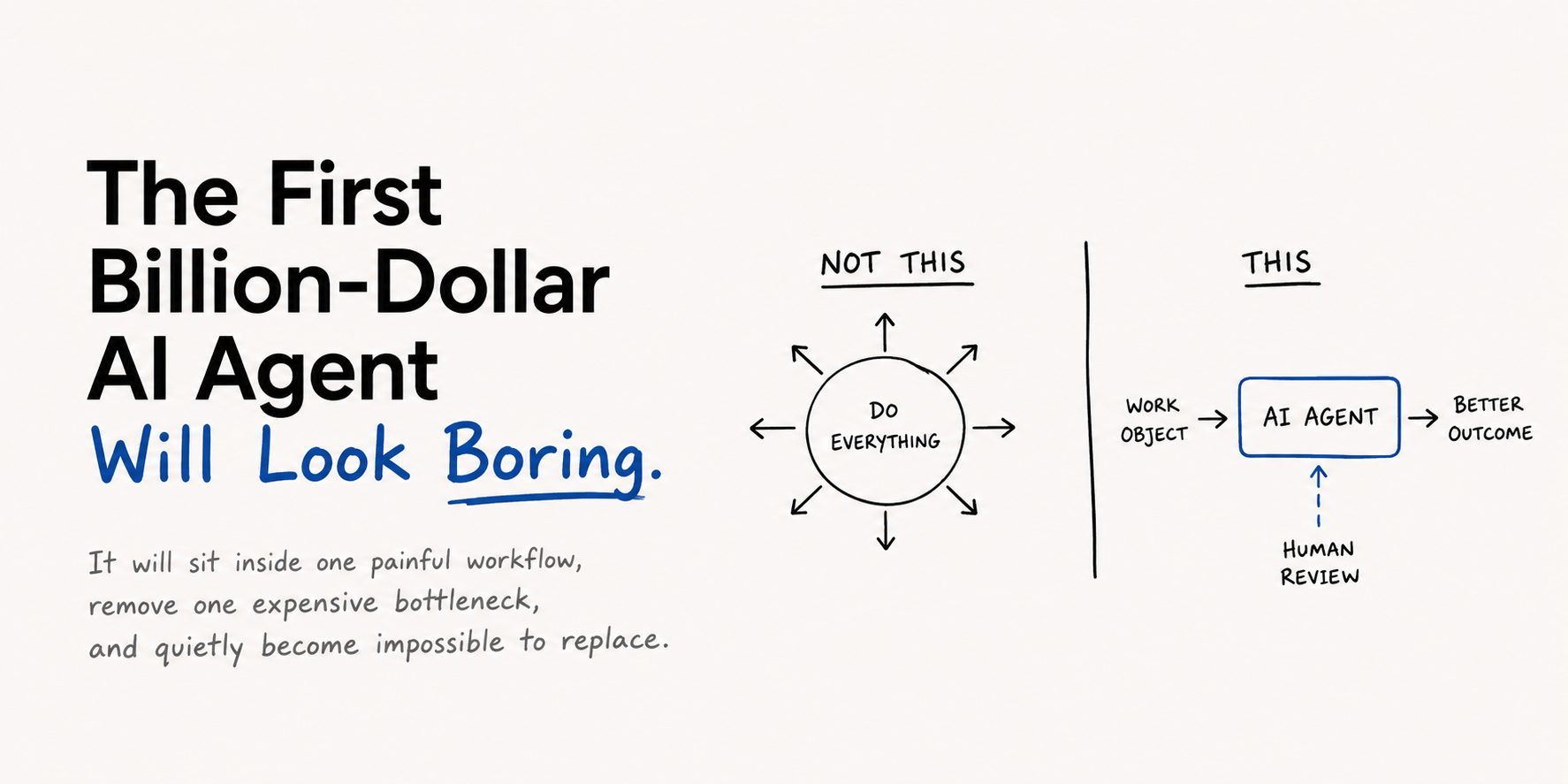
The first billion-dollar AI agent probably will not look like the demos.
It will not introduce itself as a digital employee. It will not promise to run your whole company. It will not replace every analyst, operator, support rep, salesperson, engineer, and manager at once.
Thanks for reading The Agentic Stack! Subscribe for free to receive new posts and support my work.
It will look much more boring.
It may sit inside invoice exceptions.
Or support escalations.
Or procurement intake.
Or compliance evidence collection.
Or claims review.
Or incident triage.
Or customer onboarding.
It will not feel magical at first. It will feel narrow, specific, and almost too practical.
But that is exactly why it will work.
Because enterprises do not adopt autonomy in the abstract. They adopt it where the pain is obvious, the risk is bounded, the workflow already exists, and the business can measure whether the system is helping.
The market keeps imagining the breakthrough AI agent as a universal worker.
I think the first billion-dollar agent will look more like a boring workflow machine.
It will take one expensive, repetitive, high-friction process and make it dramatically cheaper, faster, and more reliable.
That is where the real wedge is.
The boring wedge
Imagine a finance operations team at the end of the month.
The clean invoices move through automatically.
The messy ones pile up.
Wrong purchase order. Missing tax detail. Vendor mismatch. Duplicate invoice. Contract terms unclear. Approval missing. Amount slightly above threshold. Department code wrong. Payment blocked until someone checks three systems and asks two people for context.
Nobody calls this an AI opportunity in a board deck.
It is just “invoice exceptions.”
But every company has some version of this problem.
A queue of messy work objects that do not fit the happy path.
Tickets that need review.
Claims that need validation.
RFP answers that need evidence.
Audit items that need screenshots.
Refunds that need policy checks.
Incidents that need triage.
Contracts that need routing.
Customer onboarding tasks that need risk review.
This is where boring AI agents become powerful.
Not because they are glamorous.
Because the work is frequent, costly, measurable, and already painful.
A useful invoice exception agent does not need to “be a finance employee.”
It needs to do a few things very well.
It reads the invoice. It checks the purchase order. It compares vendor records. It finds the contract. It identifies the mismatch. It drafts the explanation. It recommends the next action. It routes the item to the right approver. It shows the evidence.
Maybe it does not approve the payment.
Maybe it does not change the ledger.
Maybe it only prepares the decision.
That is still valuable.
If it reduces exception review time by 40%, lowers duplicate payments, shortens month-end close, and gives finance leaders cleaner visibility into blocked invoices, it does not need to look futuristic.
It just needs to work.
That is the pattern.
The most valuable agent opportunities are often hidden inside the least glamorous workflows.
Universal agents are hard to buy
A universal AI worker sounds impressive.
It can do research. Write emails. Update systems. Analyze data. Join meetings. Call tools. Talk to customers. Summarize documents. Create tasks. Execute workflows.
The demo looks amazing.
Then the enterprise buyer starts asking basic questions.
What exactly does it own?
Which systems can it access?
Can it send emails externally?
Can it update customer records?
Can it approve refunds?
Can it change permissions?
Can it trigger payments?
Can it talk to customers without review?
Who is accountable when it makes a mistake?
How do we measure ROI?
What happens when it is uncertain?
Where does it stop?
That is where the universal-agent story becomes difficult.
The broader the agent, the harder it is to define permissions, success metrics, risk boundaries, and ownership.
A general agent creates too many open questions.
A boring workflow agent creates fewer.
It does not say, “I can do anything.”
It says:
“I reduce refund review time.”
“I triage incidents before the engineer opens five dashboards.”
“I prepare compliance evidence before the audit.”
“I classify and route procurement requests.”
“I review support tickets before they become escalations.”
“I identify invoice exceptions and prepare the resolution path.”
That is easier to buy.
Because the workflow already has a cost.
The team already has a backlog.
The business already knows what good looks like.
The agent does not need to invent a new category of work. It needs to improve an existing one.
Boring agents are easier to trust
Trust does not start with autonomy.
Trust starts with boundaries.
A narrow workflow agent can be designed with clear inputs, clear outputs, clear permissions, clear escalation paths, and clear failure modes.
That matters.
Take a support escalation agent.
A broad agent might be allowed to read every customer conversation, decide what matters, respond directly, issue credits, update account fields, and notify teams.
That is a lot of surface area.
A boring support escalation agent has a tighter job.
It scans open tickets. It identifies likely escalations. It checks account tier, sentiment, SLA status, product area, past reopen history, and recent replies. It prepares a short escalation brief. It recommends an owner. It drafts the next response. It sends high-risk items to a human.
That is much easier to trust.
The business can define what the agent is allowed to do.
It can read tickets.
It can draft responses.
It can recommend escalation.
It can attach evidence.
It cannot issue refunds above a threshold.
It cannot send sensitive replies without approval.
It cannot close enterprise customer tickets automatically.
It must escalate when confidence is low or policy is unclear.
This is how enterprise autonomy actually grows.
Not by handing the agent the keys on day one.
By starting with preparation, review, and bounded action.
The agent earns more autonomy only after it proves it can handle the workflow safely.
That is another reason boring agents win.
They make trust operational.
The workflow is the product
The biggest mistake in the agent market is treating “agent” as the product.
It is not.
The workflow is the product.
Nobody wakes up wanting to buy “an AI agent.”
They want fewer reopened tickets.
Faster claims review.
Shorter audit prep.
Cleaner customer onboarding.
Lower invoice exception backlog.
Faster RFP turnaround.
Better incident response.
Fewer missed follow-ups.
Reduced manual review cost.
The agent is the engine.
The product is the business outcome.
This is why workflow selection matters more than model selection.
A team that picks the wrong workflow will struggle even with a powerful model.
A team that picks the right workflow can create value with a less flashy system.
The right workflow has a few traits.
It happens often.
It is painful enough that people already spend money or headcount on it.
It has a clear work object: a ticket, invoice, claim, contract, alert, request, customer, or audit item.
It requires context from multiple systems.
It has repeatable decision patterns.
It has enough risk to matter, but not so much risk that no one will allow automation.
It has a measurable outcome.
That is the sweet spot.
Not “an agent that does everything.”
An agent that owns one painful slice of work.
The model is not the moat
A boring agent may use a frontier model, an open model, a smaller task-specific model, a retrieval system, rules, tools, and workflow logic.
But the model alone is not the moat.
The moat is the workflow context around the model.
The policies.
The exceptions.
The approval patterns.
The historical decisions.
The source systems.
The edge cases.
The customer-specific rules.
The edits humans repeatedly make.
The rejection reasons.
The escalation paths.
The evidence that earns trust.
A generic model can draft a refund explanation.
A workflow agent knows that refunds over a certain amount require finance approval, enterprise accounts need a customer success review, this region has a different policy, this customer has a contract exception, this product issue has an active incident, and this manager always rejects vague explanations.
That is not just intelligence.
That is operational memory.
And operational memory compounds.
Every approval, edit, rejection, override, and escalation teaches the product how work actually happens inside the company.
This is where boring agents become hard to replace.
The value is not only in the answer.
It is in the workflow learning.
Boring agents expand quietly
The best wedge starts narrow, but it does not stay small.
An invoice exception agent starts by classifying blocked invoices.
Then it drafts vendor emails.
Then it recommends approval paths.
Then it identifies recurring vendor issues.
Then it predicts which invoices will block close.
Then it connects procurement, finance, and legal workflows.
A support QA agent starts by reviewing risky tickets.
Then it suggests better responses.
Then it detects escalation patterns.
Then it recommends knowledge-base updates.
Then it routes product feedback.
Then it becomes a quality layer across the support organization.
A compliance evidence agent starts by collecting screenshots and documents.
Then it maps evidence to controls.
Then it detects missing artifacts.
Then it tracks owner follow-up.
Then it prepares audit packets.
Then it becomes the operating layer for audit readiness.
This is how boring agents become big.
They do not start as universal workers.
They start as workflow specialists.
Then they expand into adjacent bottlenecks.
That expansion is more credible than trying to do everything from day one.
The wedge is narrow.
The surface area grows.
The product becomes more valuable as it learns the workflow.
The unglamorous workflows have the best economics
There is a reason the boring workflows matter.
They are already expensive.
Companies already pay people, consultants, BPO vendors, SaaS products, or internal teams to manage them.
They already have queues.
They already have SLAs.
They already have exceptions.
They already have managers asking why things are delayed.
They already have metrics.
That makes the value easier to prove.
A universal agent may create vague productivity.
A workflow agent can show concrete numbers.
Time to resolve invoice exceptions.
Average handle time for escalations.
Audit evidence collection hours.
RFP response cycle time.
Claim review backlog.
Incident triage duration.
Customer onboarding completion time.
Reopen rate.
Approval cycle time.
Cost per case.
This matters because enterprise AI budgets will not scale forever on demos.
They will move toward measurable outcomes.
The more specific the workflow, the easier it is to prove the agent is working.
The more measurable the pain, the easier it is to justify the product.
That is why boring can become enormous.
The product should start as a reviewer
Most agent products should not start by acting.
They should start by reviewing, preparing, and recommending.
This reduces risk and builds trust.
A claims review agent can prepare the claim summary before approving anything.
A procurement intake agent can classify and route requests before creating purchase orders.
A compliance agent can collect evidence before signing off on controls.
A sales agent can draft follow-ups before sending them.
An incident agent can prepare the triage brief before taking mitigation action.
This is not a weakness.
It is the path to adoption.
The first value is not full autonomy.
The first value is better human decision-making.
When the agent consistently prepares good work, humans approve more often.
When humans approve more often, the system learns which patterns are safe.
When patterns become safe and repeatable, the product can automate more.
That is how autonomy compounds.
Review first.
Recommend second.
Act later.
The real interface is the exception queue
Boring agents often live in queues.
Not because queues are exciting.
Because enterprise work is full of exceptions.
The happy path is already automated.
The messy path is where humans get pulled in.
That is the opportunity.
The agent does not need to replace the entire workflow. It needs to absorb the messy middle.
The unclear invoice.
The risky ticket.
The incomplete onboarding task.
The missing audit artifact.
The suspicious claim.
The stuck approval.
The incident with too many possible causes.
The contract that does not fit the standard path.
A good workflow agent turns messy exceptions into prepared decisions.
It says:
Here is the issue.
Here is the context.
Here is what I checked.
Here is the policy.
Here is the recommended action.
Here is the risk.
Here is what needs approval.
That is valuable because humans do not want another blank AI assistant.
They want the messy work organized before it reaches them.
What makes a boring agent defensible
A boring agent becomes defensible when it owns the workflow deeply enough that replacing it becomes painful.
That does not happen because the UI is beautiful or the model is slightly better.
It happens because the product becomes embedded in the operating rhythm of the team.
It knows the workflow objects.
It integrates with the systems of record.
It understands policy constraints.
It captures approval decisions.
It learns from rejected recommendations.
It tracks outcome metrics.
It routes exceptions to the right owners.
It creates an audit trail.
It improves over time.
At that point, the agent is not just a feature.
It is part of how the company runs the workflow.
That is the difference between a demo and a durable product.
A demo shows intelligence.
A durable product owns a recurring business process.
The founder mistake
A lot of AI startups are tempted to start with a big promise.
“An AI employee for operations.”
“An autonomous analyst.”
“A universal agent for enterprise work.”
“A copilot for everything.”
The ambition is understandable.
But broad positioning can make the product harder to adopt.
The buyer does not know where to put it.
The security team does not know what to approve.
The business owner does not know what metric to track.
The user does not know when to trust it.
The product team does not know where the workflow starts or ends.
The better wedge is often much more specific.
Not “AI for finance.”
Invoice exception review.
Not “AI for support.”
Escalation risk detection.
Not “AI for legal.”
Contract intake classification.
Not “AI for compliance.”
Evidence collection for recurring controls.
Not “AI for engineering.”
Incident triage brief generation.
Specific does not mean small.
Specific means adoptable.
Once the product owns the workflow, expansion becomes easier.
The enterprise buyer mistake
Enterprises make the opposite mistake.
They often evaluate agents by how impressive they look in a demo.
Can it reason?
Can it use tools?
Can it answer questions?
Can it generate a plan?
Can it call APIs?
Those things matter, but they are not enough.
The better evaluation is workflow-based.
Can it reduce cycle time?
Can it lower review cost?
Can it catch exceptions earlier?
Can it produce evidence humans trust?
Can it recover when a tool fails?
Can it stay within permission boundaries?
Can it escalate when risk is high?
Can it create an audit trail?
Can it improve from human corrections?
A boring agent that improves one workflow may be more valuable than a general agent that impresses everyone for ten minutes and then creates ownership questions for six months.
The test is not how magical the agent seems.
The test is whether the workflow gets better.
Final thought
The first billion-dollar AI agent may not look like a robot coworker.
It may look like a queue.
A queue of invoices that no longer block month-end close.
A queue of support escalations that get caught before customers churn.
A queue of audit evidence that is ready before the auditor asks.
A queue of claims that move faster with better documentation.
A queue of incidents that reach engineers with context already attached.
That is not flashy.
But enterprise software has always rewarded boring products that own important workflows.
The same will happen with agents.
The winners will not be the agents that sound the most autonomous.
They will be the ones that sit inside painful workflows, remove expensive bottlenecks, earn trust through evidence, and quietly become impossible to replace.
The first billion-dollar AI agent will look boring.
That is exactly why it might win.
Discussion prompt
Which boring workflow do you think becomes a massive AI agent business first: invoice exceptions, support escalations, compliance evidence, procurement intake, claims review, incident triage, or something else?