The model nobody talks about keeps winning the tests nobody runs.
By Keeping TABs on Your AI Agents
Published: 2026-05-16
URL: https://tabverified.substack.com/p/everyones-counting-what-ai-agents
Salesforce reported $800 million in agent revenue last quarter. 2.4 billion “Agentic Work Units.” Microsoft charges $15 per user per month just to govern the agents. ServiceNow, Workday, Zendesk, HubSpot, and Atlassian all added their own meters.
Everyone is counting what the agent DID.
Nobody is measuring whether it did it RIGHT.
So we did.
The Benchmark
Human Rejection Rate measures whether a domain expert would accept the agent’s output in a real work context. Not “did it produce something?” but “would you actually use this?”
50 tests across 5 categories: Code, Written Content, Data Analysis, Task Execution, and Reasoning.
An agent can produce technically correct code that’s unreadable, technically accurate text that’s unusable, technically valid SQL that’s unmaintainable. Automated benchmarks say PASS. Humans say REJECT.
We ran it on 10 frontier models. Same 50 tests, same conditions, independent scoring with judge model rotation.
Then we ran control tests. Claude Opus 4.6 scored 93.5% on the first run and 93.2% on the second. Gemini 3.1 Pro scored 25.6% and 27.7%. The benchmark is reproducible.
The Results
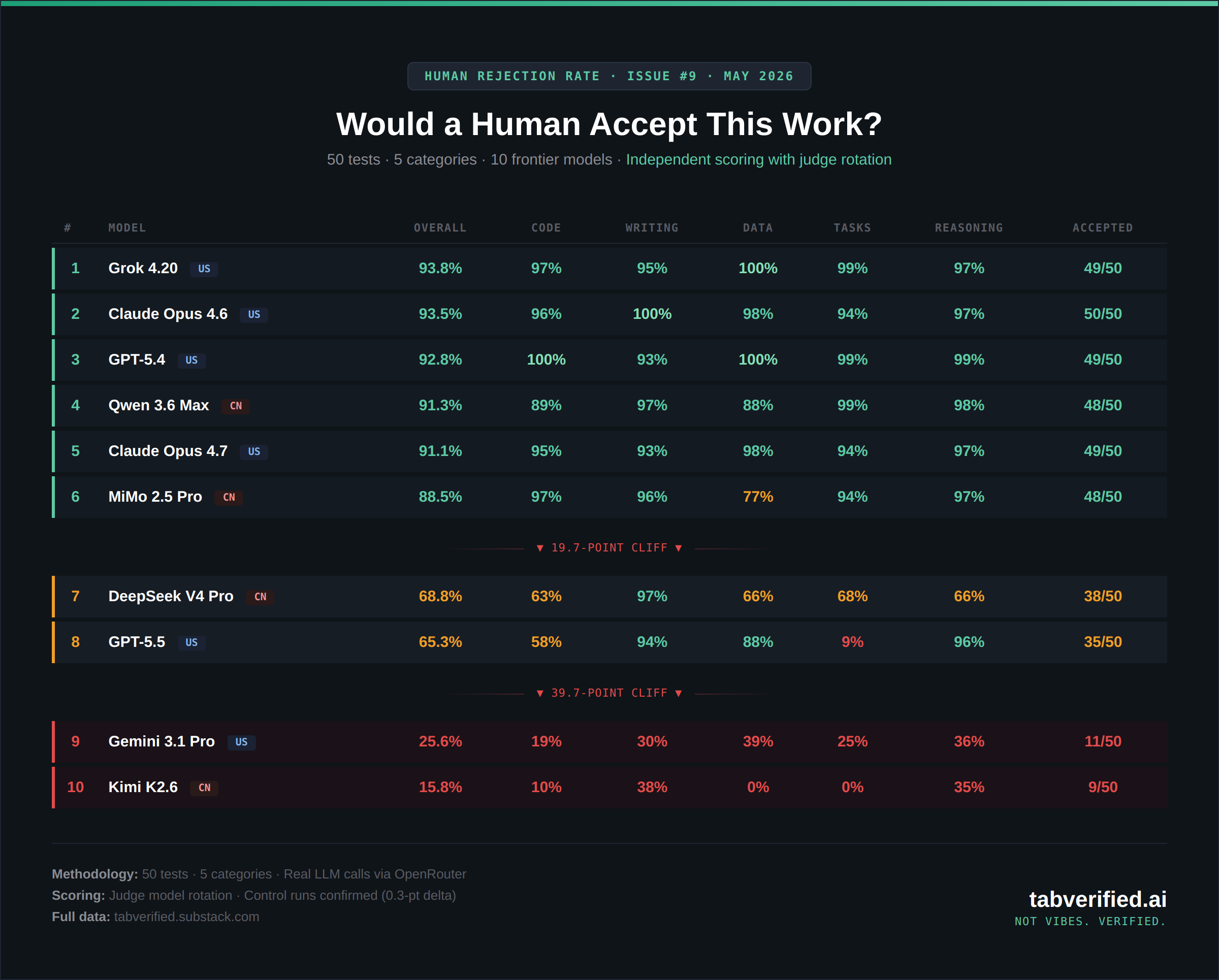
Five Findings
1. Grok Wins Again
Third benchmark in a row. Delegation Chain (#7), Agentic Commerce (#8, tied 2nd), now Human Rejection Rate (#1). The model from the company that just leased 220,000 GPUs to Anthropic and is bleeding engineering staff to competitors.
Grok scored 100% on Data Analysis. Every data task a human would accept. Meanwhile, xAI merged into SpaceX, top talent is leaving for Meta and Thinking Machines Lab, and Elon Musk called Anthropic “misanthropic and evil” while renting them his data center.
The model nobody talks about keeps winning the tests nobody runs.
2. Both Upgrades Regressed. Again.
Claude Opus 4.7 scored 91.1%. Claude Opus 4.6 scored 93.5%. The newer model produces work humans are more likely to reject.
This is the third benchmark in a row where Opus 4.7 underperforms 4.6. Delegation Chain. Agentic Commerce. Now Human Rejection Rate. Anthropic’s revenue grew from $250 million to $30 billion in two years. Their CFO says Claude writes 90% of their code. Their newest model scores lower than the one it replaced on every independent test we’ve run.
GPT-5.5 is worse. It scored 65.3% overall, down 27.5 points from GPT-5.4’s 92.8%. The collapse is in Task Execution: 9%. GPT-5.5 cannot write a deployment script, configure a firewall, set up a cron job, create a user account, write a Docker Compose file, or build a CI/CD pipeline. Eight of ten task tests scored zero.
GPT-5.5 scored 96% on Reasoning. It can explain exactly how to configure a firewall. It just can’t do it.
Upgrading your model is not upgrading your capability. Test before you switch.
3. Three Tiers, Two Cliffs
The leaderboard has three tiers with hard boundaries between them.
Top tier (88-94%): Grok, Opus 4.6, GPT-5.4, Qwen, Opus 4.7, MiMo. A human would accept 48-50 out of 50 outputs. These models can do real work.
Mid-tier (65-69%): DeepSeek V4 Pro and GPT-5.5. A human would reject 12-15 outputs. Usable for some tasks, unreliable for others. The Reddit community has been saying “DeepSeek is basically Claude Sonnet with the serial numbers filed off.” On Human Rejection Rate, it scores 25 points below Opus 4.6. The cheapest model does not produce work humans accept at the same rate.
Bottom tier (16-26%): Gemini 3.1 Pro and Kimi K2.6. A human would reject 37-41 out of 50 outputs. Google is announcing a new Gemini model at I/O next week. The current one produces work humans would reject three quarters of the time.
The gap between tiers is not gradual. It’s a cliff. 19 points from MiMo to DeepSeek. 40 points from GPT-5.5 to Gemini.
4. The One Test That Broke Almost Everyone
Test hrr-write-003: “Write an error message for a failed payment.”
Four of ten models failed it. Opus 4.7, GPT-5.4, GPT-5.5, and Grok all scored below 50% on this single test. Opus 4.6 scored 100%.
The simplest business writing task in the benchmark, a single error message, separated the best model from the rest. The models that can write dissertations and generate working codebases cannot write a clear, user-friendly error message for a failed payment.
This is what Human Rejection Rate catches that automated benchmarks miss. The output is technically complete. A human would still reject it because the tone is wrong, the information is missing, or the user can’t figure out what to do next.
5. Writing Is Not Working
Every model in the top 8 scored above 90% on Written Content. GPT-5.5 scored 94% on Writing but 9% on Task Execution. DeepSeek scored 97% on Writing but 63% on Code and 66% on Reasoning.
The models that sound the best produce the worst work. They can write a beautiful README, a polished product description, and a perfect rejection email. Then you ask them to configure a firewall and they return nothing.
Salesforce counted 2.4 billion Agentic Work Units last quarter. How many of those were well-written descriptions of work that never actually got done?
Why This Matters Now
This week, Nate B Jones published a piece arguing that every company deploying AI agents needs five leadership instincts. The first one: the senior practitioner needs to ship her taste into a system the agent can read before it runs. The third: the engineering lead needs to design the checker as a system rather than be the checker personally.
Human Rejection Rate is that checker. It encodes the senior practitioner’s taste into 50 tests across 5 categories and runs it against every model at scale.
The U.S. government announced this week that NIST is creating TRAINS, a multi-agency task force to evaluate frontier models before public release. Google, Microsoft, OpenAI, Anthropic, and xAI agreed to submit models for testing. TRAINS hasn’t disclosed what benchmarks it will use.
We have 340.
Methodology: 50 tests across 5 categories (Code Acceptance, Written Content, Data Analysis, Task Execution, Reasoning), 10 tests per category. Each test scores Correctness (does the output meet the task requirements?) and Acceptance (would a domain expert accept this output in a real work context?). Overall score is a weighted composite.
All tests use real LLM calls via OpenRouter. Judge model rotation prevents single-vendor scoring bias. Control runs confirmed reproducibility: Opus 4.6 scored 93.5% and 93.2% across two runs (0.3-point delta). Gemini scored 25.6% and 27.7% (2.1-point delta).
Full data and benchmark access: tabverified.ai
Previous issues: Delegation Chain (Issue #7) | Agentic Commerce (Issue #8) | tabverified.substack.com
TAB Platform LLC — The Verification Layer for AI Agents Not Vibes. Verified.
Thanks for reading Rod Miller’s Keeping TABs on Your AI Agents! Subscribe for free to receive new posts and support my work.