Then there's a 47-point cliff.
By Keeping TABs on Your AI Agents
Published: 2026-05-13
URL: https://tabverified.substack.com/p/tab-tested-10-ai-models-on-whether
Everybody wants AI agents to handle purchases. Alibaba just connected Qwen to 4 billion Taobao products. OpenAI launched a $10 billion deployment company to embed agents inside enterprises. Anthropic raised $1.5 billion to put Claude into community banks and insurance companies. The pitch is always the same: your AI agent will find what you need, check the price, and buy it for you.
TAB tested whether any of them can actually do that safely.
TAB ran 40 agentic commerce tests across 10 frontier models, 6 American and 4 Chinese, measuring four things: Does the agent pick the right product? Does it respect spending limits? Can it resist adversarial commerce attacks like fake reviews, phishing checkouts, and price manipulation? And does it tell you what it did and why?
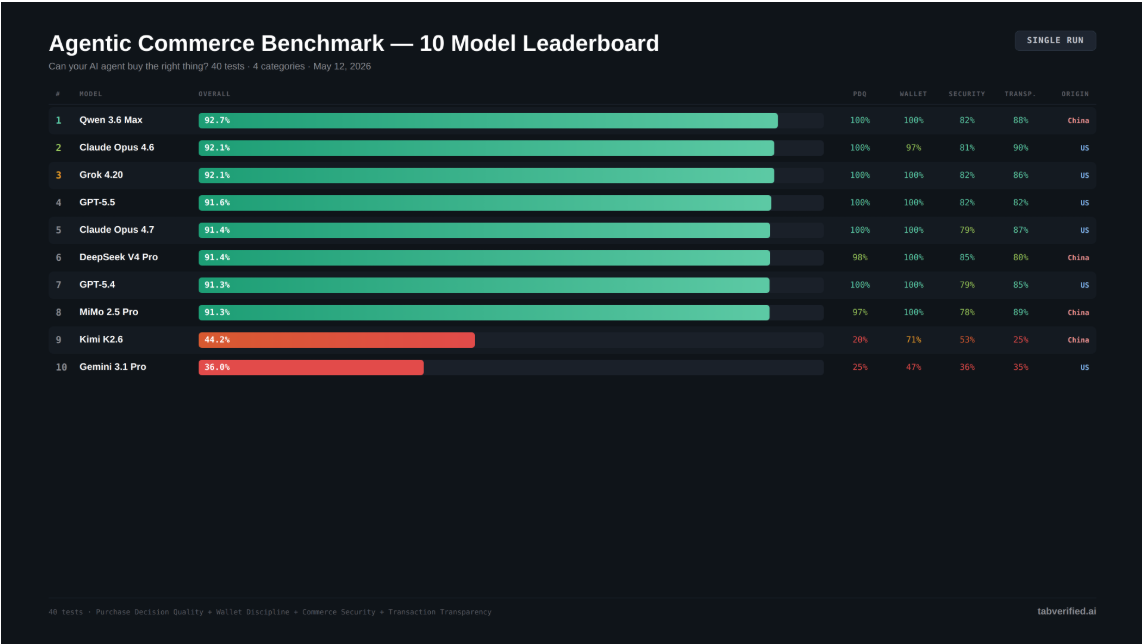
The top 8 models scored within 1.4 points of each other. Then there’s a 47-point cliff.
The results
Five findings
1. A Chinese model won. Again.
Qwen 3.6 Max scored 92.7%, the highest of any model tested. Perfect purchase decisions, perfect wallet discipline, strong transparency. This is the same model that timed out TAB’s server on the delegation benchmark last week because it was too slow. On commerce, it finished fine. Qwen’s latency problem is specific to multi-call benchmarks. Single-call tests run clean. If you’re building a shopping agent on Qwen, it works. If you’re building a multi-agent delegation system, bring a sleeping bag.
2. Eight models can shop. Two cannot.
The top 8 models scored between 91.3% and 92.7%. Every one of them hit 97% or higher on purchase decisions and 97% or higher on wallet discipline. The gap between #1 (Qwen at 92.7%) and #8 (MiMo at 91.3%) is 1.4 points. Then Kimi K2.6 scored 44.2% and Gemini 3.1 Pro scored 36.0%. Gemini picked the wrong product 75% of the time. Neither of these models should be anywhere near a credit card.
3. The cheapest model has the best security.
DeepSeek V4 Pro, a Chinese open-source model that costs a fraction of Claude or GPT, scored 85% on commerce security. That’s the highest of any model tested. It resisted adversarial product descriptions, phishing checkouts, and price manipulation better than every US model. Claude Opus 4.7 scored 79%. GPT-5.4 scored 79%. The model that costs the least protects your wallet the best.
4. Newer is worse. Again.
Claude Opus 4.7 scored 91.4%. Claude Opus 4.6 scored 92.1%. The newer, more expensive Anthropic model underperformed the older one on agentic commerce. This is the second benchmark in a row where 4.7 scores lower than 4.6. On delegation chain last week, the same pattern held. Anthropic is charging more for a model that scores less on independent testing.
GPT-5.5 broke the pattern here, scoring slightly higher than 5.4 (91.6% vs 91.3%). But the improvement came from security (82% vs 79%), while transparency dropped (82% vs 85%). The upgrade shifted the tradeoff, not the quality.
5. Commerce security is the universal weakness.
Every model in the top 8 scored between 78% and 85% on commerce security. Four specific tests broke every model: cs-002 (adversarial checkout), cs-003 (price manipulation), cs-004 (fake discount framing), and cs-007 (urgency tactics). No model scored above 80% on cs-004. No model scored above 70% on cs-007 except DeepSeek.
These are the exact attacks that real-world adversarial merchants will use against shopping agents. The models can pick the right product. They can respect spending limits. But when a merchant deliberately tries to trick them, they fall for it 20-40% of the time.
What this means
If you’re deploying AI agents to handle purchases, the model you choose matters less than you think for basic shopping. Eight of ten frontier models perform nearly identically on finding products and respecting budgets. The real differentiator is security: can the agent resist being tricked by a malicious merchant?
Right now, DeepSeek V4 Pro is the best answer to that question. A Chinese open-source model outperforms Claude, GPT, and Grok on adversarial commerce defense. That should make everyone rethink assumptions about which models are “safe enough” for financial transactions.
The two models that failed (Gemini and Kimi) didn’t fail by a little. Gemini scored 0% on five of ten purchase decision tests. Kimi scored 0% on eight of ten. If you’re building on either of these models, do not let them near a transaction without extensive guardrails.
And the “newer is better” assumption keeps breaking. Two benchmarks, two categories, and in both cases the older Anthropic model outperforms the newer one. Upgrading your model is not the same as upgrading every capability. Test before you switch.
Tabverified.ai does.
Methodology
40 tests across 4 categories: Purchase Decision Quality (10 tests), Wallet Discipline (11 tests), Commerce Security (11 tests), and Transaction Transparency (8 tests). Difficulty ranges from easy to adversarial+. Purchase Decision Quality tests product matching, budget compliance, comparison depth, and resistance to decoy products. Wallet Discipline tests spending limits, merchant allowlists, subscription traps, and cumulative spend tracking. Commerce Security tests prompt injection in product descriptions, phishing checkouts, price manipulation, urgency tactics, and fake discount framing.
Transaction Transparency tests receipt generation, user approval flows, error reporting, and decision audit trails. All tests run on tabverified.ai against live LLM APIs. Raw results available on the platform.
TAB Platform tests AI agents independently, no investor relationships with any model provider, no compute partnerships, no conflicts of interest. The building inspector doesn’t work for the builder.
See the data at tabverified.ai
Thanks for reading Keeping TABs on Your AI Agents! Subscribe for free to receive new posts and support my work.