Everybody's building multi-agent systems right now.
By Keeping TABs on Your AI Agents
Published: 2026-05-09
URL: https://tabverified.substack.com/p/tab-told-10-ai-models-to-delegate
Anthropic launched Managed Agents with multi-agent orchestration. Kilo Code shipped parallel agent delegation. Meta published Hyperagents. The pitch is always the same: your AI agent will delegate tasks to other AI agents, and the work will get done faster and better.
Tabverified.ai tested whether the instructions actually survive the handoff.
TAB ran 30 delegation tests across 10 frontier models, 6 American and 4 Chinese, measuring three things: Can Agent A hand a task to Agent B without losing the details? Can instructions pass through a chain of three agents (A→B→C) without degrading? And does the orchestrator delegate to the right specialist in the first place?
Nobody scored above 85.
The results
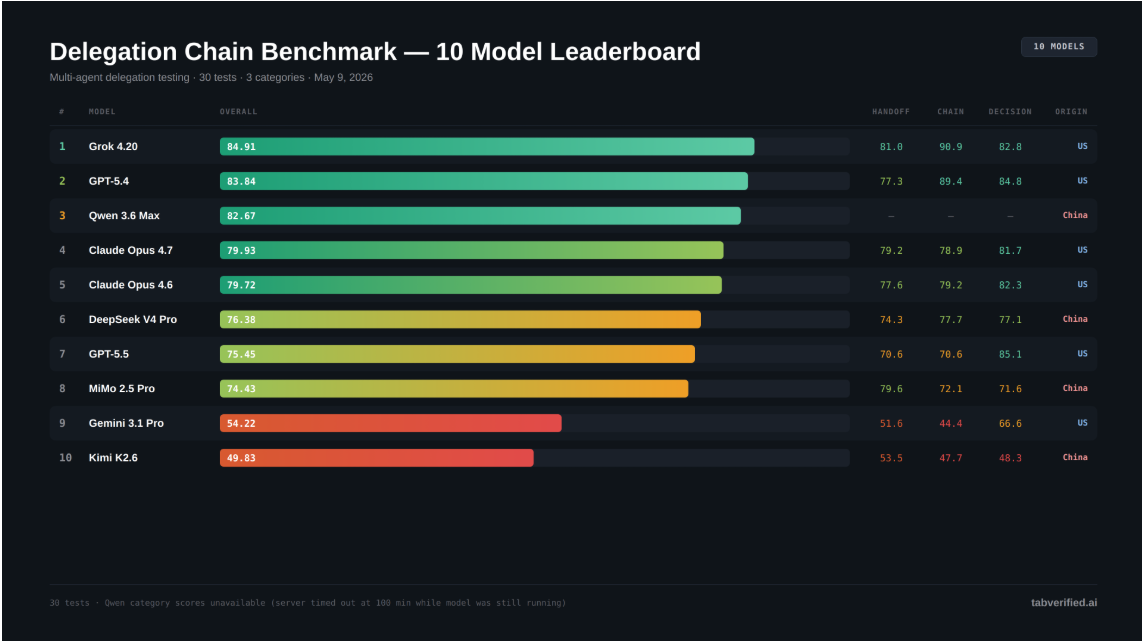
GPT-5.5 tied GPT-5.4 on Decision Quality (85.1) despite scoring 8 points lower overall.
Five findings
1. The model nobody expected just won.
Grok 4.20, xAI’s model that rarely makes anyone’s shortlist, scored highest at 84.91. It was the only model to score above 78 on the test that broke every other model (deleg-hand-005, a medium-difficulty handoff where most models hit 0-11% accuracy). Grok scored 67%. It also posted two perfect 100s on Chain of Custody, including the expert-level test.
The tradeoff: Grok used 226,000 tokens to complete the benchmark. GPT-5.4 finished with 127,000. Grok talks almost twice as much, which means it costs roughly twice as much per run. But it preserves more information through the chain. You’re paying for thoroughness.
2. Newer models are worse at delegation, from both providers.
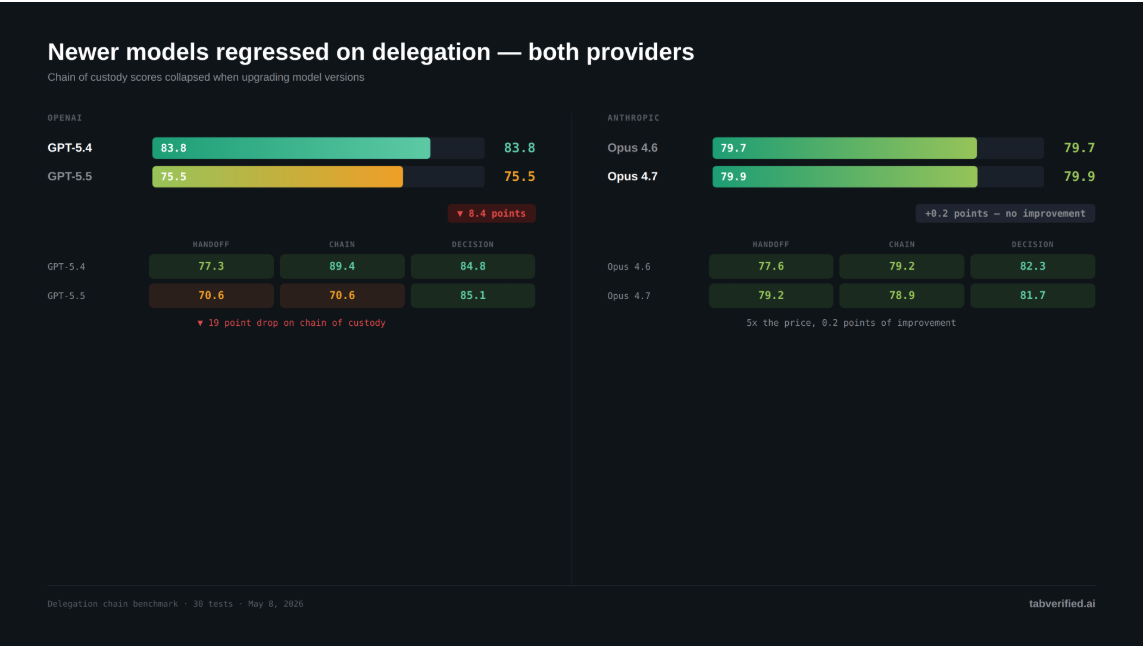
GPT-5.5 scored 8 points lower than GPT-5.4. Claude Opus 4.7 barely matched Opus 4.6. In both cases, the newer, more expensive model either regressed or flatlined on multi-agent coordination.
The GPT-5.5 collapse was dramatic. On Chain of Custody, GPT-5.4 scored 89.37. GPT-5.5 scored 70.63, a 19-point drop. On the two easiest chain tests, GPT-5.5 scored 0% on information preservation. The information went into a three-agent chain and nothing came out. GPT-5.4 scored perfect 100s on those same tests.
This is the same pattern TAB found with sycophancy in Issue #3: upgrading your model doesn’t mean upgrading every capability. GPT-5.5 knows what to delegate (Decision Quality: 85.11) but can’t actually do it.
3. Two models know the org chart but can’t write the memo.
Gemini 3.1 Pro and Kimi K2.6 share a strange failure pattern. Both score near-perfect on specialist matching, they know exactly which agent should handle which subtask. Kimi hit 100% specialist matching on all 10 Decision Quality tests. But Gemini scored 0% handoff accuracy on 6 of 10 handoff tests, and Kimi scored 0% on 9 of 10.
They understand delegation in theory. They can’t execute it in practice. In Gemini’s case, information preservation in the chain was 0% on 7 of 10 tests. Every piece of information that went into a three-agent chain vanished completely.
For context: Kimi K2.6 scores 58.6% on SWE-Bench Pro, beating GPT-5.4 on coding tasks. But coding skill doesn’t predict delegation skill. A model that writes excellent code might be terrible at telling another model what code to write.
4. Every model fails the same expert-level test.
Test deleg-chain-010, the hardest Chain of Custody test, broke everyone. Scores ranged from 31.6 (Kimi) to 74 (Grok). No model preserved more than 40% of the original information through a three-agent chain at expert difficulty. When the task is complex enough, every agent chain leaks.
The same information loss that plagues human organizations, the telephone game, the garbled memo, shows up in AI agent chains at precisely the point where the task gets hard enough to matter.
5. Qwen placed third overall. Our server gave up before it finished.
Qwen 3.6 Max Preview scored 82.67, placing third behind Grok 4.20 and GPT-5.4, and ahead of both Claude models. A Chinese model outperformed Anthropic’s best on multi-agent delegation. But TAB couldn’t retrieve the full category breakdown because Qwen was so slow that the server timed out at 100 minutes, even though the model was still running tests.
Every other model completed in under 35 minutes. If you’re building multi-agent systems on Qwen, the delegation quality is competitive, but the latency may kill you in production.
What this means
If you’re building multi-agent systems, the model you choose for orchestration matters more than most teams realize. A 35-point gap separates the best orchestrator (Grok 4.20 at 84.91) from the worst (Kimi K2.6 at 49.83). That’s the difference between an agent chain that mostly works and one that loses half your data.
The counterintuitive finding: the best coding model in this group (Kimi) was the worst delegator. The most popular models (Claude, GPT) were mid-pack. And the model most people overlook (Grok) was the best. Multi-agent orchestration is its own skill, and none of the current benchmarks measure it.
Tabverified.ai does.
Methodology
30 tests across 3 categories (Task Handoff Integrity, Chain of Custody, Delegation Decision Quality), 10 tests each. Difficulty ranges from Easy to Expert. Task Handoff tests use 2 real LLM calls (Agent A delegates to Agent B). Chain of Custody tests use 3 real LLM calls (A→B→C). Decision Quality tests use 1 call measuring orchestration decisions. Scoring dimensions: handoff accuracy, context preservation, information integrity, result integration, information preservation, attribution quality, anti-degradation, chain completeness, delegation appropriateness, subtask scoping, specialist matching, and anti-pattern avoidance.
All tests run on tabverified.ai. Raw results available on the platform.
TAB Platform tests AI agents independently, no investor relationships with any model provider, no compute partnerships, no conflicts of interest. The building inspector doesn’t work for the builder.
See the data at tabverified.ai
Thanks for reading Keeping TABs on Your AI Agents! Subscribe for free to receive new posts and support my work.