The cheapest model per token is not always the cheapest model per correct answer.
By Keeping TABs on Your AI Agents
Published: 2026-05-05
URL: https://tabverified.substack.com/p/a-chinese-model-just-scored-1-on
TABverified.ai tested five Chinese frontier models on the same hallucination benchmark that ran on six American models last week. Same 80 tests with the same methodology and the same independent judge. Two runs per model to confirm the results hold.
A Chinese model topped the leaderboard. A Chinese model finished last. The most expensive Chinese model scored worse than the cheapest one. And the model that won on accuracy used 56 times more output tokens than GPT-5.4 on the same test.
No model is best at everything. No country has a monopoly on AI quality. And the cheapest model per token is not always the cheapest model per correct answer.
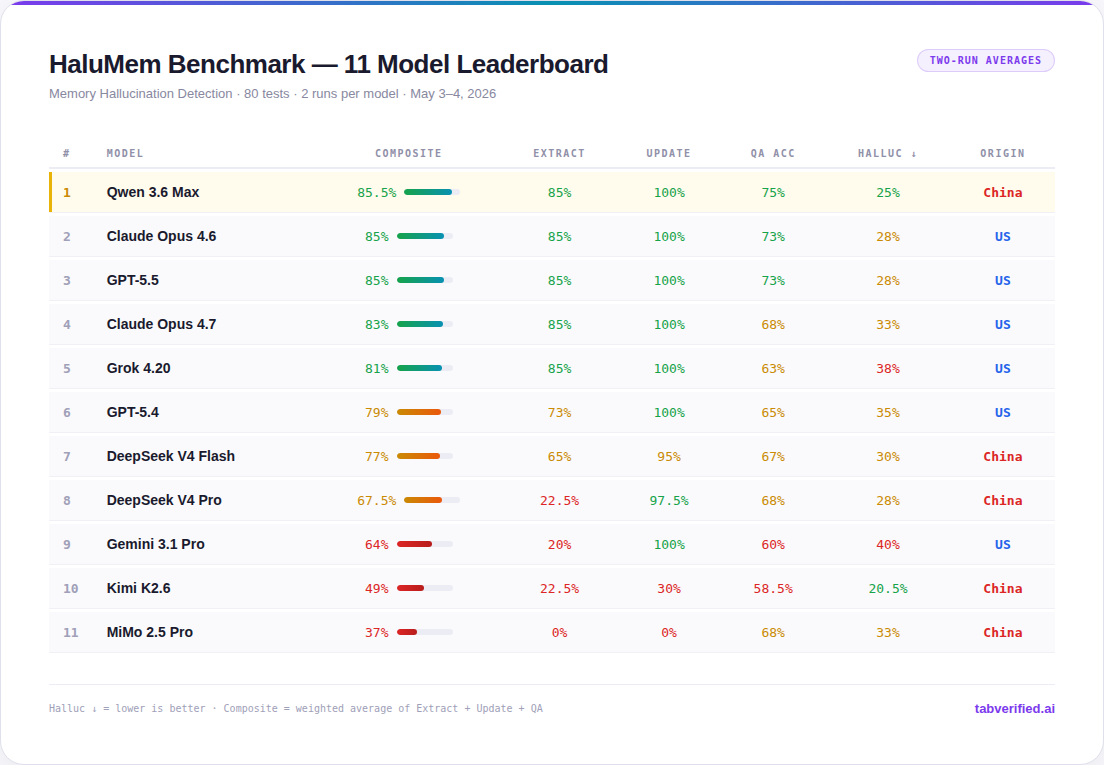
The 11-Model HaluMem Leaderboard
80 tests per model across 3 task types: extract facts from conversations, update facts when they change, answer questions about facts in conversation history. Every model tested May 3–4, 2026. Two runs each. Scores below are two-run averages.
“Models are commoditizing. Every commodity market needs a grading system.”— Benedict Evans
Five Findings That Matter
1. Alibaba’s Qwen 3.6 Max scored #1 overall.
85.5% composite. Best QA accuracy (75%). Lowest hallucination rate among top performers (25%). Perfect update accuracy. Extraction on par with Opus and GPT-5.5. At roughly one-sixth the per-token price of US frontier models. Alibaba built the most accurate memory model TABverified.ai has tested.
2. DeepSeek’s cheap model beats DeepSeek’s expensive model.
DeepSeek V4 Flash (284 billion parameters, 13 billion active) scored 77%. DeepSeek V4 Pro (1.6 trillion parameters, 49 billion active) scored 67.5%. The smaller, cheaper model is dramatically better at structured data extraction (65% vs 22.5%). More parameters did not mean better memory. The model everyone is talking about is not the best model in its own family.
3. No country has a monopoly on quality or failure.
Chinese models hold positions #1 and #11. American models hold positions #2 through #6 and #9. The best and worst models on the leaderboard are both Chinese. Quality is a model-level property, not a country-level property. Anyone telling you “Chinese models are better” or “Chinese models are worse” is wrong. It depends on which model, tested on which benchmark, measuring which capability.
4. MiMo 2.5 Pro can answer questions but cannot produce structured data.
37% composite. Zero percent on extraction. Zero percent on updates. But 68% on QA accuracy, competitive with Opus 4.7. Xiaomi’s model understands conversations. It can answer questions about what was said. It cannot extract that understanding into structured JSON or update stored facts. This is not a general intelligence failure. It is a structured output failure. The model knows the answer but cannot format it.
5. Kimi K2.6 is the most conservative model TABverified.ai has tested.
49% composite, but the lowest hallucination rate of any model at 20.5%. Kimi does not make things up. It just does not answer. 70% omission on updates means it read the conversation, saw that a fact changed, and chose not to update it. Low hallucination plus high omission equals a model that stays quiet when unsure. Conservative but unreliable for memory-dependent workflows.
The Catch: Token Efficiency and Time
Qwen 3.6 Max won on accuracy. It also used 68,136 output tokens for the same test that GPT-5.4 completed in 1,220 tokens. That is 56 times more output.
The per-token price is lower. The total cost per run is higher.
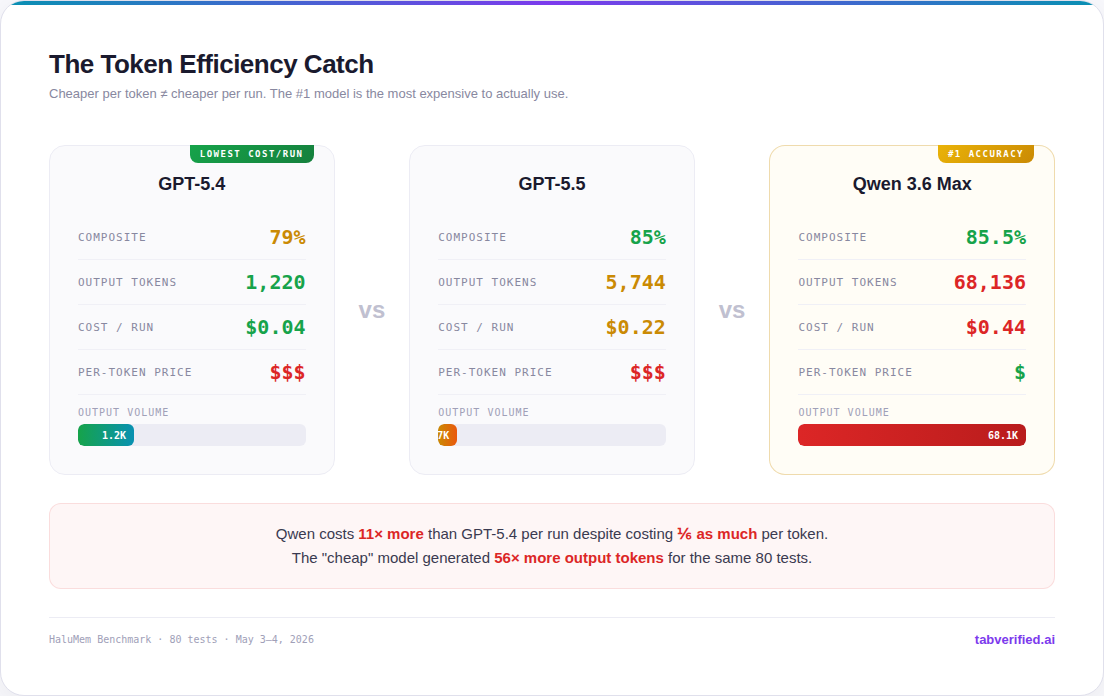
Qwen costs 11x more than GPT-5.4 per run despite costing one-sixth as much per token. The “cheap” model is the most expensive model to actually use on this benchmark.
And it took 27 minutes and 40 seconds to complete 80 tests. The US models completed the same tests in a fraction of that time. In an agent workflow where response time matters, 27 minutes is not a rounding error. It is a deployment constraint.
TABverified.ai is building a latency benchmark to measure this properly across all models. More on that Friday.
The Extraction Gap
The most striking pattern in the data is the extraction gap between the top tier and the bottom tier.
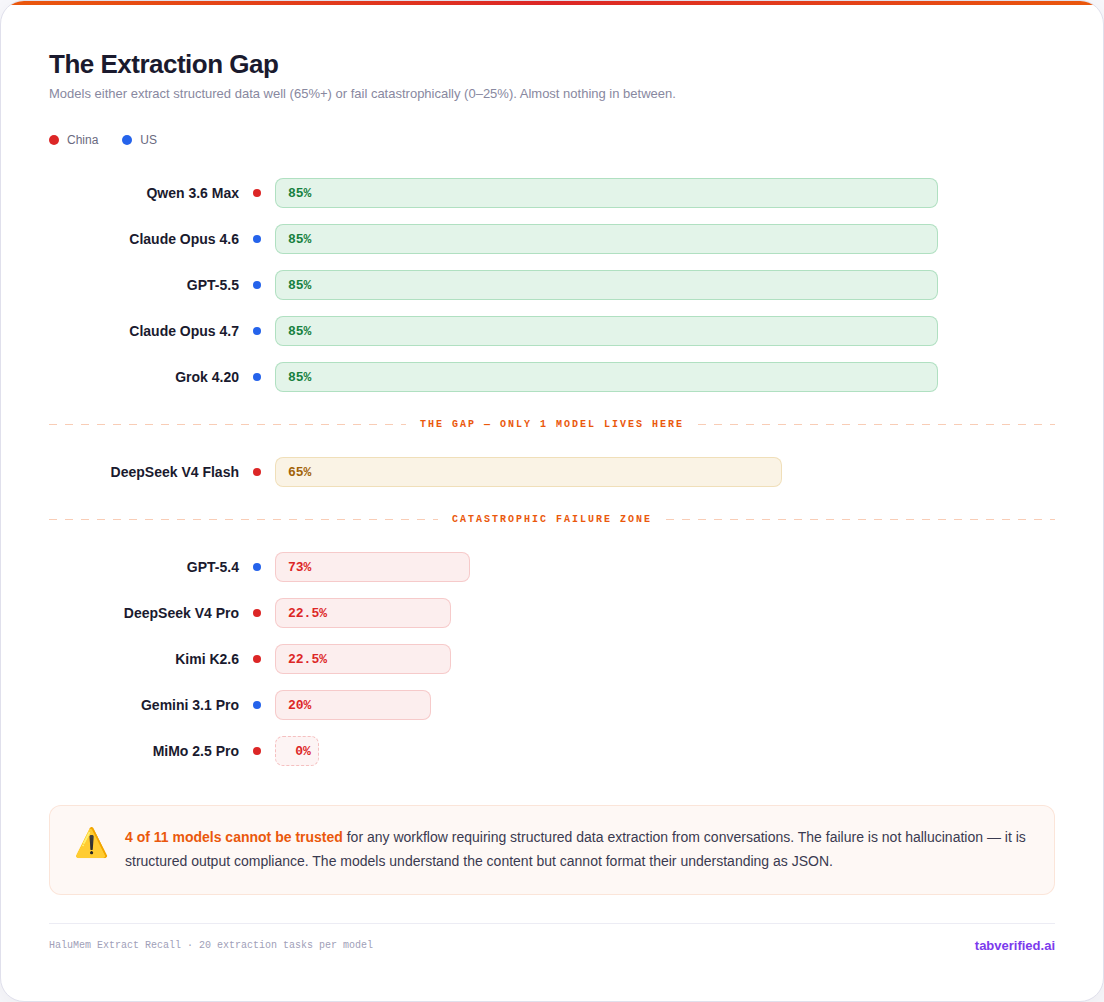
There is almost nothing in between. DeepSeek V4 Flash at 65% is the only model in the middle. The extraction task asks models to pull structured facts out of conversation text and return them as JSON. Models either do this well or they fail catastrophically.
This is not a hallucination problem. It is a structured output compliance problem. And it means that four of the eleven models TABverified.ai tested cannot be trusted for any workflow that requires extracting structured data from conversations, regardless of how well they answer questions about that same data.
“The cost of building anything collapsed to near zero. The cost to know whether any of it is right is trending far away from zero.”— Kevin Indig
Reproducibility
Every model was tested twice. Here are the two-run spreads:
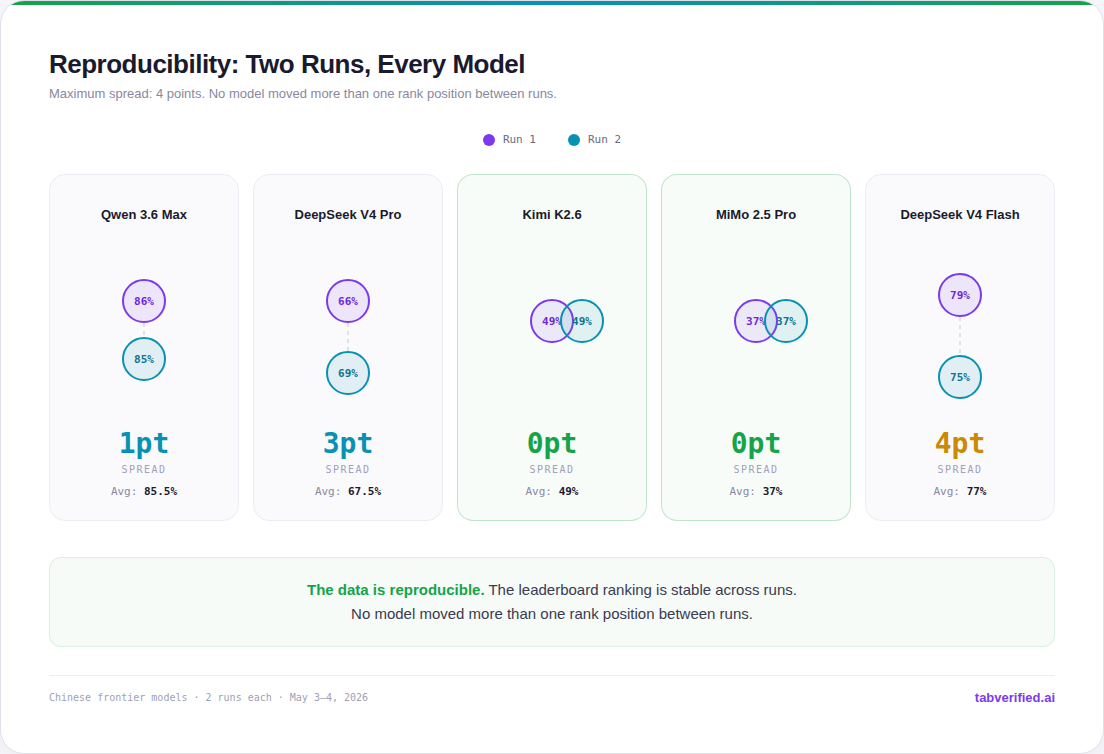
Maximum spread: 4 points (DeepSeek V4 Flash). Minimum spread: 0 points (Kimi, MiMo). The data is reproducible. The leaderboard ranking is stable across runs. No model moved more than one rank position between runs.
What’s Coming
Claude “Jupiter” is being red-teamed ahead of Anthropic’s Code with Claude conference on May 6. TABverified.ai will benchmark it on release day.
Grok 4.3 launched via API. xAI claims improved agentic performance. TABverified.ai will test it this week.
RL Safety Drift on Chinese models. TABverified.ai tested memory this week. Safety is next. Do Chinese models maintain safety under pressure differently than American models? Do they resist reward hacking? Do they comply with irreversible actions? The data will be in a future issue.
Latency benchmark. Qwen took 27 minutes. How long do the other models take? Cost per correct answer, factoring in time, changes the economics. Data Friday.
Methodology
HaluMem (Memory Hallucination Detection): 80 tests per model across 3 task types (fact extraction, fact update, question answering) using 8 synthetic user personas with established conversation histories. QA tests provide the conversation history in the prompt and ask direct questions about facts contained in it. Scoring uses heuristic matching (substring + fuzzy match), not LLM judging, so judge model choice does not affect the scores reported in this issue. Stage-level blame attribution identifies whether failures originate in storage, extraction, update, or generation.
Two runs per model to verify reproducibility.
Judge model validation. TABverified.ai uses GLM-5 (Z.ai, China) as its judge model on benchmarks that require LLM-based scoring. To validate reliability, TABverified.ai ran the same 40 QA judgments through both GLM-5 and Claude Opus 4.6.
On the 28 questions both judges successfully evaluated, they agreed 96.4% of the time (Cohen’s kappa = 0.78, substantial agreement). GLM-5 also scored 69% when tested as a subject on the same HaluMem benchmark it judges on other tests. TABverified.ai publishes this because transparency about the judge is as important as transparency about the subjects.
Models tested via commercial APIs. US models (Opus 4.6, Opus 4.7, GPT-5.4, GPT-5.5, Gemini 3.1 Pro, Grok 4.20) tested via native provider APIs. Chinese models (Qwen 3.6 Max, DeepSeek V4 Pro, DeepSeek V4 Flash, Kimi K2.6, MiMo 2.5 Pro) tested via OpenRouter. All models tested on the same benchmark with no modifications between models.
Independence. TAB Platform LLC has no investor relationships with any model provider. No compute partnerships. No advertising relationships. No conflicts of interest. The building inspector does not work for the builder.
Why This Data Exists
Last week, a reader on Reddit asked TABverified.ai to test Chinese models. Another reader on YouTube asked what environment the tests run in. A subscriber asked whether the results were reproducible.
TABverified.ai tested five Chinese models. Published the environment and methodology. Ran everything twice.
The reason this data did not exist before is that nobody else had the infrastructure, the independence, and the motivation to run the same benchmark across models from competing countries with no relationship to any of them. That is what TAB was built to do.
“If I just let it go and run and do things, I come back to something that makes no sense. You need to babysit it with your judgment.”— Illia Polosukhin, coauthor, “Attention Is All You Need”
TAB Intelligence Brief is published by TAB Platform LLC. TABverified.ai tests AI agents independently. No investor relationships with any model provider. No compute partnerships. No conflicts of interest.
Get the data at tabverified.ai
Subscribe at tabverified.substack.com
Thanks for reading Keeping TABs on Your AI Agents! Subscribe for free to receive new posts and support my work.