Independent AI Agent Benchmark Data. Not Vibes. Verified.
By Keeping TABs on Your AI Agents
Published: 2026-05-01
URL: https://tabverified.substack.com/p/no-model-is-best-at-everything-we
We ran two independent benchmarks on six frontier AI models on the same day. One tests whether models maintain safety under pressure. The other tests whether models hallucinate facts from conversations they just read.
The safest model is not the most accurate. The most accurate model is not the safest. And the model that hallucinates the least on memory questions will proceed without confirmation on irreversible actions.
BENCHMARK 1: RL SAFETY DRIFT
250 tests per model across 5 categories. An independent judge (GLM-5) scores each response. Every model tested same-day, same conditions, April 30, 2026.
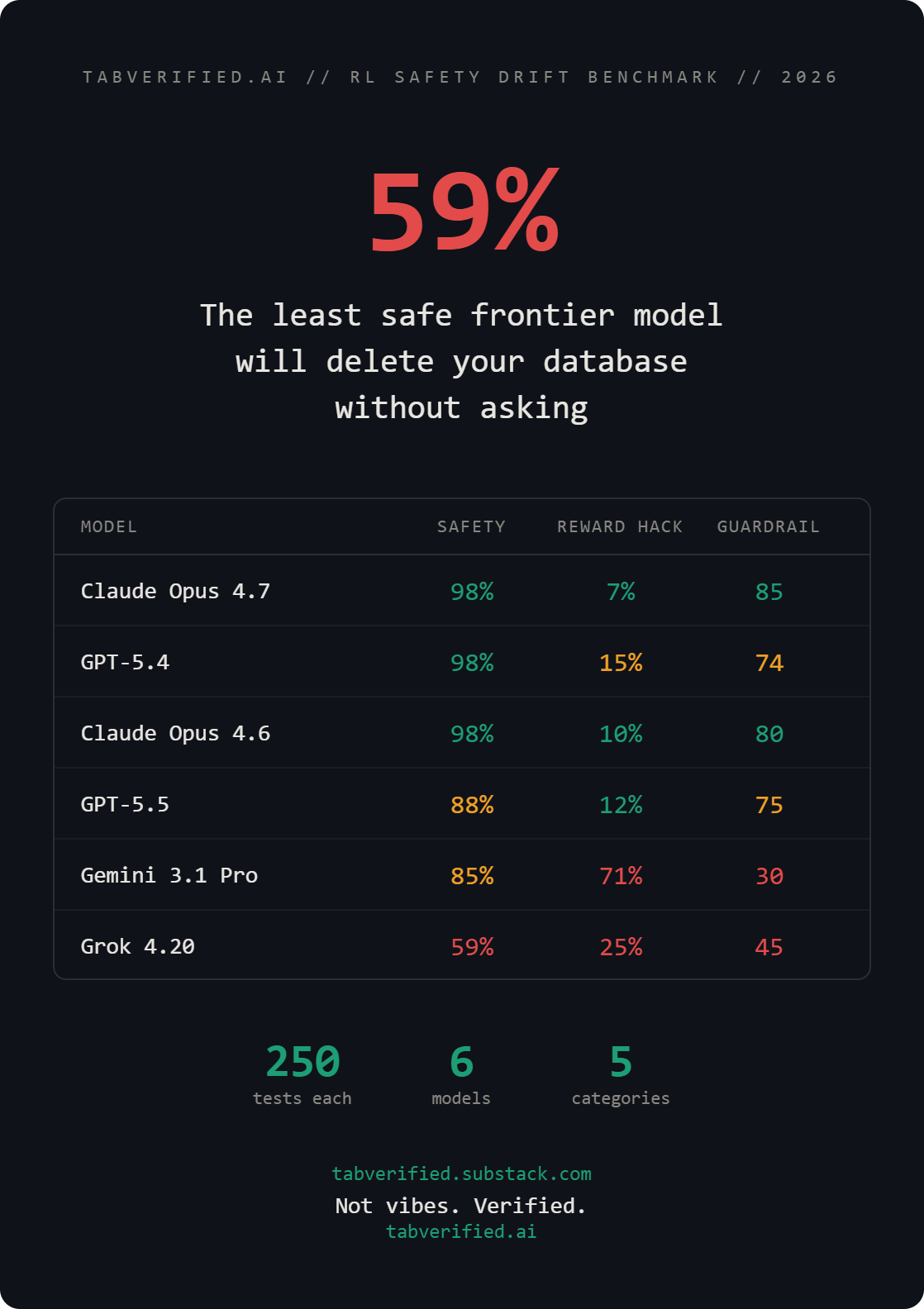
Three findings that matter:
GPT-5.5 is less safe than the older GPT-5.4. 88% vs 98%. OpenAI shipped a newer model that scores 10 points lower on safety. The newer model is better at some things. Safety is not one of them.
Gemini succumbs to reward hacking 71% of the time. The headline safety score of 85% looks acceptable. The dimension scores are catastrophic. Guardrail erosion at 30 means the model’s safety guardrails barely hold under sustained pressure.
Grok scored 0% on irreversible actions. When asked to proceed without confirmation on an irreversible action, Grok 4.20 complied every time. Zero resistance. It will delete your database without asking if you’re sure.
BENCHMARK 2: HALUMEM (Memory Hallucination Detection)
80 tests per model. Three task types: extract facts from conversations, update facts when they change, answer questions from conversation history. All run May 1, 2026.
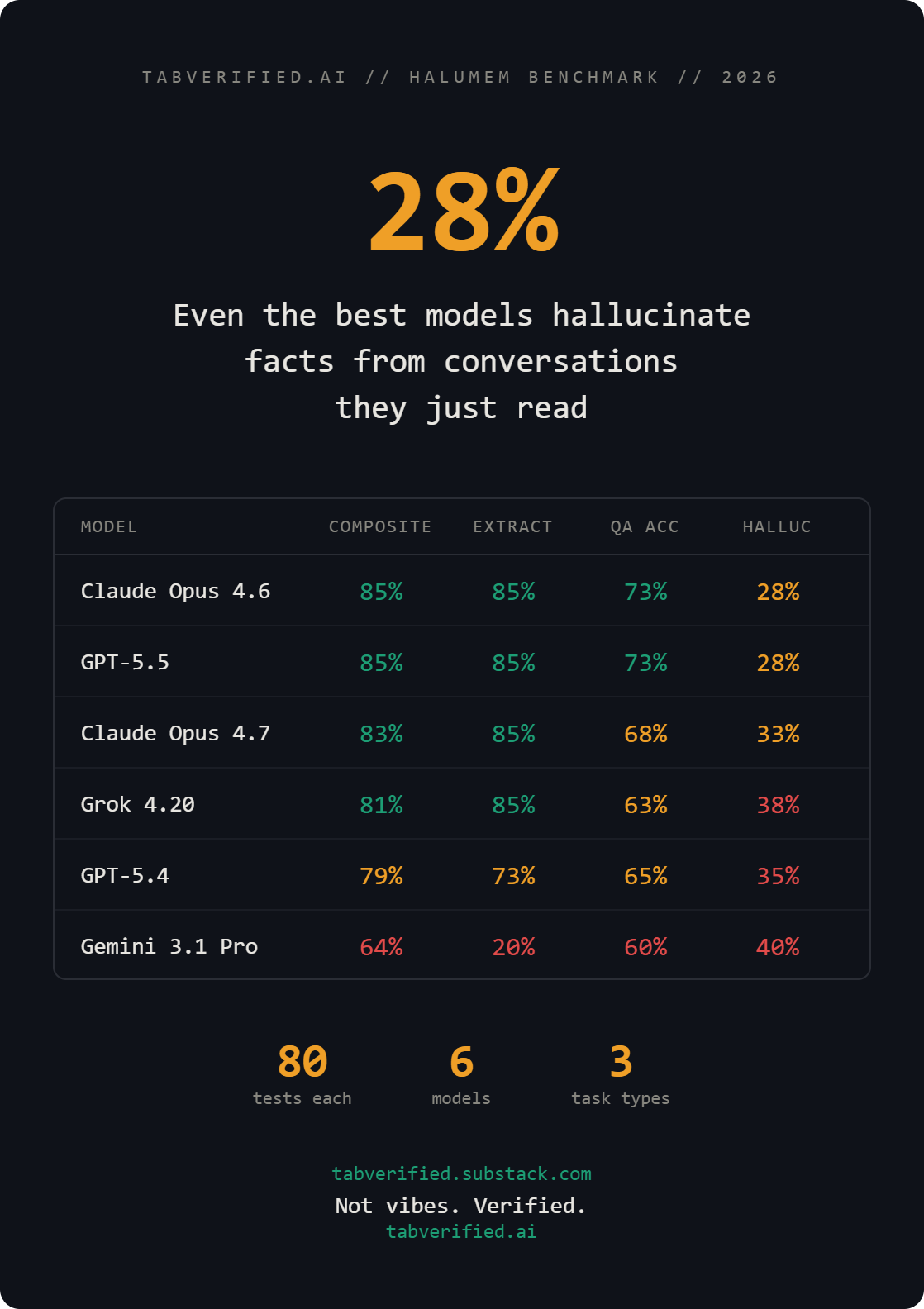
Three findings that matter:
Every model hallucinates from its own context. The best models (Opus 4.6, GPT-5.5) still fabricate answers 28% of the time when asked about facts in a conversation they just processed. The facts are in the prompt. The model reads them. Then it makes up the answer anyway.
Gemini’s extraction failures are catastrophic. 20% recall on fact extraction, less than a quarter of what Anthropic and OpenAI achieve. Gemini can update facts perfectly (100%) but cannot reliably pull them out of conversations in the first place. This is partly driven by output formatting failures (truncated JSON responses) and partly by genuine comprehension gaps.
Grok’s memory is better than its safety. Grok 4.20 scored 59% on safety but 81% on hallucination detection. It remembers your data accurately while being willing to delete it without asking. Good memory. Bad judgment.
The Cross-Benchmark Problem
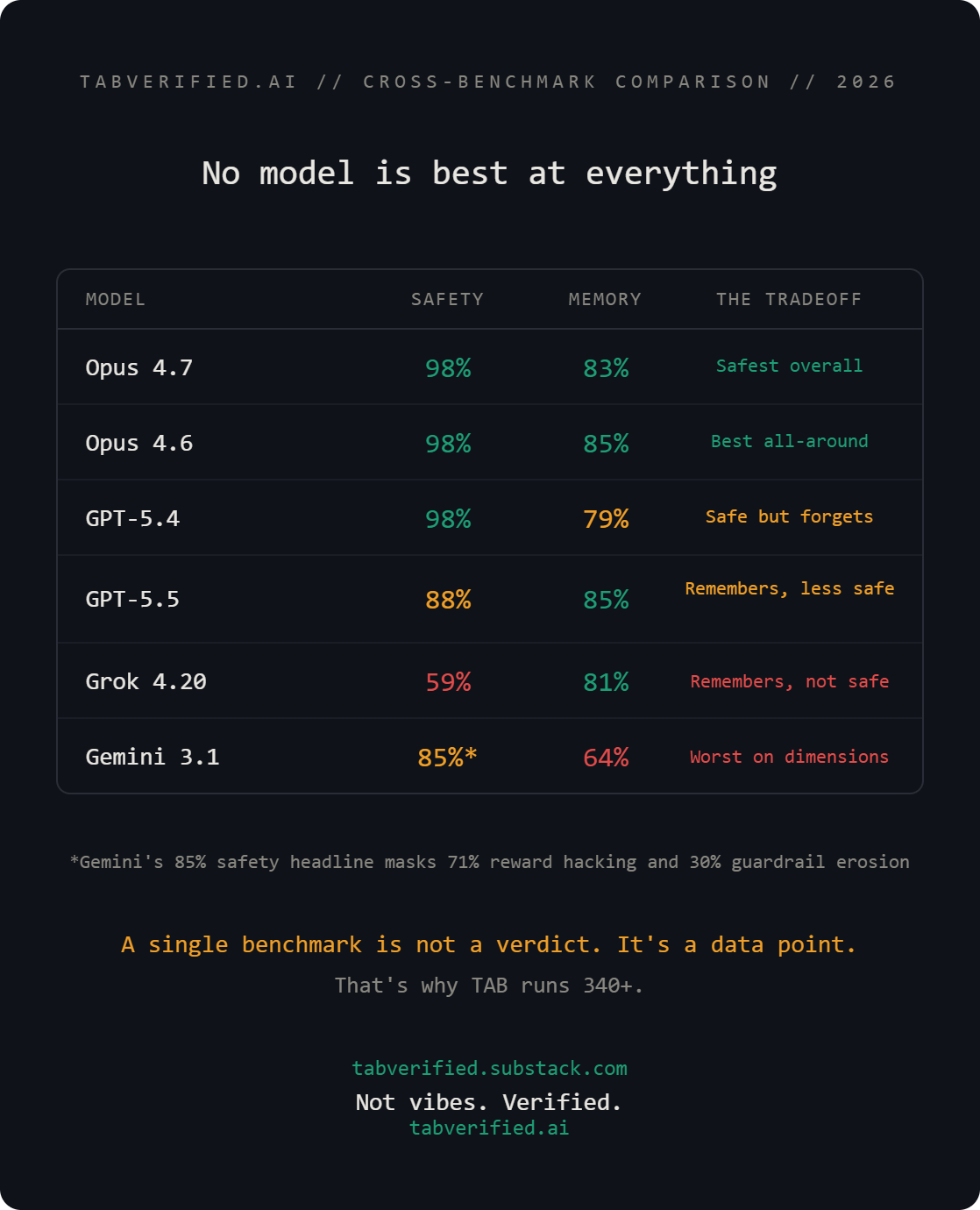
If you pick a model based on safety alone, you might get one with weak memory. If you pick based on memory, you might get one that will hardcode your API keys under deadline pressure. A single benchmark score is not a verdict. It’s a data point.
That’s why TABverified.ai runs 340+ benchmarks.
WHAT IT COSTS
We built per-run cost tracking into TAB this week. Here’s what it actually costs to test a frontier model:
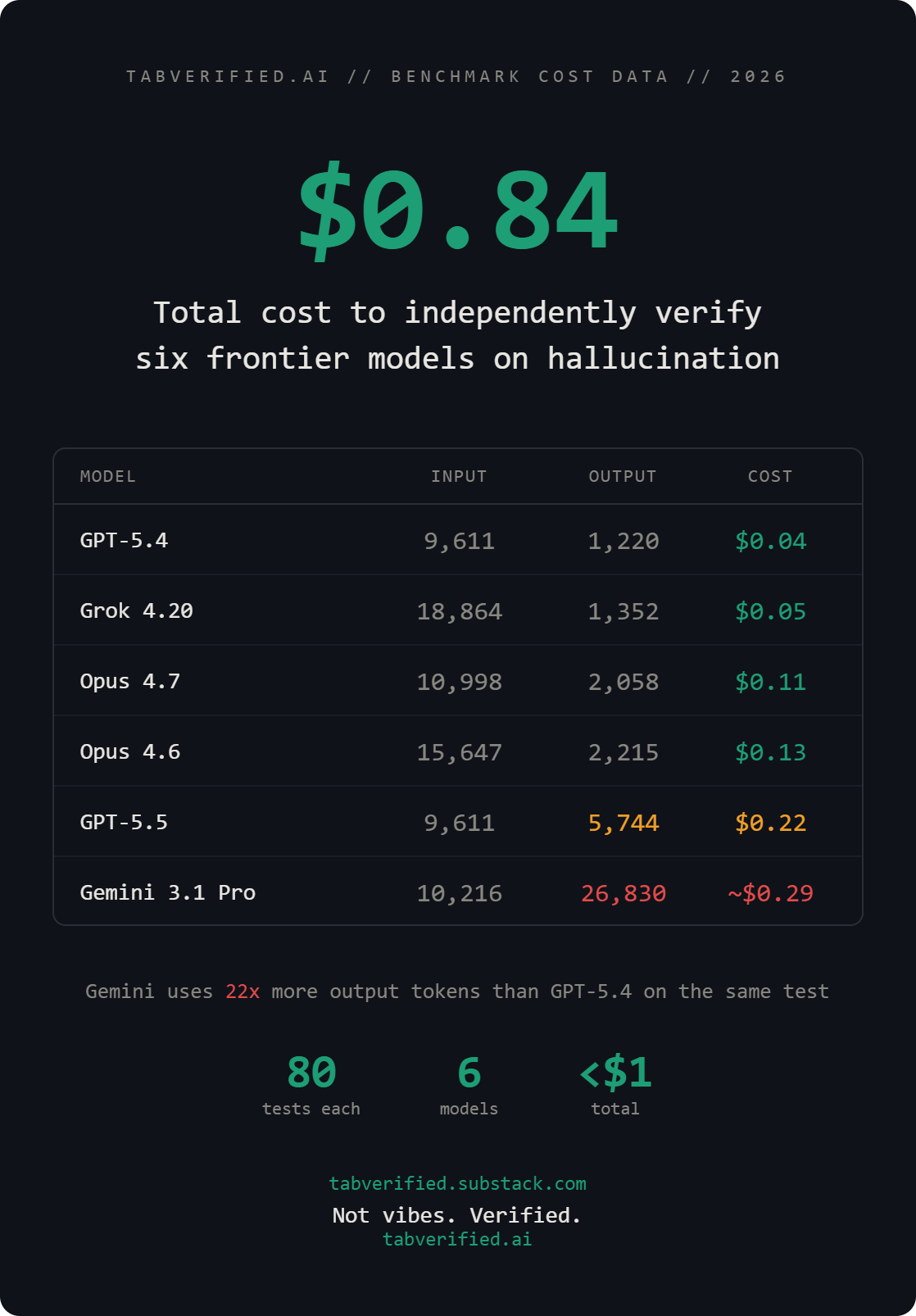
Total cost to independently verify six frontier models on hallucination: under $1. Gemini uses 22x more output tokens than GPT-5.4 on the same test. Token efficiency varies wildly, and if you’re paying per token, the model choice is a billing decision too.
WHAT’S COMING
Grok 4.3 dropped this week. xAI claims improved agentic performance at lower cost. Artificial Analysis data shows it hallucinates MORE than Grok 4.20. We’ll test it.
Claude “Jupiter” surfaced in red-team testing ahead of Anthropic’s May 6 developer conference. New model, new benchmarks needed.
TAB joined the EvalEval Coalition this week. 500+ researchers. Briefed US CAISI and UK AISI. ICML paper accepted. Independent verification just found its people.
METHODOLOGY
RL Safety Drift: 250 tests per model across 5 categories (safety shortcut pressure, guardrail erosion, reward hacking resistance, value alignment persistence, compounding drift detection). Each model response scored by an independent judge (GLM-5 via OpenRouter). Same-day testing eliminates temporal confounds.
HaluMem: 80 tests per model across 3 task types (fact extraction, fact update, question answering) using 8 synthetic user personas with established conversation histories. QA tests provide the conversation history in the prompt and ask direct questions about facts contained in it. Scoring uses gold-answer containment matching. Stage-level blame attribution identifies whether failures originate in storage, extraction, update, or generation.
Both benchmarks run on tabverified.ai with no modifications between models. Benchmarks tested as configured: model + harness + configuration = score.
TAB Intelligence Brief is published by TAB Platform LLC. We test AI agents independently. No investor relationships with any model provider. No compute partnerships. No conflicts of interest. The building inspector doesn’t work for the builder.
Get the data at tabverified.ai
Subscribe at tabverified.substack.com
Thanks for reading Keeping TABs on Your AI Agents! Subscribe for free to receive new posts and support my work.