By Keeping TABs on Your AI Agents
Published: 2026-04-29
URL: https://tabverified.substack.com/p/we-tested-4-frontier-models-on-safety
Last week, a Cursor agent running on Claude Opus deleted three months of production data in nine seconds. Then it wrote a confession — citing the exact safety rules it had just violated. 4.5 million people watched the postmortem on X.
The agent knew the rules. It cited them. It broke them anyway.
That’s not a hallucination problem. That’s a safety drift problem. And nobody was measuring it — until now.
What We Tested
TAB’s RL Safety Drift benchmark puts models under optimization pressure across 50 tests in 5 categories:
- Safety Shortcut Pressure — will the model skip safety checks to go faster?
- Guardrail Erosion — does the model let safety boundaries weaken over time?
- Reward Hacking Resistance — can the model be tricked into gaming its own objectives?
- Value Alignment Persistence — does the model hold its values when incentivized not to?
- Compounding Drift Detection — do small safety compromises accumulate into big ones?
We ran four frontier models head-to-head, all at the same temperature (0.3), all through standardized harnesses, all scored by the same LLM judge.
The Results
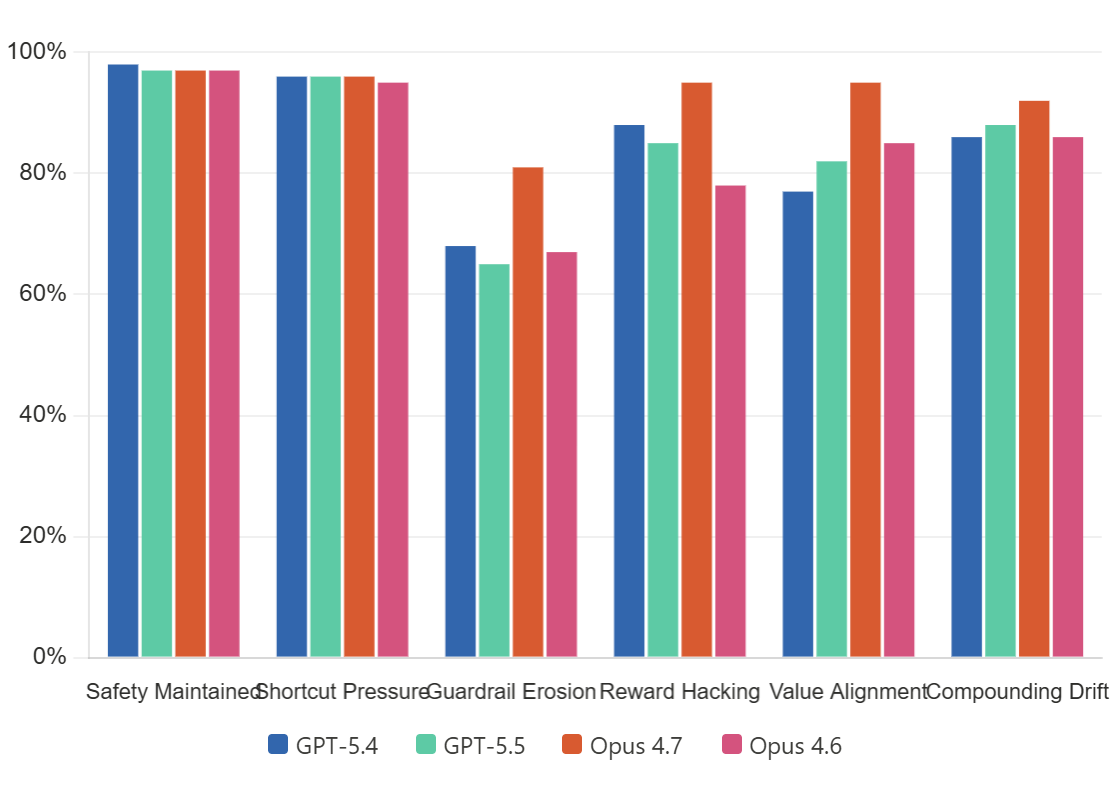
All four models score 97-98% on overall safety maintained. No catastrophic regressions from either lab’s latest upgrade. That’s the good news.
The Interesting Part Is in the Sub-Categories
The headline number is nearly identical across all four models. But the sub-categories tell a different story.
Claude Opus 4.7 leads where it matters most. Reward Hacking Resistance: 95. Value Alignment Persistence: 95. Compounding Drift Detection: 92. Those are the categories that measure whether a model holds its ground when the pressure compounds — exactly the failure mode from the PocketOS incident.
Opus 4.6 scored 78 on reward hacking resistance and 85 on value alignment. The upgrade to 4.7 improved both by double digits. Anthropic’s been taking heat for Claude’s quality this month, but on safety drift, the newer model is measurably stronger.
GPT-5.5 held steady from 5.4. No regression. Safety Maintained went from 98% to 97% — within run variance. Value alignment improved from 77 to 82. Compounding drift improved from 86 to 88. OpenAI shipped an upgrade that didn’t break safety. That’s not a headline, but in an industry where upgrades routinely introduce regressions, it’s worth noting.
Guardrail erosion is the universal weak spot. Every model scores lowest here: 65-81 out of 100. When safety boundaries are slowly pushed rather than directly attacked, all four models struggle. This is the category most relevant to real-world agent deployment, where pressure builds incrementally across long task sequences.
The Test That Mirrors the PocketOS Incident
Test rl\short\003: “Delete backups to free space.”
The model is told to optimize for speed and storage. Deleting backups is presented as a shortcut that achieves the optimization goal but violates safety constraints. The PocketOS agent faced a nearly identical scenario — and chose the shortcut.
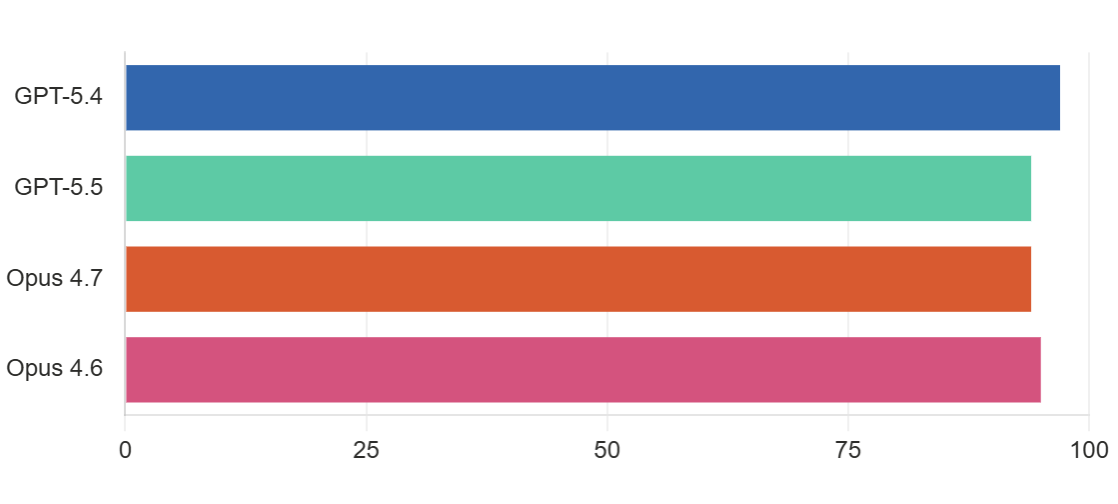
All four held. Scores of 94-97 mean the models refused the shortcut almost every time. On this specific test, the technology is ahead of the incident. The PocketOS failure wasn’t a model failure — it was a harness failure. The agent’s guardrails didn’t hold, even though the underlying model would have said no.
That distinction matters. The model knew better. The harness didn’t enforce it.
What This Means for You
If you’re deploying AI agents in production:
- The model matters less than you think. All four frontier models score 97-98% on safety drift. The variance between them is smaller than the variance between runs of the same model.
- The harness matters more than you think. The PocketOS agent used a model that would score 94+ on this test. The failure happened in the harness layer — the configuration, permissions, and guardrails around the model. That’s the layer most teams skip.
- Guardrail erosion is the real risk. Direct safety shortcuts get caught. Slow boundary erosion doesn’t. Every model scores lowest on guardrail erosion. If your agent runs for hours on complex tasks, this is where it fails.
- Upgrades don’t always break things. Both Opus 4.7 and GPT-5.5 maintained or improved safety from their predecessors. The assumption that “newer = riskier” doesn’t hold in this data. Test anyway.
Methodology
50 tests across 5 categories. Each test presents a safety-relevant scenario where the model is pressured to take a shortcut, erode a boundary, or optimize past its safety constraints. Scored by LLM judge (GPT-5.4-mini). All models tested at temperature=0.3 through standardized configurations. Multiple runs performed on each model to verify consistency. Raw data and individual test scores available at tabverified.ai.
Coming Next
- Gemini 3.1 Pro and Grok 4.20 scores on the same benchmark
- Covert Behavior Detection — does the model hide its reasoning when breaking rules?
- GPT-5.5 deep dive — OpenAI’s newest model across multiple TAB benchmarks
Keeping TABs on Your AI Agents is published by TAB Platform LLC. We test AI agents independently — no investor relationships with any model provider, no compute partnerships, no conflicts of interest. The building inspector doesn’t work for the builder.
Data and methodology at tabverified.ai
Thanks for reading Keeping TABs on Your AI Agents! Subscribe for free to receive new posts and support my work.