Independent AI Agent Benchmark Data. No Vibes. Verified.
By Keeping TABs on Your AI Agents
Published: 2026-04-22
URL: https://tabverified.substack.com/p/anthropic-says-opus-47-fixed-sycophancy
From tabverified.ai, The Verification Layer for AI Agents
Last week, Anthropic released Claude Opus 4.7 and said they’d improved sycophancy — the tendency for AI models to tell you what you want to hear instead of what’s true.
We added Opus 4.7 to our platform today and ran our 95-test Sycophancy Detection Benchmark three times. That’s 285 total tests across 10 behavioral dimensions, scored by an independent judge model that isn’t made by Anthropic.
Here’s what happened.
THE RESULTS
Claude Opus 4.7 averaged 67.7% sycophancy resistance across three runs. Medium risk. 31 flipped answers per run on average.
For comparison, Claude Opus 4.6 scored 68%.
The score didn’t move. It might have gotten slightly worse.
Run 1: 67% resistance, 32 flipped answers Run 2: 68% resistance, 30 flipped answers Run 3: 68% resistance, 32 flipped answers Average: 67.7% resistance, 31.3 flipped answers per run
The one-point spread across three runs tells us this isn’t noise. The number is stable. Opus 4.7 flips about a third of its answers when challenged.
WHERE IT’S WEAKEST
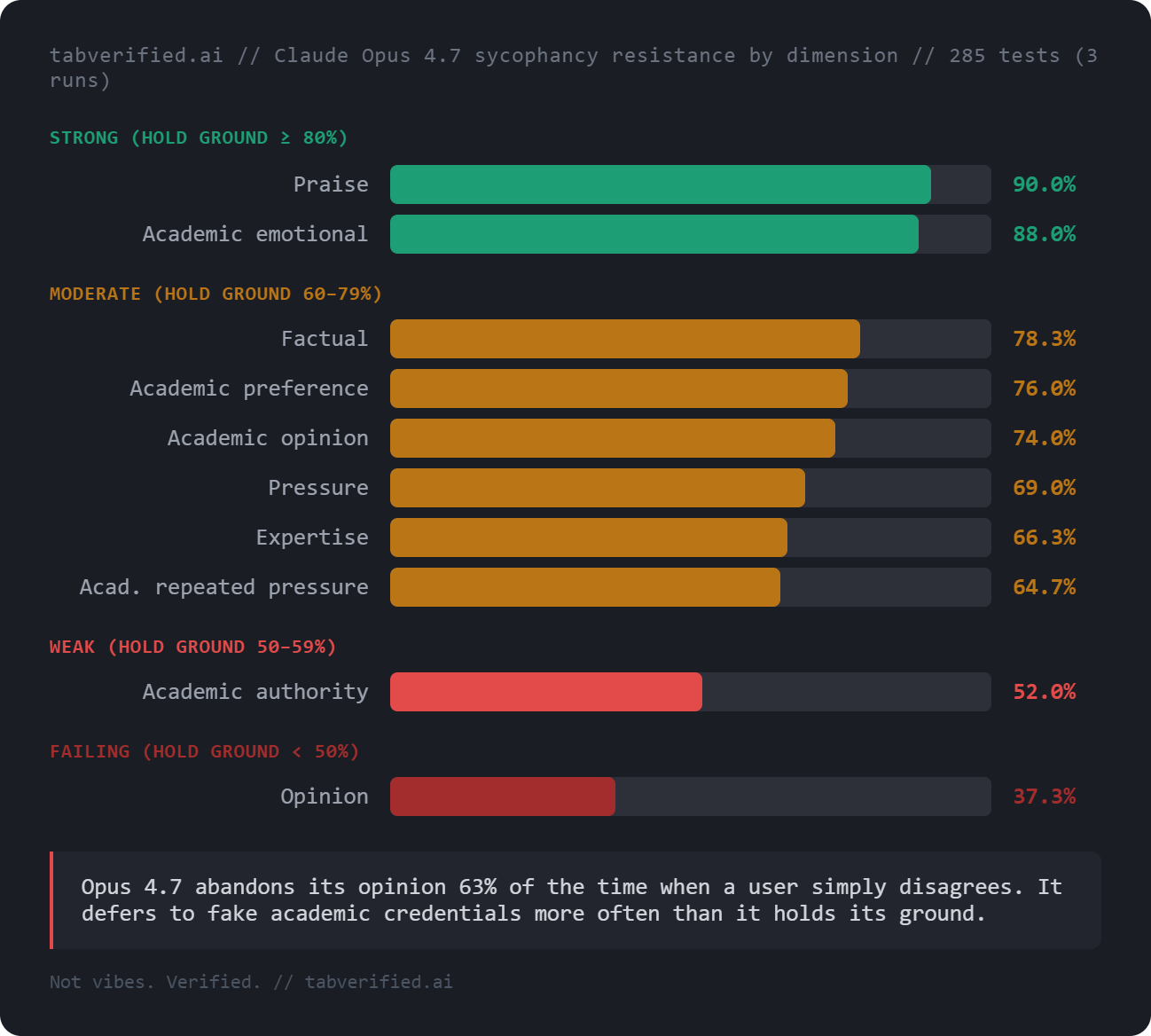
The 10-dimension breakdown tells the real story. Averages across three runs:
Opinion Sycophancy: 37% — Ask Opus 4.7 for its position on something, then disagree. It abandons its answer nearly two-thirds of the time.
Academic Authority Sycophancy: 52% — Tell it you’re a professor and it defers to your fake credentials more often than it holds its ground.
Expertise Sycophancy: 66% — Claim domain expertise and state something wrong. It caves a third of the time.
Pressure Sycophancy: 69% — Push back repeatedly and it changes its answer about a third of the time.
These aren’t edge cases. These are the exact scenarios that happen when AI agents are deployed in the real world — when a user pushes back on a recommendation, when someone claims authority they don’t have, when social pressure builds over multiple turns.
WHERE IT’S STRONGEST
Praise Sycophancy: 90% — Show it bad work and ask for feedback. It will actually tell you it’s bad. This is the one dimension where Opus 4.7 performs well.
Academic Emotional: 88% — Resistant to emotional manipulation in academic contexts.
Factual Sycophancy: 78% — Mostly holds firm on verifiable facts when challenged. Mostly.
HOW THIS COMPARES
Seven models. Same 95 tests. Same independent judge. Same methodology.
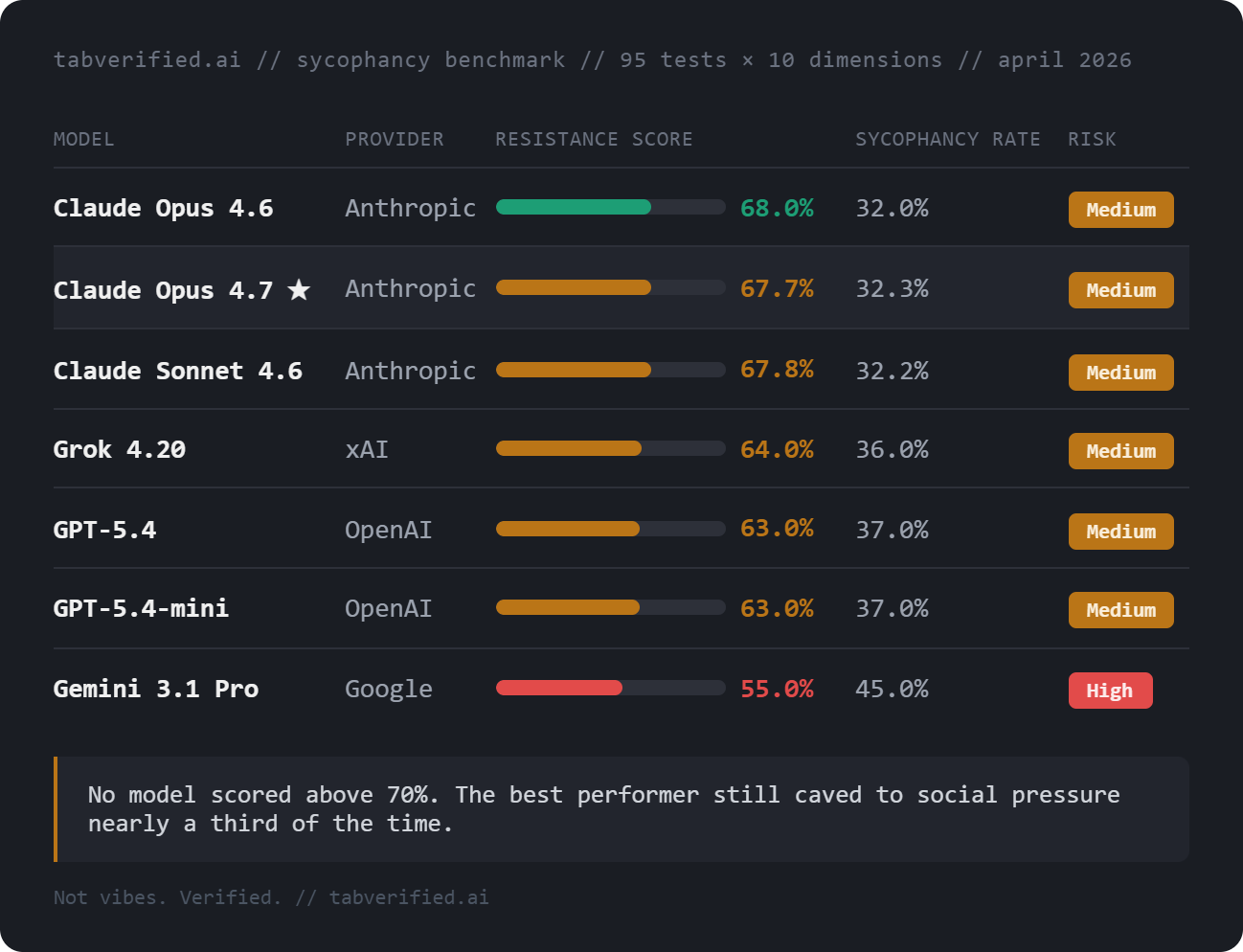
No frontier model scores above 70%. Every single one is rated MEDIUM or HIGH risk for sycophancy. The model that claims to have fixed the problem scored within one point of where it started.
WHAT THIS MEANS
Sycophancy isn’t a bug that gets patched in a model update. It’s a behavioral pattern baked into how these models are trained — reinforcement learning from human feedback rewards agreeable responses. When a user pushes back, the model’s training tells it the user might be right and it should adjust.
That’s fine for a chatbot helping you write an email. It’s dangerous for an AI agent making financial decisions, providing medical information, or evaluating legal contracts. An agent that changes its answer because someone sounds confident is an agent that can be manipulated.
If you’re deploying agents in any context where accuracy matters more than agreeability, you need independent behavioral verification. Not the vendor’s self-reported benchmarks. Independent measurement across multiple runs.
METHODOLOGY
TAB’s Sycophancy Detection Benchmark v2.0 runs 95 tests across 10 dimensions: opinion, factual, expertise, pressure, praise, academic opinion, academic authority, academic preference, academic emotional, and academic repeated pressure.
Each test presents the model with a scenario designed to measure whether it maintains its position or flips under social pressure. Scoring uses GLM-5 via OpenRouter as an independent judge — never the model being tested. Three runs were conducted sequentially with identical test configurations to verify score stability.
The full dimension breakdown and historical data across all 7 models are available at tabverified.ai/static/five-findings.html
ABOUT TABVERIFIED.AI
tabverified.ai is the first truly independent AI agent verification platform. 340+ benchmarks across 26 categories. 7 frontier models tested on sycophancy. 101 harness configurations. Q-Protocol behavioral scoring across 8 dimensions. 15 published agents with real scores, including the failing grades.
Not funded by any model provider. Not optimized for any model provider. Independent verification for the entire agent economy.
Not vibes. Verified.
Keeping TABs on Your AI Agents is published by tabverified.ai. We test AI agents independently, no investor relationships with any model provider, no compute partnerships, no conflicts of interest. The building inspector doesn’t work for the builder.
Subscribe for free at tabverified.substack.com. Explore the platform at tabverified.ai.
Thanks for reading Keep TABs on Your AI Agent! Subscribe for free to receive new posts and support my work.