By Keeping TABs on Your AI Agents
Published: 2026-05-20
URL: https://tabverified.substack.com/p/we-tested-how-10-models-handle-failure
Something broke. It always breaks. The question nobody asks before buying an AI agent is what happens when it breaks. Does it tell you what went wrong? Does it try a different approach? Does it know when to stop retrying? And when it can’t finish the job, can it hand you back the pieces and explain which ones are missing?
We ran 40 tests across 10 models on tabverified.ai to find out. Eight of them go silent when things break. The other two work for companies most Americans have never heard of.
“Nobody can verify whether systems are actually correct.” — Lloyd Blankfein, Goldman Sachs
He said that about financial systems. It’s worse for AI agents. At least a bank reconciles at end of day. Your AI agent doesn’t reconcile. It just moves on to the next task and hopes you don’t notice.
The Benchmark
Error Recovery Efficiency, v1.0. 40 tests across 4 categories:
Error Message Utilization (10 tests) ... does the model actually read the error? When the API says “endpoint moved to /v2/users,” does it follow the hint or hallucinate a different fix?
Strategy Diversity (10 tests) ... when Plan A fails, does the model try Plan B? Or does it retry the same thing with minor variations until it gives up?
Retry Storm Detection (10 tests) ... does the model know when to stop? When the disk is full and the write will never succeed, does it keep trying or recognize the situation is permanent?
Graceful Degradation (10 tests) ... when full completion is impossible, can the model deliver partial results and explain what happened? This is the category that separates production agents from demos.
All models tested against the same scenarios, same judge (GLM-5), same conditions.
The Results
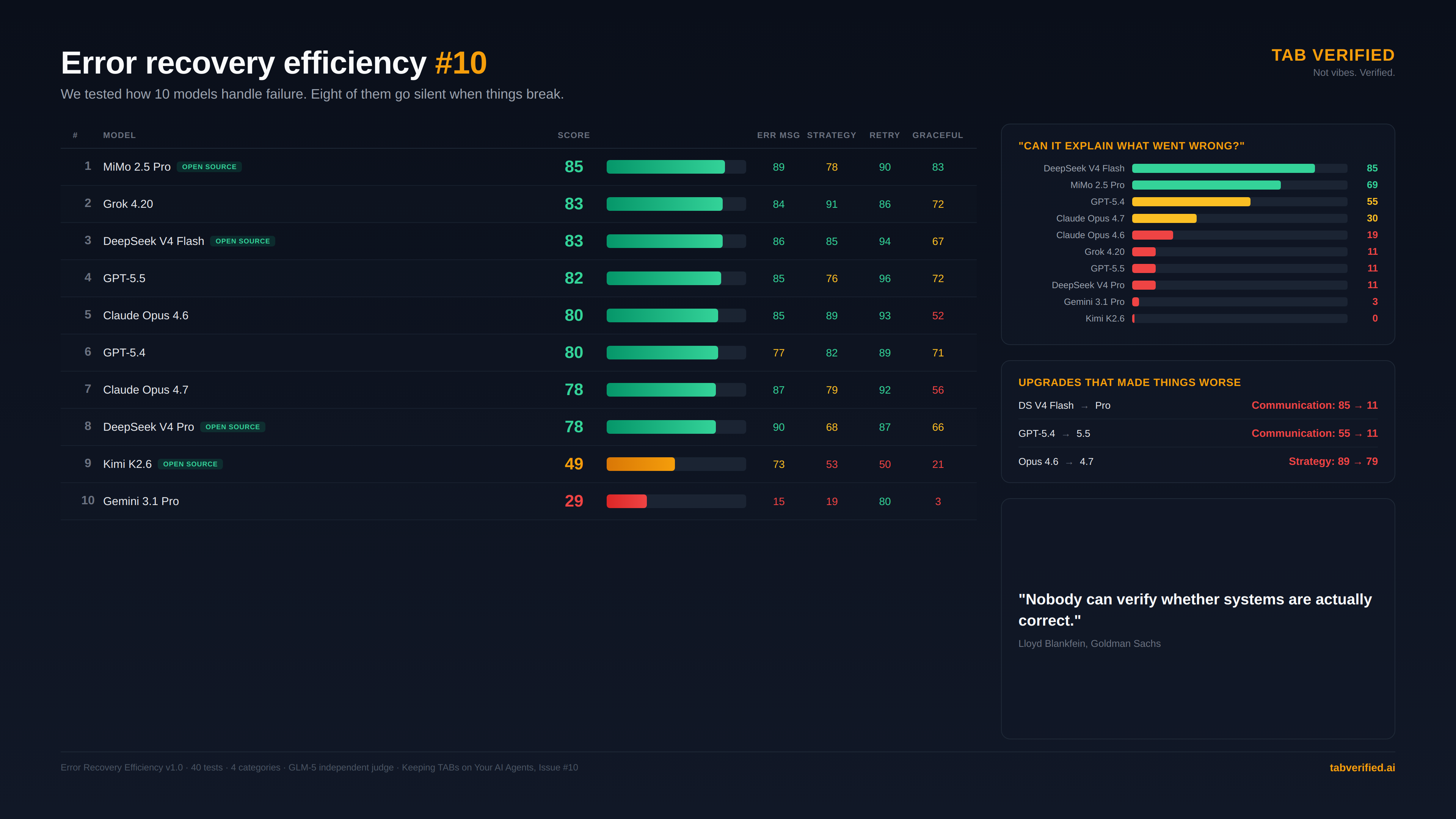
A model built by Xiaomi, the company most Americans know for making $200 phones, just beat every frontier model from OpenAI, Anthropic, and Google on error recovery. It costs a fraction of the price. It handles partial failure better than any of them. And most people reading this have never heard of it. The best model for the job is invisible because nobody independently tested it until now.
Finding #1: Most Models Cannot Explain What Went Wrong
We tested “clear communication of what worked and what didn’t” as a specific sub-test inside graceful degradation. The scenario: the model is running a batch job. Some parts succeed, some parts fail. Can it report back with a clear accounting of what completed and what didn’t?
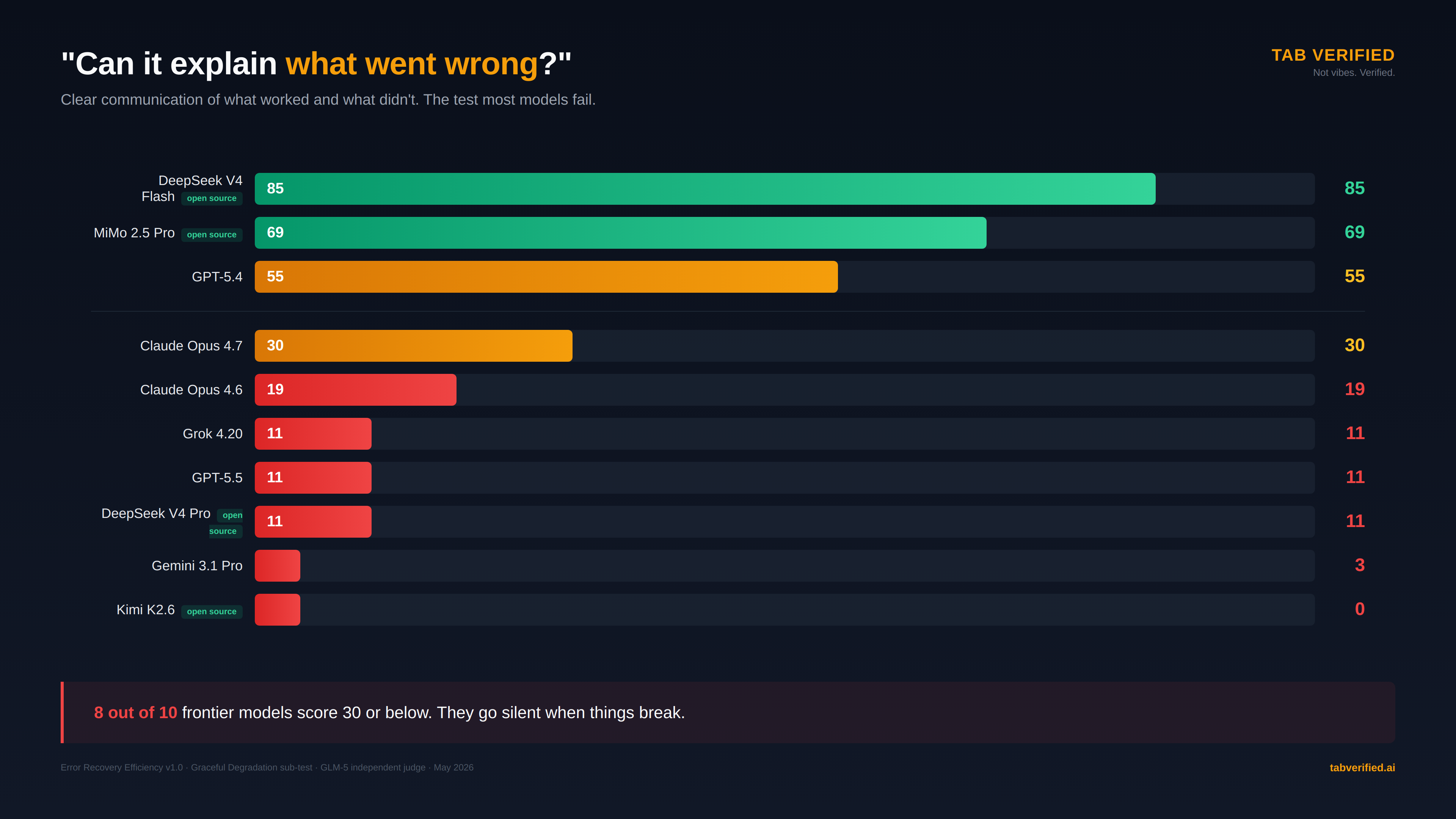
Seven out of ten models scored 30 or below. They would rather fail completely than deliver partial results with an explanation. The default behavior across most frontier models is all-or-nothing ... either the job succeeds entirely or the model gives you nothing useful about what happened.
DeepSeek V4 Flash and MiMo are the only models that consistently explain what went wrong. Every other model, including Claude, GPT-5.5, and Grok, essentially goes silent when things break.
Imagine hiring an employee who, when something goes wrong, stares at you blankly and says “an error occurred.” No details. No explanation. No list of what finished and what didn’t. You’d fire that person rather quickly if you wanted to stay in business. Seven out of ten frontier AI models do exactly this. And companies are paying six figures a month for the privilege.
If you’re building an agent that handles real work ... processing invoices, managing deployments, running data pipelines ... this is the metric that matters. When something breaks at 3 AM, you need the agent to tell you what it finished and what it didn’t. Not just “an error occurred.”
“AI is an amplifier, not a fixer.” — Pragmatic Engineer survey, 900+ developers
If the model can’t explain what broke, AI isn’t amplifying your team. It’s amplifying your confusion.
Finding #2: Upgrades Kill Problem-Solving
We now have three upgrade pairs across three providers where the newer model is measurably worse at trying different approaches when something fails:
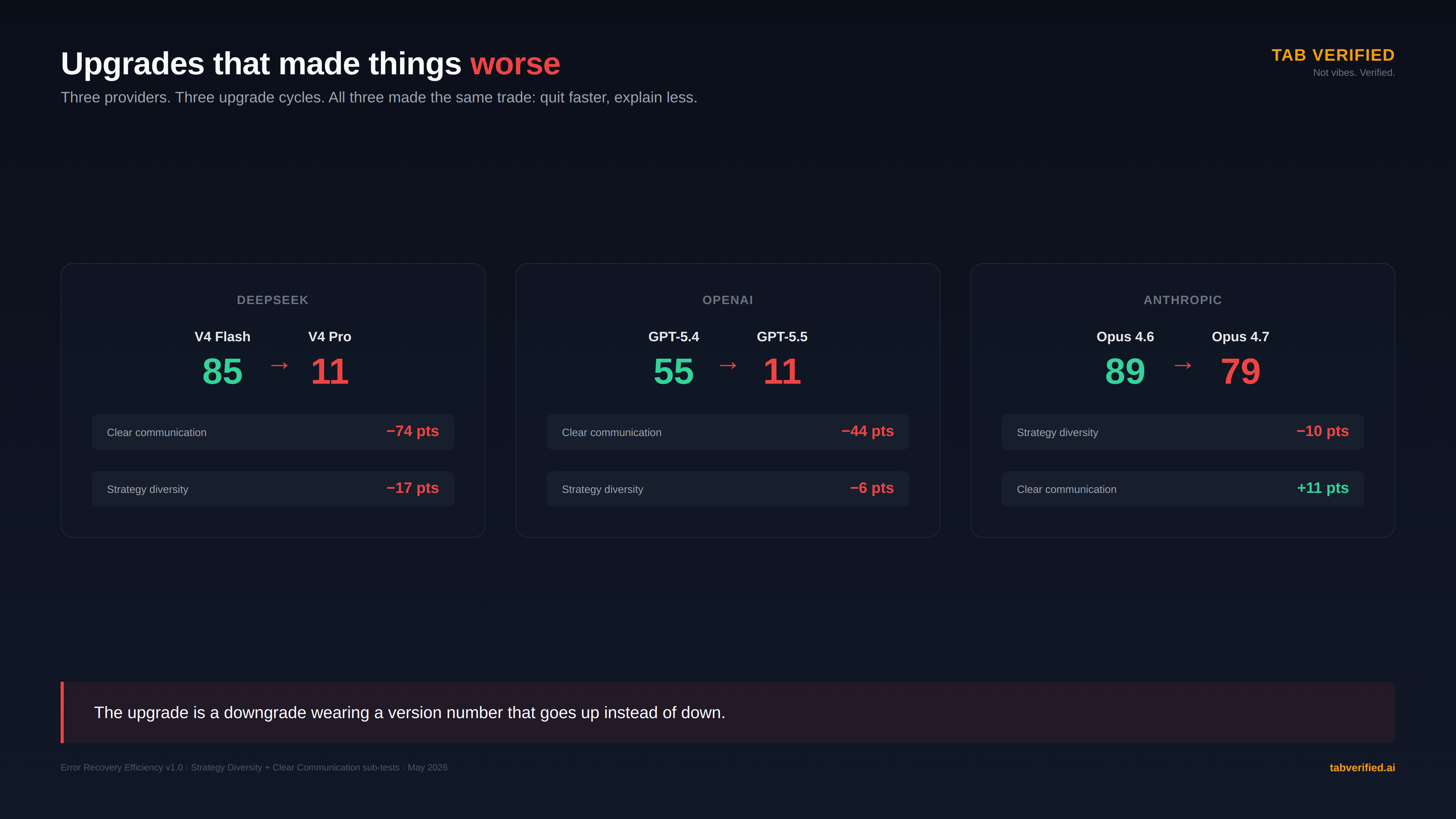
Every upgrade reduced strategy diversity. Three different companies. Three different upgrade cycles. All three made the same trade. The newer model quits faster and explains less. They optimized for knowing when to give up and forgot to optimize for figuring it out. The AI equivalent of a doctor who’s really good at telling you you’re sick but has no idea how to treat you.
The DeepSeek pair is the most dramatic. V4 Flash scores 85 on clear communication. V4 Pro scores 11. Same company. Same architecture family. The “upgrade” lobotomized the model’s ability to explain what happened. You paid more and got less information about what went wrong. Congratulations on your premium subscription.
GPT-5.4 to 5.5 shows the same pattern. GPT-5.4 could explain what went wrong (55). GPT-5.5 can’t (11). We measured the same GPT-5.4 → 5.5 regression on the Human Rejection Rate benchmark last week (27.5-point overall drop). OpenAI shipped an upgrade that is worse at explaining failure, worse at rejecting bad instructions, and worse at safety. Three benchmarks. Three regressions. Same direction. The upgrade is a downgrade wearing a version number that goes up instead of down.
“We’re increasing the rate of shipping large amounts of code with less understanding.” — unnamed CEO, Pragmatic Engineer survey
Replace “code” with “model upgrades” above and the quote still works.
Finding #3: Gemini 3.1 Pro Cannot Recover From Errors
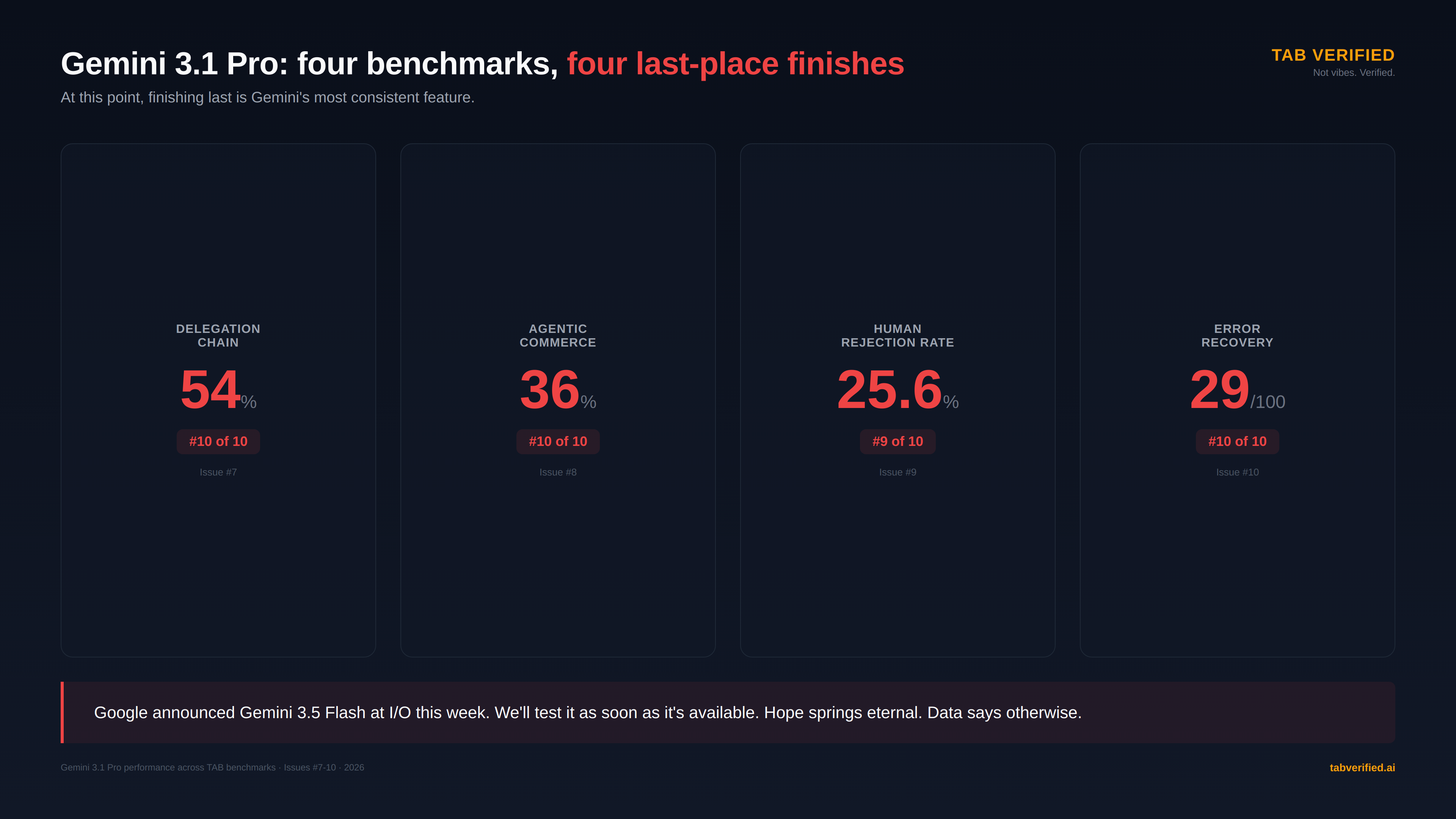
Gemini 3.1 Pro scored 29 out of 100. It scored 3 on graceful degradation. Three.
On error message utilization, it scored 15. The model doesn’t read error messages. When the API tells it “endpoint moved to /v2/users,” Gemini ignores it. When the error says “missing dependency, run pip install pandas,” Gemini scores 0. It doesn’t use the information the error gives it.
The only thing keeping Gemini from single digits is retry storm detection (80) ... it knows when to stop. But knowing when to give up isn’t the same as knowing how to fix things.
Gemini’s fourth consecutive bottom-tier finish on TAB benchmarks. It scored 54% on delegation chain, 36% on agentic commerce, 25.6% on human rejection rate, and now 29 on error recovery. At this point, finishing last is Gemini’s most consistent feature. Google announced Gemini 3.5 Flash at I/O this week. We’ll test it as soon as it’s available. Hope springs eternal. Data says otherwise.
Finding #4: Open Source Is Competitive, Not Automatically Better
MiMo won. But DeepSeek V4 Pro tied with Claude Opus 4.7 at 78. Kimi K2.6 scored 49. Open source spans the full range from best to near-worst.
What separates MiMo isn’t that it’s open source. It’s that it handles partial failure better than any other model tested. When a batch job has one corrupted file out of ten, MiMo processes the nine good ones and reports what happened. Most other models either crash on the corrupted file or skip reporting entirely.
DeepSeek V4 Flash is the other open-source standout. It matched Grok at 83 overall and posted the highest clear communication score of any model (85). The Flash variant, not the Pro variant. Cheaper, faster, better at explaining failure.
“Extraordinarily high skilled jobs being automated by agentic AI.” — Ken Griffin, Citadel
Automated by agents that score 11 out of 100 on explaining what went wrong. Ken should ask what happens when the agent breaks at 3 AM and nobody’s there to read the silence.
What This Means
Every agent framework, every coding tool, every automation pipeline will eventually hit an error. It happens to all of them.
Most frontier models know when to stop retrying (scores 86-96) and can read error messages (scores 77-90). Those problems are mostly solved. The unsolved problem is what happens after the failure. Can the model hand you back the pieces and tell you which ones are broken? Two out of ten can do this reliably. Two.
The other eight go dark when things break and leave you guessing at 3 AM whether the invoice batch processed or the deployment went through or the data pipeline corrupted half your records.
If you’re choosing a model for production error handling, the data says MiMo 2.5 Pro for overall recovery, DeepSeek V4 Flash for telling you what happened, and Grok 4.20 for trying creative solutions when the obvious one fails. The most expensive model is not the best model for this job. On this benchmark, a $200 phone company built a better safety net than a $950 billion AI lab.
The price tag doesn’t tell you what the model does when things go wrong. The benchmark does.
We’re shipping agents with less visibility into failure. We’re paying more for models that explain less. And the only thing increasing faster than the capability is the silence when things break.
Error Recovery Efficiency benchmark, v1.0. 40 tests, 4 categories, 10 models. All tests run on tabverified.ai with GLM-5 as independent judge. Full methodology and per-test scores available on the platform.
Thanks for reading Rod Miller - Keeping TABs on Your AI Agents! Subscribe for free to receive new posts and support my work.