What Xirp, Kiro Crew and Warp Factories reveal about the shift from isolated sessions to persistent agent development systems.
By Sumant Thakur
Published: 2026-08-26
URL: https://sumantthakur.substack.com/p/three-ai-coding-launches-in-14-days
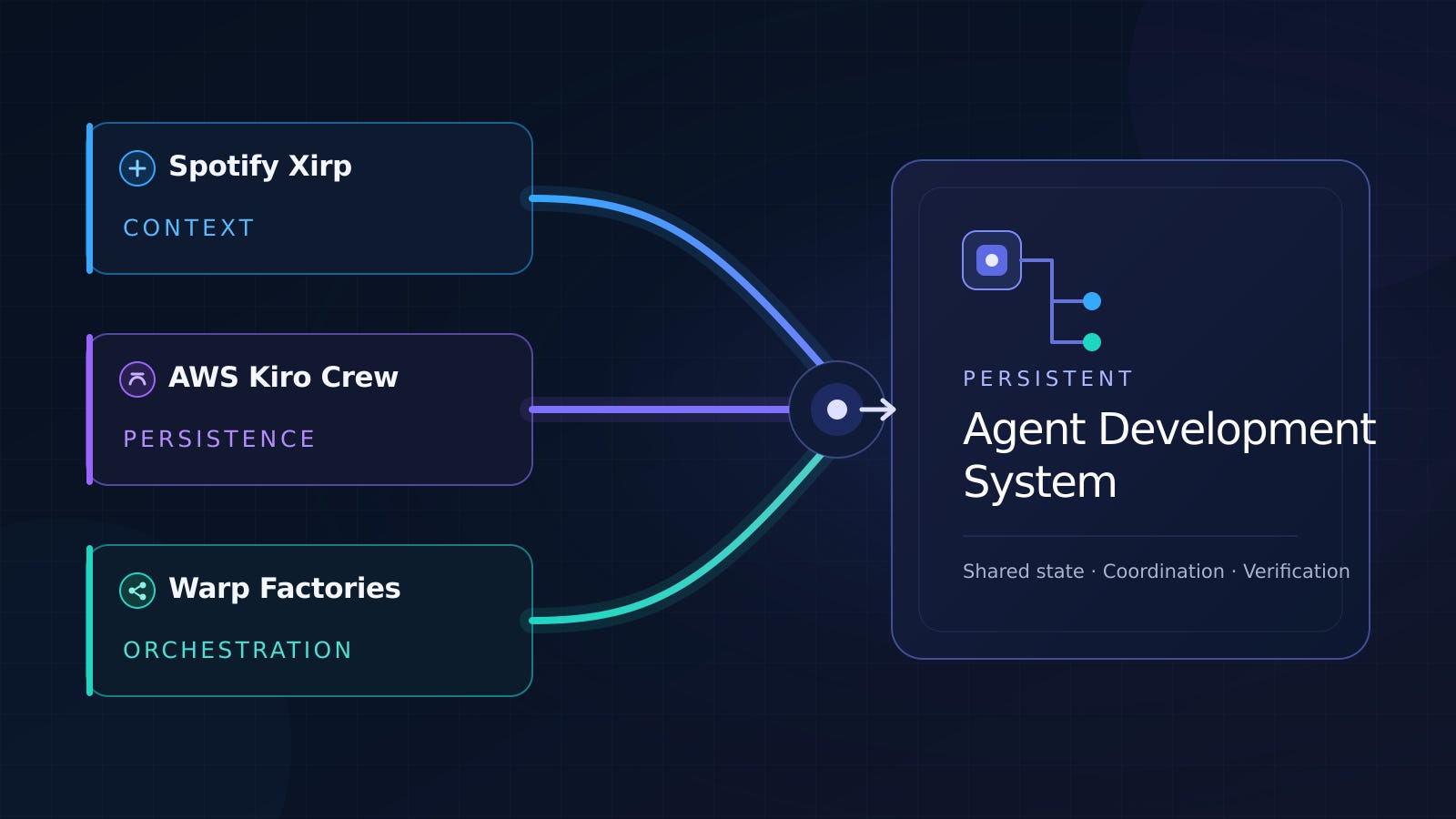
On August 4, AWS released Kiro Crew.
Six days later, Spotify introduced Xirp.
On August 18, Warp announced Factories.
One is an open-source workspace that keeps agents working across sessions.
Another manages dozens of Claude Code, Gemini CLI and Codex sessions.
The third provides infrastructure for building what Warp calls a cloud software factory.
They appear to be different products.
All three begin with the same problem: one developer, one agent and one session no longer describe how AI-assisted software development is being used.
The first generation of coding agents fitted comfortably inside an editor or terminal. A developer opened a repository, described a task and worked with the agent until it produced a satisfactory change.
That model works when the agent is a tool used during an active session.
It becomes harder when developers run several agents at once, work continues after they step away, and context discovered by one agent is required by another.
The agent may still generate the code, but the surrounding work now needs isolation, memory, coordination, verification and some durable record of what happened.
The coding session has become too small a boundary for the work taking place inside it.
Thanks for reading Autonomous AI Architect! Subscribe for free to receive new posts and support my work.
The session was never the full engineering system
A single coding session can contain a surprising amount of information.
The agent reads files, searches the repository, runs commands, studies errors, discovers conventions and learns why an earlier implementation failed. By the end of the session, it may understand far more than it did when the task started.
Most of that understanding is temporary.
A new session may need to repeat the investigation. Switching from one coding agent to another can require reconstructing context. Another engineer working on the same service may not know what the first agent discovered. A long-running migration can lose continuity when it crosses machines, tools or working hours.
Teams try to compensate with repository instructions, prompt collections, MCP configurations and project documentation. These help, but they also create fragmented context with different owners and update cycles.
Spotify describes encountering this problem as agent adoption expanded internally. Engineers began running sessions across tools, repositories and branches. Context accumulated inside individual sessions while the organization needed it elsewhere. Spotify says the result included repeated discovery, inconsistent outcomes and wasted tokens.
Xirp is Spotify’s response.
The product manages sessions across coding harnesses including Claude Code, Gemini CLI and Codex.
Each session runs in its own Git worktree, allowing agents to work on the same repository without sharing a checkout.
Spotify says Xirp was designed to coordinate more than 50 sessions and has been used across more than 36,000 internal sessions.
The more important design choice is that Xirp attempts to separate working context from the agent that created it.
An engineer can change harnesses during a project without rebuilding the entire environment. Session state remains available even if the team decides that another model or coding agent is better suited to the next part of the task.
When Xirp connects to Spotify Portal, the context expands beyond the repository. Agents can receive information from the software catalog, including service ownership, dependency relationships and architectural decisions. Session transcripts and metadata can then flow back into Portal for later work.
Xirp can operate as a session-management environment without Portal. Its larger organizational-context argument depends on that connection.
That distinction matters. Managing several isolated agents is an execution problem. Giving all of those agents a shared understanding of the organization is a knowledge problem. Spotify is attempting to connect both.
Kiro Crew starts with work that refuses to end
Kiro Crew approaches the same pressure from another direction.
Its starting point is engineering work that spans repositories, tools, reviews and days. The developer remains the person reconnecting context, checking progress and restarting work whenever a session ends.
Kiro Crew moves that continuity into a persistent workspace.
It carries memory, project context and previous corrections into later sessions. Repeated workflows can become reusable skills. Schedules can start recurring work. Webhooks can respond to external events. Heartbeats can watch pull requests, deployments and pipelines for changes that require action.
A task can pass through checkpoints, validation and retries while the developer works elsewhere. Independent sub-agents can investigate or implement parts of the task and return their results to a coordinating conversation.
AWS says Kiro Crew grew from an internal project called MeshClaw and reached more than 39,000 Amazon builders before its public release. As with Spotify’s figures, this is vendor-reported adoption rather than an independent assessment.
Persistent execution also changes the security requirement.
An interactive agent operates while a developer is present and can ask before taking a sensitive action. A scheduled agent may run at 3 a.m., respond to a CI event or continue a migration while nobody is watching it.
Kiro Crew includes an operating-system sandbox, denied command patterns, sensitive-path protections, credential redaction, input validation and signed activity records. Its interface exposes agent plans, tool calls, approvals and results while work is running.
These controls do not guarantee that the agent makes the right engineering decision. They recognize that unattended access to code, credentials and development systems needs more than a capable model.
Kiro Crew is open source, but it runs on the Kiro CLI at launch. Existing Kiro configurations, steering files, skills and custom agents carry into the workspace. The orchestration layer is inspectable, while the initial execution path remains connected to Kiro’s harness.
Xirp emphasizes portability across coding agents and organizational context. Kiro Crew emphasizes persistence, event-driven work and controlled autonomy. Both move essential state outside the temporary conversation.
Warp moves the same problem to the organization
Xirp and Kiro Crew still begin with developers and their workspaces.
Warp Factories moves the problem to the level of the engineering organization.
Warp describes a factory as an automation loop around the software-development lifecycle. Work can move through separate agents responsible for triage, specification, implementation, review and verification. A ticket, Slack message, repository event or monitoring signal can trigger the workflow.
The factory configuration is stored as version-controlled code. Agent roles, models, harnesses, skills, MCP connections and permissions become explicit configuration rather than settings scattered across individual laptops.
Warp also adds the measurement layer.
Factories record throughput, cost and quality. Teams can compare models and harnesses on their own tasks. Observer agents can evaluate runs and propose changes to the factory configuration.
Warp reports that it currently automates about 30 percent of its own tasks this way. The figure is a company claim, and Factories remains in closed beta. It should be read as evidence of Warp’s product direction rather than proof that most engineering organizations are ready to automate the same proportion of work.
Cursor provides supporting evidence for the broader movement. Cursor Automations can start cloud agents from schedules and events such as GitHub updates, Slack messages and PagerDuty incidents. The agent receives a sandbox, configured tools and memory from previous runs. Cursor describes using these automations for security review, incident investigation, test coverage and repository maintenance.
The pattern now extends beyond any single product.
Coding agents are being connected to event systems, long-running execution environments, shared memory, organizational context and measurement infrastructure. The interactive prompt remains available, but it is no longer the only way work begins or continues.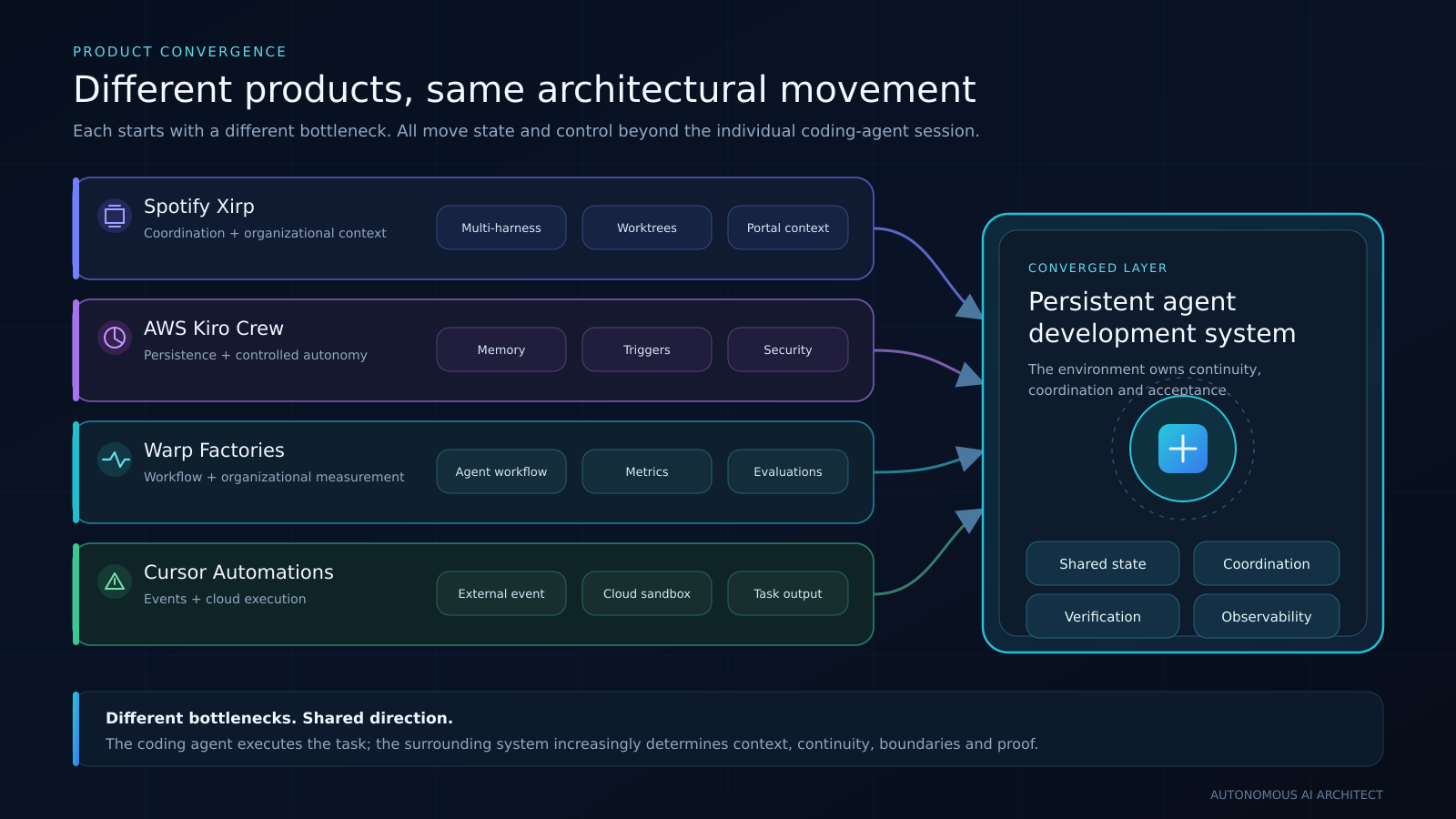
The agent is becoming one component
These products do not yet form a settled category.
Xirp calls itself an agentic development environment. Kiro Crew describes itself as a persistent development workspace. Warp uses the language of cloud software factories. Cursor talks about always-on automations.
The labels differ because the products begin at different points in the workflow.
Underneath them, several architectural decisions are converging.
Working state must survive the model session. Parallel tasks need isolated environments. Organizational context must be retrieved rather than reconstructed by every agent. External events need to initiate work. Long-running tasks need checkpoints and stopping rules. Teams need to see what is running, what it costs and what evidence supports the output.
This changes the role of the coding agent.
Claude Code, Codex, Gemini CLI or Kiro CLI can execute a task, but the surrounding system increasingly decides what context the agent receives, which tools it can access, where it runs, when it should continue and what must be verified before the work is accepted.
Model and harness choices will continue to change. Spotify explicitly designed Xirp around that assumption. Warp also supports multiple models and harnesses. The durable value is moving toward the context, workflow history, evaluation data and organizational rules that remain useful when the execution engine changes.
More orchestration creates new failure modes
The launches make the direction visible. They do not prove that persistent multi-agent development has been solved.
Memory is useful only when the system knows what deserves to be remembered.
A correction from one project may be harmful in another. An architectural decision can become stale. A session transcript may contain an abandoned approach rather than an accepted decision. Feeding more historical material into every agent can increase confidence without improving accuracy.
A stale architectural rule distributed to every session can be more damaging than missing context because it arrives with institutional authority.
Parallel execution creates another constraint.
Running 20 agents can produce more changes, but it can also produce conflicting assumptions, duplicated work and a larger verification queue. Worktree isolation prevents agents from editing the same checkout. It does not determine whether their changes remain architecturally compatible when they are merged.
The bottleneck can move from implementation to specification, review and integration.
Measurement is also harder than counting completed tasks or generated pull requests. A factory can increase output while adding rejected changes, production defects or human review time. Cost per pull request says little if the pull request should never have been opened.
Security controls provide boundaries and records. An audit log can show which tool the agent called and which files it changed. It cannot establish that the original goal was correct or that the verification criteria captured the real production risk.
Each new layer solves one coordination problem while introducing another question about authority.
Who owns the durable memory? Which source is allowed to define architecture? What evidence lets an agent move from implementation to completion? Which actions require approval? Who can change the rules that govern the other agents?
Those decisions will determine whether these systems become dependable development infrastructure or expensive ways to generate more work.
The decision facing engineering teams
Teams evaluating this new layer should begin with the bottleneck they already experience.
A team switching frequently between models may care most about portable context and isolated sessions. A team running migrations and maintenance work may need persistent execution, schedules and checkpoints. A larger organization may need shared context, cost measurement and governance across hundreds of agent runs.
Choosing a product before identifying that bottleneck risks buying an impressive interface around the wrong problem.
The important questions sit underneath the feature list.
Where does working state live after the session ends? How is parallel work isolated and later integrated? What can start an agent without a person present? Which conditions stop it? How is context updated when the system changes? What evidence must exist before generated work is accepted?
The answers define the development system around the agent.
If your team is already running several coding agents, where does their shared state live today: inside individual sessions, in the repository, in a developer portal or in something your team built?
References
-
-
-