From coding agents to engineered software systems
By Sumant Thakur
Published: 2026-09-02
URL: https://sumantthakur.substack.com/p/ai-coding-is-moving-beyond-the-agent
For the last two years, most conversations about AI coding have revolved around models and agents. The question was usually some variation of the same thing: which model writes better code, handles a larger repository, or completes more of a task without human intervention?
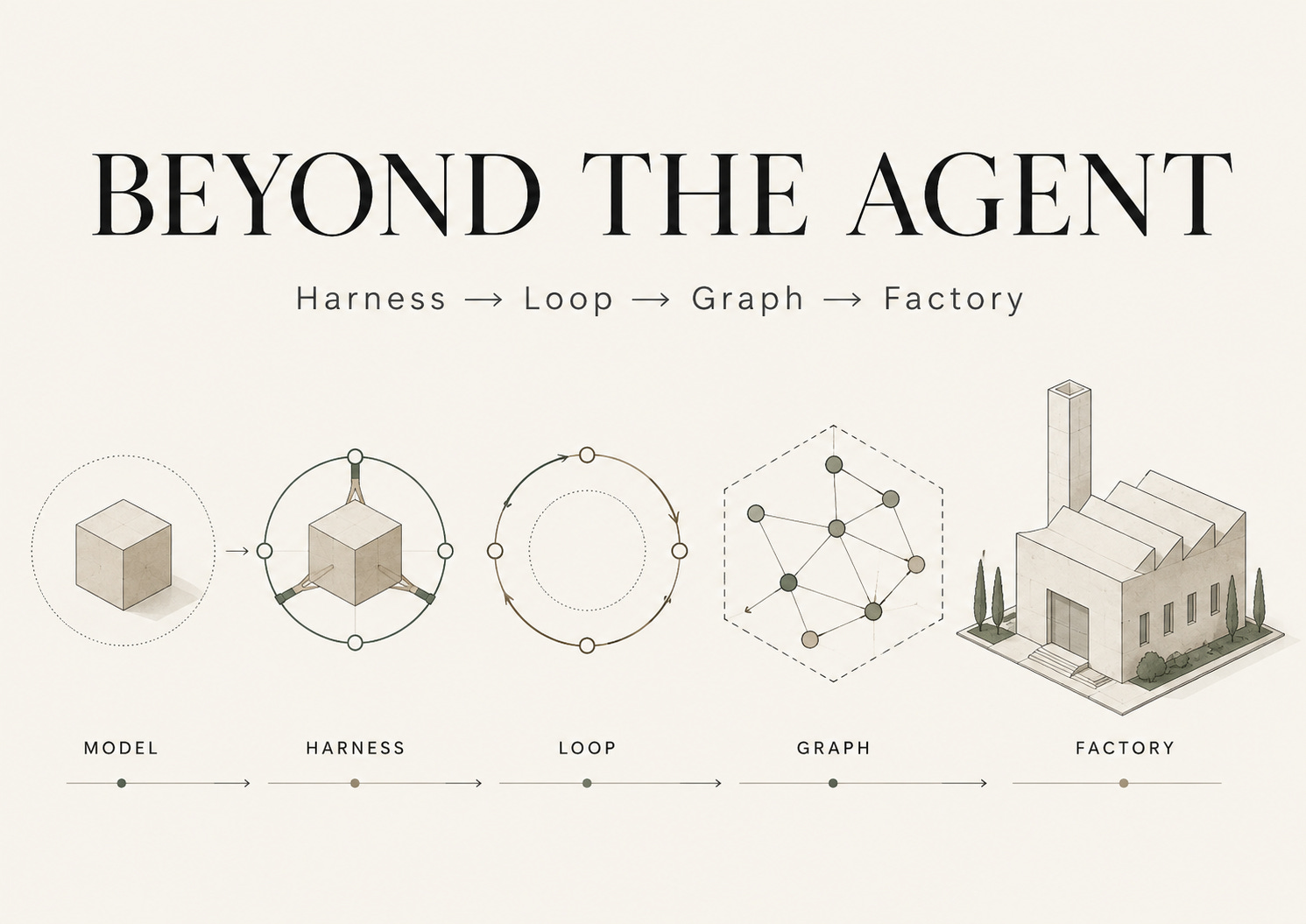
That conversation is starting to move up the stack. Terms such as harness engineering, loop engineering, graph engineering, and software factories are appearing with increasing frequency.
Taken individually, they can look like four more labels competing to describe the future of software development. But when you look at what engineering teams are actually building, a more coherent architecture begins to emerge.
These are increasingly different layers of the same system around the model.
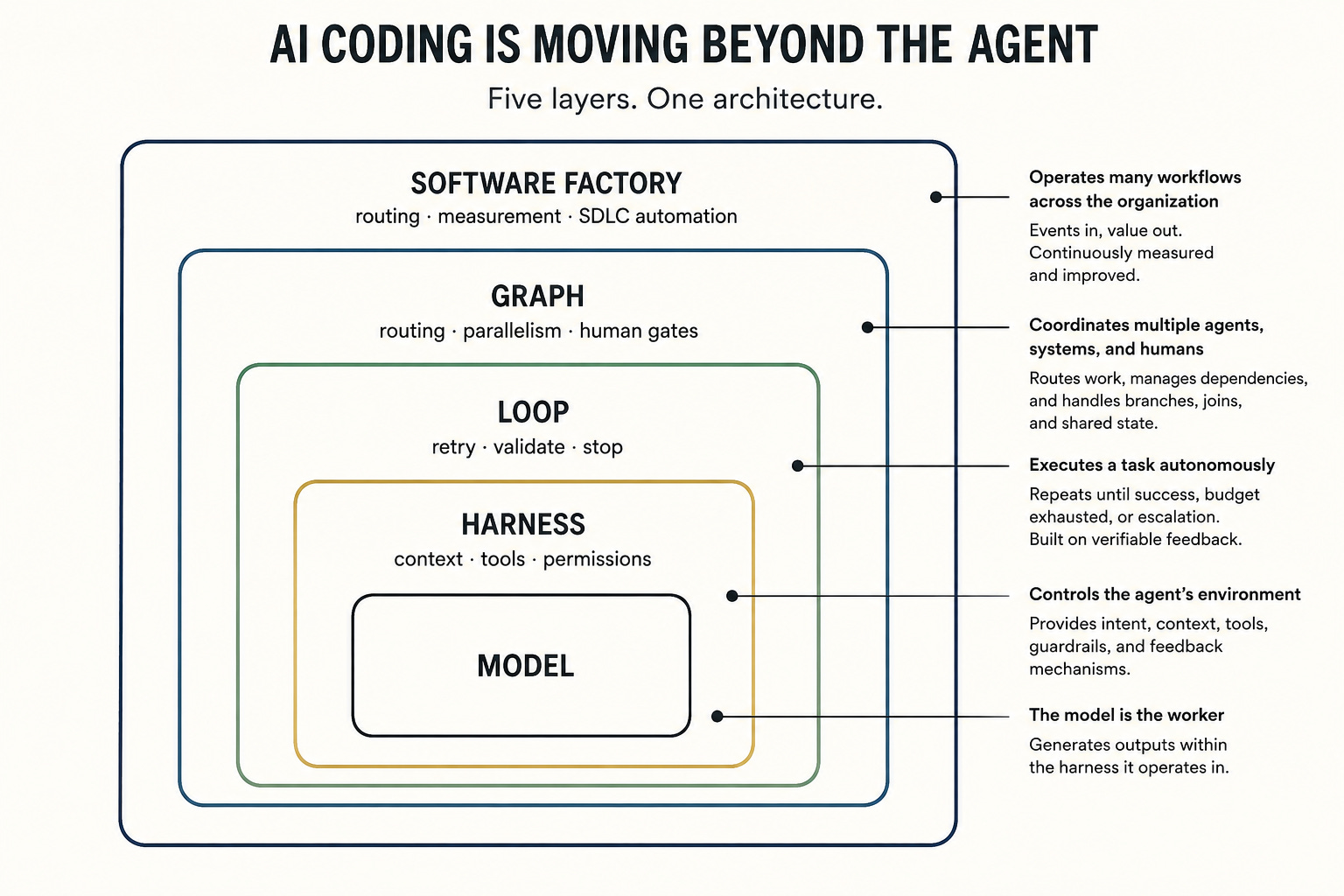 The model is becoming one worker inside a larger engineering system.
The model still matters, but it is becoming one worker inside a much larger engineering architecture. The system around that worker increasingly determines what context it receives, what it may change, how its work is verified, when it retries, and when control moves to a human.
That is a much broader engineering problem than model selection.
Before the terminology, look at the architecture
Consider a coding workflow that starts not with:
“Build this feature.”
but with an approved specification.
That specification defines what the implementation must satisfy. It may describe input and output contracts, security boundaries, failure behaviour, acceptance criteria, allowed change scope, and the evidence required before the task can be considered complete.
I have been experimenting with a version of this architecture in a real engineering repository. A planner first turns the approved specification into bounded implementation work, after which a builder operates inside an isolated workspace.
The builder is allowed to propose an implementation, but it does not get to declare its own work correct. Deterministic checks evaluate the resulting changes, and failed checks enter a bounded repair cycle rather than an open-ended conversation with the model.
Once those checks pass, a clean evaluator verifies the resulting state independently. A fresh reviewer examines the implementation itself, while human authority remains at the final merge boundary.
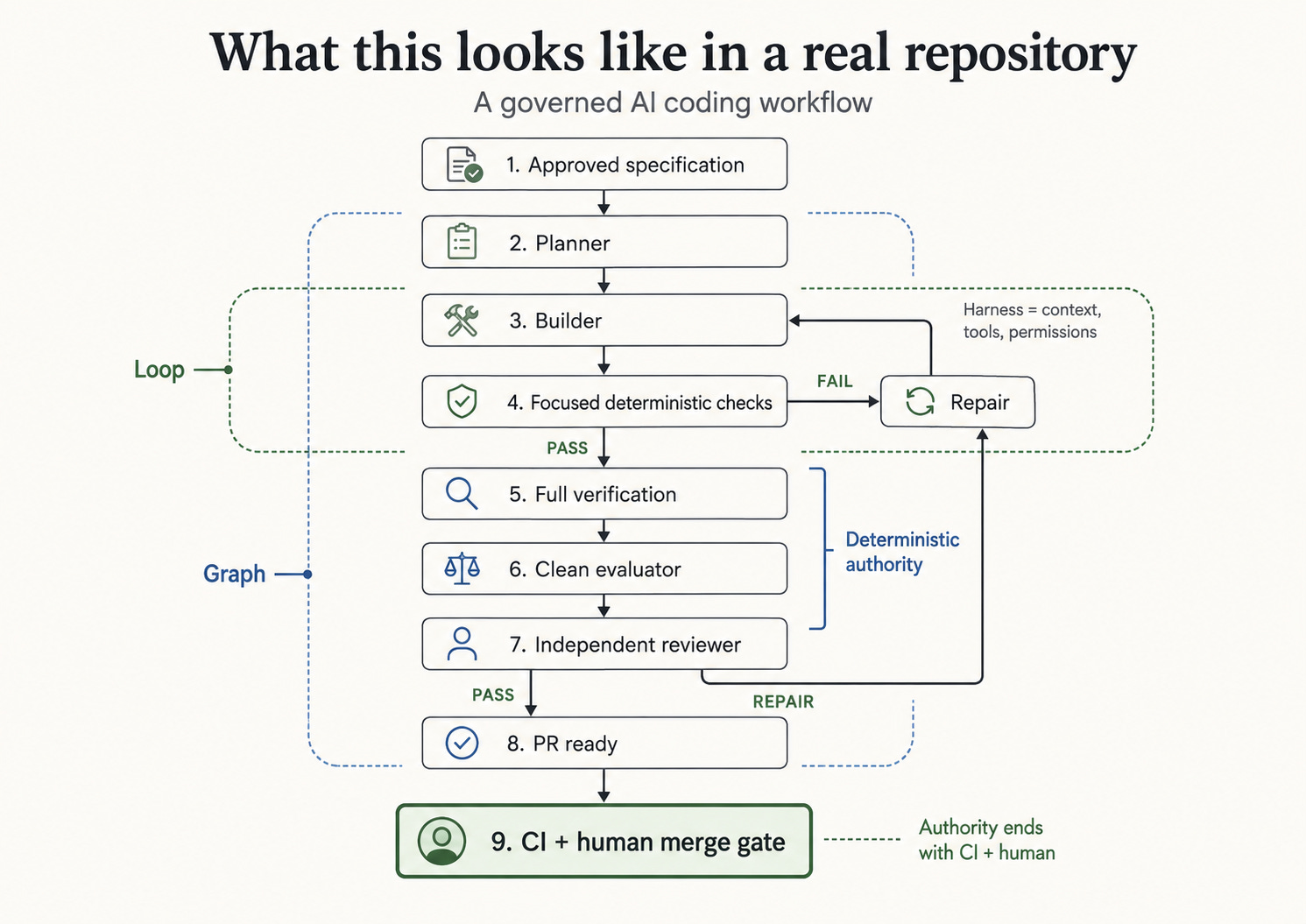 The agent proposes changes. Deterministic systems and human authority decide when those changes are allowed to progress.
Nothing in this architecture is particularly mysterious. But once the newer terminology is mapped onto it, the different layers become easier to distinguish.
The agent’s context, tools, permissions, and execution environment form the harness. The builder → verifier → repair cycle forms the loop.
The larger planner → builder → evaluator → reviewer workflow forms the graph. If many such workflows are dispatched continuously across an engineering organisation, the system begins to resemble a software factory.
The terms are related, but they solve different problems.
Harness engineering: engineer the environment around the worker
OpenAI provided one of the clearest examples of this shift earlier this year.
A small engineering team built an internal product where Codex generated effectively all of the application code. The agents also produced tests, CI configuration, documentation, observability, and internal tooling.
After roughly five months, the repository had grown to around one million lines of code and approximately 1,500 merged pull requests, initially driven by three engineers.
The interesting result was not simply the amount of generated code. It was how the engineers’ work changed as more implementation moved to agents.
Instead of writing each change themselves, the engineers increasingly focused on specifying intent and structuring the repository so agents could navigate it reliably. Architectural constraints, supporting tools, and validation mechanisms became first-class engineering concerns.
That is the essence of harness engineering.
A model may already know how to write Go, React, or Terraform. The harness determines how reliably that capability can be applied inside a particular codebase.
It controls the context the agent receives and the tools it can use. It defines what the agent is allowed to modify, which commands it may execute, and what tests or evaluations run after a change.
Anthropic reached a similar pattern from a different direction. Its work on long-running application development evolved toward separate planner, generator, and evaluator roles, with structured artifacts carrying state between them.
The separation between generator and evaluator is especially important. The worker producing an implementation should not automatically become the authority that declares the implementation correct.
Once evaluation becomes an independent part of the system, the quality of the surrounding architecture becomes as important as the raw capability of the model.
Model capability sets a ceiling. The harness determines how much of that capability survives contact with a real repository.
Loop engineering: engineer continuation
Harness engineering defines the environment around the worker. Loop engineering deals with what happens after the worker makes an attempt.
The naive version is easy to build. The agent tries something, the system detects a failure, and the agent tries again.
That creates repetition, but not necessarily a reliable autonomous system.
A useful production loop needs evidence and an external stopping condition. Verification has to decide whether the result is acceptable, and a failure needs to be classified before the system determines whether another attempt is justified.
Retries also need boundaries. When the retry budget runs out, or when the failure requires a decision outside the agent’s authority, the task needs to stop or escalate.
Atlan encountered this while deploying Sherlock, an AI system for investigating production incidents. Its initial agent could perform investigations, but production quickly exposed how much engineering was required around that agent.
Roughly 11,000 alerts per month reached the channels Sherlock monitored. Atlan eventually introduced a deterministic admission layer that suppresses more than 85% of those alerts before a model is invoked, while investigations that previously took more than ten minutes fell to roughly two minutes on average.
The important result is not simply that the investigation became faster. It is that a well-designed loop does not maximise model usage.
Sometimes the most valuable decision the loop makes is that the model should not run at all.
Production also required controlled tools, tracing, memory of earlier failures, credential isolation, and human review. The intelligence of the model remained important, but it was only one component of the system.
Kiro Crew brings similar mechanics directly into software development. Its Task Runner can decompose a specification, execute tasks in fresh sessions, test the implementation, and send the resulting diff to an independent reviewer.
Failed work can be retried within bounded limits before the system considers replanning. The runtime also introduces mechanisms for checkpointing, recovery, and repeated-error detection.
There is now early empirical evidence that these patterns are appearing in real repositories as well. A recent exploratory study mined 36,710 software repositories, surfaced 256 candidates using its heuristics, and confirmed autonomous agent loops in 217 of those candidates.
The repeated patterns were telling: machine-checkable stopping conditions, verifier agents, persistent state, budgets, and explicit human escalation.
That should not be read as an ecosystem-wide adoption rate. The study is exploratory and its candidate-selection methodology matters.
But it does suggest that loop engineering is moving beyond demos and into real repository structure.
The model may propose another attempt. The loop decides whether another attempt is justified.
Graph engineering: when one loop is not enough
Graph engineering is where I would be more cautious with the terminology.
Graphs, DAGs, workflow engines, and state machines are not inventions of the LLM era. Software systems have coordinated distributed work this way for decades.
What is changing is what now occupies the nodes.
A modern engineering workflow can contain planning agents, specialist implementation agents, deterministic integration steps, policy checks, verification systems, repair cycles, and human approval points.
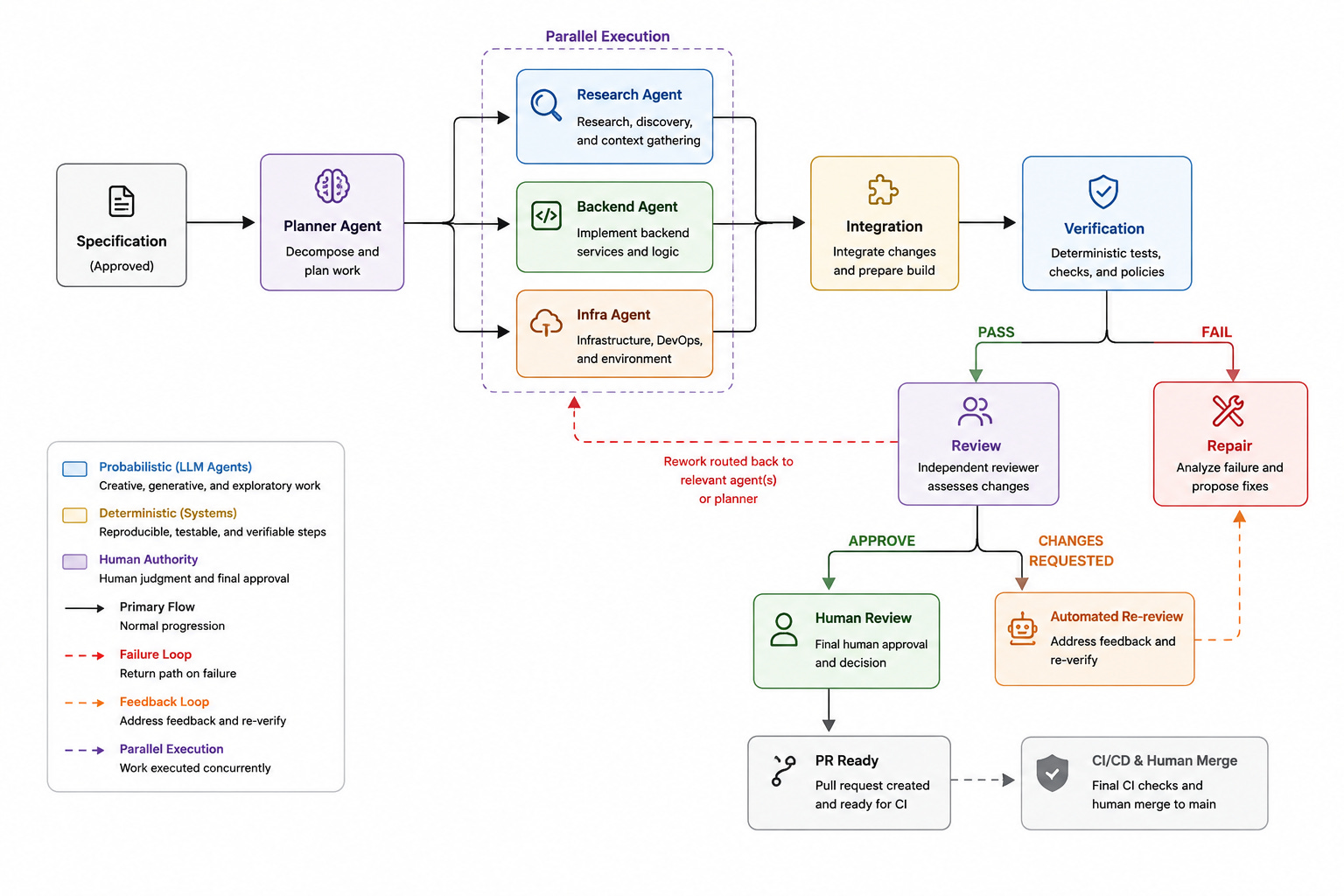 Graph engineering coordinates probabilistic workers, deterministic systems, feedback loops and human authority inside one workflow.
One agent might research a dependency while another works on backend implementation. An infrastructure agent could operate in parallel, after which those outputs meet at an integration step before deterministic verification begins.
Different failures also need different routes through the workflow. An implementation error may return to the builder, while a flawed plan should go back to planning. If the missing piece is a product or architecture decision, the graph may need to stop and wait for a human.
At that point, we are no longer engineering a single autonomous loop. We are engineering how work, evidence, and authority move between agents, deterministic systems, and humans.
That is the useful part of the graph-engineering idea even if the terminology eventually changes.
The underlying techniques are familiar. What is different is the composition.
Probabilistic workers now sit beside deterministic functions. Shared state connects them, validators control progress, and human authority remains available at selected boundaries.
This is also different from the kind of graph I have previously written about as a platform graph.
A platform graph represents knowledge about services, infrastructure, ownership, dependencies, and runtime state. The graph here represents how work moves through an execution system.
It tells us who acts next, what state crosses the boundary, and what evidence must exist before another node may run.
That relationship also makes the distinction between loop engineering and graph engineering clearer.
A graph can contain loops. A verification failure may create an edge back to implementation, while another edge sends unresolved decisions to a human.
The loop becomes a node. The edges become an engineering decision.
Those edges encode decisions that previously lived inside the developer operating the coding assistant.
Which task runs next? Which tasks can execute concurrently? Which state should survive between workers?
Which failure deserves another attempt? Which one requires replanning? At what point does authority need to move from an agent to a human?
Those are architecture questions.
Software factories: when the workflow becomes infrastructure
This perspective also changes how systems such as Spotify Xirp, Kiro Crew, and Warp Factories fit together.
They can appear to be competing approaches to AI coding. Look at the layer each is addressing, though, and the differences become more useful.
Xirp focuses heavily on sessions, isolated workspaces, and portable context.
Kiro Crew adds persistent autonomous execution, retries, replanning, and longer-lived task orchestration.
Warp Factories moves further upward toward orchestration across the software-development lifecycle.
Spotify’s experience is particularly revealing because its problem emerged from scale.
Engineers were no longer operating one coding assistant inside one repository. They were running many concurrent sessions across different tools, models, branches, and projects.
Context discovered in one session needed to survive into another, while developers also had to manage separate worktrees and coding environments. Spotify says Xirp has been used across more than 36,000 sessions and was designed to coordinate more than 50 parallel sessions.
At that point, context management is no longer a convenience around prompting.
It becomes platform infrastructure.
Warp moves another level upward by drawing a distinction between the coding harness and the software factory.
A coding harness runs the worker. A factory decides which worker should receive a task, which context it gets, which permissions it receives, and what verification must happen around its work.
The factory can also decide where human checkpoints belong.
That means Codex, Claude Code, OpenCode, Kiro, and future coding systems do not necessarily need to own the entire development stack.
They can become replaceable workers inside a larger engineering system.
A factory does not have to be another coding agent. It can be the system that chooses and governs coding agents.
Five layers, five engineering questions
I find the hierarchy easiest to understand through the question each layer answers.
MODEL
What should I produce?
The model generates an implementation, plan, explanation, or proposal.
HARNESS
What am I allowed and equipped to do?
The harness defines the environment around the worker.
LOOP
Should I continue?
The loop examines the result and decides whether to stop, repair, retry, or escalate.
GRAPH
Who or what acts next?
The graph manages dependencies and routes work between agents, deterministic systems, and humans.
FACTORY
How do we operate and improve all of this at scale?
The factory runs many such workflows and measures their outcomes over time.
Seen this way, these terms are not competing descriptions of one idea. Each layer moves another important decision outside the model and into the surrounding engineering architecture.
The model generates. The harness constrains and equips. The loop observes and retries. The graph coordinates. The factory operates and improves.
What engineers actually engineer now
If model capability continues improving, generating an implementation becomes cheaper. The difficult decisions around that implementation do not disappear; they move elsewhere.
Someone still has to define what a valid specification looks like and determine which context is useful. Tool boundaries need to be designed, and success criteria have to exist before the agent begins working.
Failures also need classification. Some deserve another attempt, while others require a different plan or a human decision.
Verification has to remain independent enough that the agent cannot make its own work look successful by weakening the test that produces the score. Parallel work needs somewhere to synchronize, and authority still needs to move to a human when the system reaches a decision it should not make alone.
More of the engineering work therefore moves toward intent, context, constraints, verification, routing, retry budgets, authority, and evidence.
Implementation has not disappeared.
It is becoming one node inside a larger engineering system.
The hierarchy matters more than the terminology
I do not know whether all of these names will survive.
Graph engineering may eventually become ordinary workflow orchestration, while loop engineering may become so common that nobody bothers naming it.
Harness engineering may simply become part of software engineering. Software factory may settle into being a product category.
The terminology can change without changing the architecture underneath it.
A model operates inside a harness. Loops govern repeated attempts, while graphs coordinate those loops with deterministic systems and humans. Factories operate many such workflows continuously.
That gives us a better way to evaluate the flood of new AI-development products.
Instead of asking whether Xirp is better than Kiro, or whether Warp will replace coding agents, we can ask a more useful question:
Which layer of the system is this product trying to own?
And instead of asking only which model writes the best code, we can ask the questions that increasingly determine whether that code is trustworthy.
What context did the model receive? What was it allowed to change?
What evidence did the implementation produce? Who decided that the task was complete?
What happened when verification failed? Which decisions remained human?
What does the system learn from the run?
For the last two years, model choice dominated AI coding discussions.
Model capability still matters, but more of the engineering advantage is moving outside the model. It is moving into context, constraints, verification, retry logic, orchestration, and evidence.
The model is becoming one worker.
The architecture around it is becoming the engineering discipline.
Sources and further reading
OpenAI — Harness engineering: leveraging Codex in an agent-first world
Anthropic — Effective harnesses for long-running agents
Atlan — Loop Engineering in Production: Putting AI Agents on Call
Spotify — Introducing Xirp
AWS / Kiro — Kiro Crew Task Runner
Warp — Open infrastructure for building a software factory
Research — Loop Engineering repository study and the recent Graph Engineering survey
Thanks for reading Autonomous AI Architect! Subscribe for free to receive new posts and support my work.