When generated changes land faster than humans can reason about them, “just roll it back” becomes too blunt for modern SRE.
By Sumant Thakur
Published: 2026-07-02
URL: https://sumantthakur.substack.com/p/ai-agents-will-break-your-rollback
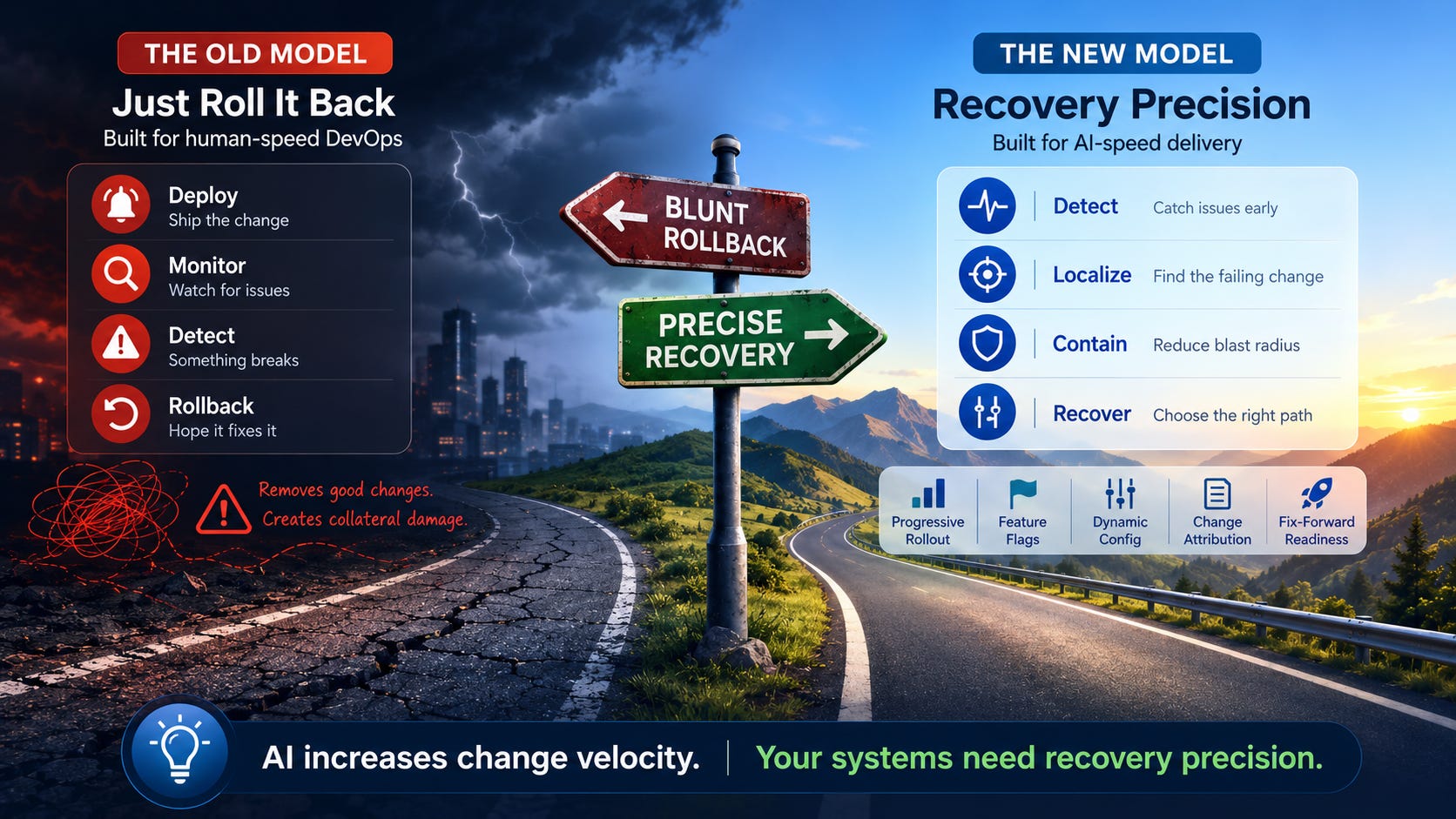
Part 1: The Pain Point
Just roll it back.
For the last decade, that was the most comforting phrase an incident commander could utter during a high-severity production outage. The system broke, latency spiked, or error rates climbed. The safest, most logical move was obvious: revert the last deployment and return the cluster to a known good state.
This safety net worked because production change moved at a human cadence. A single engineering team reviewed a pull request, a manager pressed a button, and a discrete release went live. If things went sideways, you had a single suspected cause, a clear change window, and a single recovery action.
The assumption cracking in 2026: Traditional DevOps assumes production state changes slowly enough for human minds to track, isolate, and reverse it.
AI coding agents have shattered that assumption. They aren’t just writing code faster; they are exponentially increasing production change density—the number of independent, overlapping changes landing in your environment within a compressed window of time.
When your delivery pipeline is absorbing a continuous torrent of AI-generated hotfixes, infrastructure tweaks, and configuration adjustments, binary rollback becomes a dangerously blunt instrument. If you blindly roll back the cluster to fix a regression, what else are you accidentally unwinding? A critical security patch? A customer-specific database migration? A hotfix from an entirely different team?
If your agents deploy at machine speed but your recovery strategy remains anchored to human-speed DevOps, system reliability inevitably becomes your organization’s ultimate bottleneck.
Part 2: The Architectural Solution
To survive high-density change environments without tanking your Change Failure Rate (CFR), enterprise architecture must evolve from simple rollback speed to Recovery Precision.
Recovery precision is the architectural capability to isolate and mitigate failing runtime behaviors without blindly reverting unrelated engineering progress. This requires a fundamental pivot in our core operational loop: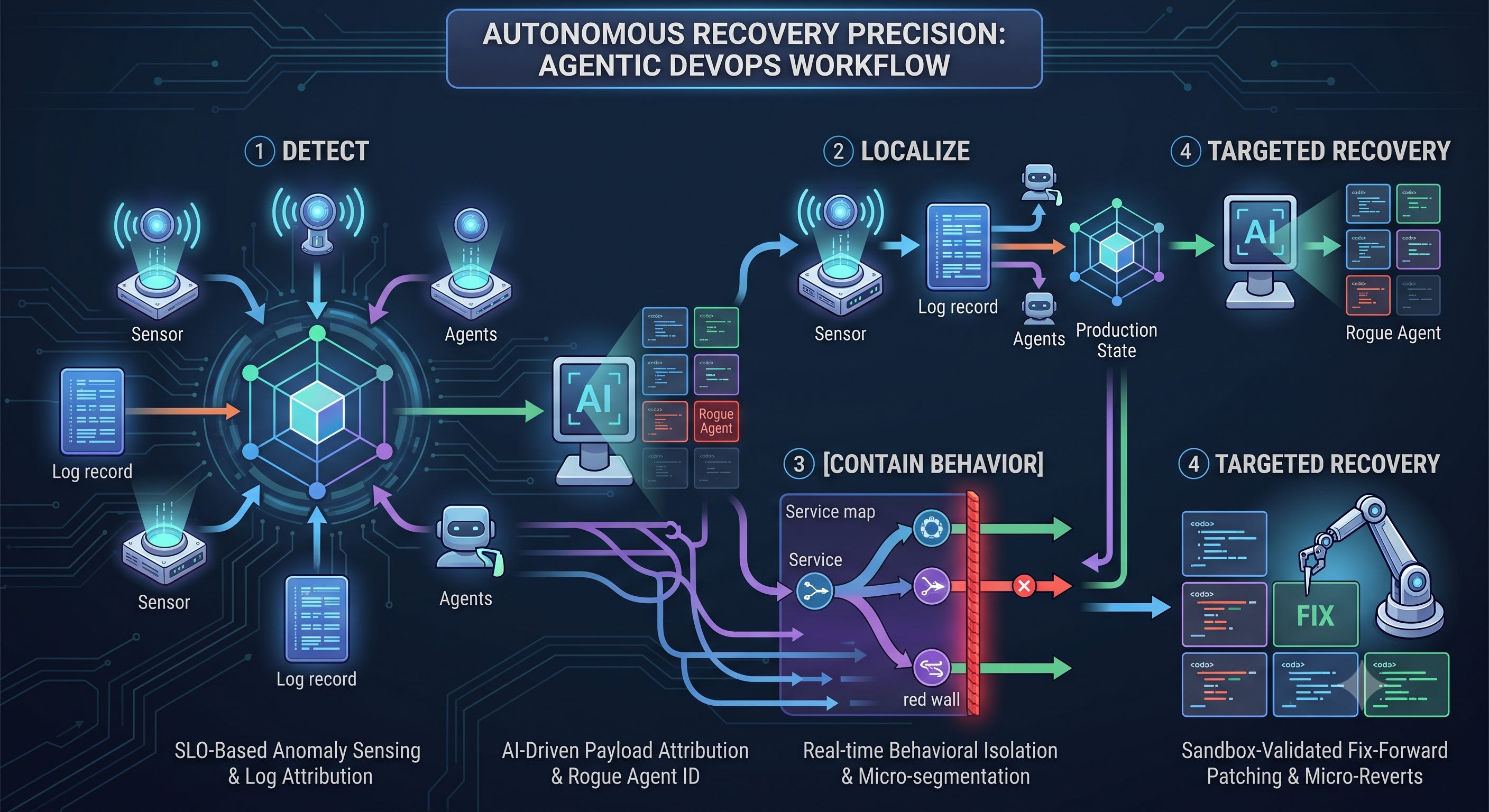
When multi-agent architectures operate on your codebase, your infrastructure plane must implement a four-layer verification and containment topology:
-
Change-Aware Detection: Traditional static dashboards are too slow and noisy. Precision recovery requires real-time telemetry tied directly to an immutable ledger of active deployments, flagging when an active Service Level Objective (SLO) begins to degrade in the exact micro-window a change occurs.
-
Algorithmic Localization: With multiple AI agents changing code concurrently, identifying the root cause is a needle-in-a-haystack problem. System integrators must design automated localization layers that correlate runtime anomalies with change attribution data, immediately identifying which agent, code path, or configuration payload introduced the structural drift.
-
Micro-Containment (Blast-Radius Controls): Before executing a destructive rollback, the system must use localized traffic shaping, feature flags, and circuit breakers to wall off the damage. If an agent-generated feature path fails, the system kills traffic to that specific path while keeping the rest of the application live.
-
Adaptive Recovery: Once contained, the system determines the lowest-risk recovery path. In high-density architectures, the safest move is rarely backward. Instead, the infrastructure utilizes automated validation to execute a precise fix-forward patch or a targeted micro-revert of a single decoupled component, leaving the broader system untouched.
Part 3: The Precision Recovery Matrix
The core operational challenge for tech leaders isn’t a lack of tools; it’s fragmentation. In most enterprise stacks, the CI/CD system deploys the change, the observability tool detects the symptom, the feature flag system controls the behavior, and the platform team owns the pipeline.
When change accelerates, this fragmentation becomes fragile. To achieve recovery precision, these siloed layers must behave as a unified Recovery Surface.
CapabilityLegacy Revert ModelPrecision Recovery SurfaceMitigation VectorDestructive Binary Rollback (De-registers versions)Runtime Micro-Containment (Traffic shaping, flag isolation)Attribution SpeedManual log analysis & git-blame triageAutomated correlation of runtime anomalies to deployment telemetryRecovery StrategyStrictly Backward (Rewinds the entire cluster state)Adaptive/Forward (Targeted micro-reverts or verified hotfixes)
This structural evolution addresses what Google SRE terms the Intervening Pull Request Problem—the operational chaos that occurs when a blunt rollback cuts through dozens of subsequent, successful deployments.
By treating recovery as a behavioral containment problem rather than a version-control problem, you protect the velocity of your delivery system. You give your platform room to breathe without treating every incident as a reason to rewind the entire engineering organization.
Part 4: The System Integrator’s Takeaway
As a technology leader, optimizing for deployment velocity without building the matching infrastructure for recovery precision is a recipe for operational bankruptcy. To transition your organization to an AI-ready posture, implement these three strategic directives immediately:
-
Move SRE Up the Abstraction Ladder: Reallocate your SRE and Platform teams away from writing linear deployment scripts or acting as reactive incident responders. Task them with writing declarative Policy-as-Code guardrails that define acceptable blast radiuses and automate micro-containment routines.
-
Deconstruct Your MTTR Metric: Stop measuring Mean Time to Resolution as a single, opaque metric. Break it down into Time to Containment and Time to Clean Recovery. Your priority should be driving Time to Containment to near-zero via automated traffic shaping, buying your teams time to resolve issues without executing frantic rollbacks.
-
Enforce Strict Dependency & Change Attribution: Update your platform’s delivery specifications. No autonomous agent or developer should be permitted to apply a change—whether to application code, Terraform files, or IAM boundaries—without appending a verifiable metadata manifest that ties that change to a specific system path and a localized kill-switch.
P.S. Why I’m Thinking About This
This structural tension is exactly why I keep analyzing infrastructure agents through the lens of blast radius and recovery rather than just code generation.
A generated Terraform change, deployment workflow, IAM update, or networking modification is not dangerous only because it might contain a bug. It is dangerous because recovery is rarely simple once that change interacts with stateful infrastructure, policy boundaries, service dependencies, and live production traffic.
That is the kind of engineering bottleneck shaping how we think about Flurit. Our focus isn’t merely on whether AI can generate an infrastructure change, but whether an enterprise platform can autonomously test it, contain it, understand its blast radius, and recover precisely if production behaves unexpectedly. For complex infrastructure, the future cannot just be about AI-generated change; it must be about recoverable change.