he seat cost is visible. The real bill shows up later in review, verification, security, platform support, incidents, and rework.
By Sumant Thakur
Published: 2026-06-30
URL: https://sumantthakur.substack.com/p/your-ai-coding-tools-arent-reducing
The Pain Point
Your AI coding strategy probably has a clear line item for tools.
Copilot seats. Cursor seats. Claude Code usage. Codex usage. Agentic coding platforms. Maybe a few internal experiments around autonomous pull requests.
That is the visible cost.
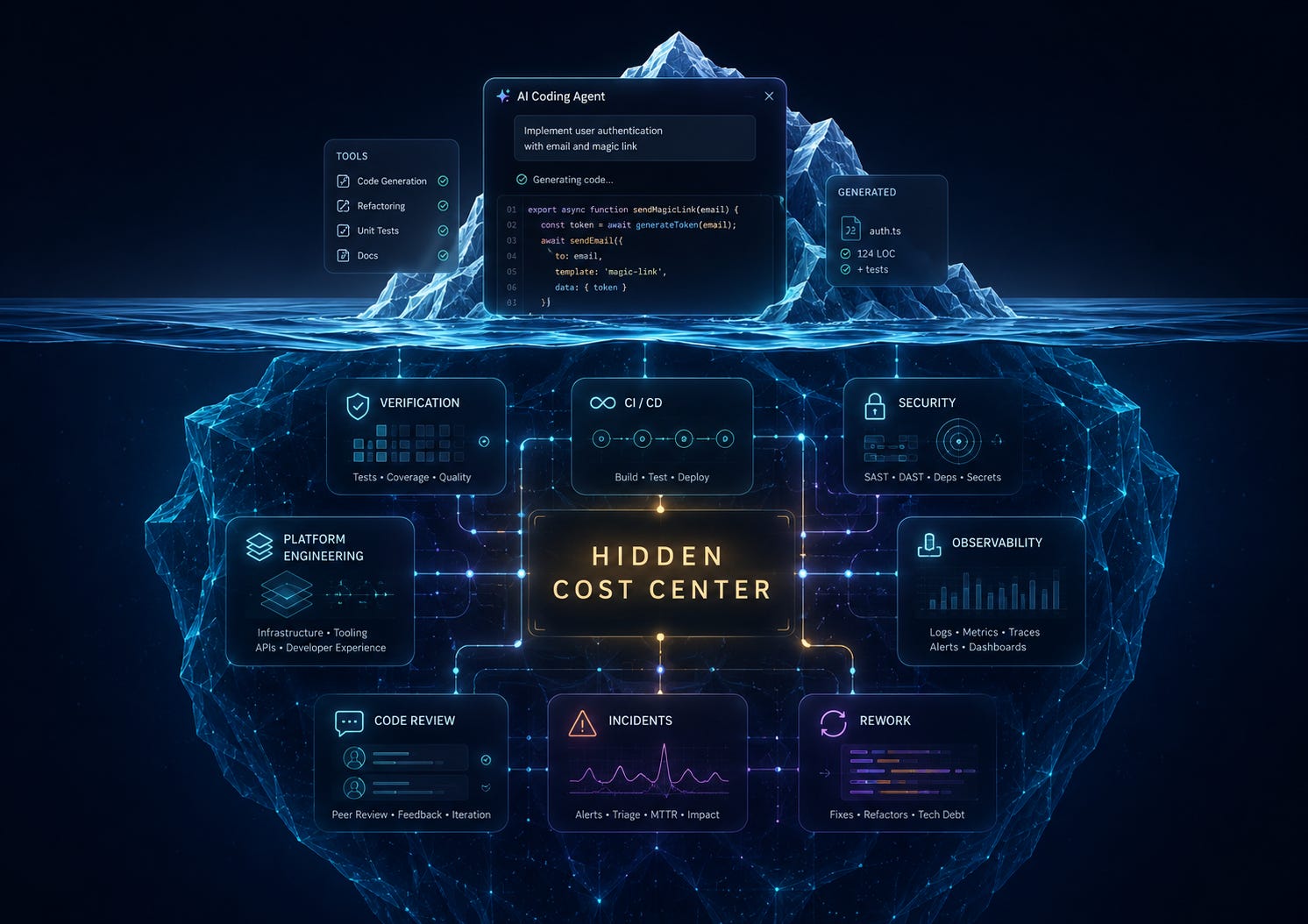
The hidden cost is everything your engineering system must now do to absorb the output.
This is the part many AI adoption plans miss.
They treat AI coding as a developer productivity upgrade. A team buys the tools, enables access, runs a few pilots, and starts tracking adoption. Developers generate code faster. Some tickets move more quickly. Demos look impressive. The story writes itself:
Implementation is getting cheaper.
But software delivery was never only priced by implementation.
The real cost of a production change includes understanding the requirement, finding the right path through the system, preserving architecture, validating behavior, testing failure modes, securing the change, reviewing risk, deploying safely, monitoring production, and cleaning up the consequences when something was almost right but not quite.
AI reduces the cost of creating code.
It does not automatically reduce the cost of making that code production-ready.
In many organizations, it shifts the cost downstream.
The tool invoice lands in one budget.
The real cost shows up everywhere else.
It shows up as more CI minutes, more review load, more test maintenance, more security exceptions, more platform requests, more context engineering, more rework, and more debugging of code nobody deeply understands.
None of that appears as “AI cost” in a clean financial model.
It appears as engineering drag.
That is why some AI coding strategies look successful in the first month and expensive by the third.
The team is not wrong to adopt the tools. The tools are genuinely useful. Coding agents are becoming capable enough to investigate repositories, create plans, make changes, run checks, and open pull requests.
The market is clearly moving from AI autocomplete toward AI participation in the software delivery lifecycle.
But that does not mean the cost disappears.
It means the cost moves.
Before AI, the expensive part was often getting enough implementation capacity.
After AI, the expensive part becomes turning machine-generated work into stable, secure, maintainable production behavior.
That is the hidden cost center.
And if engineering leaders do not budget for it, they will pay for it anyway through senior-engineer toil, platform-team overload, production instability, and quality debt.
AI coding ROI does not come from generating more code.
It comes from reducing the total cost of production-ready change.
That distinction matters.
A team can generate more pull requests and still become less efficient.
A team can close more tickets and still increase long-term maintenance cost.
A team can reduce implementation time and still increase the burden on review, security, testing, and operations.
This is why AI coding strategy cannot be treated as a tool rollout.
It is a delivery-system redesign.
The question for CTOs and VPs of Engineering is not:
“How many engineers are using AI?”
The better question is:
“What new costs are we creating as AI changes the shape, speed, and volume of engineering work?”
That is where the real strategy begins.
Thanks for reading Autonomous AI Architect! Subscribe for free to receive new posts and support my work.
The Architectural Solution
The mistake is measuring AI coding strategy at the point of code creation.
That is where the benefit is easiest to see, but it is not where business value is realized.
Business value is realized when a change reaches production safely, improves the product, and does not create hidden drag for the next team that touches the system.
That means engineering leaders need a different unit of analysis.
Not cost per line of code.
Not cost per pull request.
Not even cost per completed ticket.
The right unit is:
Cost per production-ready change.
A production-ready change is not just something that compiles.
It is a change that has enough context, validation, ownership, security, observability, and rollback confidence to move safely through the delivery system.
Once you use that as the unit, the AI cost picture changes.
The coding tool is only one part of the cost surface.
There is also the cost of context.
Agents need access to the right repositories, documentation, architecture decisions, coding standards, service ownership, policy rules, and runtime assumptions. Without that context, they produce work that looks useful locally but creates downstream ambiguity.
There is the cost of verification.
Generated work still needs tests, static analysis, security scanning, dependency review, policy checks, and operational validation. If AI increases the amount of change entering the system, your verification layer has to scale with it.
There is the cost of integration.
AI tools need to fit into issue trackers, repositories, CI/CD systems, developer environments, observability tools, security workflows, and approval paths. If the integrations are weak, humans become the glue.
There is the cost of governance.
Leaders need to define what agents are allowed to change, where they can run, which tools they can call, which repositories are in scope, which changes require human approval, and how audit trails are preserved.
And then there is the cost of rework.
This is the most dangerous one because it is easy to hide. A generated change can pass review today and still make the system harder to modify next quarter. It can save two hours now and cost twenty hours later.
That is why AI coding strategy needs an architectural layer above the tools.
Call it the AI delivery cost surface.
The AI delivery cost surface is the full set of costs required to convert AI output into production-ready change.
Most organizations are not measuring this surface yet. They are measuring adoption, activity, and sometimes developer sentiment.
Those are useful, but they are incomplete.
Adoption tells you whether people are using the tool.
Activity tells you whether more work is being produced.
Developer sentiment tells you whether the tool feels useful.
None of those, on their own, tell you whether the organization is becoming more efficient.
For that, you need to measure what happens after the code is generated.
Does lead time improve?
Does review load decrease or increase?
Does rework go down?
Do incidents per change improve?
Do platform teams spend less time unblocking delivery, or more?
Do security reviews become easier, or are they handling more ambiguous changes?
Do senior engineers spend more time on architecture, or more time cleaning up machine-generated work?
That is the difference between AI adoption and AI economics.
AI adoption asks whether engineers are using the tools.
AI economics asks whether the total system is cheaper, faster, and safer because of them.
This is where many organizations will get surprised.
They will calculate AI ROI as if the only meaningful variable is developer time saved during implementation. But the real system has more variables than that.
If AI saves ten hours of implementation and creates twelve hours of review, rework, platform support, and production debugging, the organization did not gain leverage.
It moved labor into a less visible place.
The architectural solution is to make that movement visible.
The best engineering organizations will build measurement around the full path from idea to production. They will tag AI-assisted work. They will compare review time, rework, incident rates, deployment outcomes, and maintenance burden. They will separate low-risk automation from high-risk autonomous change. They will invest in the platform layer that makes AI-generated work easier to trust.
That last point matters most.
The hidden cost center is not always a bad thing.
Some hidden costs are the cost of doing AI well: stronger test systems, better internal platforms, policy layers, agent observability, context infrastructure, security isolation, and new management habits.
Those costs are real.
But they are investments in leverage.
The danger is not that AI creates new costs.
The danger is pretending those costs do not exist.
The Operating Model for AI ROI
A serious AI coding strategy starts by changing the ROI conversation.
There are two ways to misunderstand AI coding ROI.
The first is to count only the tool cost.
The second is to count only the time saved during implementation.
Both are too narrow.
The real ROI question is whether AI reduces the total cost of getting a safe, maintainable change into production.
That requires looking at the entire delivery path, not just the coding step.
Do not begin with the tool.
Begin with the workflow.
The right starting point is a workflow portfolio.
Group AI use cases by risk and reversibility.
Low-risk, reversible workflows are where teams should look for early leverage. These include documentation, tests, internal scripts, code search, issue summarization, dependency cleanup, and simple maintenance work.
Medium-risk workflows should be AI-assisted, not AI-owned. These include refactoring, migration planning, release preparation, incident analysis, and code review support.
High-risk workflows need explicit controls before agents get meaningful autonomy. These include production infrastructure, authentication, permissions, networking, deployment policy, customer data paths, and database changes.
This portfolio view prevents a common mistake: treating AI as a horizontal productivity layer instead of a risk-sensitive delivery capability.
A generated documentation update and a generated database migration are not the same kind of work.
A test expansion and a change to authentication are not the same kind of work.
A UI refactor and a Terraform networking change are not the same kind of work.
If your AI strategy treats them the same, your risk model is too shallow.
A mature operating model defines where AI can act, where it can assist, where it can recommend, and where it should not operate without stronger controls.
That is not bureaucracy.
That is cost control.
Every unmanaged AI workflow eventually creates a bill.
The bill usually shows up in four places.
The first is infrastructure cost. More generated work can mean more CI runs, more test environments, more model calls, more cloud usage, and more automation spend.
The second is human attention. Senior engineers, security reviewers, platform teams, and engineering managers become the hidden absorption layer when AI-generated work lacks context or evidence.
The third is operational risk. A change that looks locally correct can still increase blast radius, weaken observability, bypass policy, or make rollback harder.
The fourth is maintenance drag. This is the most dangerous category because it compounds quietly. A generated change can save two hours today and create twenty hours of future complexity if it moves the system away from its intended architecture.
A mature AI operating model does not pretend these costs disappear.
It decides which costs are worth paying, which ones should be automated away, and which ones should block the workflow entirely.
This also changes how leaders should think about pilots.
A weak AI pilot asks:
“Did developers like the tool?”
A better AI pilot asks:
“Did this workflow become cheaper, faster, and safer end to end?”
That requires a baseline.
Before rolling out a coding agent broadly, leaders should know the current cycle time, review time, rework rate, deployment frequency, change failure rate, and incident profile for the workflow being tested.
Without that baseline, AI success becomes a collection of anecdotes.
Someone will say the tool saved them hours.
Someone else will say review got worse.
Both may be telling the truth.
The leader’s job is to understand the system-level outcome.
That means measuring AI-assisted work through the whole delivery path:
From ticket or prompt, to generated change, to review, to CI, to deployment, to incident data, to rework.
This is not about surveillance.
It is about learning where the system is actually improving.
The best AI ROI model will not be a single productivity number.
It will be a map of tradeoffs.
Leaders should also expect a J-curve.
The early phase of AI adoption often creates new work before it removes old work.
Teams need time to learn the tools. Platform teams need to integrate them. Security teams need new policies. Reviewers need better signals. CI systems may run more often. Managers need new measurement. Engineers need to learn when to trust the machine and when to slow it down.
This can make AI look less efficient at the beginning.
That does not automatically mean the strategy is failing.
It may mean the organization is paying the transition cost required to make AI useful at scale.
The real danger is not the J-curve.
The real danger is pretending there will not be one.
That is how companies end up funding the tools but not the operating model.
Developers adopt AI, but the platform does not evolve.
Agents generate work, but verification stays manual.
Output increases, but architecture remains tribal.
Leadership celebrates adoption, but nobody funds the absorption layer.
Then the organization wonders why the ROI is unclear.
The answer is simple:
The tool was funded.
The operating model was not.
This is the shift engineering leaders need to make now.
Budget for the tools, yes.
But also budget for the platform, process, measurement, security, and governance changes required to make those tools useful at scale.
The next competitive advantage will not belong to the company that gives every developer a coding agent first.
It will belong to the company that understands the real unit economics of AI-assisted delivery.
That means knowing what it costs to produce trusted change.
Not just generated code.
Trusted change.
Code that fits the architecture.
Code that passes the right tests.
Code that respects policies.
Code that is observable in production.
Code that has an owner.
Code that can be rolled back.
Code that does not create a bigger bill for the next team.
That is what AI coding strategy has to optimize for.
Otherwise, you are not reducing cost.
You are moving it into places your dashboard cannot see.
The System Integrator’s Takeaway
-
Stop calculating AI ROI only at the developer seat level. Tool cost and time saved during implementation are only the visible part of the model. The real question is whether AI reduces the total cost of production-ready change across review, testing, security, deployment, incidents, and rework.
-
Budget for the absorption layer. If AI increases the volume and speed of generated work, your platform has to absorb it. That means better context, stronger test systems, clearer policy boundaries, agent observability, security controls, review routing, and feedback loops from production.
-
Instrument AI-assisted delivery end to end. Track what happens after AI generates the code: review time, rework, CI cost, deployment outcomes, incident rates, rollback frequency, and maintenance burden. If implementation gets faster but the rest of the system gets more expensive, your AI strategy is not creating leverage.
The leadership lesson is straightforward:
AI coding tools are not free productivity.
They are a new production input.
Like any production input, they change the shape of the system around them.
The organizations that win will not be the ones that generate the most code.
They will be the ones that understand the full cost of turning AI-generated work into safe, maintainable, production-ready change.
That is where AI ROI will be won or lost.
Not in the demo.
Not in the seat count.
Not in the number of generated pull requests.
In the total cost of trusted delivery.
P.S. Why I’m Thinking About This
This is one of the reasons I keep coming back to infrastructure and production systems when thinking about Flurit.
Infrastructure code is deceptively easy to generate.
It is much harder to trust.
A generated Terraform change, deployment workflow, or cloud policy can look correct while quietly changing blast radius, cost, security posture, or recovery behavior.
That is why I do not think the future is simply “AI writes more code.”
The future is systems that can make AI-generated change cheaper to verify, safer to approve, and easier to operate after it reaches production.
That is the cost center worth building around.