Coding agents can read repositories. They cannot yet understand services, ownership, dependencies, policies, infrastructure, and production state. That is the next architecture layer.
By Sumant Thakur
Published: 2026-07-07
URL: https://sumantthakur.substack.com/p/the-platform-graph-the-missing-context
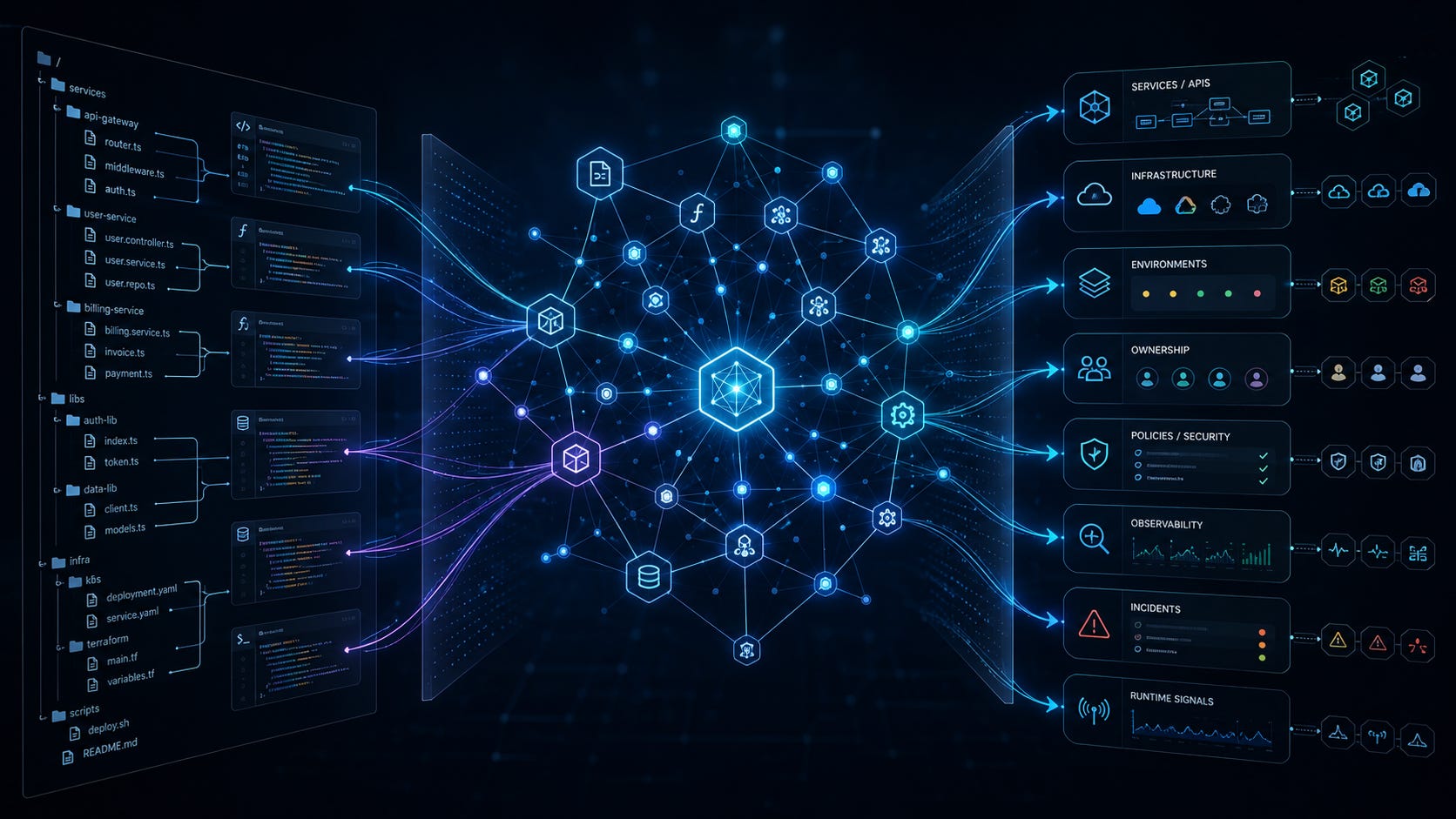
Repository-Native Agents Are Hitting a Ceiling
Most coding agents today are repository-native.
They can inspect files, parse symbols, follow imports, search documentation, run tests, generate patches, and open pull requests. That is already useful. For local implementation work, repository context gives agents enough signal to understand the immediate shape of the codebase: where functions live, how modules are organized, which tests exist, and how one file relates to another.
Thanks for reading Autonomous AI Architect! Subscribe for free to receive new posts and support my work.
This is why the first wave of AI software engineering has been so code-centric. The repository is an obvious place to start. It is structured, versioned, searchable, and already part of the engineering workflow. If an agent can read the repo and make a change that passes tests, it feels like the system is becoming intelligent.
But the software system the agent is changing is not the repository.
It is the platform around the repository.
A service does not exist as a folder. It has owners, dependencies, environments, deployment history, SLOs, incident history, runtime behavior, infrastructure underneath it, policies around it, and customers depending on it. The repository may contain the implementation, but it rarely contains the full operating context.
That is the ceiling repository-native agents are about to hit.
-
An agent may know how to modify an API endpoint, but not that a downstream service is already consuming most of its error budget.
-
It may know how to add a synchronous call, but not that the dependency has a history of regional incidents.
-
It may know how to update a Terraform module, but not that the IAM boundary is owned by a platform team with strict approval rules.
-
It may know how to refactor a service, but not that another team depends on its current behavior during month-end processing.
-
The agent can see the code. It cannot reliably see the system.
This distinction matters because AI agents are moving beyond autocomplete. They are starting to participate in delivery: proposing changes, opening pull requests, updating infrastructure, preparing reviews, triaging incidents, and recommending operational actions. At that point, missing platform context is no longer a quality issue. It becomes an architectural risk.
Repository context tells an agent what code exists.
Platform context tells the agent what the system actually is.
That is the missing layer.
The next bottleneck in AI engineering is not only model capability, prompt quality, or larger context windows. The next bottleneck is context infrastructure: the ability to expose the living shape of an engineering system to both humans and agents.
That layer is what I call the Platform Graph.
The Missing Layer Is the Platform Graph
A Platform Graph is a live relationship model of your engineering system.
Not just the codebase. The system.
It connects services, APIs, repositories, infrastructure, environments, deployments, dependencies, owners, policies, incidents, SLOs, runtime signals, and production state into one context layer.
The important word is connects.
-
A service catalog is useful, but a list of services is not enough.
-
A dependency graph is useful, but dependency edges alone are not enough.
-
Observability is useful, but metrics without ownership and change context are incomplete.
-
A CMDB is useful, but static asset inventory is not enough for agentic engineering.
-
A Platform Graph sits across these systems and makes their relationships queryable.
It should help answer questions that a codebase cannot answer by itself.
-
Who owns this service?
-
What systems depend on it?
-
Which APIs does it expose?
-
Which environments does it run in?
-
What infrastructure supports it?
-
What policies apply to it?
-
What recent deployments changed it?
-
What incidents involved it?
-
What SLOs does it carry?
-
Which teams need to approve changes?
-
What blast radius could a change create?
-
Which runtime signals indicate whether it is healthy?
These are not nice-to-have details. They are the difference between an agent that guesses and an agent that can reason inside the real engineering environment.
This is also why “Platform Graph” should not be understood as just “put everything in a graph database.” The graph is an architectural model, not a vendor choice. A Platform Graph could be built on top of Backstage, service catalogs, observability systems, cloud inventories, policy engines, CMDBs, CI/CD metadata, incident tools, internal developer platforms, or a dedicated graph store. The implementation can vary.
The important idea is that engineering context is relational.
Services depend on APIs. APIs depend on databases. Databases run inside cloud accounts. Cloud accounts follow policy boundaries. Teams own services. Incidents affect customer journeys. Deployments change runtime behavior. SLOs define reliability expectations. Architecture decisions constrain future choices.
The intelligence is not only in the nodes.
The intelligence is in the edges.
That is why agents need a Platform Graph.
A repository can tell an agent how a function is implemented. A Platform Graph can tell the agent whether changing that function affects a regulated customer path, a high-error-budget service, a fragile dependency, a platform-owned boundary, or a team that must approve the change before it moves forward.
That is the architecture shift.
The codebase remains the implementation layer. The platform remains the execution layer. The Platform Graph becomes the context layer.
For AI engineering, the context layer may become the most important layer of all.
Why Graphs Matter for AI Engineering
The reason graphs matter is that software systems are not linear.
They are networks of dependencies, ownership, runtime behavior, and constraints.
A coding agent operating only on repository context sees a narrow slice of that network. It can understand local code relationships, but it often misses the broader system relationships that determine whether a change is safe, useful, or aligned with the organization’s architecture.
Consider a simple request: improve latency in a service.
A repository-native agent might inspect the code, find a slow path, and add a cache. Locally, this can look reasonable. The code may be clean. The tests may pass. The pull request may be easy to review.
But the platform context may tell a different story. The service may already have reliability issues because of cache invalidation bugs. The platform team may be standardizing on a shared cache layer instead of local caches. The downstream dependency may be the real bottleneck. The service may handle regulated customer data that cannot be cached in the proposed way. The SLO may show that tail latency matters more than average latency. The last incident may have been caused by exactly this class of optimization.
None of that is guaranteed to be visible in the repository.
This is where the Platform Graph changes the agent’s starting point. Before proposing the change, the agent can understand the service boundary, ownership, dependencies, current SLO status, incident history, policy constraints, and runtime behavior.
The agent is no longer just asking, “What code should I change?”
It can ask, “What system am I changing?”
That is a very different question.
This also explains why platform engineering becomes central to AI engineering. For years, platform teams have built paved roads for human developers: standardized templates, CI/CD workflows, service catalogs, golden paths, observability, infrastructure modules, policy checks, and deployment systems.
In the AI era, those paved roads need to become machine-readable.
The platform is no longer only a developer experience layer. It becomes the environment that teaches agents how the organization builds, runs, and governs software.
That means the internal developer platform has to evolve. It should not only help a developer find the right service; it should help an agent understand whether it is allowed to change that service. It should not only expose deployment status; it should connect deployments to incidents, ownership, risk, and runtime health. It should not only show documentation; it should connect documentation to live systems, policies, and operating constraints.
The Platform Graph is the structure that makes this possible.
It turns scattered platform knowledge into a machine-readable context layer.
What Platform-Aware Agents Can Do
The value of a Platform Graph is not that it makes architecture diagrams prettier. The value is that it expands what agents can safely do.
A platform-aware agent can route work to the right reviewers because it understands ownership, service boundaries, and approval paths. It can identify blast radius because it understands dependencies, environments, cloud resources, and runtime relationships. It can avoid forbidden patterns because it understands policy boundaries, architecture decisions, and platform standards. It can plan infrastructure changes more carefully because it understands which services depend on which resources and which teams own the consequences.
It can also improve incident workflows. A repository-native agent may inspect code and logs. A platform-aware agent can correlate a recent deployment, a service dependency, an SLO breach, an incident history pattern, and ownership metadata. That does not magically solve the incident, but it gives the human operator a much better starting point.
This is the difference between a coding assistant and an engineering assistant.
A coding assistant helps with implementation.
A platform-aware engineering assistant helps reason across the system.
This distinction will become more important as agents move from local code changes into DevOps, SRE, platform engineering, security review, and infrastructure workflows. The more an agent participates in the software delivery lifecycle, the more it needs context that is not present in the repository.
The Platform Graph can also reduce the burden on senior engineers.
Today, a lot of engineering context is smuggled through humans. Staff engineers remember why a pattern was rejected. Platform teams know which infrastructure modules are safe. SREs know which service has fragile dependencies. Security teams know which systems require stricter review. Engineering managers know which teams own which tradeoffs.
That human memory is valuable, but it does not scale well into agentic workflows.
If agents are going to participate in delivery, the organization cannot rely only on tribal knowledge. The system needs to expose that knowledge as context.
This does not mean agents should become fully autonomous overnight. That is the wrong conclusion. The better conclusion is that human and machine decisions should be grounded in the same platform model.
A Platform Graph helps both.
Humans get better visibility into the system they are changing.
Agents get the context they need before they propose, review, deploy, or recover changes.
The organization gets a shared map.
That is the real point.
The Operating Model for the Platform Graph
A Platform Graph is not a one-time documentation project.
It has to stay alive.
This is important because a stale graph can be worse than no graph in some situations. If ownership is outdated, policies are missing, dependencies are incomplete, or runtime signals are disconnected, the agent may act on an inaccurate model of the system. The danger is not only lack of context. It is false confidence created by stale context.
So the Platform Graph has to be fed by real engineering systems.
Service catalogs provide software ownership, component metadata, system boundaries, and API relationships. CI/CD pipelines provide deployment events, build metadata, rollout history, and change status. Cloud inventories provide infrastructure resources, accounts, regions, permissions, and environment state. Observability systems provide metrics, logs, traces, SLO status, and runtime behavior. Incident tools provide failure history, affected services, customer impact, and recovery patterns. Policy engines provide constraints around security, compliance, cost, and operational risk. Architecture decision records provide the “why” behind system direction.
The goal is not to centralize everything into one giant tool. That would create another platform monolith.
The goal is to make relationships visible and queryable.
A useful Platform Graph should not merely say, “Service A exists.” It should say Service A is owned by Team X, depends on API Y, runs in Environment Z, is backed by Database D, has a 99.9% SLO, was involved in Incident N, was deployed three times this week, is governed by Policy P, and supports Customer Journey J.
That is the kind of context agents need.
It is also the kind of context engineering leaders need if they want to scale AI beyond code generation.
A weak AI strategy asks, “How much of the codebase can the agent access?”
A stronger AI strategy asks, “How much of the engineering system can the agent understand?”
Those are not the same question.
The first question produces repo-connected agents.
The second produces platform-aware agents.
Platform-aware agents are the ones that will matter as AI moves from writing code to participating in delivery.
This is also why the Platform Graph belongs to platform engineering. It is not just an AI feature. It is the next evolution of the internal developer platform. The IDP becomes not only a paved road for human developers, but also a context substrate for agents.
That is a major shift.
The platform team is no longer only building templates, workflows, and self-service portals. It is building the machine-readable map of how the engineering organization works.
That map becomes the foundation for safe agentic DevOps.
The System Integrator’s Takeaway
-
Stop treating repository access as enough context. Code tells agents what exists, but not what matters. AI agents need to understand services, ownership, dependencies, environments, policies, incidents, SLOs, and runtime state before they can safely participate in delivery.
-
Build the Platform Graph before scaling autonomy. If agents are going to propose changes, route reviews, update infrastructure, or assist with incidents, they need a live map of the engineering system. Otherwise, they will operate through fragmented docs, stale assumptions, and tribal knowledge.
-
Make platform context machine-readable. Service catalogs, deployment history, ownership maps, observability signals, incident records, policy boundaries, and infrastructure state should not remain separate human-only systems. They are the context layer for AI-native engineering.
The leadership lesson is simple: AI agents do not just need better models. They need better maps.
The organizations that win with AI engineering will not be the ones that give agents the most repository access. They will be the ones that give agents the clearest understanding of how software actually runs.
That is the real role of the Platform Graph. It is not just another architecture diagram. It is the missing context layer between AI agents and production engineering.
Without it, agents can generate code.
With it, agents can begin to understand systems.
P.S. Why I’m Thinking About This
This is one of the core ideas shaping how I think about Flurit.
Infrastructure agents cannot rely only on repository context. A Terraform file can show what resource is being declared, but not always why it exists, which service depends on it, which team owns the blast radius, what policy boundaries apply, what environment it affects, or what runtime risk it introduces.
That is why I keep coming back to graph-backed infrastructure context.
The future is not just AI that generates infrastructure code. It is AI that understands the platform context around that infrastructure before it proposes, changes, deploys, or recovers anything.
For me, that is where agentic DevOps becomes serious.
Not more code. More system awareness.
Thanks for reading Autonomous AI Architect! Subscribe for free to receive new posts and support my work.