The real cost of agentic systems is not generation — it is keeping them reliable, reviewable, and controllable over time.
By Sumant Thakur
Published: 2026-04-21
URL: https://sumantthakur.substack.com/p/agents-need-an-operations-model
Building an agent is not the hard part anymore.
Operating it is.
That is the shift most teams still have not fully absorbed.
A lot of people are still treating agents like product features—or worse, like clever prompts wrapped around a few tools. That works right up until the system starts touching real workflows, real users, real dependencies, and real consequences.
Then everything changes.
The question is no longer:
Can the agent do the job?
It becomes:
Can we keep this thing running without creating chaos?
That is not a product question.
That is an operations question.
And that is where most agent systems either become infrastructure—or become expensive experiments.
Thanks for reading Autonomous AI Architect! Subscribe for free to receive new posts and support my work.
The first run is the easiest part
Getting an agent to do something useful once is not especially impressive anymore.
It can plan. It can call tools. It can automate a workflow. It can stitch together decisions across systems.
Fine.
That is the easy part.
The real cost begins after the first success.
Because the moment the agent goes live, it enters a moving system.
Policies change. Tools change. Schemas change. Humans change how they use it. Downstream systems become unreliable. Context becomes stale. The workflow that looked clean in week one starts accumulating friction by week three.
This is where most teams get blindsided.
The system rarely fails loudly.
It degrades.
Quietly.
Just enough to make every run a little less trustworthy than the last one.
An agent is not a feature
This is the mental model problem.
A feature is something you ship.
A system is something you operate.
Agents belong in the second category.
The moment an agent starts acting on behalf of a person or a business process, it becomes part of the operating environment.
That means it now has:
- failure modes
- review paths
- rollback needs
- policy constraints
- state drift
- traceability requirements
- cost structures
- maintenance overhead
That is not a prompt problem.
That is a service problem.
And services need operating models.
What operating an agent actually means
This is the part nobody puts in the demo.
Operating an agent means answering uncomfortable questions:
What happens when a tool fails halfway through execution?
What happens when the agent makes a decision using stale context?
What happens when a policy changes, but the workflow does not?
What happens when the model is confident—and wrong?
What happens when a human needs to step in?
What happens when the system has to resume three hours later?
What happens when leadership asks why the agent made that decision?
That is the real work.
Not the happy path. Not the polished demo. Not the first successful run.
Keeping the system reliable after it has already proven it can work once.
The hidden cost is not compute
A lot of teams still think the cost of agents is mostly model usage.
It is not.
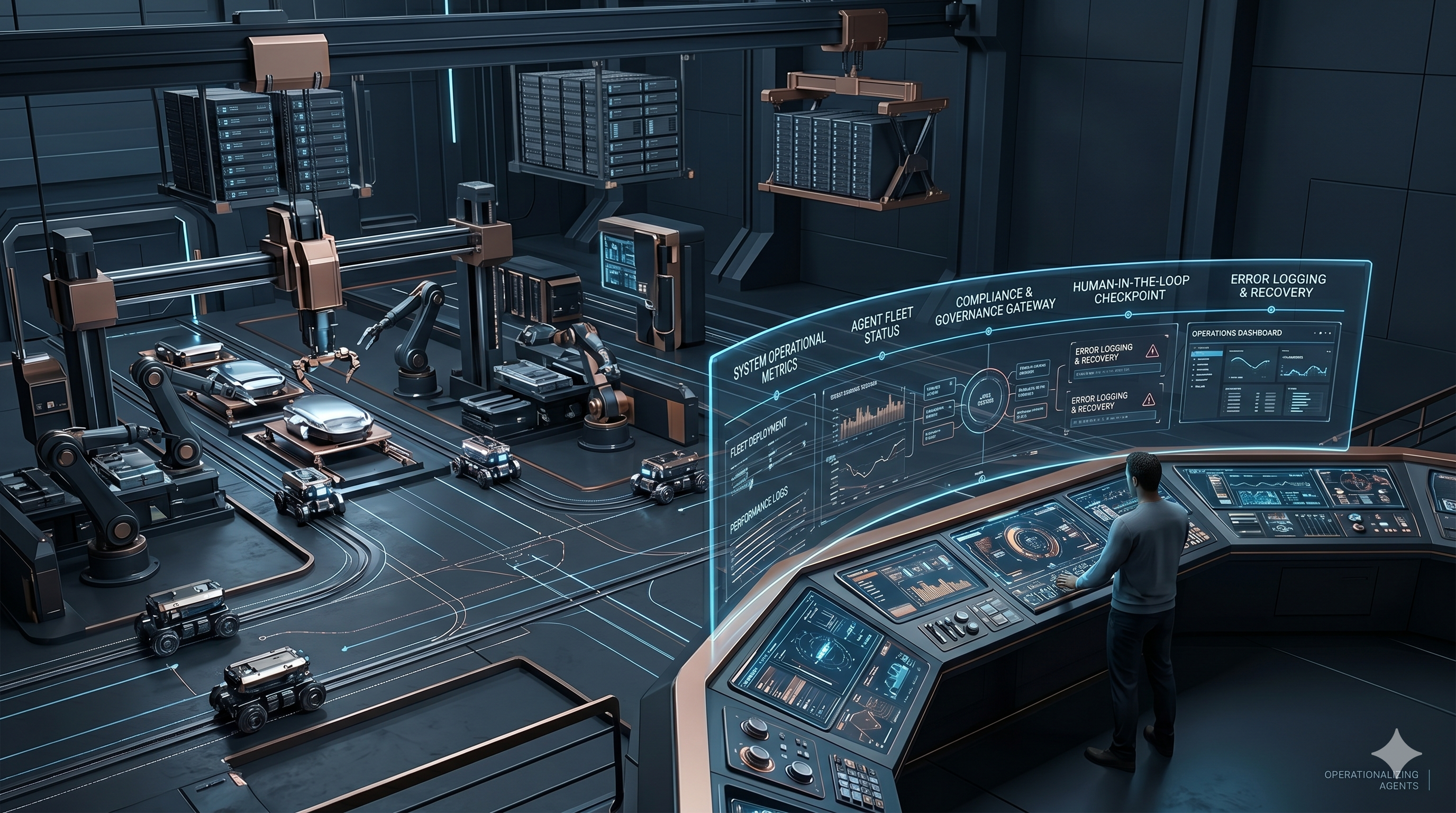
The hidden cost is everything required to keep the system under control:
- state management
- policy enforcement
- human review
- tracing
- recovery paths
- exception handling
- workflow updates
- maintenance of all of the above
That is where the real bill shows up.
And that bill grows over time.
Because every new edge case adds one more thing the system has to remember, validate, review, or recover from.
This is why agent systems feel cheap early and expensive later.
The expensive part is not the first answer.
It is the tenth correction.
We need an ops mindset, not a feature mindset
This is where many teams are still behind.
They build agents like application features.
But agents behave like operational systems.
That means the mindset has to be closer to infrastructure than interface design.
Think in terms of:
- runbooks
- review gates
- failure handling
- recovery paths
- operational ownership
- trace inspection
- policy drift
- cost control
That is how systems stay usable.
Not by hoping the model stays smart.
Not by assuming the workflow stays stable.
Not by pretending maintenance is a future problem.
The real question is not “can we build it?”
That is the wrong question.
The better question is:
Can we operate it responsibly?
That question forces honesty.
Some workflows are worth automating.
Some need human review on every critical step.
Some require strict rollback boundaries.
Some are too fragile to trust.
Some are too expensive to maintain relative to the value they create.
That is fine.
The goal is not to make everything autonomous.
The goal is to know what it costs to keep a workflow trustworthy.
That is what separates a useful system from a liability.
What this changes
Once you think in operations terms, the architecture changes.
You stop asking only what the agent should do.
You start asking:
What should it remember? What should it log? What should it block? What should it escalate? What should it retry? What should it never be allowed to do alone?
Observability stops being debugging.
It becomes control.
Human review stops being overhead.
It becomes part of the operating model.
Maintenance stops being a future concern.
It becomes the actual cost of ownership.
That is the shift.
The part nobody likes to say out loud
Most agent systems look promising because the first run is easy to make look good.
That is not the hard part.
The hard part is everything that happens after the first success.
Keeping the system aligned. Keeping policies current. Keeping traces readable. Keeping retries sane. Keeping the human workload under control. Keeping the workflow from quietly drifting away from what it was supposed to do.
That is the work.
And that work does not end.
The line that actually matters
The real divide is not smart versus dumb.
It is not autonomous versus manual.
It is this:
Operable versus fragile.
If a system can be kept healthy, it has a future.
If it cannot, it will slowly become a liability.
That is the truth of agentic systems.
Not just build them.
Operate them.
Because the best agent is not the one that looks impressive on day one.
It is the one you can still trust on day one hundred.
Flurit is what I’m building to make agentic DevOps safe by design where identity, policy, and execution boundaries are first-class, not afterthoughts.
Thanks for reading Autonomous AI Architect! Subscribe for free to receive new posts and support my work.