What it actually takes to keep AI systems correct, observable, and controllable over time
By Sumant Thakur
Published: 2026-04-16
URL: https://sumantthakur.substack.com/p/agents-are-easy-to-build-expensive
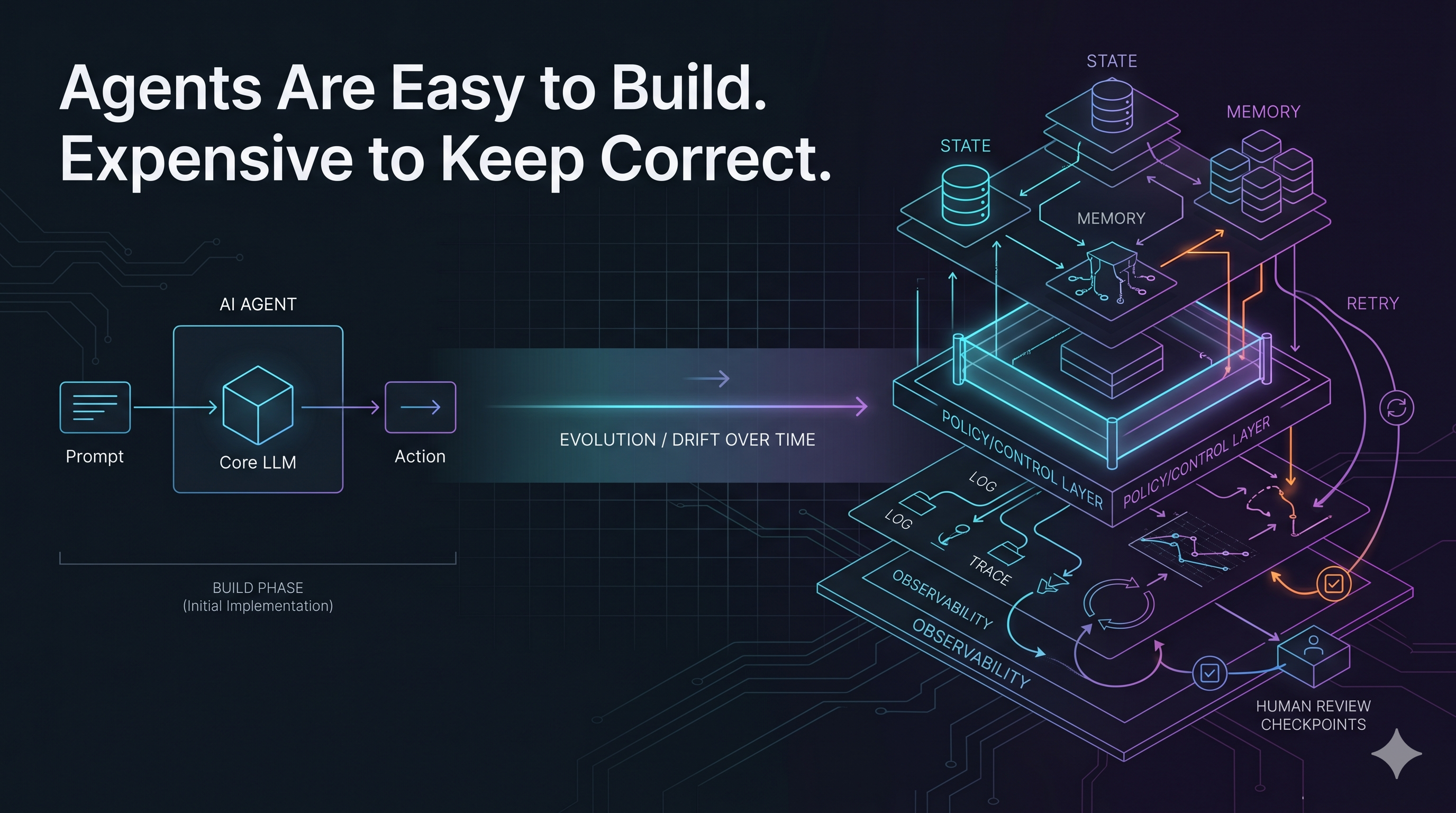
Most discussions around agentic systems focus on what they can generate.
That is the wrong place to look.
The real cost of an agent is not in generation. It is in everything required to keep the system correct after generation.
This distinction becomes obvious the moment an agent moves beyond a controlled environment and starts interacting with real systems, real data, and evolving constraints. At that point, the problem shifts from “can the agent produce output?” to “can the system remain reliable over time?”
That is an operational question, not a modeling question.
Thanks for reading Autonomous AI Architect! Subscribe for free to receive new posts and support my work.
Agents introduce long-lived state
Traditional request-response systems are largely stateless. Even when state exists, it is usually well-defined and tightly controlled.
Agentic systems are different.
They introduce:
- execution state across steps
- intermediate decisions
- partial results
- evolving context
- long-running workflows
This state is not incidental. It is central to how the system behaves.
And once state exists, it starts to drift.
State becomes stale. Assumptions become invalid. Dependencies change. External systems evolve.
The system does not fail immediately. It degrades.
That degradation is subtle, and it is cumulative.
Maintaining state correctness over time is one of the primary costs of running agents.
Policies are not static
Agents do not operate in isolation. They operate within constraints:
- access control
- compliance rules
- business logic
- safety boundaries
These constraints change.
Permissions evolve. APIs change behavior. Regulatory requirements shift. Organizational policies get updated.
Every policy change introduces a potential mismatch between what the agent was designed to do and what it is now allowed to do.
If the system does not adapt cleanly, two failure modes emerge:
- the agent becomes overly restricted and ineffective
- the agent violates constraints in ways that are hard to detect
Maintaining alignment between agent behavior and policy is not a one-time setup. It is an ongoing operational task.
Observability is the real control surface
In traditional systems, observability focuses on metrics, logs, and traces tied to deterministic execution.
In agentic systems, observability has to answer a different question:
Why did the system decide to do what it did?
That requires:
- visibility into intermediate decisions
- traceability across steps
- reconstruction of execution paths
- correlation between context and actions
Without this, debugging becomes guesswork.
With it, the system becomes operable.
This is why observability is not an optional layer for agents. It is the primary control surface through which the system is understood, debugged, and trusted.
Retries, recovery, and failure handling expand
Failures in agentic systems are not isolated events. They propagate across steps.
A tool failure can invalidate downstream decisions. A partial success can leave the system in an inconsistent state. A retry can reintroduce side effects.
Handling this requires:
- idempotent operations
- checkpointing
- rollback strategies
- clear termination conditions
These are well-understood problems in distributed systems.
The difference is that in agentic systems, the control flow is partially dynamic, which makes failure handling harder to reason about.
The cost is not just in handling failure. It is in ensuring that recovery does not introduce new inconsistencies.
Human review does not disappear
There is an implicit assumption that agents reduce human involvement.
In practice, they shift it.
Human intervention moves from execution to oversight:
- approving high-risk actions
- reviewing unexpected behavior
- resolving ambiguous decisions
- auditing outcomes
This introduces a new cost layer:
- review workflows
- escalation paths
- tooling for inspection
- operational overhead
The system is not autonomous. It is supervised.
Designing that supervision layer is part of the system, not an afterthought.
The maintenance surface area grows over time
Once deployed, an agentic system accumulates complexity.
Prompts evolve. Tools change. Schemas shift. Workflows expand. Edge cases emerge.
Each change introduces potential inconsistencies.
Without deliberate effort, the system becomes harder to reason about and harder to trust.
This is the maintenance surface area.
It does not stay constant. It grows.
A more useful question
Most teams ask:
“Can we build this agent?”
A more useful question is:
“What does it cost to keep this agent correct over time?”
That includes:
- state management
- policy alignment
- observability
- failure handling
- human review
- evaluation and monitoring
These are not secondary concerns. They are the system.
The shift that matters
The first wave of agentic systems optimized for capability.
The next wave will optimize for maintainability.
The systems that succeed will not be the ones that can produce the most impressive outputs.
They will be the ones that can remain correct, observable, and controllable as the environment around them changes.
Because the hard problem was never getting an agent to work once.
The hard problem is keeping it working.
Flurit is what I’m building to make agentic DevOps safe by design where identity, policy, and execution boundaries are first-class, not afterthoughts.
Thanks for reading Autonomous AI Architect! Subscribe for free to receive new posts and support my work.