The metric everyone celebrates is an extraction ratio. Here is the complete loop from quarterly bonus to public cost.
By Sovereign Insight Strategies
Published: 2026-03-15
URL: https://sovereigninsightstrategies.substack.com/p/profit-per-employee-lets-take-it
Profit Per Employee (PPE): Let’s Take It Apart
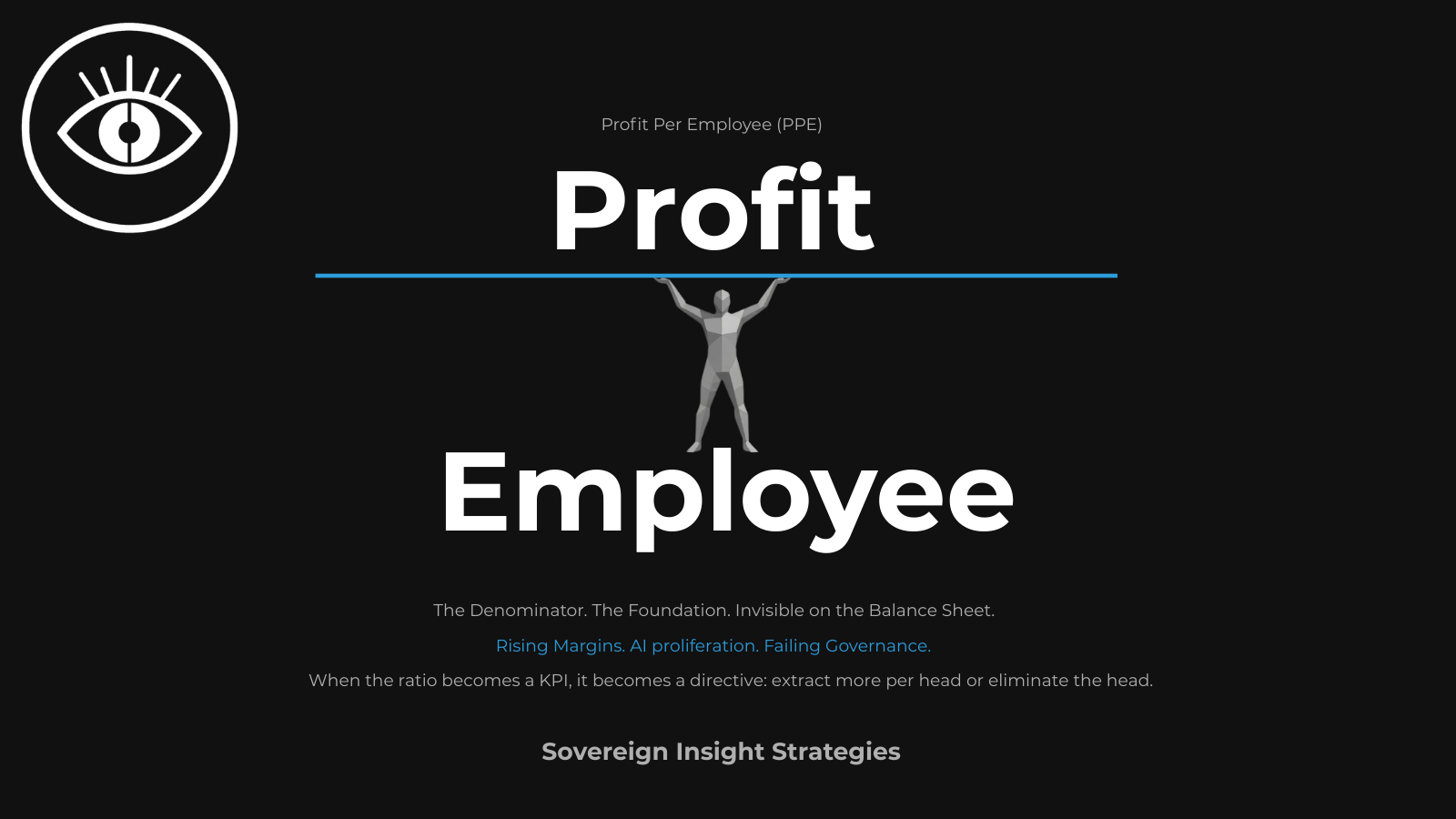
When a company announces record profit per employee, financial media call it a masterclass in capital efficiency. Analysts upgrade the stock. The CEO and the Executives collect a bonus tied to the metric they just gamed.
Nobody asks who is in the denominator. Nobody asks who built the numerator. Nobody asks where that gap between what workers produce and what they are paid went.
Here is what I know from the inside: the surplus did not disappear. It was routed away from the worker. Deliberately, legally, and with the full cooperation of the accounting standards, the tax code, and the regulatory architecture that was built to let it happen.
That question never makes the analyst call. Everyone knows the surplus went somewhere. Almost nobody knows the architecture that makes its disappearance from the worker's paycheck automatic, invisible, and uncontestable.
I’m asking.
Profit Per Employee Is an Extraction Ratio. Here Is the Math.
Profit per employee is simple arithmetic: total net profit divided by employee headcount. When that number rises, financial analysts call it operational excellence. What they are actually observing is the extraction ratio improving in the firm’s favor. What they are not measuring is what that costs.
One Human Head. That’s the denominator.
When that ratio becomes a KPI and an input to executive compensation it stops being a measurement, and it becomes a directive. Every major workforce decision runs through that one filter: does this let us extract more per head, or can we eliminate the head?
The Worker is the Denominator. The Entire Incentive Structure is Designed to Shrink it.
The financial press has no incentive to name the deeper flaw: how our tax and legal systems treat human capital.
Human capital does not appear on the balance sheet as an asset. Wages and salaries are expensed immediately and treated as an operating cost. By accounting convention, it is treated as a disposable, low-stakes expenditure.
Physical capital, on the other hand, gets depreciated over its useful life. Human capital gets written off the moment it is paid for.
When a firm outsources or deploys AI to eliminate a workforce, no write-down occurs. No loss is recorded. No governance flag is triggered. The firm simply looks more efficient. The destruction of accumulated human expertise, institutional knowledge, trained judgment. Restructuring charges, if they exist, only capture severance, not the value of what walks out the door. None of it registers.
The metric does not just fail to capture the loss. It records it as progress.
As someone who has worked at the intersection of international workforce planning, global supply chains, and risk management, the consistent blind spot I see in organizations outsourcing, offshoring, and deploying AI is this: they are optimizing against a metric that cannot see or account for what they are destroying.
When competitive advantage increasingly depends on the quality of human judgment sitting above the automation layer, expensing human capital like a consumable is not just outdated accounting. It is a strategic liability disguised as efficiency.
The Surplus Went Somewhere
Since 1979, productivity and worker compensation have moved in opposite directions.
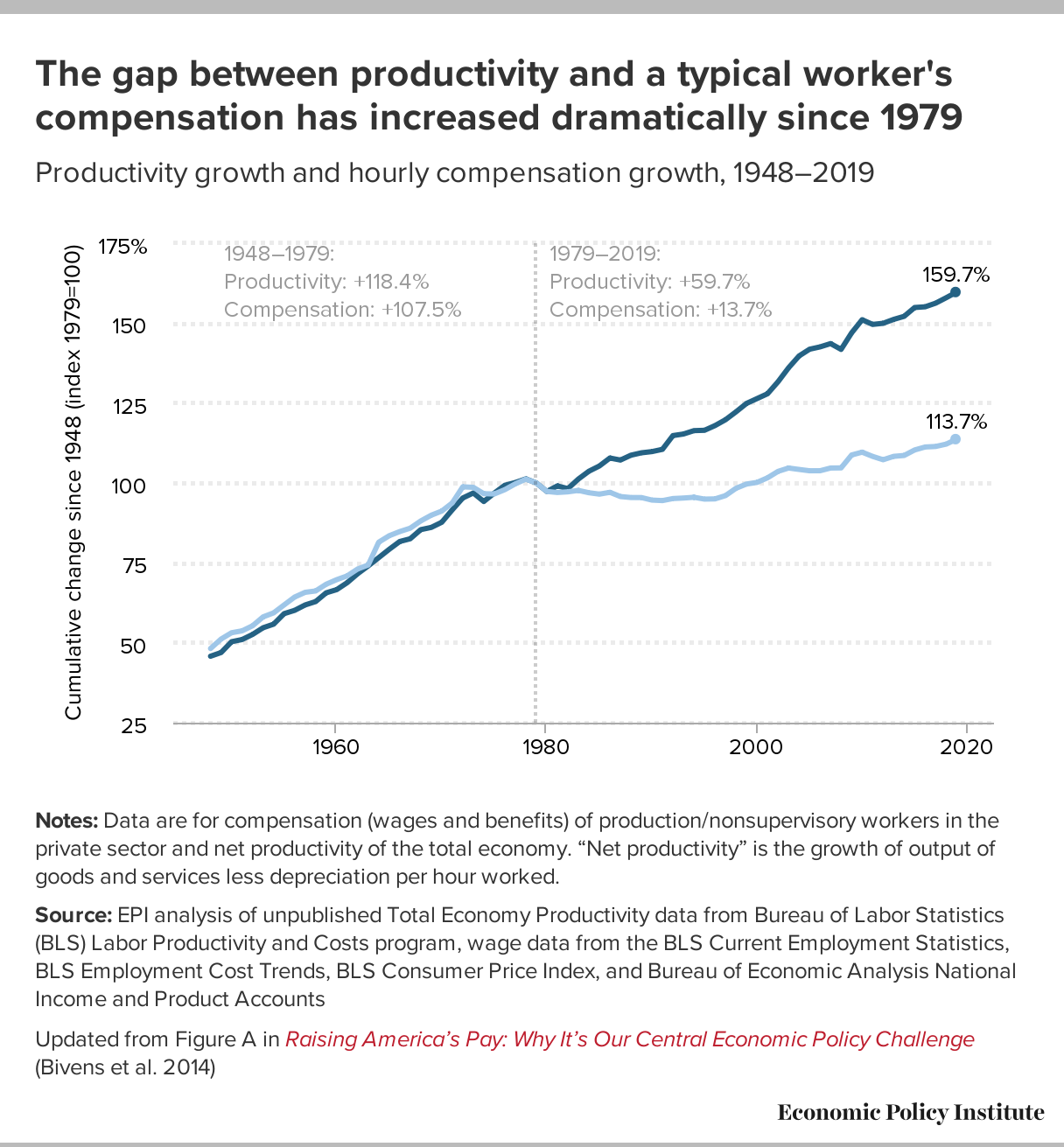
The BLS itself documented the divergence: from 2000 to 2009, productivity averaged 2.5 percent annual growth; real hourly compensation averaged 1.1 percent. The gap was not a rounding error. It was the policy. The EPI chart above makes the four-decade trajectory visible.
Every dollar of productivity gain that did not reach a worker’s paycheck traveled in one direction: up.
The numbers from the last five years make that destination explicit.
The Meta Cuts - 2023 the “Year of Efficiency”
Meta cut 21,000 workers across 2022 and 2023, declaring a "Year of Efficiency." Explicitly tracking the metric: earnings per laid-off worker. No write-down for destroyed human capital appeared on the balance sheet.
What did appear: C-suite performance bonuses paid simultaneously. CPO $940,000, CTO $714,000, COO $786,000. Meta's net income for 2024 reached $62.4 billion, a 59% year-over-year (YoY) increase. The stock rose 19% on news of layoffs alone. The executives whose decisions led to the overhiring that required the cuts received top-tier performance ratings.
As of March 14, 2026, Meta is reportedly planning a third round of head cuts of potentially 20% of its remaining workforce. Explicitly to fund AI infrastructure costs. The denominator shrinks. The metric improves. The pattern holds.
The Pattern Holds Across Sectors
Microsoft generated $9.8 million in EBITDA for every worker it cut in January 2023. Their 2022 end of year EBITDA landed at 98.8 billion. Amazon eliminated 30,000 corporate positions between October 2025 and January 2026 while reporting $77.7 billion in net income, representing a 31.25% YoY net income growth.
Its CEO explicitly stated that the cuts were not financially driven: “it’s culture.” Amazon’s stock rose 3% on the announcement. Alphabet, Google’s parent company, spent $70 billion on stock buybacks in 2023, after approximately 12,000 layoffs and benefit cuts starting in 2022.
Their CFO stated, ‘Our priority is to invest in growth.”
Banking ran the same playbook. The twenty largest global banks eliminated nearly 62,000 positions in 2023 while posting record profits. The deepest annual cut since the 2008 financial crisis, when they cut approximately 140,000 jobs.
The Pattern Seems to be Increasing.
January 2026 logged 108,435 announced layoffs, the highest January total since 2009, while GDP grew 2.1% and US Corporate earnings for year-end 2025 grew in double digits and beat analyst predictions.
AI was cited as the reason for just 7% of those cuts. The rest were due to restructuring, market conditions, contract losses, and tariffs. AI is not driving the cuts. It is providing the story that makes the cuts acceptable to the public while the real mechanism, margin extraction and shareholder return, runs underneath undisturbed.
No write-downs appeared on any balance sheet related to the cuts, but the PPE metric improved.
Buybacks do not build anything. They concentrate equity value in existing shareholders while headcount contracts, and then externalize the cost of displaced workers onto public systems funded by the payroll taxes that just shrank. The firm captures the gain. The public finances the cost. That loop is the complete mechanism.
NVIDIA’s $2M Profit Per Employee Has a Secret. It’s called TSMC.
The financial press loves NVIDIA’s numbers. Revenue per employee: $3.62 million in fiscal 2025, more than double Apple or Alphabet. Net income per employee: $2 million, the highest of any major tech company. The metric gets called capital efficiency genius.
I call it geographic arbitrage on labor rights.
The humans making its chips are employed by TSMC in Taiwan. TSMC’s own 2024 sustainability report shows an average total employee compensation of approximately $116,000 USD, with manufacturing technicians starting at $59,000 USD.
Those workers do not appear on NVIDIA's balance sheet as an asset to be protected. They appear on TSMC's books as an operating expense to be managed. The labor that makes NVIDIA's margins possible is simply offshored out of the denominator.
NVIDIA has captured the entire economic value chain of the AI infrastructure and automation layer, with only 36,000 employees, by moving the denominator wherever it costs the least and fights back the least.The $2 million net income per employee figure is directly related to workers abroad earning a fraction of that amount to produce the physical foundation that makes the number possible.
The NVIDIA balance sheet does not record that relationship. The PPE metric celebrates the ratio without naming what it rests on.
This is the externalizing incentive made structural, and it directly impacts the welfare and longer-term health of the American workforce and supply chains. Under a profit per employee target, the optimal strategy is not to invest in your workforce to increase productivity. It is to redefine who counts as your workforce and move that definition wherever labor wages and rights are weakest.
In the U.S., where global labor standards are the weakest among peer nations, Uber and Lyft reclassified their entire driver workforce from W2 employees to 1099 independent contractors, removing them from the denominator entirely and absolving themselves of any legal obligation to those workers.
Nike owns the brand and the margin. The humans making the product are someone else’s cost center. IBM compressed its denominator twice: first through outsourcing and offshoring, then through AI, eliminating the roles that replaced those offshored.
The pattern is not a coincidence. It is rational behavior under a metric designed to reward it
This Is Not Dysfunction. The Incentive Architecture Is Working Perfectly. As Designed.
The metric is the visible layer. Here is what runs underneath it. Executives are agents of shareholders. Their compensation is indexed to metrics that measure shareholder returns rather than workforce health, supply chain resilience, or community impact. Offshoring, outsourcing, and now AI compress labor cost per unit of output.
The margin expansion flows through earnings per share, which triggers stock price appreciation, which vests executive equity, which pays performance bonuses tied to the efficiency metrics that just improved.
The worker generated the surplus, but the governance structure routes all gains to capital before the worker can name what happened. This is not a failure of the system. It is the incentive architecture operating exactly as designed. That architecture now has a new instrument: Artificial Intelligence.
AI is entering legal work, financial analysis, software development, strategic consulting, medical diagnosis. Every professional domain that previously served as a refuge from automation. The credential strategy that told a generation of workers “stay complex, stay safe” is expiring.
There is no value chain left to climb into that is not already within the trajectory of the next deployment cycle. And unlike previous automation waves, this one does not create an adjacent tier of cognitive work to absorb the displaced.
It compresses the entire pyramid simultaneously.
The near-term economics of most AI deployments remain net negative for the deploying firm, largely because firms are laying technology on top of broken processes and bad data. But that is a deployment problem, not a capability ceiling. Firms that address the sequencing and cleaning processes before deploying automation will cross the threshold first.
When they do, the displacement will not be incremental. It will be structural and sudden. The governance infrastructure to contest it is not being built at anywhere near the speed required.
The Displacement Is Not Coming. It Is Already Here.
This is the part where people want to debate timelines. I am not interested in timelines. I am interested in what is already measurable. Anthropic’s own economic policy research acknowledges early statistical disruption signals in graphic design and software development. This is happening now, not projected.
Goldman Sachs estimates 6-7% baseline job displacement across the economy under widespread AI adoption, with the highest risk concentrated in computer programmers, accountants, legal and administrative assistants, and customer service roles. Early disruption signals are already visible in graphic design, software development, and office administration, where employment growth has fallen below trend.
These are not projections. They are current readings.
The largest law firms are shrinking summer associate classes, cutting support staff, and investing heavily in AI for document review and contract analysis. The pipeline reduction is structural and early. It will not show up fully in employment data until it already has.
These are not recession layoffs. They are structural reductions in entry-level professional hiring driven by capability replacement via outsourcing and AI. The bottom of the credential pyramid is being quietly restructured before the data catches up.
That last point matters beyond individual job loss. Entry-level professional roles are not just jobs. They are how institutional knowledge gets built. They are the pipeline through which the next generation of senior practitioners develops the judgment that cannot be automated.
When firms eliminate those roles in favor of AI augmentation of existing senior staff, they are not just reducing headcount. They are defunding the human capital development pipeline that produces the expertise the firm will need in five years.
Despite that reality, no write-down appears on the balance sheet. The profit per employee metric records it as an improvement.
The technology is moving faster than any governance and retraining infrastructure can keep up with. In 1910, a displaced factory worker could retrain and move up the value chain. The value chain above them existed and was still largely human.
In 2026, the cognitive value chain is being automated from the bottom up, simultaneously across all professional sectors. The direction of travel is not theoretical. It is the present reality, accelerating, with the governance infrastructure needed to contest it being dismantled in real time.
The Micro and the Macro Are the Same Loop
A firm deploys AI. Under the One Big Beautiful Bill Act of July 2025, *businesses receive an immediate 100% write-off for qualifying equipment and technology hardware.
The physical infrastructure of AI deployment. The human capital it displaces gets no equivalent treatment.* Output per worker rises. Immediately. Profit per employee improves. The surplus routes to shareholders via buybacks and to executives via performance bonuses indexed to the metrics that just improved.
The workers’ compensation stays flat or is simultaneously cut.
No contractual claim on the efficiency gain exists, and if cut, you’re not even guaranteed a severance or decent unemployment benefits. The worker has no institutional mechanism to contest it because those mechanisms are being systematically removed.
The firm externalizes the human cost to the public. The displaced worker files for unemployment. Social Security draws on a payroll tax base that just contracted. More than three-quarters of US federal tax revenue comes from labor, approximately 49% from individual income taxes and 36% from payroll taxes. AI displacement erodes both simultaneously.
The fiscal gap arrives precisely at the moment when demand for retraining support, unemployment insurance, and social safety-net spending rises most sharply.
The modern American tax code makes this structurally worse. Firms can immediately write off AI infrastructure. Human capital investment, the training and reskilling that would help workers adapt, remains restricted and difficult to deduct under current law. The code is explicitly biased toward replacing workers rather than developing them. So the public absorbs the cost of a displacement that the tax code subsidized the firm to create.
The loop is closed.
The metric celebrates efficiency. The firm captures the gain. The public finances the externality.
And not one line of any balance sheet records what was lost.
Three Layers of Worker Protection. All Three Are Being Taken Apart.
Worker protection in the United States operates through three distinct layers. Each is being dismantled through separate mechanisms, affecting different populations, but moving in the same direction at the same time.
The right to organize.
The NLRB, the agency responsible for protecting 100 million private sector workers’ right to collectively bargain, was effectively paralyzed in January 2025. The Trump administration fired board member Gwynne Wilcox in an unprecedented move, leaving the board without a functioning quorum for most of 2025. NLRB-overseen union elections dropped 30% in 2025. 59,000 fewer workers participated compared to 2024.
Employers immediately exploited the vacuum. Amazon filed objections to a Whole Foods union election result immediately after Wilcox was fired, knowing there was no functioning enforcement body to stop them.
The right to physical safety.
OSHA workforce health and safety penalty totals dropped 47% in the first nine months of 2025 compared to the same period over the previous 17 years.
This was due to drastic defunding and deregulation efforts. Amazon, which accounts for 79% of US warehouse employment and 86% of all warehouse injuries, settled a multi-site OSHA investigation covering 10 facilities for a total of $145,000 after 9 of 10 citations were withdrawn. $145,000 against $77.7 billion in annual profit.
That enforcement ratio is not a bug. It is the current state of the system.
The right to exist as an employee at all.
Worker classification rules are being rewritten to expand the category of people with no bargaining rights, no benefits, and no legal standing. Starting in 2025, the Trump administration has helped weaken worker classification protections by signaling reduced enforcement and moving to make independent-contractor status easier to claim, thereby reducing access to wages, benefits, and collective-bargaining rights tied to employee status.
Making it easier for the gig economy to flourish. The gig designation that stripped Uber and Lyft drivers of employee status is the template. As AI blurs the boundaries of work relationships and firms have every financial incentive to shrink the denominator, the legal architecture is moving toward fewer protections at precisely the moment more workers need them most."
These are not separate stories. The rules were written by, and for the industry they were meant to regulate.
The Chamber of Commerce Published a Wish List. The NLRB Executed All 10 Items.
This is not structural drift. It is not an unintended consequence. It has a documented paper trail with named authors and published agendas.
The US Chamber of Commerce, the world’s largest business organization representing interests of more than 3 million business interests, published a 10-item wish list for the NLRB in 2017. The Trump NLRB has executed or is executing all 10. Corporate lobbying expenditures reached $4.2 billion in 2023 and $4.4 billion in 2024.
When corporations first mobilized politically in the 1970s, they were fighting labor and regulation as a common enemy. As the labor movement weakened and the government became more accommodating, lobbying did not decrease. Corporations accelerated spending and shifted from defense to offense.
The result is a regulatory environment that swings based on who governs, but trends in one direction regardless of who governs. Union density is at historic lows across administrations. The productivity-pay gap keeps widening across administrations.
But the profit per employee metric keeps improving across administrations.
Lobbying is not about buying individual votes. It is buying the architecture within which all outcomes become possible.
This is a rigged market. Not in a conspiratorial sense. But in the structural sense: the rules of exchange are written by one party with disproportionate access to the rulemaking process, enforced by agencies staffed with that party’s former counsel, and measured by metrics designed to make the extraction look like progress. That is not hyperbole. That is the documented sequence of events.
The Governance Exists. The Will Was Bought.
The diagnosis is clear. So is the intervention. The legal and regulatory tools already exist. What is missing is the political will to deploy them and the governance infrastructure to extend them into AI-era labor relationships. Here is what that infrastructure needs to look like. This analysis draws from direct experience in global workforce planning, operational risk, and credit risk management across energy value chains.
Managing global labor continuity during COVID-19 made the fragility of the workforce planning architecture impossible to ignore. Global supply chains did not break because of the virus. They broke down because decades of margin optimization had removed every buffer, every redundancy, and every human relationship that would have absorbed the shock.
Fix the Accounting First.
Human capital needs to appear on the balance sheet as an asset, not an expense. Intangible assets like brand value, IP, and goodwill already appear under GAAP. The productive capacity of a trained workforce is at minimum as measurable and, unlike goodwill, demonstrably tied to actual output.
When a firm deploys AI to eliminate a workforce, the destruction of that human capital asset should be recorded as a write-down. Right now, it is invisible. Invisible destruction gets celebrated as efficiency. Making it visible is the first governance requirement.
Supply Chain Labor Accountability that Follows the Economic Relationship, not the Org Chart.
If your profit per employee metric is structurally dependent on a supplier workforce operating under weaker labor protections, your governance obligation reaches there. NVIDIA’s $2 million in net income per employee is directly tied to TSMC production workers earning $59,000 annually.
The governance framework that sees only NVIDIA’s 36,000 employees is incomplete by design and blind to systemic shocks. Worker protections should attach to the economic substance of the relationship: the degree of control, the dependency, and the integration into operations. Not the legal form chosen to obscure it. Remove the reclassification escape route and the externalizing incentive collapses.
AI Deployment and Significant Outsourcing as a Material Board-Level Event.
Boards disclose material capital expenditures because they affect future productive capacity and corporate risk. An AI deployment decision that materially alters workforce composition does the same. It should carry the same disclosure obligation: pre-deployment impact assessments, post-deployment reporting on compensation outcomes relative to productivity gains.
This is not new regulatory logic. It is existing materiality standards applied to a new category of operational decision. The WARN Act exists for exactly this reason. The firms that resist this are the ones whose numbers would not survive the scrutiny.
Productivity sharing with third-party audit.
Disclosure without redistribution is transparency theater.
If AI compresses task time by a measurable threshold, workers capture a defined share of the resulting margin delta. The trigger, the share, and the measurement methodology are established in employment contracts before deployment, not negotiated after the fact when the worker has no leverage, and the efficiency gain is already priced into executive compensation.
This is the contractual claim on efficiency gains that currently does not exist at scale anywhere. It is also the only mechanism that directly interrupts the principal-agent routing of surplus to capital.
None of this is technically complex. The obstacle is not regulatory capacity. The institutions designed to mandate these changes are funded, staffed, and in many cases led by the industry they would regulate. That is not a stable governance condition. It is a deferred liability.
The Fiscal Architecture Is Next.
More than three-quarters of federal revenue comes from labor. The tax code now subsidizes replacing workers with AI while restricting deductions for reskilling them. The payroll tax base is contracting while Social Security draws on it.
The conversation about how to fund public systems as the tax base shifts is overdue: automation levies, consumption tax expansion, payroll tax reform. They need to happen now, not after the gap is structural and the options have narrowed. Governments that design the fiscal architecture early will have choices. Governments that wait will have crises.
In the U.S., none of these are being built at the speed the technology is moving. They are moving in the opposite direction. That gap, between the pace of AI deployment and the pace of governance construction, is where the transfer happens. That is where the surplus disappears into the numerator while the denominator bears every cost.
Are You Receiving the Productivity Uplift?
The worker is holding up the entire structure. The surplus flows to the top. The accounting makes the destruction invisible. The metric celebrates the ratio. The lobbying bought the rules. The enforcement agencies are paralyzed. And the automation and AI technologies are accelerating the wealth transfer faster than any of the systems designed to contest it.
The balance sheet does not capture it. The board presentation does not name it. The profit per employee metric records it as progress.
The productivity gains are real. The fiscal time bomb is real. The dismantling is documented, ongoing, and accelerating.
Are you receiving the productivity uplift?
The answer is no.
And right now, neither the policy nor the governance exists to change that.