Surveillance-Driven Management and the Erosion of Governance Capacity
By Sovereign Insight Strategies
Published: 2026-01-27
URL: https://sovereigninsightstrategies.substack.com/p/when-companies-treat-people-as-commodified
How to Read This Analysis
This post examines organizational failure through a governance and risk lens, not a cultural or ethical one. It advances three claims:
- Many high-profile corporate failures share a common precursor: degraded governance capacity, not technical incompetence.
- Surveillance-driven workforce management can increase short-term efficiency while systematically weakening escalation, judgment, and internal correction mechanisms when observation is coupled to punitive incentives.
- AI does not introduce this governance risk. It amplifies it, increasing the speed, scale, and opacity of failure once governance capacity has eroded.
The analysis is grounded in regulatory findings, investigative reporting, and cross-sector case studies. Claims are framed as risk mechanisms, not inevitabilities.
Important note on data limitations: Employee engagement scores are not the same as governance capacity, but they're related. Engagement measures whether workers are willing to go beyond minimum requirements. Governance capacity measures whether workers can actually escalate problems and have the authority to act.
A motivated worker in a system with no escalation path still can't fix problems. This analysis uses engagement data to establish a floor; low engagement reliably signals governance risk, but high engagement doesn't prove governance works.
The Gallup data shows baseline risk levels, not organizational capability.
The Failure Companies Keep Misdiagnosing
When complex organizations fail, leaders tend to blame discrete factors: a software defect, a rogue employee, a missed procedure, a localized execution error. These explanations are appealing because they are narrow, actionable, and non-threatening to existing power structures.
They are also usually incomplete.
Across industries, the more consistent failure mode is structural. Organizations weaken or dismantle the human work systems required to detect emerging risk, escalate concerns to decision-makers, and intervene before failures compound. They then deploy increasingly sophisticated technology, including AI, atop this weakened infrastructure and interpret early performance gains as evidence of success (e.g., higher throughput, lower labor costs, faster cycle times, fewer recorded exceptions).
When applied to workforce management, these mechanisms make employee behavior easier to track and compare while degrading institutional self-correction.
Critically, AI does not cause this failure pattern. It accelerates it under specific conditions.
Governance Capacity: A Functional Definition
Governance capacity is the operational ability of an organization to efficiently and effectively:
- question outputs to identify inconsistencies, errors, and emerging issues
- escalate concerns across authority boundaries
- exercise judgment under uncertainty
- intervene before risk becomes irreversible
Governance capacity is not culture, intent, or formal compliance. It is an infrastructural property of human work systems, shaped by incentives, decision rights, reporting protections, and the cost of dissent.
It resides in escalation pathways, discretionary judgment, trust in reporting mechanisms, and organizational tolerance for challenge under uncertainty. When these systems function, emerging risks are detected, escalated, and corrected in a timely manner. When they erode, organizations may appear stable while escalation slows, information becomes incomplete or distorted, and risk accumulates out of view.
Governance capacity is not binary. It degrades gradually and measurably, often while headline performance metrics improve.
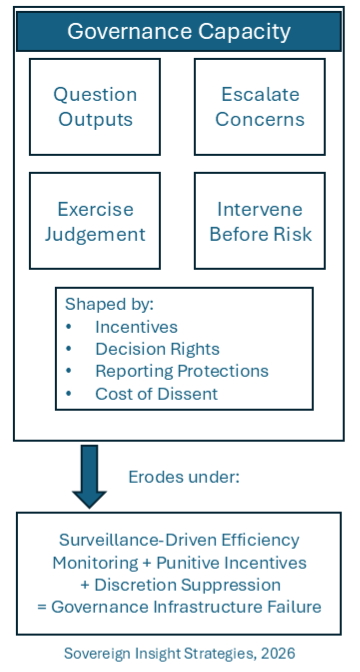 \Governance capacity as operational infrastructure: four core functions shaped by incentives, decision rights, and reporting protections—not culture or intent.\
Governance Capacity Is Already Degraded (Gallup Baseline)
This erosion is measurable.
Gallup’s 2025 State of the Global Workplace report indicates that roughly one-quarter of workers worldwide operate under conditions consistent with effective governance capacity. This is defined here as having sufficient trust, agency, and psychological safety to question outputs, exercise judgment beyond narrow task parameters, and escalate concerns without fear of retaliation.
The inverse is more revealing. Approximately three-quarters of the global workforce operates without those conditions. Gallup categorizes this population as disengaged or minimally engaged. These cohorts are performing what Gallup terms “quiet quitting,” meaning they are meeting formal job requirements while withdrawing their discretionary effort.
While employee engagement is not a direct proxy for governance capacity, it is a necessary precondition for the discretionary judgment, challenge behavior, and escalation that governance systems require, particularly in judgment-intensive, safety-relevant, or escalation-dependent roles. Where engagement is low, workers rationally limit actions that carry personal risk but unclear reward, including raising concerns, questioning automated outputs, or interrupting flawed processes.
This pattern does not reflect apathy. It reflects the structural expectation of futility, retaliation, or lack of authority.
Managerial Degradation as a Governance Multiplier
The degradation is not confined to frontline workers.
Gallup reports that global manager engagement has fallen to approximately 27%, with fewer than half of managers having received formal training in people management, escalation handling, or decision facilitation (Gallup, 2025). Given Gallup’s own findings that managers account for a majority of variance in employee engagement, this decline represents a second-order governance failure.
Managers are the primary escalation conduits in most organizations. When they lack engagement, authority, or training, escalation pathways collapse even when frontline workers detect risk. Governance capacity fails not because signals are absent, but because they cannot travel upward without penalty or distortion.
This is not a motivation problem; it reflects a failure of governance infrastructure at the managerial layer.
Boeing: Latent Governance Risk in Safety-Critical Systems
The crashes of Lion Air Flight 610 (2018) and Ethiopian Airlines Flight 302 (2019) are frequently framed as technical failures involving Boeing’s MCAS flight control system. Technically, MCAS relied on a single sensor input, which repeatedly pushed the nose-down trim, creating a ‘tug of war’ where pilots were fighting to maintain control of the aircraft (NTSB, n.d)
Regulatory investigations show that this technical fragility was known internally. Engineers and test pilots raised concerns years before the accidents. Simulator tests demonstrated unexpected system responses (DOJ, 2021)
The failure was not that risks went undetected. Multiple sources indicate that engineers and test pilots raised concerns years before the accidents, and simulator tests demonstrated unexpected system responses.
What failed was the organizational infrastructure required to translate those signals into corrective action before the aircraft entered service (Gates, 2019). Whether escalation pathways didn't exist, didn't function, or were overridden by competing pressures, the outcome was the same: known risk persisted until external intervention forced correction.
Governance mechanisms failed in several ways. Engineering judgment lacked final decision authority. Escalation carried reputational and career risk. Certification and training decisions were optimized for competitive speed. Managerial incentives favored schedule adherence over safety signaling.
These conditions increased the likelihood that the known risk would persist until failure.
Subsequent events reinforced the pattern of deficient governance capacity.
In January 2024, a mid-cabin door plug separated from an Alaska Airlines 737 MAX 9 during flight. Investigators identified missing bolts and systemic managerial breakdowns, including fragmented accountability, inadequate training amid high turnover, and a safety environment in which workers feared being labeled troublemakers (NTSB, 2025).
Whether the immediate failure involved software or hardware, the underlying risk amplifier was the same: diminished governance capacity in safety-critical human systems.
These patterns are not confined to aviation. They reflect a broader shift in how organizations attempt to manage risk under scale and cost pressure.
Surveillance-Driven Efficiency as Internalized Control Logic
When being observed determines job security, workers optimize for compliance rather than correction.
The enabling mechanism is making work continuously visible and easy to compare at scale.
The trade-off is institutional self-correction; the ability to stop, question, and intervene before harm spreads.
This dynamic emerges when work is structured so it can be continuously measured, standardized, and compared by centralized systems. Tasks are broken into observable units, tracked in real time, and evaluated against predefined performance benchmarks. While framed as optimization, these systems prioritize throughput and consistency over resilience, learning, or safe escalation. As measurement tightens, behaviors that are easy to quantify and score are rewarded, while behaviors that rely on discretion, contextual judgment, or interruption become costly or invisible.
Organizations gain tighter control and comparability, but lose early warning capacity.
Across sectors, surveillance-driven efficiency systems converge on four properties:
- High-Resolution Behavioral Monitoring
Work is tracked continuously, down to seconds or micro-actions. While framed as optimization, this suppresses discretionary judgment—the same judgment required to detect anomalies and halt unsafe processes.
- Algorithmic Target Setting
Performance benchmarks are derived from historical output distributions rather than human assessment of safety margins, recovery capacity, or learning curves. Systems optimize throughput, not resilience.
- Metric Substitution
Quantified outputs substitute for system health. Throughput replaces safety margin. Utilization replaces redundancy. Volume replaces trust. Unmeasured risk accumulates until external intervention forces recognition.
- Cost Externalization
Burnout, injury, turnover, and knowledge loss are treated as individual outcomes rather than system-generated risk. These costs re-enter later as regulatory action, litigation, operational failure, or reputational loss.
Under these conditions, silence is not cultural. It is economically rational.
The risk does not arise from monitoring alone, but from coupling high-resolution monitoring to punitive or zero-tolerance incentive systems that make escalation economically unsafe.
Wells Fargo: Financial Systems and Escalation Suppression
From 2002 to 2016, Wells Fargo employees created 3.5 million unauthorized customer accounts to meet aggressive sales targets. Internal reporting channels existed, but escalation was economically unsafe.
Governance failures operated at multiple levels. Incentive structures penalized dissent and rewarded results regardless of how they were achieved. Turnover in their Community Bank division exceeded 35%, driven by fear of termination for failing to meet unsustainable sales goals, while leadership actively ignored evidence of fraudulent account creation to protect revenue targets (OCC, 2020). Performance metrics measured cross-sell ratios and account openings but remained deliberately detached from customer harm or consent verification.
The result was a system optimized for behavioral compliance rather than institutional correction.
Measured outputs improved. Cross-sell ratios rose. Revenue appeared stable. Risk accumulated invisibly until regulatory intervention forced recognition years later, resulting in $3B+ in civil and criminal penalties, executive prohibitions, and an ongoing asset cap that has constrained Wells Fargo’s growth for nearly a decade. The former CEO estimated financial damages at “tens of billions of dollars” (OCC, 2020).
Early detection did not produce early correction. The information reached management, but the infrastructure to act on it had been systematically dismantled.
Amazon: Algorithmic Management in Physical Systems
Amazon operates one of the most advanced automated workforce management systems globally. In fulfillment centers, productivity benchmarks are set algorithmically with limited human override.
Investigative and regulatory reporting shows elevated injury rates relative to peers, with higher injury incidence correlated with automation intensity. Amazon’s serious injury rate in 2021 was 6.8 per 100 workers, more than double the rate in non-Amazon warehouses and 28% higher in its robotic fulfillment centers (Strategic Organizing Center, 2022). Workers report avoiding injury reporting because time away from work negatively affects algorithmic performance scores tied to job security.
In physical systems, near-miss reporting and discretionary slowdowns are essential governance functions. When reporting risk threatens employment, escalation collapses by design.
Amazon has not experienced a catastrophic safety failure. Whether this represents effective risk management or simply indicates that sufficient stress conditions haven’t yet occurred remains an open question. What is measurable is elevated injury rates and the suppression of escalation, both established precursors in other sectors where catastrophic failures eventually occurred.
AI as a Governance Risk Multiplier
AI systems do not create governance capacity; they assume it exists.
Effective AI deployment requires human override authority, clear escalation paths for anomalous outputs, accountability for harm caused by models, and sufficient audit latency to enable intervention. In organizations where surveillance-driven efficiency has already suppressed judgment and dissent, such conditions are rare. The predictable result: Automation bias increases, meaning human judgment is deferred more often, risk escalation slows, and AI outputs unjustifiably gain authority.
AI amplifies both the speed and opacity of failures as governance capacity diminishes.
Why Capital Markets Lag and Insurance Markets React Earlier
Public equity markets discount future risk imperfectly and often reward near-term efficiency gains. Governance degradation unfolds over longer horizons and is difficult to attribute until failure occurs, in part because markets primarily price formal, visible signals of performance rather than the quality of internal judgment, escalation, and decision-making.
Insurance markets operate under different constraints. Insurers respond to realized losses and expected claim costs, not abstract narratives about performance or intent. In liability underwriting, for example, directors’ and officers’ (D&O) insurers price policies based on the specific risk posed by each firm, and underwriting assessments routinely focus on corporate governance characteristics because they materially affect expected losses and litigation risk. Underwriters’ detailed inquiry into governance practices can result in higher premiums for firms with weaker governance structures and, conversely, more favorable pricing for firms with stronger governance indicators.
Patterns often described as culture or character, such as elevated turnover, suppressed internal reporting, and aggressive automation, do not register as abstract governance concerns for insurers. They register as concrete drivers of claim frequency and severity, triggering premium increases, exclusions, or coverage withdrawal (Baker & Griffith, 2007).
As a result, insurance pricing may surface governance failure risk earlier than equity markets. Not because insurers forecast better, but because premiums and underwriting terms already embed governance-related risk assessments that reflect realized or imminent loss exposures. Emerging underwriting behavior in AI-exposed domains further supports this pattern.
In some lines of coverage, particularly professional liability, cyber, and D&O, insurers have begun excluding, limiting, or conditionally underwriting AI-enabled workflows where decision logic, accountability, or escalation pathways cannot be clearly demonstrated.
These exclusions do not reflect opposition to AI adoption per se, but the difficulty of pricing loss severity in systems where errors propagate quickly and accountability is diffuse. This remains a testable hypothesis that would require systematic analysis of how insurance premiums change alongside indicators of internal escalation capacity, managerial behavior under stress, and workforce stability, rather than board structure alone.
Early Warning Indicators
Leading indicators (precursors to governance erosion):
- Structural disengagement above baseline
- Sustained turnover in safety-critical or decision-critical roles
- Manager selection criteria that ignore governance facilitation
- Leadership separation from frontline operations
Lagging indicators (evidence governance has already eroded):
- Performance systems that penalize escalation or discretion
- Algorithmic targets without meaningful human override authority
- AI deployments optimized around already narrow, output-focused metrics
Clusters of leading indicators signal rising probability of governance failure. The presence of lagging indicators means degradation is already underway. Neither guarantees failure, but both materially increase tail risk exposure.
When Does Surveillance Not Erode Governance?
This analysis does not claim that surveillance-driven efficiency universally destroys governance capacity. It claims specific combinations of conditions create foreseeable failure pathways.
Surveillance-intensive systems can maintain governance capacity when:
- Strong regulatory oversight creates external escalation pathways
- Union protection or professional licensing requirements reduce the risk of retaliation.
- Reputational markets punish safety failures faster than they reward efficiency gains.
- Monitoring focuses on process adherence rather than discretion suppression
The critical distinction: surveillance becomes destructive when high-resolution monitoring is coupled to zero-tolerance performance systems that make escalation economically unsafe. Monitoring alone is neutral.
Monitoring + punitive incentives + discretion suppression = governance infrastructure failure.
Current AI deployments, especially in the US, disproportionately occur in contexts lacking protective conditions, which is why the risk is acute rather than theoretical.
Conclusion: Governance Capacity Is Operational Infrastructure
The cases examined here do not illustrate moral failure. They illustrate predictable risk pathways.
Surveillance-driven efficiency generates short-term gains at the expense of the organization's capacity for correction. The costs surface later, under stress, and with greater severity.
AI does not destabilize organizations on its own. It destabilizes organizations when it amplifies structures that suppress judgment, escalation, and correction.
Governance capacity forms part of the critical infrastructure in work systems. It is generated by human judgment operating through escalation pathways, decision rights, and protected challenge. When that judgment is treated as an extractable efficiency input, systems are designed for human replaceability, which slows escalation and delays correction.
Governance capacity is not a new requirement, but AI makes its absence more visible as it scales decisions that are difficult to trace, challenge, or reverse. Precise quantification of this risk increase requires proprietary actuarial data linking governance indicators to loss frequency across industries.
What is currently measurable: Boeing's governance failures generated $2.5B+ in penalties. Wells Fargo generated $3B+ in penalties and ongoing asset caps. These are not statistical outliers—they represent the realized tail risk when governance capacity erodes in complex, safety-critical, or fiduciary systems.
What is often described as “culture” is the downstream expression of these structural constraints, not the governing mechanism itself.
Predictable does not imply certainty. It implies a material increase in failure probability and tail risk under identifiable conditions. Organizations that suppress escalation capacity do not fail immediately. They accumulate latent risk until failure shifts from anomaly to statistically foreseeable outcome.
AI multiplies whatever infrastructure it inherits. Where that infrastructure is extractive, collapse becomes a matter of timing, not chance.