What most businesses are still missing about the Hormuz disruption — and why the clock is already running.
By Sovereign Insight Strategies
Published: 2026-03-20
URL: https://sovereigninsightstrategies.substack.com/p/the-supply-chain-seized-your-operational
You are looking at a war. Your operational forecasts and financial models are looking at traded commodities and energy prices. They are not looking at who owns the procurement decisions at your company, whether that person is still employed, or whether the vendor agreements embedded in your Q2 operating plans are already triggering force majeure clauses.
That gap between what is happening and what your planning framework was built to measure is where the real business event lives. It lives between the moment a supply chain seizes and the next quarterly review. That is when cost exposure that has been building for weeks finally becomes visible: to your CFO, to your board, to your lenders.
By then, the options narrow fast. The question your board is going to ask isn't whether you saw the disruption. It's whether you looked at the right layer of your business when you did. Many risk exposure analyses will have missed significant portions of the procurement layer entirely. That’s the layer currently on fire.
What the Strait Is Actually Choking - Global Supply Chain Functioning
The Strait of Hormuz normally carries roughly 20% of the world’s oil trade, about 30% of global seaborne fertilizer supply, and Qatar’s helium exports. Since the start of hostilities, more than 95% of “Western-affiliated” shipping traffic has been disrupted. This will touch every supply chain.
Few operating plans understand the downstream scope. Some are monitoring fertilizer as a price risk. Almost none are modeling supply security and availability risk across the full range of raw, intermediate, and finished goods. Helium does not appear in most enterprise risk registers at all.
As of this writing, the strait has not simply closed. Iran is conducting permission-based transits, selectively allowing ships from India, Pakistan, Turkey, and China to pass while blocking "Western-affiliated" vessels. Access to the world’s most critical shipping corridor is no longer determined by commerce.
It is determined by geopolitical alignment, and there are no good short- or medium-term solutions that do not require a fundamental redesign of global production and transport flows.
The visible layer is already significant: fertilizer, rubber, electronics, batteries, pharmaceuticals, packaging.
- Urea prices, used widely in fertilizer production, have moved from $475 to $680 per metric ton. The US Midwest corn and soy planting window is approaching. Farmers already under pressure from tariff exposure are running into a supply shock on top of a cost shock.
- Approximately 85% of Middle Eastern polyethylene exports move through this route, raising input costs for packaging, automotive components, and consumer goods.
- 25-30% of Europe’s jet fuel supply originates from or transits the strait.
Then there are the layers most operating plans have not yet reached
Sulfur: The Feedstock Underneath Everything
Gulf producers account for approximately 45% of global sulfur exports. Most people treat sulfur as a refinery byproduct. It is also the feedstock for sulfuric acid, the most widely produced industrial chemical in the world. Without it, fertilizer manufacturing, semiconductor fabrication, and copper and nickel ore processing stop.
The downstream exposure runs through EVs, batteries, renewable energy infrastructure, marine construction, electronics, and consumer goods. Nearly half of the world's sulfur supply is currently stranded on the Persian Gulf side of the strait.
Helium: The Input you Cannot Substitute
Qatar produces roughly one-third of the world’s helium, making it the second-largest supplier after the United States. The global helium market entered 2026 already fragile — four shortage cycles since 2006, only reaching surplus in mid-2024, with no buffer to absorb a new disruption. Strikes on Ras Laffan Industrial City have disrupted production directly. More than a quarter of global helium supply could be offline if the strait remains closed.
Helium is not substitutable at scale. It is required for MRI machines, saturation diving, fiber optic cable production, and semiconductor fabrication, where it functions as a carrier gas, cooling medium, and cleanroom pressurization input. Semiconductor manufacturers account for roughly 24% of global helium consumption, a share that grows with every AI chip order placed. *TSMC and every major semiconductor fabricator uses helium at every stage of production, from wafer cleaning to final packaging.
A sustained disruption extends lead times on everything from smartphones to AI accelerator chips. If your operations depend on chip-dependent products, your lead times already changed.*
Cloud and Data Infrastructure: Automation and AI Core Inputs
One layer further down: Iranian drone strikes on March 1 took down three AWS data centers in the UAE and Bahrain simultaneously. Banking applications, payment platforms, and supply chain software went dark at the same moment the physical supply chain was seizing. Multiple availability zones failed simultaneously.
The redundancy architecture designed to prevent exactly this kind of outage could not compensate, because the attack hit several zones at once. As of March 20, the AWS Health Dashboard is still showing the UAE and Bahrain regions as disrupted or impacted.
What this means operationally: the AI and automation tools your team is using to manage this disruption were trained on data from before February 28. They are optimizing toward assumptions in a world that no longer exists, one built on stable commodity pricing, reliable contracted delivery volumes, functioning war risk insurance for shipping, and open transit lanes. All four failed simultaneously on February 28.
Water: The Dependency No One Is Modeling in their Supply Chain Ops
Most people tracking this conflict are watching energy prices, fertilizer costs, and freight rates. They are not tracking war risk insurance premiums for vessels, which have increased 300%. They are not tracking GPS jamming disrupting navigation. They are not tracking the fact that strait access is now granted by Tehran on a country-by-country basis.
And they are not tracking water.
Gulf refineries, petrochemical plants, and industrial facilities run on desalinated water. Industrial consumption dwarfs drinking water use. Gulf states produce 40% of the world’s desalinated water. Desalination plants in Iran and Bahrain have already been directly struck. Facilities in Kuwait and the UAE have reported damage from nearby drone and missile activity.
A direct hit on a desalination plant is not even required. Strike the power grid or fuel supply serving a plant and it shuts down just as completely. Desalination is one of the most energy-intensive industrial processes on earth. The same disruption choking the strait is simultaneously threatening the fuel supply running the plants producing the region’s water. These are not parallel failure modes. They are the same failure mode, running in a loop.
Drinking water can be emergency-trucked. The millions of gallons per day required to run a refinery or petrochemical plant cannot. And in a region where temperatures routinely exceed 115 degrees Fahrenheit, water is also what keeps port workers, logistics operators, and field crews functional.
No water. No life. No markets.
The Compounding Problem: Why the Damage Is Still Growing1
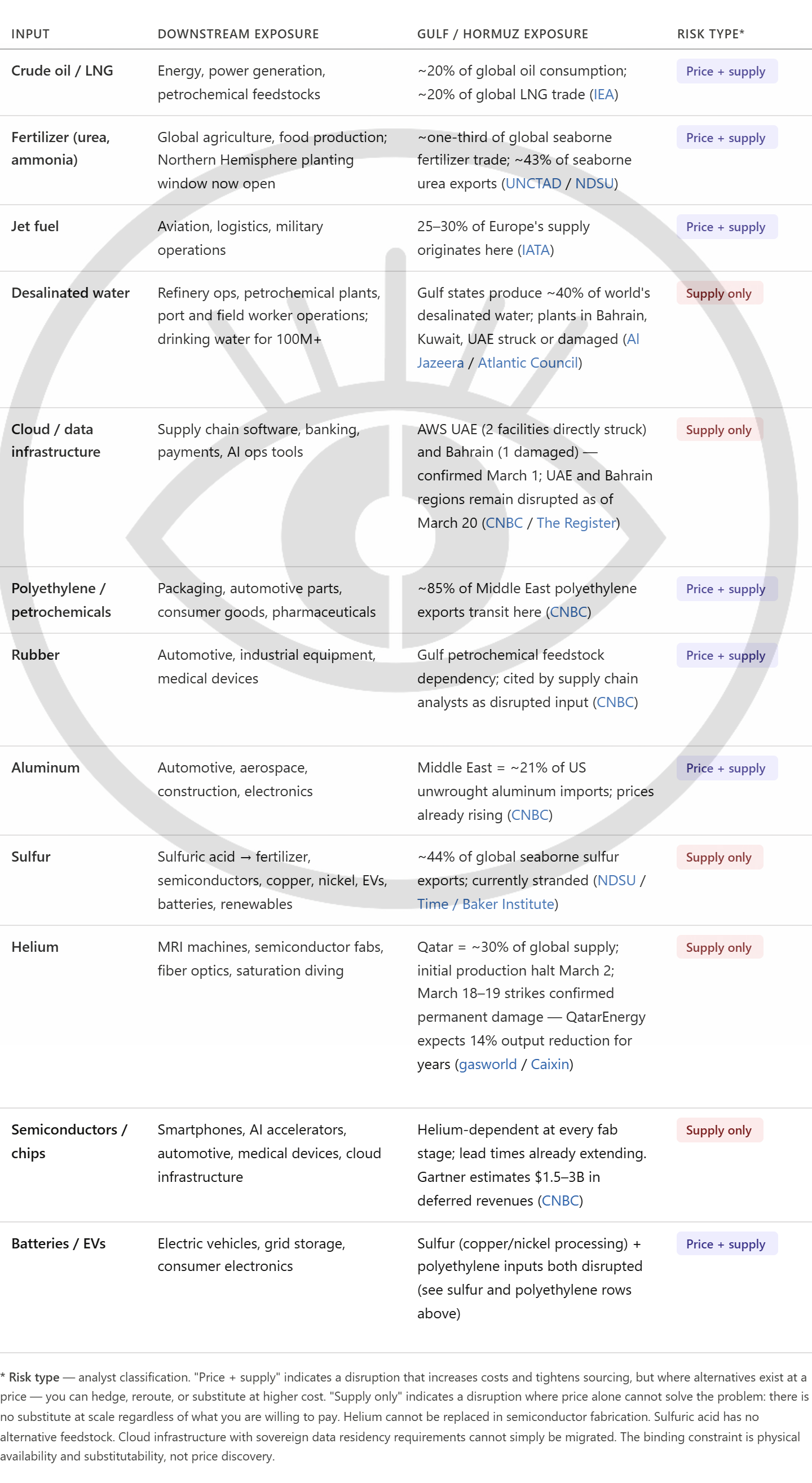
For many of these inputs, inventories cover only a few weeks.
Shortages do not announce themselves. They compound. Supply chain professionals call it the bullwhip effect: small disruptions at the point of consumption generate increasingly large order swings as they travel upstream.
A retailer who fears an upcoming shortage orders double. The distributor orders triple. The manufacturer schedules accordingly, only to find that underlying demand never moved that much. In a disruption of this scale, the bullwhip does not just amplify the signal. It distorts every planning assumption simultaneously, and the distortion grows larger the further upstream you look. By the time that signal reaches procurement and finance, it no longer resembles the original event.
This is the cost-of-goods shock the war just triggered. It is still compounding.
And it is landing inside a financing environment that was already fragile before the first missile left the ground.
The Financial Environment Your Company is Operating In
The commodity shock is landing inside a credit market that was already under stress before the first strike on Iran.
A series of high-profile leveraged loan defaults in late 2025 and the rising use of payment-in-kind toggles in direct lending signal mounting pressure across corporate balance sheets. The headline default rate in private credit has remained below 2%, but once selective defaults and liability management exercises are included, the real rate approaches 5%. Credit markets are navigating the most challenging liquidity environment since 2008.
That gap between reported and real is a governance artifact as much as a financial one. Lenders have been buying time through covenant waivers, maturity extensions, and PIK conversions (a sign of acute liquidity stress), where borrowers pay interest with more debt instead of cash.
The DOJ has publicly warned about divergent valuation practices in private portfolios.
A BlackRock private credit CLO, a structured vehicle that bundles corporate loans into tradeable securities, already breached its over-collateralization test before February ended.
This matters to operators because the lenders financing your working capital, inventory positions, and capital expenditure programs are themselves under liquidity pressure. The adjustments that kept covenant packages technically intact through 2024 and 2025 were underwritten against a supply chain that no longer exists.
Your Forecast Model is Wrong at the Input Level
The first failure is structural. Procurement and supply chain have been treated as cost centers, not strategic functions. That framing is the root of everything that follows.
Operating plans modeled commodity price exposure. What most did not model was supply chain resilience and procurement governance. Those are not the same thing.
In most organizations, supply chain resilience has been systematically dismantled through headcount reductions, offshoring, and outsourcing decisions made in the name of efficiency. The capability to manage a shock like this was not lost overnight. It was deliberately removed, one restructuring at a time.
I grew up in an Aramco community in Saudi Arabia. I watched Gulf producers operate under pressure from early on, how contracted volumes, sovereign relationships, and infrastructure protection actually work when the calculus shifts. Gulf producers do not operate on Western business timelines. Decisions move at the pace of sovereign interest, not quarterly earnings.
When infrastructure is under threat, the logic is simple: protect the kingdom first, honor the contract second. That is not a cultural criticism. It is an operational fact that belongs in your risk model.
QatarEnergy invoked force majeure on all LNG shipments on March 4, 2026. That event was not a surprise to anyone who understood how Gulf producers behave when their own infrastructure is under threat. It was invisible only to plans that treated contracted supply as a reliable input variable.
Consider a cargo contracted and loaded in the Gulf under normal conditions. Three weeks into transit, the war begins. Insurance is canceled. Rerouting adds two weeks. The contracted delivery date passes. The buyer’s production line waits. Settlement happens 60 days after loading, in a world that no longer resembles the one the contract was written for. That gap does not close itself.
During the pandemic, managing global operational vendors across multiple jurisdictions in E&P, I watched force majeure cascade in ways no one had accounted for. Procurement teams discovered that their contingency plans were documents written for auditors, not operators.
The organizations that survived the early disruptions with the least damage were the ones that understood their supply chains end to end, had real relationships with vendors and sovereigns, and had access to the right data at the right time.
The ones that did not have those things fared very differently.
Most companies do not treat force majeure clauses as live operational scenarios. They treat them as legal boilerplate. The people who would have caught that — the procurement managers, the category specialists, the logistics coordinators who knew the vendors, understood the exposure, and had the relationships to navigate a crisis — were eliminated in post-pandemic restructurings in the name of efficiency and cost cuts.
The executives who approved the operating plan inherited their assumptions without inheriting their knowledge. Those assumptions are now baked into your Q2 projections as though they were facts
They are not facts. They are the beliefs of people who were never required to be accountable for being wrong.
That is the Human Risk Layer™. The gap between operational reality and what the plan was told to assume, populated by decision-makers whose failure modes were never stress-tested because the people who understood the risks had already left the building.
Many high-profile business failures trace back not to bad companies, but to governance assumptions that were never pressure-tested against the people who made them.
What your Organization Needs to Do Now
The majority of global supply chains lack the resiliency needed for the future. Gartner estimates approximately two-thirds of all supply chains are fragile. This means they lose value under uncertainty rather than absorb it.
A supply chain diagnostic on any Gulf-exposed business in Q2 2026 would surface four gaps most leadership teams have not stress-tested.
First: map the unhedged operational assumptions. Not the hedged positions. The inputs underneath them. Where does the company source petrochemical feedstock, aluminum, fertilizer-dependent agricultural inputs, helium, sulfur, jet fuel, or electronic components with Gulf exposure? What percentage of contracted volumes transit Hormuz? What is the contingency if 30% of contracted volume becomes unavailable for 90 days? Which strategic suppliers are facing the same exposures?
Second: find the procurement governance gap. Who owns the supplier relationship? Does that person sit in operations or supply chain? What authority do they have to invoke alternatives? What is the escalation path when a primary supplier invokes force majeure? Is that path documented, or is it institutional knowledge in one person’s head. Has that person been laid off in the last restructuring?
Third: stress-test the plan against the actual timeline. Supply chain disruption increases costs and compresses revenues, but management adjustments and add-backs can mask how quickly operating profit is eroding. The flexibility built into your 2024 planning assumptions is the opacity that will blindside your board in 2026.
Fourth: price the governance failure as a strategic variable. If the company has no documented contingency for a Tier-1 supplier invoking force majeure, that is not an operations problem. It is a planning assumption that has already been falsified by current events. The question is not whether this war will affect the business. The question is when it surfaces in your results, will you have enough runway to act on your terms rather than under pressure.
The Adversarial Read
The counter-argument is that this resolves quickly. Naval escorts normalize transit, oil retreats, supply chains reroute around the Cape of Good Hope, and in 90 days the quarterly review looks fine.
Maybe.
Oil futures markets are already pricing a significant decline from current spot levels by early 2027, suggesting markets expect resolution. Plausible scenario, or wishful thinking?
It is also the scenario in which no one gets fired for failing to stress-test their operations against the alternative. Markets have a structural incentive to price resolution. You have a strategic obligation to price the tail.
On March 18, Israel struck Iran’s South Pars gas field, the largest natural gas field in the world and the same reservoir that feeds Qatar’s Ras Laffan production hub. That is not de-escalation. That is the conflict expanding into the infrastructure this piece is about.
Europe’s largest naval powers have stated they see no path to reopening the strait before the war subsides and are refusing to deploy warships until the conflict eases. Naval escorts normalizing transit is not a near-term scenario. It is a hope.
Iran’s rapid reconstitution of ballistic missile capability narrows the window for diplomatic resolution. The arms logic does not favor a clean 90-day outcome. And even if the strait reopens, the second-order effects do not simply reverse. Insurance premiums do not reset immediately. Shipping relationships that have been severed take time to rebuild. Supplier alternatives locked in by competitors with faster procurement governance do not come back available. Supply chains are not elastic the way financial instruments are.
Rerouting decisions made under duress create structural dependencies that persist.
Every additional week of disruption makes recovery harder and more expensive. The asymmetry runs one direction.
What to Do Now, Before Your Quarterly Review
You do not need a new strategy. You need to stress-test the procurement governance and supply chain flows currently embedded in the one you are already executing.
For every business with meaningful exposure to goods that transit Hormuz, and that list is longer than you think once you include second, third, and fourth-order inputs: fertilizer, packaging, electronics, helium, sulfur, jet fuel, automotive components — four questions deserve answers before the next quarterly review:
- What are the operational assumptions underneath the plan, and who owns them?
- What is the documented contingency if a Tier-1 supplier invokes force majeure?
- Which suppliers are we dependent on for bare minimum operations, and how are their finances?
- Is the person who knows the answer and has the relationship still at the company?
That last question is not rhetorical. Post-pandemic restructurings gutted procurement functions across the middle market. The institutional knowledge that would have managed this: the relationships, the alternative sourcing routes, the supplier negotiation leverage, walked out the door in 2022 and 2023 in the name of operational efficiency.
Hyper-efficiency was the metric. Headcount reduction was the playbook. Resilience was not priced, written off because automation would cover it. Now resilience has a market rate. And that rate is significantly higher than it was three weeks ago.
The business event is not the war. The business and risk event is the gap between what your procurement function can actually execute and what your operating plan assumed it could. That gap was created before the first strike on Iran. The war just made it legible.
The question your board is going to ask is not whether you saw the disruption. It is whether you looked at the right layer of your business when you did. The clock started on February 28. Your next quarterly review date has not moved.
Sources for Table:
- Crude oil / LNG: IEA — Strait of Hormuz overview
- Fertilizer (urea, ammonia): UNCTAD — Hormuz shipping disruptions rapid analysis; NDSU Agricultural Trade Monitor, March 2026
- Desalinated water: Al Jazeera — Gulf desalination dependency; Atlantic Council — Attacks on desalination plants
- Cloud / data infrastructure: CNBC — Amazon drone strikes UAE and Bahrain; The Register — AWS Middle East outages
- Polyethylene, rubber, aluminum: CNBC — Hormuz closure supply chain impact, March 11, 2026
- Sulfur: NDSU Agricultural Trade Monitor, March 2026; Time / Baker Institute — What is the Strait of Hormuz
- Helium: gasworld — Qatar LNG damage cuts helium output 14%, March 19, 2026; Caixin Global — Qatar helium shutdown chip supply chain risk, March 16, 2026
- Semiconductors / chips: CNBC — Qatar attack semiconductor supply chain, March 19, 2026
- Risk type classification: Analyst judgment informed by sourced inventory and logistics data. “Supply only” denotes structural scarcity where substitution at scale is not feasible regardless of price.