Written interview with Joan Kinyua, Kenya-based digital rights advocate and and founding President of the Data Labelers Association, on her stories of using AI and AI using people's data and works.
By Karen Smiley
Published: 2026-04-09
URL: https://sixpeas.substack.com/p/aisw-105-ai-software-wetware-joan-kinyua-kenya
Introduction - Joan Kinyua
This week’s AI, Software, & Wetware features awritten interview with Joan Kinyua, a 🇰🇪 Kenya-based digital rights advocate. Joan is the founding President of the Data Labelers Association, which was recently profiled by 404 Media “[AI Is African Intelligence': The Workers Who Train AI Are Fighting Back”, by Jason Koebler, Mar 12, 2026].
We discuss:
- Her experience as a data worker and how that prompted her to found the Data Labelers Association
- How she does & doesn’t use AI tools to help with her advocacy work
- Examples of misalignment between data work tasks and local context or Kenyan ways of understanding situations
- How an AI tool caused her to lose an account, with only a facade of an appeal process
- Ways people can work with the Data Labelers Association to support digital rights
and more. Check it out, and let us know what you think!
This post is part of our AI6P interview series on “AI, Software, and Wetware”. Our guests share their experiences with using AI, and how they feel about AI using their data and works. (This is a written interview; read-aloud is available in Substack. If it doesn’t fit in your email client, click HERE to read the whole post online.)
##### Note: In this article series, “AI” means artificial intelligence and spans classical statistical methods, data analytics, machine learning, generative AI, and other non-generative AI. See this Glossary and “AI Fundamentals #01: What is Artificial Intelligence?” for reference.
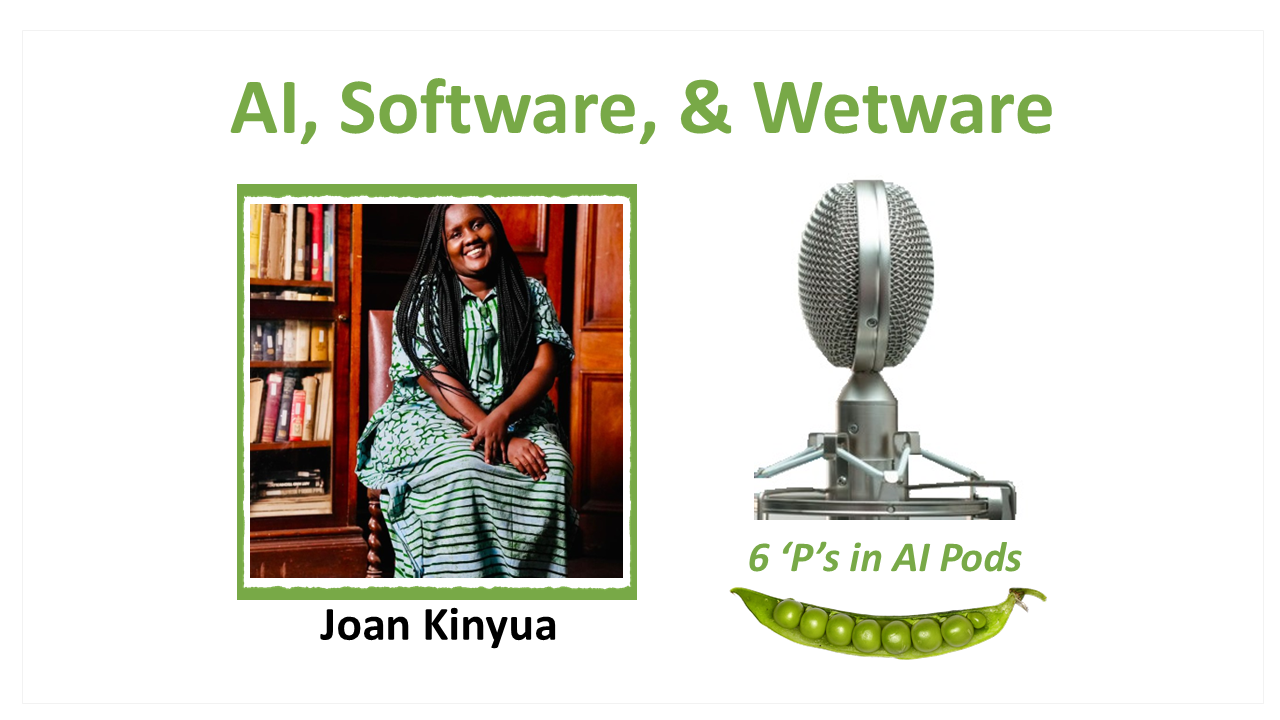
Interview - Joan Kinyua
Karen: I am delighted to welcome Joan Kinyua from Kenya as my guest today on “AI, Software, and Wetware”! Joan, thank you so much for joining me on this interview. Please tell us about yourself, who you are, and what you do.
Joan: Thank you so much for having me! I’m Joan Kinyua, from Nairobi, Kenya. I’m a digital rights and labor advocate and the founding President of the Data Labelers Association, a grassroots, worker-led organization that represents data workers who label datasets for AI systems. My work focuses on advocating for ethical labor practices, fair pay, transparency, and mental well-being for people working in the AI value chain.
I started my journey as a data worker myself, so my advocacy comes from lived experience. I’ve seen firsthand the challenges, precarious working conditions, and lack of recognition that data workers face. Through the Association, we aim to make this invisible workforce visible, valued, and protected, ensuring that the human labor behind AI is recognized as central to technological development, not peripheral.
Karen: What is your level of experience with AI, ML, and analytics? Have you used it professionally or personally, or studied the technology?
Joan: My experience with AI, machine learning, and analytics is primarily from the perspective of a data worker and labor advocate, rather than as a developer or engineer. I have extensive hands-on experience in data annotation, labeling datasets that are used to train AI models for social media, autonomous vehicles, and other applications. Through this work, I gained a deep understanding of the types of data AI systems rely on, how datasets are structured, and the labor required to make AI function effectively.
In addition, I have studied and engaged with AI and ML concepts to advocate for ethical practices and fair labor standards. This includes analyzing the impact of AI on labor markets, understanding biases in algorithms, and exploring how governance frameworks can protect workers in the AI ecosystem. While I’m not building AI models myself, my professional and research experience allows me to bridge the technical and human sides of AI, highlighting the critical role of the workforce that powers these systems.
Karen: That’s critically important work. Are AI tools ever of help to you in doing that work? I hear from a lot of entrepreneurs that they find AI tools can save them time on the many tasks of running a business or organization.
Joan: Yes, to some extent they are helpful. We primarily use AI tools for grammatical structuring and refining sentence flow, especially when preparing formal communications, reports, or policy documents. They are also useful when we need to adapt language for specific audiences, ensuring the tone and framing are appropriate for different stakeholders, whether policymakers, workers, or international partners.
At an organizational level, AI tools can also support basic administrative functions such as bookkeeping and record organization, helping streamline internal processes. However, their use remains complementary, the core of our work, particularly around advocacy and worker engagement, is still deeply human-centered.
Karen: I’m also curious if you ever use AI tools in your personal or community life?(AI is hard to avoid in daily life - see “But I don’t use AI”: 8 Sets of Examples of Everyday AI, Everywhere)
Joan: Yes, I do use AI tools in my personal and community life, particularly as a way to make complex information more accessible. For example, when I encounter concepts or discussions that are difficult to understand, I use AI to break them down into simpler, clearer explanations.
This is especially helpful when dealing with heavy legal or litigation language, which can often be dense and difficult to interpret. AI tools help translate that into more understandable terms, making it easier to engage with and share within community contexts.
That said, it’s mainly a support tool — it helps with clarity and accessibility, but the interpretation and application still come from lived experience and collective understanding.
Karen: Can you share a specific story on how you have used a tool that included AI or ML features? What are your thoughts on how the AI features [of those tools] worked for you, or didn’t? What went well and what didn’t go so well?
Joan: Yes! I actually worked on a large language model (LLM) project, where my task was to prompt the model with a question, review the response, and select the answer that best fit the prompt. The project was in Kiswahili, which made it particularly interesting, and in many ways, I can see a direct parallel with tools like ChatGPT.
What struck me was how the model seemed to extract so much from me as a human worker. It relied heavily on my judgment and contextual understanding to evaluate responses correctly. On the positive side, it was impressive how the LLM could generate coherent answers and handle linguistic nuance, especially in Kiswahili, which is less commonly represented in AI datasets.
On the other hand, challenges included ambiguities in the responses, occasional irrelevance, and the model’s tendency to overgeneralize, which meant I had to pay careful attention to quality and correctness. Overall, it was a fascinating experience that highlighted the essential role human judgment plays in AI systems, especially in non-English contexts.
Karen: Aside from the challenges you noted with the quality of the answers, were you ever asked to handle any questions that just didn’t align with typical Kenyan values or ways of thinking? For instance, if the question had a built-in assumption that meant none of the answers would really be ‘right’ for a Kenyan person who would be using the tool in Kiswahili, even if the answers were syntactically correct.
Joan: Yes, I would respond to that in a general way.
At times, the tasks and instructions we were given came with predefined assumptions that didn’t necessarily align with local context or Kenyan ways of understanding situations. As data workers, we were expected to strictly follow the instructions, even when they didn’t fully reflect the reality on the ground.
For example, content such as photos or videos of protests could be framed in a way that emphasizes instability or insecurity, suggesting that a country is unsafe. However, from a local perspective, these protests are often rooted in legitimate grievances and injustices that people are actively addressing. That nuance is not always captured in the task framing.
So even if the outputs were technically or syntactically correct, they could still misrepresent context, reinforce bias, or miss important cultural and social realities. This highlights a broader issue in AI systems, the gap between standardized instructions and lived, localized understanding.
Karen: Those are great examples - thank you, Joan.
If you have avoided using AI-based tools for some things (or anything), can you share an example of when, and why you chose not to use AI?
Joan: Yes, there are areas where I intentionally avoid using AI tools.
I generally avoid relying on AI for things that require deep human context, emotional nuance, or professional judgment. For example, matters involving feelings, personal experiences, or relationship decisions are not something I would trust AI with, because these require empathy, lived experience, and an understanding of context that a machine cannot fully grasp.
Similarly, I would not rely on AI for medical advice or prescriptions, where accuracy, accountability, and professional expertise are critical.
In these cases, I see AI as just an interface or support tool, not a substitute for human judgment, care, or expertise.
Karen: A common and growing concern nowadays is where AI and ML systems get the data and content they train on. They often use data that users put into online systems or publish online. And companies are not always transparent about how they intend to use our data when we sign up.
How do you feel about companies using data and content for training their AI/ML systems and tools? Should ethical AI tool companies be required to get Consent from (and Credit & Compensate) people whose data they want to use for training? (the “3Cs Rule”)
Joan: I am of the firm opinion that if data or content does not belong to you, it should never be used without explicit permission. AI and ML models are not inherently intelligent, they are entirely dependent on human labor, input, and creativity. Yet too often, companies extract this work without consent, recognition, or compensation, creating vast asymmetries of power where humans provide the intelligence and the AI takes the credit.
Ethical AI companies must adhere to the “3Cs Rule”: Consent, Credit, and Compensation. Users and workers whose data powers AI systems should have full agency over whether their data is used, be acknowledged for their contributions, and receive fair remuneration. Without these safeguards, AI development perpetuates exploitation and erodes accountability, ignoring the very people whose labor and knowledge make these technologies functional. Respecting these principles is essential for building AI systems that are genuinely responsible, sustainable, and equitable.
Karen: As a user of AI-based tools, do you feel like the tool providers have been transparent about sharing where the data used for the AI models came from, and whether the original creators of the data consented to its use?
Joan: No, in my experience, AI tool providers are generally not transparent about where their training data comes from or whether the original creators have consented to its use. For example, many large language models claim to use “publicly available” data, but they rarely clarify which sources were included, whether creators were informed, or if any compensation was provided.
This lack of transparency is concerning because it obscures the human labor and creativity that underpin these systems, effectively allowing companies to benefit from the work of others without accountability. For AI to be ethical, users and creators must know where the data comes from, that their consent has been given, and that they are recognized and compensated for their contributions.
Karen: (And that the data was annotated and processed by workers who are treated ethically ;) If you’ve worked with building an AI-based tool or system, what can you share about where the data came from and how it was obtained?
Joan: Honestly, most of the time, I have no idea where the data is coming from, nor do I fully understand the model I’m contributing to. To make it even more surreal, the project names themselves are almost always cryptic, often just an animal or a random jumble of letters, so it’s impossible to make sense of what they’re actually building. We’re handed tasks, complete them, and move on, without context or insight into the final product.
It really shows how opaque AI development is, and how the human labor powering these systems is treated as invisible, even though, without us, these models wouldn’t function at all.
Karen: As consumers and members of the public, our personal data or content has probably been used by an AI-based tool or system. Do you know of any cases that you could share (without disclosing sensitive personal information, of course)?
Joan: Yes, it’s very likely that people’s personal data or content has been used by AI systems, though it’s often hard to pinpoint exactly when or how. Many of the tasks we work on are piecemeal and fragmented, which makes it difficult to understand the bigger picture of what we’re contributing to. Because each task is so small and isolated, it can feel almost insignificant, and we rarely have a clear sense of what information we are being exposed to or how it is being used.
This fragmentation obscures the true scale of human labor behind AI and the potential privacy implications for the people whose data powers these systems.
Karen: Has your own data ever been used in an AI tool that you’re aware of?
Joan: I’m not entirely sure.
Like many people, I use platforms such as LinkedIn, email services, and other digital tools that may incorporate AI in different ways. However, it’s often not clear how or when personal data is being used, or to what extent it contributes to training or improving these systems.
So while it’s possible that my data has been used in some capacity, there isn’t enough transparency for me to say that with certainty.
Karen: Do you know of any company you gave your data or content to that made you aware that they might use your info for training AI/ML?
Joan: No, I do not know of any company that explicitly informed me that the data or content I provided would be used to train AI or ML systems. In most cases, there is no transparency or disclosure, and workers or users are left unaware of how their input is being leveraged.
Karen: Has a company’s use of your personal data and content created any specific issues for you, such as privacy, phishing, or loss of income? If so, can you give an example?
Joan: No, I have not experienced issues like privacy breaches or phishing directly. However, I have had my account terminated arbitrarily, with the company stating I was in breach of their policies.
This decision was made by an AI system, which highlights a troubling reality: the very systems we are helping to train and teach are increasingly making decisions that affect our own livelihoods. It’s a stark reminder of how human labor powers these models, yet the models themselves can exert control over the humans contributing to them.
Karen: That sucks that your account was terminated. Did you have any recourse when it happened? Was there any human review or appeal process that you could use to regain it?
Joan: No, there wasn’t any meaningful recourse. In fact, the appeal process often feels like a façade: you submit your request, but there is little to no response, and no clear indication that a human is actually reviewing your case.
Once the decision is made, it’s essentially final. There’s no transparency around why it happened, no opportunity to properly challenge it, and no real pathway to regain access. This lack of accountability can be incredibly frustrating, especially when your work and livelihood depend on these platforms.
Karen: Public distrust of AI and tech companies has been growing. What do you think is THE most important thing that AI companies need to do to earn and keep your trust? Do you have specific ideas on how they can do that?
Joan: The most important thing AI companies must do to earn and maintain trust is to recognize the human labor, creativity, and knowledge that power their systems, and act transparently and responsibly. Too often, AI models operate as black boxes, built on data, artwork, music, and creative content extracted without consent or compensation, while the people who make these systems possible remain invisible.
Ethical AI companies must center humans in their governance, ensuring that workers, artists, and contributors have a voice in how systems are designed, deployed, and monitored. Transparency is not just about sharing technical details, it’s about acknowledging the labor behind the AI, explaining decisions that affect lives, and being accountable for harm. Until AI companies take these steps, public trust will remain fragile, and the human foundation of AI will continue to be undervalued and exploited.
Karen: Thank you so much for making time for this interview, Joan! Is there anything else you’d like to share with our audience?
Joan: I’d encourage anyone interested in learning more about our work to visit our website atwww.datalabelers.org.
We are always open to partnerships and collaborations with organizations, researchers, policymakers, and industry actors who are committed to advancing ethical AI and data worker rights. Please feel free to reach out through the website to connect with us.
 Joan Kinyua
Interview References and Links
Joan Kinyua on LinkedIn
Joan Kinyua on Bluesky
Data Labelers Association website and on LinkedIn
About this interview series and newsletter
This post is part of our AI6P interview series on “AI, Software, and Wetware”.
It showcases how real people around the world are using their wetware (brains and human intelligence) with AI-based software tools, or are being affected by AI.
And we’re all being affected by AI nowadays in our daily lives, perhaps more than we realize. For some examples, see post “But I Don’t Use AI”:
We want to hear from a diverse pool of people worldwide in a variety of roles. (No technical experience with AI is required.) If you’re interested in being a featured interview guest, anonymous or with credit, please check out our guest FAQ and get in touch!
6 'P's in AI Pods (AI6P) is a 100% human-authored, 100% reader-supported publication. (No ads, no affiliate links, no paywalls on new posts).
All new posts are FREE to read and listen to. To automatically receive new AI6P posts and support our work, consider becoming a subscriber:
Series Credits and References
##### Disclaimer: This content is for informational purposes only and does not and should not be considered professional advice. Information is believed to be current at the time of publication but may become outdated. Please verify details before relying on it. All works, downloads, and services provided through 6 'P's in AI Pods (AI6P) publication are subject to the Publisher Terms available here. By using this content you agree to the Publisher Terms.
Microphone photo by Michal Czyz on Unsplash (contact Michal Czyz on LinkedIn)
Credit to CIPRI (Cultural Intellectual Property Rights Initiative®) for their “3Cs' Rule: Consent. Credit. Compensation©.”
Credit to for the “Created With Human Intelligence” badge we use to reflect our commitment that content in these interviews will be human-created:
If you enjoyed this interview, my guest and I would love to have your support via a heart, share, restack, or Note! (One-time tips or voluntary donations via paid subscription are always welcome and appreciated, too 😊)