Running AI Agents in Enterprise Systems: Architecture Considerations
By Lakshmi Veeramani
Published: 2026-04-14
URL: https://sixpeas.substack.com/p/the-control-plane-for-agentic-ai
Prefer listening? Read-aloud is available through the Substack app.
Agentic AI platforms are now introducing a new participant into this architecture: AI agents as decision-making components.
Unlike traditional services, agents:
Interpret unstructured data
Make contextual decisions
Trigger workflows
Call enterprise APIs
Collaborate with other agents
Operate with varying levels of autonomy
As agents become embedded into enterprise workflows, the platform needs the same discipline that governed traditional banking systems — extended to autonomous decision layers.
This is where a control plane for Agentic AI platforms becomes important.
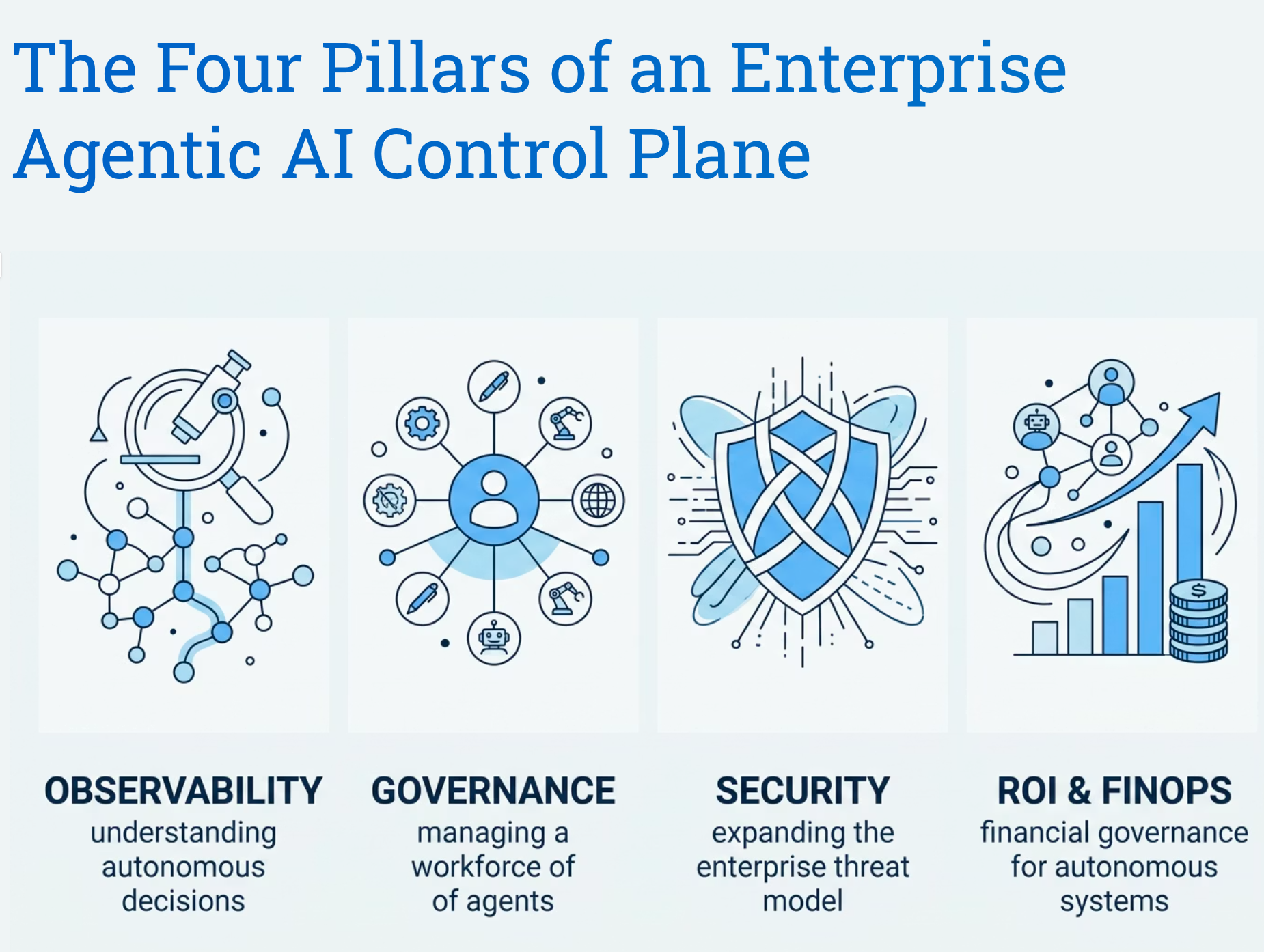
In practice, this spans four areas: Observability, Governance, Security and ROI monitoring.
The Missing Control Plane for Agentic AI Platforms
Every enterprise is building an AI platform — banks, retailers, healthcare systems, manufacturers, governments. Most are converging on the same architecture: LLMs, RAG pipelines, AI agents, tool orchestration, and workflow automation. This is the Agentic AI stack. Yet a critical structural gap is emerging across nearly every platform I review is the Architecture foundation for stability and scale.
The Investment
Enterprises pour resources into building agents — impressive demos follow
The Gap
Almost nothing invested in governing an ecosystem of agents at scale
The Result
Fragile production systems — Agentic AI fails not because models are weak, but because platform control is missing
The answer is a four-layer control plane sitting above all AI and non-AI components: Observability, Governance, Security, and ROI & FinOps Monitoring — providing the operational discipline autonomous systems demand.
From AI Pipelines to Agentic Systems
Traditional AI — Passive
- Predict outcomes from data
- Classify inputs into categories
- Recommend options to humans
Models return results. Humans act.
Agentic AI — Active
- Decide and execute autonomously
- Call APIs and trigger workflows
- Modify data and coordinate across systems
- Interact with users in real time
An agent is no longer a model wrapper — it is a decision-making unit embedded in business operations. Once deployed, enterprises must answer: who approved this? What data influenced it? Can we roll back safely? Without a control plane, these questions remain dangerously unanswered.
The Four Pillars of an Enterprise Agentic AI Control Plane
Each pillar addresses a distinct operational failure mode. Together, they form a unified control plane that transforms experimental agent deployments into production-grade, enterprise-ready systems governed with rigor and accountability.
Pillar 1: Observability
Agent Observability: Debugging Decisions, Not Just Code
Observability in traditional systems focuses on infrastructure metrics. Agentic platforms require decision observability — the ability to trace, explain, and audit every autonomous action an agent takes. Instead of debugging code, platform teams debug decisions.
Execution Traces
Full step-by-step records of agent reasoning and action sequences
Tool Invocation Chains
Which tools were called, in what order, and with what parameters
Workflow Transitions
State changes, retry behavior, failure modes, and escalation points
Latency & Throughput
Performance baselines per agent, per task, per deployment version
Data Observability: Agentic Systems Are Only as Reliable as Their Inputs
When agents simultaneously process documents, emails, live APIs, and streaming data, input quality becomes a first-class operational concern. Data observability must be instrumented into every pipeline that feeds an agent.
Input Lineage & Source Attribution
Track where every data element originated, enabling full auditability of agent inputs and preventing silent data substitution.
Schema Consistency & Drift Detection
Identify structural changes in upstream data sources before they silently corrupt agent reasoning and decisions.
Extraction Confidence & Validation
Score the reliability of structured and unstructured data transformations entering agent pipelines, flagging low-confidence inputs for review.
AI Observability: LLMOps Built Into the Platform
AI-specific telemetry must be a native platform capability — not bolted on after deployment. This forms the foundation of LLMOps inside the platform fabric, enabling teams to reason about model behavior in production with the same rigor applied to traditional software systems.
Model Selection & Prompt Versioning
Track which model and prompt version produced each output, enabling reproducibility and A/B rollback
Retrieval Quality & Hallucination Indicators
Measure RAG recall precision and flag outputs that exhibit hallucination risk patterns
Token Consumption & Latency per Model
Per-call cost and performance metrics at the model level, feeding directly into FinOps dashboards
Confidence Scoring
Quantify output certainty to route borderline decisions to human review before downstream harm occurs
Fallback Usage Tracking
Monitor how often agents fall back to secondary models or degraded modes, signaling reliability concerns
Reasoning Step Capture
Preserve chain-of-thought outputs for audit, explainability, and continuous improvement cycles
Pillar 2: Governance
Agent Governance: Managing a Workforce of Agents
As agent count grows from dozens to hundreds, governance becomes mandatory. Without it, platforms devolve into uncontrolled sprawl — duplicate capabilities, conflicting automations, and unapproved data access. Governance treats agents as managed operational entities, not experimental code.
Register
Agent registry with capability declarations, tool access policies, and ownership metadata
Approve
Structured approval workflows and deployment lifecycle gates before production promotion
Version
Full versioning, rollback controls, and human override rules for every production agent
Govern
Enforce capability boundaries, tool access restrictions, and operational policy continuously
Data & Model Governance: Aligning AI Platforms With Enterprise Compliance
Agentic systems dramatically amplify data exposure risk. An agent that can read, transform, and route data across enterprise systems requires the same compliance controls as any regulated business process — applied programmatically at platform scale.
Data Governance
- Data classification and PII masking
- Access enforcement and usage audit trails
- Data residency and sovereignty enforcement
- Policy-driven data routing across regions
Aligns the AI platform with GDPR, HIPAA, SOC 2, and enterprise data policies.
Model Governance
- Approved model registry with risk-tiered usage policies
- Model version lifecycle and retirement controls
- Fallback strategy definition and enforcement
- Explainability capture for regulated decisions
- Responsible AI policy enforcement at inference time
Integrates AI governance into the platform fabric rather than relying on disconnected external review processes conducted after deployment.
Pillar 3: Security
Security: Expanding the Enterprise Threat Model for Agentic AI
Agentic AI introduces entirely new attack surfaces that traditional API security was never designed to handle. Autonomous decision flow — not just request-response traffic — must be protected. The threat model must be rewritten from the ground up.
Prompt Injection
Malicious input designed to override agent instructions and hijack execution
Tool Exploitation
Abusing agent-accessible tools to execute unauthorized operations or exfiltrate data
Data Exfiltration via Reasoning
Sensitive data leaked through model outputs, reasoning traces, or tool call parameters
Autonomous Privilege Escalation
Agents acquiring permissions or accessing resources beyond their defined operational boundaries
Agent Security Controls: AI-Specific, Execution-Level, and Enterprise-Grade
Securing agentic platforms requires three complementary layers of controls operating simultaneously. Each layer addresses a distinct attack surface unique to autonomous AI systems operating within enterprise infrastructure.
AI-Specific Controls
- Prompt injection detection and neutralization
- Output filtering before downstream action
- Policy guardrails enforced at inference
- Hallucination risk blocking for high-stakes decisions
- Toxicity and regulatory compliance filters
Agent Execution Controls
- Tool permission boundaries and API allowlists
- Sandboxed execution environments
- Rate limiting per agent and per tool
- Role-based agent access and identity propagation
Enterprise Controls
- Immutable audit logging of every agent action
- End-to-end encryption and secret isolation
- Identity federation across enterprise systems
- Continuous policy enforcement at runtime
Pillar 4: ROI & FinOps
ROI & FinOps: The Most Overlooked Layer in Enterprise AI
Many organizations cannot answer the most fundamental business question about their AI investments: What value are our agents actually delivering? Agentic AI introduces new, disaggregated cost structures that traditional IT finance frameworks cannot track or attribute effectively.
New Cost Structures to Track
Model inference cost per call and per agent
Tool execution and API integration costs
Workflow orchestration and infrastructure overhead
Human review cost for escalated decisions
Agent FinOps Metrics
- Automation rate and human override frequency
- Cost per automated task and cost per decision
- ROI per agent and payback period
- Throughput per agent and operational savings
- Revenue impact and token consumption efficiency
This is where AI platforms transition from innovation projects to operational investments held to enterprise financial standards.
Measuring What Matters: From Model Accuracy to Business Value
Traditional AI measurement focused on a single dimension: model accuracy. Agent FinOps demands a multidimensional business value framework that connects every autonomous action to operational and financial outcomes.
Per Automated Task
Total platform cost attributed to each automated unit of work completed without human intervention
Per Deployed Agent
Return on investment calculated per agent, enabling portfolio-level decisions about which agents to scale or retire
Human Override Rate
Frequency with which humans override agent decisions, revealing confidence gaps and automation readiness
Payback Period
Time to recover agent development and infrastructure investment through realized operational savings
Agent FinOps is not a post-deployment report — it is a real-time operational capability embedded in the control plane from day one. Finance and engineering teams must share a single source of truth for AI cost and value attribution.
The Architecture Shift: From AI Platform to Agentic Operating System
The next generation of enterprise platforms will not be model-centric. They will be agent-centric — designed around the orchestration, governance, and lifecycle management of autonomous decision-making units operating at scale across the enterprise.
Agent Registries & Libraries
Reusable, versioned agent libraries with standardized capability declarations replacing ad-hoc agent proliferation
Hybrid AI + Deterministic Workflows
AI reasoning layers orchestrated alongside deterministic business logic, with clear handoff and escalation boundaries
Human-in-the-Loop Governance
Structured human oversight embedded at policy-defined decision thresholds, not as an afterthought but as a designed control
Cross-Agent Collaboration
Governed multi-agent coordination with defined execution boundaries, preventing runaway autonomous behavior at scale
As this ecosystem grows, the control plane becomes the most critical platform component — not the model, not the prompt, not the framework. The operating discipline around agents is the durable competitive asset.
Closing Thought: The Next Wave Is Control
The first wave of enterprise AI focused on intelligence. The second wave focuses on autonomy. The next wave will focus on control.
Build Agents Only
Organizations that invest only in building agents will produce impressive prototypes — and struggle in production at scale
Build the Control Plane
Organizations that invest in observability, governance, security, and ROI discipline will build platforms that scale responsibly and profitably
In the coming years, competitive advantage will not come from having AI agents. It will come from running them responsibly, securely, and profitably at scale. That requires a control plane designed for Agentic AI from day one — not retrofitted after production failures reveal its absence.
Thanks for reading 6 'P's in AI Pods (AI6P)! This post is public, so feel free to share it.