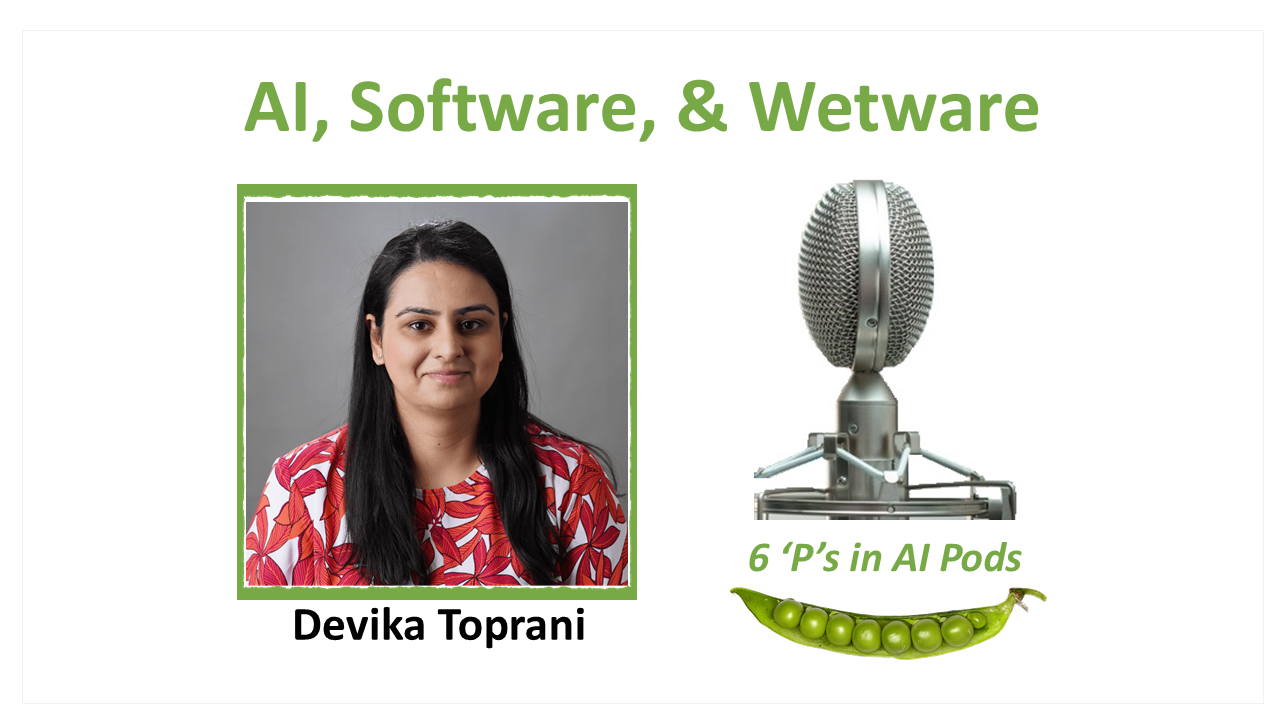
Audio interview with USA-based founder Devika Toprani on her stories of using AI and how she feels about AI using people's data and works (42:15)
By Karen Smiley
Published: 2026-04-02
URL: https://sixpeas.substack.com/p/aisw-104-ai-software-wetware-devika-toprani-usa
Introduction -
This edition of AI, Software, and Wetware features an audio interview with Devika Toprani, the 🇺🇸 USA-based creator of Somagraphic Learning™ and the author of . We discuss:
- Her multi-cultural background and influences on her views about AI and feedback
- Using AI for research, drafting, summarizing, and checking for errors, but not writing or developing her Somagraphic Learning Framework
- Why AI tools are only used in the third phase of Somagraphic Learning (Refine) and not in the first two (Attempt and Map)
- The time an AI summary omitted “Soul” when summarizing her works in “Soulful Learning With AI”, along with other misinterpretations
- Training an AI image generator tool on her own Doodles by Devika artworks
- Thoughts on the feedback loop of students using of AI tools for writing, which helps to train the tools, which in turn shape students’ future writing
- How bots on Instagram are confounding her ability to understand what resonates most with her audience
and more. Check it out, and let us know what you think!
This post is part of our AI6P interview series on “AI, Software, and Wetware”. Our guests share their experiences with using AI, and how they feel about AI using their data and works.
##### This interview is available as an audio recording (embedded here in the post, and later in our AI6P external podcasts). This post includes the full, human-edited transcript. (If it doesn’t fit in your email client, click HERE to read the whole post online.)
Note: In this article series, “AI” means artificial intelligence and spans classical statistical methods, data analytics, machine learning, generative AI, and other non-generative AI. See this Glossary and “AI Fundamentals #01: What is Artificial Intelligence?” for reference.
Interview - Devika Toprani ()
Karen: I am delighted to welcome Devika Toprani from the United States as my guest today on “AI, Software, and Wetware”. Devika, thank you so much for joining me on this interview! Please tell us about yourself, who you are, and what you do.
Devika: Hi, Karen. Thank you so much for having me today. I’m Devika Toprani. I’m born in Oman. I’m brought up in Dubai. I’ve studied in India, and I’ve been living in the US for the past four years. I have worked with K to 12 higher education. I worked with the Council on Social Work re-accreditation as well. And I currently work at the intersection of human-centered learning and responsible AI.
A little more about me. I’m the creator of the Somagraphic Learning framework, which focuses on human sense making before AI – the human layer that we get into before we touch AI for refinement. It’s built so that learners can get that initial understanding, make connections before using tools to generate polished outputs. Thank you for having me, Karen.
Karen: Oh, my pleasure. And I want to hear more about Somagraphic Learning as we go on through the discussion. First, can you tell us a little bit about your level of experience with AI and machine learning and analytics? I’d like to hear if you’ve used it professionally or personally, or if you’ve ever studied the technology.
Devika: Yeah. The thing is that I never had plans of working with analytics or machine learning. I didn’t want to get into it. But there’s a twist. Nothing in life is planned, right? AI, the invention was not planned, but it’s still here. We have to deal with it.
So starting off with my journey, I started off with preschool teaching. I did not even want to do a master’s degree in STEM, but here I am. I have studied a master’s in management and quantitative sciences. I also have a bachelor’s degree in psychology.
So I would say I’m a combination of systems, a mix of human-centered with data.
And getting to your question, yes, I do use AI, like everyone does. I use it for research, drafting, summarizing, identifying mistakes and errors. Everyone makes errors. So do I. So I’ve used it for that. I’ll give an example of how I have used AI. I’ve used it to just compare frameworks. Institutions have different frameworks today to compare context, to compare information, ideas, research, and to understand what each framework is saying, the patterns.
So that’s how I use AI. I don’t use it to replace my thinking. I use this as a tool to speed up my understanding of what I already know. And while using it, I’m very intentional. I ask myself, how is this information that AI is giving me shaping my perspective? Is it right? Is it real? And I think waiting and stopping and reflecting for that one moment helps me understand so many things much better. Yeah.
Karen: Yeah. So it sounds like you use it as an assistant for your professional work. Do you also use it personally for anything? It’s very hard to avoid AI nowadays in our personal lives. Is there any situation where you use it for personal activities outside of your work?
Devika: Yes, I do. I do own a Substack called Soulful Learning with AI, where I do have to research a lot of different things. And there are things that come to me in the bathtub like, “Okay, this idea would work well with Somagraphic Learning.” So I try to note down those ideas and maybe ask AI, based on what I’ve already created – like, Somagraphic Learning is already created by me – so I would ask AI, *“Okay, how does this approach work or relate to Somagraphic Learning, for example?
How would neurodivergent learners learn well with Somagraphic Learning?”* That’s somethingI use AI for. It gives me perspectives on something I have already developed. Gives me different angles for that, and that’s how I personally use it.
And I think feedback is a gift, right? A lot of my professors at University of Illinois have shared with me that feedback is a gift. You are always open to refining things. So yes, AI is a gift in that aspect. But I have to also use my own brain. I have to take the trouble of doing that too. So it goes both ways.
Karen: All right, thank you. Can you share a specific story on how you’ve used tools that have AI or machine learning features? I’m curious to hear your thoughts on what aspects of the tools worked well for you and maybe an example of something that didn’t work so well.
Devika: Yes. In my master’s program as a millennial, I have noticed it’s very important to be aware of real-world examples around you, and not believe what AI says blindly. And during my master’s program I noticed that several learners were prioritizing speed over actual understanding.
And that’s what led me to develop Somagraphic Learning, which focuses on AI in the last step. Attempt, Map, and Refine. Refine is the last stage, where AI is used.
So yes, I have avoided using AI tools in my framework in the first two steps, Attempt and Map. And I would say Refine uses it because AI cannot be avoided as such today.
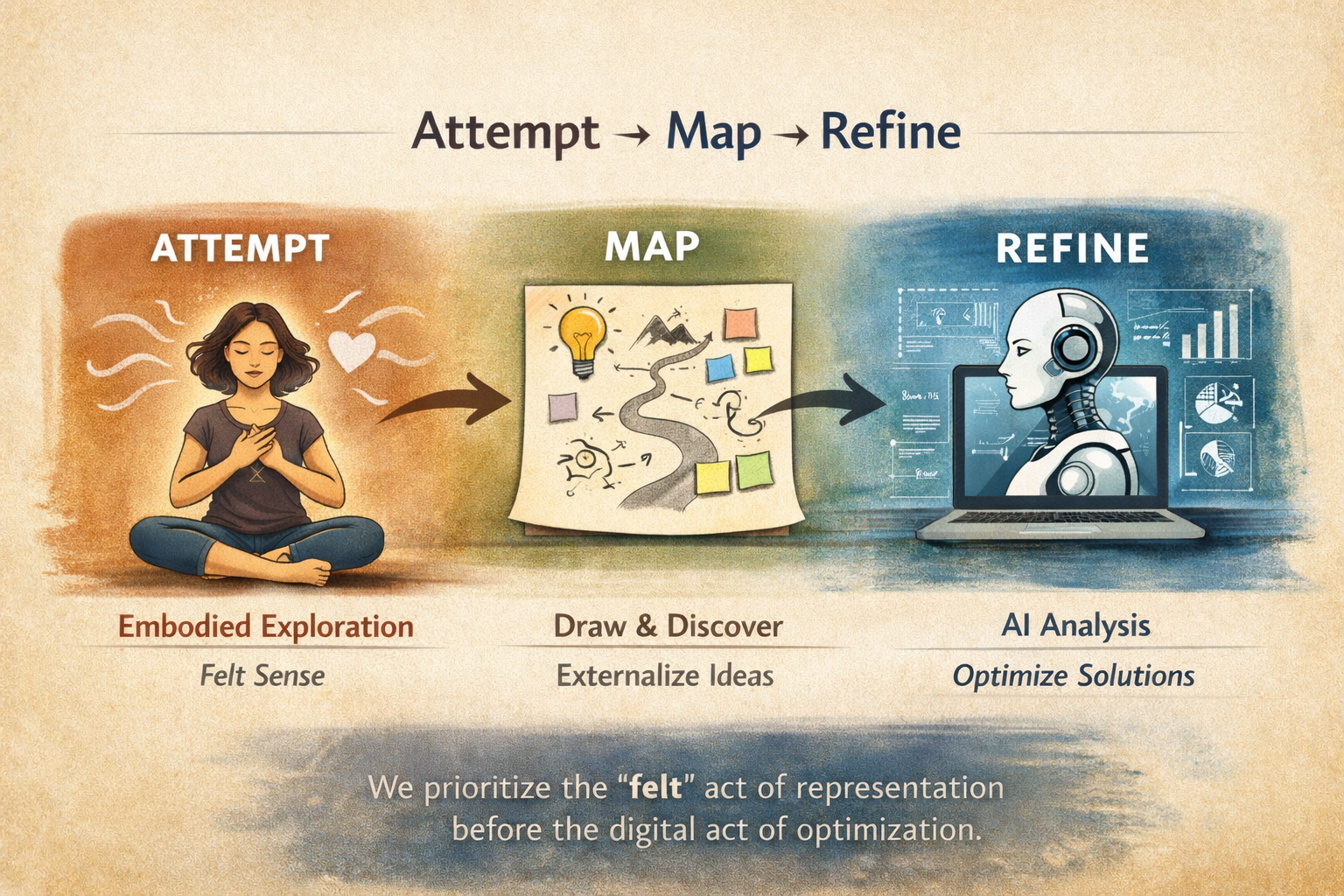 \Three phases ofSomagraphic Learning(from theOverview):Attempt,Map,Refine. 'Learning is Not AI-made. It is Soul-made.’ Conceptual clarity begins with the learner's own “struggle" and AI enters later, for refinement.\
AI is something that’s going to stay. What we need to work on is refining our educational architecture to incorporate AI. And that’s an example where I chose to use AI and chose not to use AI as well. And the reason I created this is because students need that desirable difficulty. They need that struggle before using AI. You can’t give them the perfect answers just in hand all the time. In that way, they will never learn.
Embedded post: https://doodlesbydevika.substack.com/p/when-ai-writes-too-well-do-students
And professors today also need a way to evaluate whether the student is retaining knowledge or not. And the Attempt and the Map phase give professors a visible output, okay? Students have learned this. There is proof to show that they have. These are two ways in which I have used AI and I have not used AI. Same example.
I once used AI to summarize a policy paper, which was really long. The summary that I needed was developed by AI. It was very nice, it was well structured, it was concise. But the problem was when I actually reviewed the real document that I used AI to summarize. I noticed that there were certain nuances and details that were omitted by AI in the shortened version.
And this experience made me realize something very important. I realized that yes, summaries are great. They’re useful to speed up the process. They simplify things. It’s great to understand. But sometimes the nuances, the details, the disagreement, where things are going wrong, where the bottleneck is: those are omitted.
And that’s where the actual deeper understanding develops, when you understand those. And that is a paradox, and I think AI is great with that. But revising and revisiting the original material helps me grasp things better than what AI gives me in the simplified version. I think that balance of speed and depth is something that needs to be focused on much more.
And personally, I’m very intentional about that in my work.
Karen: Yeah. I think a lot of us have had this experience, where we read an article that summarizes a study and what actually was reported in the study has a lot more nuance and detail that is not reflected in the summary, even when a human writes it. And so AI is doing, in many cases, a similar thing, where it’s abstracting and glossing over some points that are important for understanding what the article and what the study is actually about. It’s kind of the same thing.
There’s also some interesting studies on retention. It’s like when students used to use Cliff’s Notes instead of reading the actual book that was assigned for a class.
Devika: Yes, yes.
Karen: We’ve talked mostly about text-based tools, large language models. Other forms of generative AI and other non-generative AI are out there. For instance, there are AI tools that will generate images, videos, or music. Have you ever used any of those? Or do you avoid using them for any reason? Or you just haven’t had a chance to try them?
Devika: I avoided tools to develop my framework, which incorporates the human sense-making before AI. So to generate that approach, I have avoided using AI, I would say, because I sensed the pattern in the real world.
Embedded post: https://doodlesbydevika.substack.com/p/what-if-the-missing-step-in-ai-learning
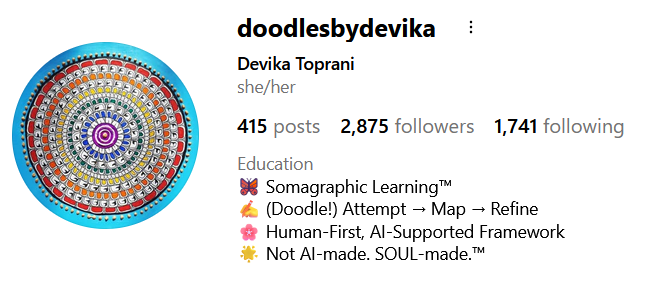
I don’t use AI tools to generate images. I don’t like doing that. But what I do is something very interesting. I have my own Instagram page called Doodles by Devika where I have hand-drawn images of my original artwork, not AI-generated. I did something very interesting. I copyrighted those images, because of course they are handmade by me. I put them in AI and I told it to generate similar images using that doodle.
And I think that was very interesting. It could not replicate the same thing, but I got an idea of what it could and what it could not. Services I would avoid? Not really. I can’t think of anything like that.
But I would just say AI images need to be a bit more human. Yeah, that’s all. Speaking from my experience from Doodles by Devika, that’s all.
 \Doodles by Devikainstagram profile banner\
Karen: Doodles by Devika — is that a professional site or something tied to your work? Or is it something that you do more on the personal side for fun?
Devika: I began Doodles by Devika in 2020 as a small business. Images were provided to me by clients blindly from Pinterest, and they would ask me to hand draw it and customize it, okay? This is a blue color image that is on Pinterest. They like the design, but they wanted me to recreate the same design in red, for example. I would customize it into handcrafted trays, coasters, or jewelry boxes.
So it was mostly like a gifting personalized item business that I had. Now, the interesting part is that I use the same account on Instagram, Doodles by Devika, for Somagraphic Learning. So now I have transitioned from working with visual art. incorporating that experience into Somagraphic Learning for education.
Karen: Very interesting. I know a lot of people have expressed concerns about Meta services such as Instagram. But a lot of people do run businesses on Instagram, and it would be very hard for them to stop using even if they wanted to, because that’s where they find the people that are interested in their work.
Devika: Yes. Thinking of another perspective, your question was on AI-based services I would avoid. But now there are services like Substack that prioritize the human experience and the human connection. I mean, why is Substack gaining so much popularity? Because people crave soul, people crave connection, and they reject AI automated content on Substack, if you would’ve noticed. I think AI services are moving towards human connection.
Karen: Yep. Good perspective. Thanks. So on the one hand, people use these tools to help them with their creations. But at the same time, in many cases, their creations are being taken without their permission and used to feed an AI tool, which then someone else uses. And it’s basically co-opting their work, which as you mentioned is copyrighted in cases like you’ve done your artwork, or someone did writing, or created a piece of music. So one concern that comes up is where the AI and machine learning systems get the data and the content that they use for training. Oftentimes they’ll use data that’s been published online, on Instagram, on YouTube, or anywhere else, or they use books that have been published. And companies aren’t always very transparent about how they intend to use our data when we sign up for using those services. So I’m wondering how you feel about the way these companies are getting the data and the works that they train their tools on.
There’s a concept called the 3Cs, which is Consent, Credit, and Compensation. And the idea is that if people make doodles, or whatever other artworks, or writing, they’re entitled to be able to consent to whether the work gets used; to be credited when it’s used; and to be compensated if it’s used. And this idea is being applied to creative works that are often being used now for feeding an AI tool. On the other hand, some people feel that they’re okay with their work influencing those tools, because they have a voice, and they want their opinions reflected, and such. So I’m curious what your thoughts are about that. Since you have a Substack, did you opt your Substack out of being used for training?
Devika: Yes, I did. And I think you were the first one who informed me that you should do that, I would say, or maybe there’s an option to do that, right? And that’s how I got to know this. But yes, I do think this is a big problem today. Consent and fair attribution are very important, because of course the artist or the musician has put in so much effort to do this.
But I’m also reflecting on this from a student’s perspective. For example, imagine a student In high school or college uploads an essay into an AI generating tool. Over time, that system would learn so many things that the student is inputting into it, like argument patterns, sentences, structures, tones like kind tone, angry tone, from thousands of different students.
But when students use that tool, it may suggest these similar things again and again, and that might impact how they write in real life. So they would not understand, is it right? Is it not right? It’s not harmful, but it can make their perspective biased. And it also raises a very thoughtful question. Are we bringing in innovation? Are we bringing in diversity? Or are we standardizing it according to the information that AI is giving us? So that is a big question that needs to be addressed.
And there’s a kind of feedback loop out here. Students, they contribute to work, systems improve based on that content, and then students are impacted by that content and they rely on it. But then where does that actual student’s own individuality and innovation come in? I’m worried about that.
And over time, this drafting habit might just be moving towards reliance, like over-reliance and automation bias on AI. So yes, data integrity and ethics matter, but we also need to observe how these ecosystems, how this feedback loop influences audience and learning behaviors over time.
And that is the pattern and the long-term arc that I’m paying attention to.
Karen: Yeah. Very important to look at the overall systemic aspects and what my friend Jing Hu calls these second order effects of these systems. And my friend Jax looks at it, as she says generation 2200: what will be all the implications of this, and what are we doing now that will influence how future generations use these tools? You’re talking about students. Decades from now, we will be looking back at how we handle this technology now, whether we’re making good decisions now about affecting their futures.
Devika: Yes. I’m thinking about what AI would do to Gen Alpha, so I’m wondering on those lines too.
Karen: So as someone who does use AI tools, do you feel like the companies that provide the tools that you’ve been using have been transparent about where they got the data that they used for their tools? Which tools do you use the most often at this point?
Devika: I use Claude. I use GPT. I use Google Gemini. I experiment with each and every tool out there. But from my perspective, transparency does exist, but I think the levels of understanding vary. Most AI providers serve very broad licensing criteria, data, public sources. That’s helpful for compliance, but what about the broader impact on humanity?
Yes, there is transparency, but I do think of it very differently. It’s not just about companies being transparent about where the data comes from. It’s about understanding what kinds of patterns has the system absorbed?
For example, if a medical student uses AI to draft a patient explanation, the tone and the structure of the output that AI provides shapes the model, right? Whether it’s shaped on clinical notes, textbooks, certain documentation styles or frameworks, that’s a very subtle influence on the student on what is standard and what isn’t.
So I think AI tools need to find a way to work around that.
And for me, it’s not just consent; it is awareness. Because students might start adopting that pattern and that argumentation style doesn’t really generate those. But it also carries forward the habits of that. And I think as users we also need to understand more. Of course the AI company might provide that, but we need to create more AI literacy and awareness on it too, so we can engage with it thoughtfully.
Karen: One important consideration. You mentioned the patterns that it learns, and some of that is due to the biased data sets that are used as training. You mentioned being born in Oman, raised in Dubai, studied in India. In general, the global south has very low representation in the data that is used on training these tools. So there tends to be what some people call a WEIRD bias: Western, Educated, Industrialized, Rich, Democratic society biases. So basically the US and Western Europe, that’s very heavily weighted in what it learns. And it’s not just in the factual information, but there’s aspects of the way they view gender, and the way they view individualism versus collective or community activities and patterns. So a lot goes into this and we see that in influences on students. It’s not just a style of writing. It’s almost like the water that we swim in or the air that we breathe. We don’t realize what’s there and how it’s influencing us. And that’s another dimension that I’d like to hear your thoughts about.
Devika: Yeah. I would say the way that I was raised earlier and the way Gen Alpha is being raised today, it’s very different. I was raised without social media, and Gen Alpha is continuously exposed to screens. I’ve had certain examples that I would like to share. I’m very active on Substack. I write regularly about learning AI systems. I do a lot of research.
One day I decided to Google myself just out of curiosity on what information would come up about me. And I noticed something very interesting. Search engines and AI pulled together a summary of all my LinkedIn and Substack posts, my podcasts, everything from my public profile and they generated descriptions of my work.
Some of it was not accurate, but it made me laugh. It was amusing. A lot of it was accurate, to be honest. It was just simplified, merged in ways that didn’t really capture the whole thing, the whole idea I was trying to convey. There were subtle differences. It left the soul out of Soulful Learning with AI! I would say this is not harmful, but it just struck me as a reminder. Of course, every content creator’s work is public, and it’s part of AI systems, how they describe you.
This made something very clear to me. As creators, we don’t just publish content anymore. We also indirectly train the model on how machines represent us. I think of it as very different, as the fact that we are also data points. We are not just creators. It’s not negative, but it makes me personally more conscious and intense about what I write, what I post, what citations I use for my research.
And it makes me more aware of my behavior as a content creator and also as a person.
Karen: Yeah, that’s a good example of how our information gets used as a member of the public, someone whose information is out there, and sometimes not within our control, sometimes within our control.
It’s interesting that it picked up your Substack posts, if you’ve opted out of the training. I had an experience when I was doing some data analysis on interviews. And I have it turned off on my 6 ‘P’s in AI Pods, where I put these interviews, because not everybody wants the content of their interview to be exposed to an AI tool. So I have it disabled on my whole newsletter. But when we were trying to do some data analysis, one of the people doing the research tried to fetch an interview from telling the AI tool to “Go get me the content of this interview; here’s the URL.” And it didn’t work, which was kind of good, but then it offered to get it from this ‘Substack mirror site’. I’m like, “What the heck is that? There’s not supposed to be one of those.” And what it came back with was just garbled. Like, it was supposed to be a female program manager in Costa Rica, and it came back with a male embedded software developer in Costa Rica, just completely messed up. So on the one hand, the Substack switch to disable that, to shield it, partially worked. But if I didn’t know better, I would’ve thought that what it gave me was the right information. So it can be very misleading to someone who really wants to find out about you.
Devika: Can be. Of course, the Substack, that toggle is off for it, but what if somebody from your subscribers copy-pastes that and puts it into AI?
Karen: Mm-hmm.
Devika: Right? That would also bring in the content.
Karen: Yeah. And that’s something I think a lot of people don’t realize. If they use a free Grammarly account, in their terms for free accounts, they say they’re entitled to use what you put in there, even if you never publish it. I think awareness is starting to come of how our information gets used.
The other thing I think people don’t realize is: as we’re using an AI tool, we are training it in our interactions with the tool. Like if I prompt it to give me some code and I say, “Okay, well, that code’s not right. You need to add error handling.” Or whatever. I’m teaching it that good code needs error handling, you know? Or just the way that we correct it – we’re doing this feedback. We’re giving them free data to improve their tools just by the way that we use them. And I think a lot of people don’t always realize that aspect of it either. And it’s kind of disconcerting that they left out soul, your whole Soulful Learning. To leave soul out of the summary – that seems like a big oversight!
Devika: Yeah, that’s ironic, I would say. But yeah.
Karen: Yeah. All right. So I’m curious about any time that a company may have actually told you that they were going to use your information for training an AI or machine learning system?
Devika: There were several companies that did. Walmart is one example, I would say, just wanted to advertise certain data to me. More social media and social platforms explicitly state that, “Okay, personalized ads will improve their systems”. As you mentioned, they include privacy policies, account settings, that’s there. I’ve experienced all of this.
For example, if I spend time researching a specific topic like learning management systems, I start getting their promotional ads within a few days of my search. These would not be general educational ads, but it would be targeted to my content to learning management systems to match the categories I just searched up.
This makes me realize that behavioral data is not just used to refine models. It is also used to show ads, to improve how consumer interests are processed, maybe for more profit in their company. I’m not sure.
But yeah, that’s what I’ve also been thinking about. At the same time, it’s not surprising. It’s part of how social media works. Every tiny thought, every tiny action, every click that you have on something specific, every time of the duration that you spend on a certain reel: they all contribute to these systems.
And they’re continuously learning and adapting to these preferences. And this is very ironic, but it’s very different than just having a social media account out there. There’s a lot of things happening behind the scenes, I would say. Yeah.
Karen: One of the newer concerns that we’ve started hearing more about lately is that it’s one thing for the system to get signals about our interests and to respond to them, and then to send us information that’s tailored to those interests. The other concern, that I think is more subtle, and maybe more insidious, is the idea of putting ads into ChatGPT. If it’s recommending something to you, is that because an advertiser paid them to do it? Or is it because it’s actually the best information that’s out there? And that line gets very blurred.
When Google Search first introduced ads, there was a bit of a pushback saying, “No, you need to flag that this is a paid ad”. And they do that. But in the large language models and those tools, it’s going to be a lot harder to tell, I think. What are your thoughts about that?
Devika: I would say, yeah, that’s a big concern today. Personally I have not experienced any kind of privacy breaches or financial loss with this, but I do know some people who have. So it might differ from person to person.
But I did experience something very tiny. As mentioned earlier, I do have my Instagram account called Doodles by Devika. I noticed that certain bot accounts were viewing my Instagram stories. I tried to block it off, but the same bot with a different name viewed it the next day. They did not have any real profiles, no followers, no content.
It was clearly automated. Reported and blocked every bot that came in. But that was not the problem. It was how it affected my analytics on my account. As a creator of Doodles by Devika, I look at metrics to understand engagement.
What resonates with my audience, what doesn’t? How are people responding? What is satisfying for my viewers? But when such bots inflate my view counts even slightly, it makes the data analytics and the metrics of social media less reliable for me. As a creator, it makes it harder to interpret what is working for my audience and what is not.
Now for somebody who works with systems, this is a very interesting perspective. Data isn’t just about collection. It is also about impact and accuracy, right? So when automated bots enter the space, measurement can shift. Data can be skewed. This wasn’t harmful to me. But it made me reflect on the fact that digital systems are shaped both by human perspective and AIs and sites, and this also affects how creators think about their social media performance and conduct, right?
Karen: That’s a really interesting insight on how bots are affecting the data that you as a creator would look at to evaluate your work. And that’s probably hard to tease out. It’s good that you noticed it and made that connection. So thank you for sharing that story.
Last question, and then we can talk about anything else that you want: Public distrust of AI and tech companies has been growing. What do you think is the most important thing that these companies could do to earn and keep your trust, if you think that’s possible? And if you do, do you have any specific ideas on how they could go about that?
Devika: Yeah, AI is here and it’s here to stay. So I believe the most important thing that AI companies can do is prove the real world impact of their capacity, and not just tech, but how it’s impacting real humans. I think that’s very important for AI systems and companies to be growing today. It’s easy to publish, you know, that there’s a new model, a new update, a new product that’s come out.
But what builds consumer trust? It’s demonstrating how these systems actually perform in real-world environments like classrooms, hospitals, workplaces. And being transparent about the results and the impact that it has on real people.
For example, if an AI tool is used in education, I want to see how students are benefiting from it. What are the learning outcomes that are coming out? Has it improved AI literacy in learners? For example, has the knowledge retention improved? Were diverse audiences supported better than others?
What was the data out there? What was the impact that AI created on this? And for example, if it’s used in healthcare, I want to see what outcomes, how is it affecting patients? Is it impacting recovery, is it not?
So AI companies can work on that and getting that data out. And that will make consumers build trust in these companies. Not just what these companies do, but what impact they have in the future. The reality is that consumers trust only when they know that the impact is good. So I think that’s what companies need to do today.
Karen: Very good. Thank you for sharing that. So those are all my standard questions. I appreciate you making time for this interview. Is there anything else that you would like to share with our audience? Anything coming up or any points you want to make about Somagraphic Learning? We didn’t get into it too much.
Devika: Yes. So I’m an alumnus of University of Illinois School of Business. And I’m going to be speaking about Somagraphic Learning at University of Illinois Web CON 2026. I’ll be speaking on April 9th.
The topic is, of course, going to be Somagraphic Learning, but there’s a nuance, and there’s a detailed aspect of it that I’ll be speaking on. AI today is producing information faster than most learners can absorb it. There’s a gap where there’s information overload, but human sense making is lagging behind. Clarity is a huge challenge in education today.
So my topic for WebCon 2026 is that Somagraphic Learning introduces a visual grammar, concepts in simple shapes, before getting into AI text or formulas. Now, the main goal for this is to reduce overwhelm and cognitive load for learners. It’s also used to support neurodiverse learners to make connections, make complex information easier to understand, and make learning more human accessible and emotionally engaging so that students don’t lose out on that experience of discovering, being curious to learn.
And it also gives them that struggle, that push to map out things, make connections, maybe strike out what doesn’t seem right. And I think that’s very important before generating AI responses today.
I’m always open to constructive feedback from professionals working in academia at Tech and MedEd regarding Somagraphic Learning. As mentioned in this conversation, feedback is a gift. Somagraphic Learning is always open to feedback refinement.
And I’m currently open to pilot programs to assess learner outcomes in real world settings because I do want data to show that it works. Always excited to connect with like-minded folks on Substack, LinkedIn, everywhere.
So yeah, just open to all perspectives out there.
Karen: That sounds like it’ll be an interesting talk. We’ll include that link in your interview when we publish this. That all sounds very cool.
Devika’s presentation will be at the University of Illinois [Web CON 2026]
Could you maybe share a small example of how a neurodivergent learner could use these simple shapes from Somagraphic Learning to help them?
Devika: Yes. For example, imagine a student with ADHD, learning about a topic like inflammation. Like what happens when you get a cut. It’s a very simple topic, but let me tell you how a Somagraphic Learner would learn that.
In traditional learning, if you start with a long, dense paragraph and they’re trying to understand, remember everything, that’s a lot for somebody, a neurodiverse learner with ADHD. Their attention span may not be able to take that.
But with Somagraphic Learning, I’ll say, “Okay, let’s draw it out. Let’s draw a tiny dot. Okay, that is a cut. Then let’s draw an arrow. Okay, that’s connecting. That’s the body sending signals. Now let’s draw a bigger shape. Oh, that’s a swelling.” And in this situation, if you’ve noticed, there is no decoding text. No long, overwhelming paragraphs to read.
And this approach maintains their attention span in real life. They’re watching, making connections, using their hand to make connections.
Somagraphic Learning: Soma is the hand, the body. It needs to calm your nervous system down, and that’s what it does to neurodiverse learners. When they draw it out themselves, their attention just works differently. It’s slower, it’s more anchored, and the whole process is sequenced in such a way for their attention span to stay. AI and terms get introduced later, but that’s when the learner already has the conceptual clarity of inflammation, right?
That makes a huge difference. And in this process, AI is only used for refinement, when the concept is already understood. And the whole idea of Somagraphic Learning focuses on the learner being its own education, maintaining individuality and reducing automation bias. Yeah.
Karen: This reminds me of the old saying that a picture is worth a thousand words. And in some cases, I noticed when I was reading a lot of academic papers, I would end up trying to draw a diagram to help me figure out what this paper was saying. Having a diagram just worked much better for me to say, “Okay, now this is what they’re talking about, and this goes from here to there, and this is where it might change and take a different path.” I suppose I did hand-draw it in a lot of cases. I didn’t think about that. But is that similar to what you’re talking about with using these shapes?
Devika: Yeah, it is. But if you go back to the information aids where we learned, we had to write paragraphs. There’s an intention behind why I did not choose writing. Why did I choose drawing? Because we have 3-second reels today, and learners are exposed to that. They are not going to sit down and write long paragraphs like we did back then. They need something that holds their attention span, makes it slower, and makes them understand, and then move to AI.
So that intentional slowing down of the brain happens with doodles while maintaining their attention span. And I think that’s very important today as the world keeps evolving with AI.
Karen: That’s a different aspect of doodling than writing doodles.
Devika: Yes. Yes, of course. And it all stems from my personal experience, right? I have had friends who have seen me in seventh grade, a version of Somagraphic Learning, which did not exist then. I was being introduced to math concepts, formulas directly.
And I was sitting down and kind of making sense of all of these things by doodling them, doodling the formulas in different colors, sketch pens. And that’s how I made sense of things. And the world needs it today because attention spans have been low. So, yeah.
Karen: That’s very interesting. And so that’s what you’re going to be talking about in your April 9th presentation?
Devika: Yes, I will be. I’ll be mostly focusing on the visual grammar and how it supports learners, the attention span, how Somagraphic Learning can help before learners move to AI.
Karen: All right. So it’s great that you’re writing on Substack, and I think that’s where I found you and found your Somagraphic Learning and your interest in this dimension on how AI is used and not used in education. And I am looking forward to you participating in ourAI Everywhere, Volume 2. Can you maybe say a little bit about that and what you’re going to write about there?
Devika: Yes. I’m excited to be part of that. And thank you, Karen, for including me in this book. I sawVolume 1 and I read that. It was very interesting.
It had a lot of women writers write about different aspects of AI. I will be focusing on Somagraphic Learning and sense-making before AI. That would be the main topic out there and how it would impact learners. Yes.
And I’m excited for the book to go out, excited to edit, work on it, and even look through new perspectives because feedback is a gift, right?
Karen: Yes. Yes, absolutely. Yeah. And you’ve mentioned neurodivergent learners a couple of times. Do you find these techniques are useful for people who are not neurodivergent or who have something other than ADHD? Maybe dyslexia or dysgraphia or some other type of neurodivergence? Or is it even useful for neurotypical people?
Devika: I have not explored that dimension yet. But again, feedback is a gift. That is something I will focus on in the future, and I will put it out on my next few Substack posts, probably. Let’s see.
Karen: That sounds great. All right, well, thank you so much Devika! I appreciate you joining me for this interview and we’ll look forward to further conversations.
Devika: Sounds good. Thank you, Karen.
Interview References and Links
More about Devika’s global journey
Devika Toprani on LinkedIn
Doodles by Devika on Instagram
Doodles by Devika on Bluesky
Overview of Somagraphic Learning™
Toprani, D. (2026). Somagraphic Learning Framework: A Human-First, AI-Supported Visual Cognitive Approach (Version 1). OSF Preprints. https://doi.org/10.35542/osf.io/fnk7z\_v1
Devika Toprani on Substack (Soulful Learning with AI)
[ Soulful Learning with AI
I write about human sensemaking "before" AI refines it.
By Soulful Learning With AI](https://doodlesbydevika.substack.com?utmsource=substack&utmcampaign=publicationembed&utmmedium=web)
About this interview series and newsletter
This post is part of our AI6P interview series on “AI, Software, and Wetware”.
It showcases how real people around the world are using their wetware (brains and human intelligence) with AI-based software tools, or are being affected by AI.
And we’re all being affected by AI nowadays in our daily lives, perhaps more than we realize. For some examples, see post “But I Don’t Use AI”:
We want to hear from a diverse pool of people worldwide in a variety of roles. (No technical experience with AI is required.) If you’re interested in being a featured interview guest, anonymous or with credit, please check out our guest FAQ and get in touch!
6 'P's in AI Pods (AI6P) is a 100% human-authored, 100% reader-supported publication. (No ads, no affiliate links, no paywalls on new posts).
All new posts are FREE to read and listen to. To automatically receive new AI6P posts and support our work, consider becoming a subscriber:
Series Credits and References
##### Disclaimer: This content is for informational purposes only and does not and should not be considered professional advice. Information is believed to be current at the time of publication but may become outdated. Please verify details before relying on it. All works, downloads, and services provided through 6 'P's in AI Pods (AI6P) publication are subject to the Publisher Terms available here. By using this content you agree to the Publisher Terms.
Audio Sound Effect from Pixabay
Microphone photo by Michal Czyz on Unsplash (contact Michal Czyz on LinkedIn)
Credit to CIPRI (Cultural Intellectual Property Rights Initiative®) for their “3Cs' Rule: Consent. Credit. Compensation©.”
Credit to for the “Created With Human Intelligence” badge we use to reflect our commitment that content in these interviews will be human-created:
If you enjoyed this interview, my guest and I would love to have your support via a heart, share, restack, or Note! (One-time tips or voluntary donations via paid subscription are always welcome and appreciated, too 😊)