You spent three years describing your niche to anyone who'd listen. You called it complaining.
By Alessandro Magionami
Published: 2026-08-24
URL: https://shipwithai.substack.com/p/the-thing-you-complain-about-at-work
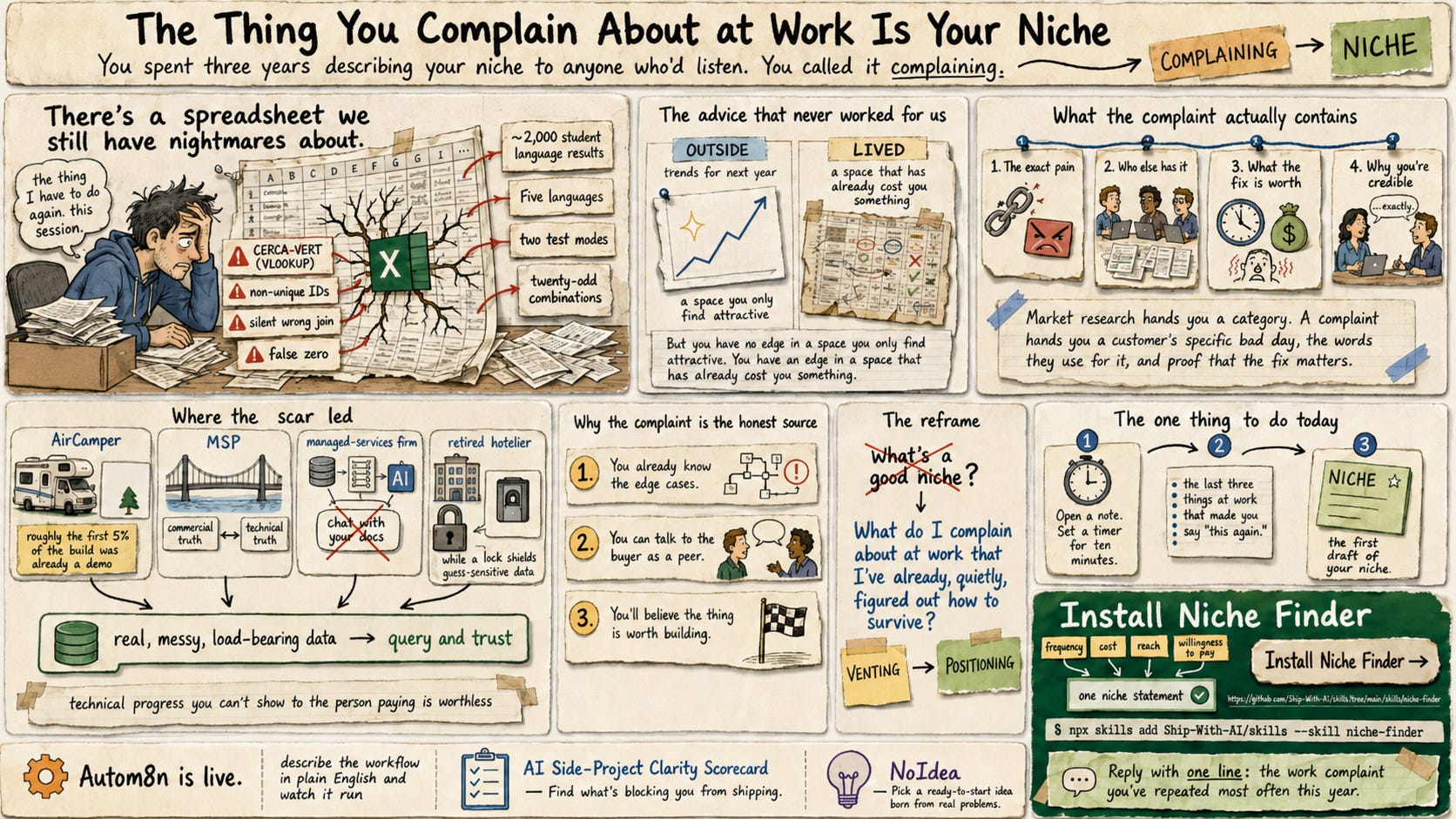
There's a spreadsheet we still have nightmares about.
Every exam session, ~2,000 student language results came out of a learning platform as raw exports. Five languages, two test modes, disability accommodations, in-class reduced tests, cohorts, programs — twenty-odd combinations, each with its own exception. The tool that processed them was built in Visual Studio 2010. The real logic lived in Excel, in a forest of CERCA.VERT (VLOOKUP) formulas stacked over layouts that were never once normalized. Student IDs weren't unique — dual-degree students showed up twice, so a naive join silently attached the wrong career to the wrong person. The platform occasionally reported a real score as a zero.
We didn't call this a niche. We called it the thing I have to do again this session. We complained about it. Loudly. For years.
That complaint was the whole business, and we couldn't see it — because you don't respect a problem you've already learned to survive.
The advice that never worked for us
For a long time we looked for a niche the way everyone tells you to. Scan the market. Find a growing category. Pick something with a large addressable audience and low competition, ideally something you saw on a "trends for next year" list. We read the posts. We filled in the worksheets. We produced tidy answers that felt like strategy and led nowhere, because they were built on markets we didn't actually live in.
The mistake underneath all of it: we treated "niche" as something you choose from the outside, like picking a stock. You survey the field, weigh the options, and place a bet on a space you find attractive.
But you have no edge in a space you only find attractive. You have an edge in a space that has already cost you something. The niche you can win isn't the one that looks best on a slide. It's the one whose specific, boring, infuriating details are burned into you because you've paid for them with your evenings.
We had that niche the entire time. It was the exam spreadsheet. It was the "quick export" that took a full day. It was every legacy process we'd cursed at and then quietly fixed, because fixing it was faster than explaining why it was broken.
What the complaint actually contains
Sit with a work complaint long enough and you notice it isn't vague. It's dense with exactly the information a market report can't give you.
When we complained about the exam pipeline, we weren't complaining about "education technology." We were complaining about a very precise thing: taking messy, non-normalized real-world company data and turning it into something a human can trust and act on, without hiring a data team. Non-unique keys. Silent wrong joins. False zeros. Twenty exception paths that no clean schema anticipated.
That precision is the asset. It tells you:
-
The exact pain — not "data is hard" but "the join is silently wrong and nobody notices until an angry email arrives."
-
Who else has it — anyone running a real business on real data that grew organically: the small operators, not the ones with a platform team.
-
What the fix is worth — measured in the hours and the dread the current process costs, which you can already feel because you've lived it.
-
Why you're credible — you're not pitching a capability. You're describing their Tuesday better than they can, because it's also been yours.
Market research hands you a category. A complaint hands you a customer's specific bad day, the words they use for it, and proof that the fix matters. Those are worth more.
Where the scar led
Once we stopped hunting for a market and started following the friction we already knew, the same shape of client kept appearing — and it was never a coincidence. It was the niche revealing itself.
A camper-and-RV business, AirCamper, needed a booking and management platform built the right way — and, just as importantly, needed to see it working before releasing the first payment. Their financing partner had been burned by past teams who took an advance and disappeared, so they refused any classic upfront advance. The first tranche had to be gated on something visible, concrete, and understandable by a non-technical person. That constraint is only obvious if you've lived on the other side of a stalled project. We had. We recut the whole plan into vertical slices — each feature complete end to end, something you can click and watch work — so that roughly the first 5% of the build was already a demo, not a backend nobody could see. The complaint we'd internalized for years ("technical progress you can't show to the person paying is worthless") became the exact thing that won the trust and released the money.
Then it kept happening. An MSP that needed its client-asset records to finally bridge the commercial truth and the technical truth. A managed-services firm that wanted a knowledge layer over its own company data — not a generic "chat with your docs," but deterministic structure plus AI over the numbers that actually ran the business. A retired hotelier who wanted a read-only "box" that could answer everyday questions off his property system without ever touching the guest-sensitive parts. Different industries, identical shape: someone's real, messy, load-bearing data, turned into something they can query and trust.
We didn't find that niche in a trends report. We found it in a spreadsheet we'd complained about for three years. Every client since has been a variation on the exact problem we already knew in our bones.
Why the complaint is the honest source
We're careful here, because "follow your pain" can curdle into a motivational slogan, and we've read enough of those to distrust them.
The reason a complaint is a better niche source than research isn't inspirational. It's practical, and it comes down to three things research can't fake.
You already know the edge cases. The value in almost any real automation is the exceptions — the twenty combinations, the non-unique key, the false zero. An outsider learns those over months of expensive discovery. You learned them by getting burned. That head start is your margin.
You can talk to the buyer as a peer. When we sit across from an operator drowning in a manual process, we're not performing expertise. We're finishing their sentences. That's not a sales technique you can learn from a script — it comes from having actually stood in the same mess.
You'll believe the thing is worth building. Motivation is a real input. You will push a solution to your own recurring pain across the finish line long after you'd have abandoned a market you merely found interesting. The exam pipeline got fixed because we couldn't stand to do it by hand one more session.
None of that shows up in a category analysis. All of it shows up in a complaint.
Our first minibook is out: The Reluctant Engineer
It’s for engineers who’ve watched AI produce garbage and concluded the model was the problem.
The book doesn’t tell you you’re wrong; it tells you you’re half right. Slop is a process defect; it shows up exactly where verification, permission layers, a clean context window, and someone actually reading the diff are missing. “AI writes crap code” is like “juniors write crap code”: sometimes true, and the answer was never to fire the juniors.
So it doesn’t ask you to lower your standards; it asks you to raise the controls.
7 chapters, ~16,000 words, beginner basics deliberately stripped out. Exercises you run in a real terminal, not read about.
The reframe
So here's the move for this week, and it's small on purpose.
Stop asking "what's a good niche?" That question sends you outward, into markets you don't live in, hunting for something attractive. Start asking a different one: "What do I complain about at work that I've already, quietly, figured out how to survive?"
That thing — the process you dread, the tool you curse, the export you'd automate in your sleep — is not a distraction from finding your niche. It is the niche. You've been describing it to colleagues for years. You just filed it under venting instead of positioning.
The only work left is to write it down in a form you can act on. That's the artifact below.
The one thing to do today
Open a note. Set a timer for ten minutes. Write down the last three things at work that made you say "this again." Not solutions — the raw irritations, in the exact words you'd use to a coworker. That list is the first draft of your niche. You already had it; today you just moved it out of your head.
Then run it through the finder.
The artifact: Niche Finder
Install Niche Finder directly from the Ship With AI marketplace. Feed it your ten-minute complaint list. It ranks the pain by frequency, cost, reach, and willingness to pay, then returns one niche statement plus the proof you already hold.
Or install it from your terminal:
npx skills add Ship-With-AI/skills --skill niche-finderRun your list through it once. The line it hands back is not a brand exercise. It's the sentence you'll open your first client conversation with — and you earned every word of it the hard way, one complaint at a time.
— Ale & Manuel
PS. Reply with one line: the work complaint you've repeated most often this year. That sentence is closer to your first paying client than any market you were about to go research.
When you're ready, two more ways we can help:
1. AI Side-Project Clarity Scorecard. Find what's blocking you from shipping.
2. NoIdea. Pick a ready-to-start idea born from real problems.