Transform a tool you already have into client proof in 30 minutes.
By Alessandro Magionami
Published: 2026-09-05
URL: https://shipwithai.substack.com/p/5-steps-to-make-your-internal-script
Most advice about "showing your work" stops at the pep talk. Yes, your internal tools are proof. Great — now what? How do you get from a script only you understand to a page a stranger would read and think that's exactly my problem, I should talk to this person?
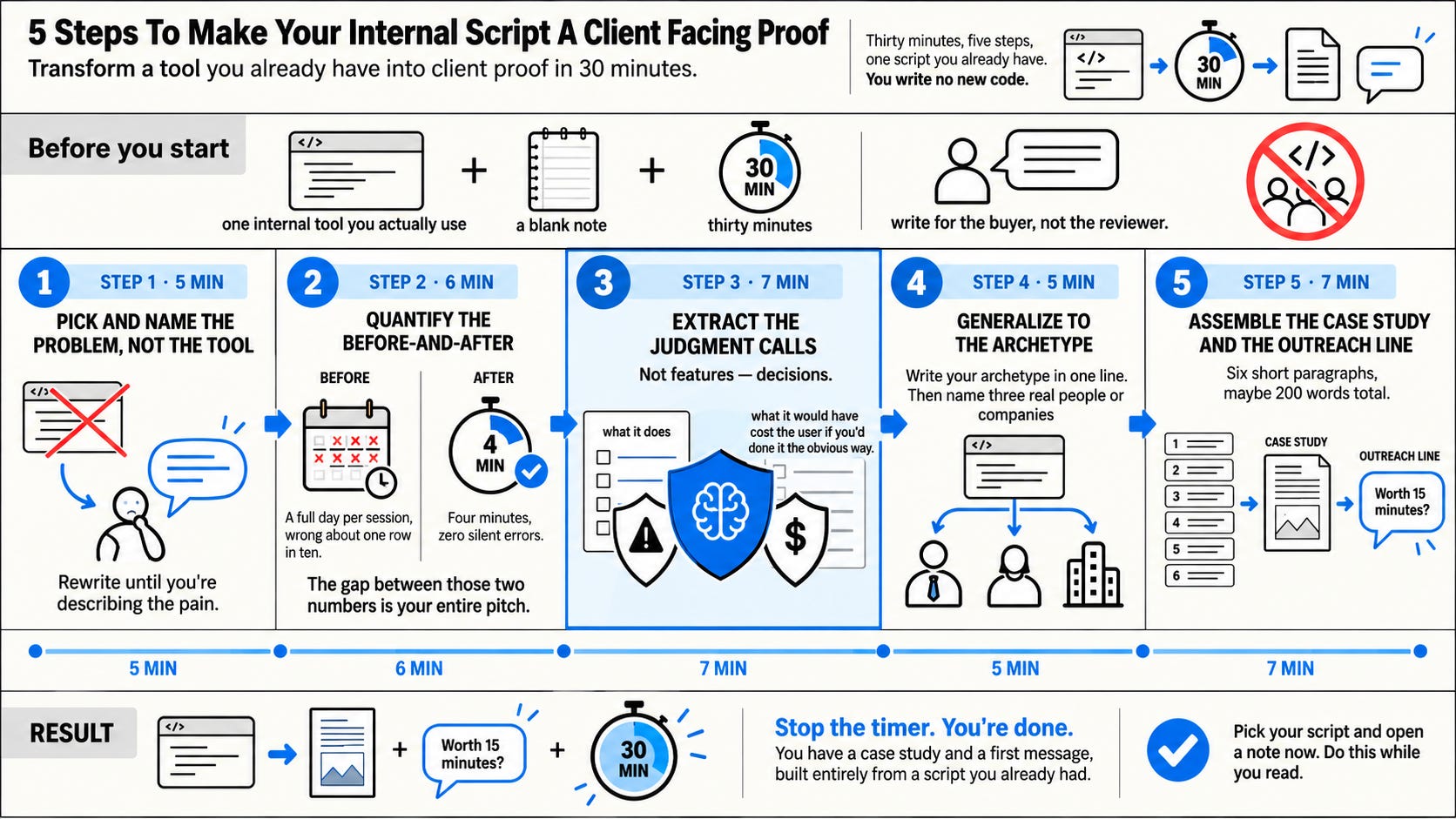
This week is pure procedure. Thirty minutes, five steps, one script you already have. At the end you'll have a client-facing case study and one paste-ready line you can send today. You write no new code. The build already happened, possibly years ago. We're only doing the part you skipped: naming it.
Pick your script and open a note now. Do this while you read.
Yesterday, turning a client's manual process into a working automation meant a week of glue code before you could even show them the shape of it.
Today it means: describe the workflow in plain English and watch it run.
Autom8n is live. The gap between "I have an automation idea" and "it's running in production" just got a lot smaller.
Before you start
You need three things: one internal tool you actually use, a blank note, and thirty minutes. Don't pick the fanciest thing you've built. Pick the one you'd be most annoyed to lose — the small, reliable script that quietly saves you time. Boring-and-used beats impressive-and-abandoned every time, because "still in use" is itself proof.
One rule for the whole session: write for the buyer, not the reviewer. The buyer cares what the tool does for someone. They will never see the code, so don't describe it. "Turns a lost day of manual reconciliation into a four-minute run" is right. "Refactored the join logic into a pandas merge" is wrong, and useless to them.
Set the timer for 30 minutes. Go.
Step 1 — Pick and name the problem, not the tool (5 minutes)
Write down, in one sentence, the problem your tool solves — in the words the person with the problem would use, not the words you'd use to another engineer.
Not "a script that parses exports and dedupes on a composite key." That's the tool. Instead: "the monthly report used to take a full day and was wrong about one row in ten." That's the problem.
The test: could someone who can't code read your sentence and recognize their own bad day in it? If not, you're still describing the machine. Rewrite until you're describing the pain.
When we did this for our own worst offender — an exam-results pipeline — the problem sentence was "2,000 student results, five languages, twenty exception paths, and a process that occasionally reported a real score as a zero into official records." No code in it. All pain. Anyone who's owned a fragile reporting process feels it.
Step 2 — Quantify the before-and-after (6 minutes)
Two numbers, side by side. This is the spine of the whole case study, so don't skip it because the numbers are rough.
-
Before: how long did the problem take, how often did it break, what did that cost? "A full day per session, wrong about one row in ten."
-
After: the same measure, with your tool. "Four minutes, zero silent errors."
Rough is fine. "Cut a full afternoon to under five minutes" is more convincing than a precise-but-vague "improved efficiency by 40%." If you genuinely can't estimate a before, that's a signal the tool might not clear the bar — note it and consider picking a different script.
The gap between those two numbers is your entire pitch. A client doesn't buy technology. They buy the distance between the before number and the after number.
Step 3 — Extract the judgment calls (7 minutes)
This is the step that separates a real case study from a feature list, so give it the most time.
List two or three decisions your tool makes that a naive version would get wrong. Not features — decisions. The place where the obvious approach would have quietly burned the user, and your tool doesn't.
Examples from our own tools:
-
Refusing a naive join on a key that isn't actually unique, because dual-degree students appeared twice and the wrong career would get attached silently.
-
Treating a zero as suspicious rather than valid, because the source system occasionally reported a real score as a zero.
-
Failing loudly on a malformed row instead of skipping it, because a silently dropped record is worse than a visible error.
For each decision, write one line: what it does and what it would have cost the user if you'd done it the obvious way. Those "would have cost" clauses are the most persuasive sentences in the entire case study, because they're the only part a non-technical buyer can actually evaluate. They can't judge your code. They can absolutely judge whether you thought about the thing that would have hurt them.
If you can't name a single judgment call, this tool is a receipt, not a case study. Go back to Step 1 with a different script.
Step 4 — Generalize to the archetype (5 minutes)
Right now your case study is about one specific thing — exam results, contact dedup, invoice reconciliation. That's too narrow to attract clients, because the next person's specifics are different. So strip them out and find the kind of problem underneath.
"Exam results" isn't the archetype. "Messy, non-normalized, load-bearing real-world data that a human has to trust" is. Once we named ours that way, the same shape kept appearing: an MSP whose asset records didn't reconcile between the commercial and technical sides; a managed-services firm wanting a deterministic knowledge layer over its own numbers; a retired hotelier who wanted a read-only box to answer daily questions off his property system without exposing guest data. Different industries, one archetype, and our narrow internal script had already solved it.
Write your archetype in one line. Then name three real people or companies — actual names, not categories — who have the archetype. If you can name three, you have a case study and a prospect list. If you can name zero, your archetype is still too narrow or too personal; widen it or pick another tool.
Step 5 — Assemble the case study and the outreach line (7 minutes)
Now stack what you've written into a short, buyer-facing case study, in this order:
The problem (Step 1, their words) -> the before number (Step 2) -> what I built, in one plain sentence -> the judgment calls and what they'd have cost (Step 3) -> the after number (Step 2) -> who else has this (Step 4).
Six short paragraphs, maybe 200 words total. That's a complete case study. It reads as proof because every line of it is true and specific, and you earned all of it.
Then compress the whole thing into one outreach line you can send to one of your three named prospects:
"I built a tool that took [before number] down to [after number] for [the problem, their words] — and kept it [the key judgment call] so [the thing that would've burned them] never happens. You're dealing with [the archetype]. Worth 15 minutes?"
Stop the timer. You're done. You have a case study and a first message, built entirely from a script you already had.
Why this works — the receipt
We didn't invent this sequence in the abstract. It's the same move that won AirCamper, a camper-and-RV client whose financing partner refused any upfront payment, having been burned by teams who vanished with an advance. We couldn't lead with a portfolio site. We led with judgment — cut the delivery into vertical slices so the first tranche was the whole product, clickable, on real data (add a stop in the backoffice, watch it go live), and the 70% milestone was search, pick dates, pay with a test card, get the confirmation email, see the booking land. That pitch was a case study of judgment calls, told before the product existed. The same five steps above turn a script you've already shipped into the same kind of proof.
The one thing to do today
You already did the session — that was the point of reading with the timer on. Now take the outreach line from Step 5 and send it to one of your three named prospects. Nothing attached, no deck, just the line and a question. That single message is move one toward a first client, and it's built on proof you wrote months or years ago. Send it before you close the tab.
The artifact: the /case-study skill
We packaged the whole 30-minute teardown into a Claude Code skill.
Run it inside the project that contains your internal script. Claude Code reads the README, entry points, tests, and git history; identifies the buyer's problem; recovers the before-and-after evidence and judgment calls; then asks only for facts the repository cannot prove.
Install it once:
# Cross-agent (Claude Code, Codex, Cursor, Gemini CLI, Copilot, +35 more)
npx skills add Ship-With-AI/skills --skill case-study

# Or Claude Code native (two commands, plugin marketplace)
claude plugin marketplace add Ship-With-AI/skills
/plugin install ship-with-ai@ship-with-ai-skills
Then open Claude Code in the tool's project directory and run:
/case-studyThe skill performs the same five steps automatically. It writes CASE-STUDY.md with:
-
a buyer-facing description of the problem;
-
before-and-after evidence labeled as observed, implemented, documented, or user-supplied;
-
two or three judgment calls and the failures they prevent;
-
the broader problem archetype and your named prospects;
-
a roughly 200-word case study and one paste-ready outreach message.
It will not invent metrics, outcomes, or prospects. Missing facts stay visibly marked until you confirm them.
The impressive portfolio project you keep meaning to build will still be imaginary next quarter. The script that already works won't wait either — the details of why you made each call fade fast, and those details are the proof. Mine one while it's fresh. Thirty minutes, and you walk out with a case study you didn't have to build.
— Ale & Manuel
PS. Reply with the outreach line from Step 5. If a step stalled you, tell us which — Step 3 (judgment calls) is where most people freeze, and it's usually because the judgment is so obvious to you that you've stopped seeing it as rare. It isn't.
When you're ready, two more ways we can help:
1. AI Side-Project Clarity Scorecard. Find what's blocking you from shipping.
2. NoIdea. Pick a ready-to-start idea born from real problems.